 TOPICS

Mandelbrot Set

The term Mandelbrot set is used to refer both to a general class of fractal sets and to a particular instance of such a set. For a family of polynomial maps, a Mandelbrot set marks the set of points in the complex plane such that the corresponding Julia set is connected.
"The" Mandelbrot set is the set obtained from the quadratic recurrence equation
 |
(1)
|
with  ,
where points
 in the complex plane for which the orbit of
 does not tend to infinity are in the
set. Starting instead with
 gives the same boundedness criterion, since
 is the first iterate of 0. The Mandelbrot set was originally
called a
 molecule by Mandelbrot. J. Hubbard and A. Douady proved that the Mandelbrot
set is connected.
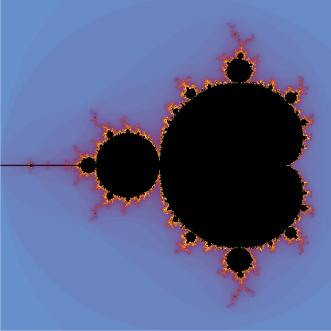
A plot of the Mandelbrot set is shown above in which values of  in the complex plane are
colored according to the number of steps required to exceed
 . The kidney bean-shaped portion of the Mandelbrot
set turns out to be bordered by a cardioid with equations
 |  |  |
(2)
|
 |  |  |
(3)
|
The adjoining portion is a circle with center at  and radius
 .
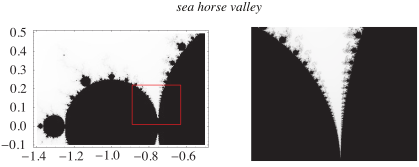
The region of the Mandelbrot set centered around  is sometimes known as the sea
horse valley because the spiral shapes appearing in it resemble sea horse tails
(Giffin, Munafo).
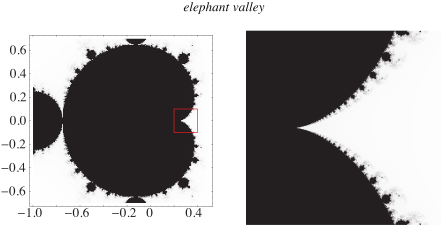
Similarly, the portion of the Mandelbrot set centered around  with size approximately
 is known as elephant
valley.
Shishikura (1994) proved that the boundary of the Mandelbrot set is a fractal with Hausdorff dimension 2, refuting the conclusion of Elenbogen and Kaeding (1989) that it is not. However, the conjecture that the Mandelbrot set is locally connected remains open (Dudko 2025). If it is locally connected, then Hubbard and Douady's proof implies that the Mandelbrot set is the image of a circle and can be constructed from a disk by collapsing certain arcs in the interior (Douady 1986).
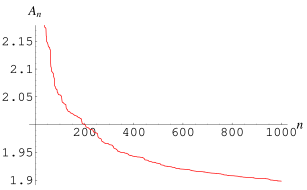
The area of the Mandelbrot set can be written exactly as
 |
(4)
|
where  are the coefficients of the Laurent series about
infinity of the conformal map
 of the exterior of the unit disk
onto the exterior of the Mandelbrot set,
 |  |  |
(5)
|
 |  |  |
(6)
|
(OEIS A054670 and A054671; Ewing and Schober 1992). The recursion for  is given by
 |  |  |
(7)
|
 |  |  |
(8)
|
 |  |  |
(9)
|
where  .
These coefficients can be computed recursively, but a closed form is not known. Furthermore,
the sum converges very slowly. An empirical extrapolation by Munafo estimates approximately
 terms for two decimal places
and
 terms for three decimal places. These estimates are not rigorous convergence bounds.
Ewing and Schober (1992) computed the first
 values of
 , found that
 in this range, and conjectured that this inequality
always holds. This calculation also provided the limit
 and led the authors to believe that the true value
lies between
 and
 .
The area of the set obtained by pixel counting is  (OEIS A098403;
Munafo; Lesmoir-Gordon et al. 2000, p. 97) and by statistical sampling
is
 with 95% confidence (Mitchell 2001), both of which are significantly smaller than
the estimate of Ewing and Schober (1992).
To visualize the Mandelbrot set, the limit at which points are assumed to have escaped can be approximated by  instead of infinity. Beautiful computer-generated plots can be then be created by
coloring nonmember points depending on how quickly they diverge to
 . For an escaping point, an integer
called the count can be defined as the first iteration
 such that
 . With
 , exceeding this threshold certifies escape for the
critical orbit. Points with different counts are colored
differently. The boundary between successive counts defines
a series of "Mandelbrot set lemniscates"
(or "equipotential curves"; Peitgen
and Saupe 1988) defined by iterating the quadratic
recurrence equation,
 |
(10)
|
The first few lemniscates are therefore given by
 |  |  |
(11)
|
 |  |  |
(12)
|
 |  |  |
(13)
|
 |  |  |
(14)
|
 |  |  |
(15)
|
 |  |  |
(16)
|
 |  |  |
(17)
|
(OEIS A114448).
When writing  and taking the absolute square of each side, the
lemniscates can be plotted in the complex plane,
and the first few are given by
 |  |  |
(18)
|
 |  |  |
(19)
|
 |  |  |
(20)
|
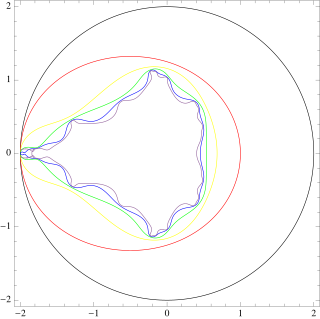
These are a circle (black), an oval (red), and a pear curve (yellow). In fact, the second
Mandelbrot set lemniscate  can be written in terms of a new coordinate system with
 as
 |
(21)
|
which is just a Cassini oval with  and
 . The Mandelbrot
set lemniscates grow increasingly convoluted with higher count,
illustrated above, and approach the Mandelbrot set as the count
tends to infinity.
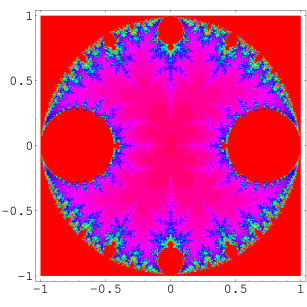
The term Mandelbrot set can also be applied to generalizations of "the" Mandelbrot set in which the function  is replaced by some other function. In the above
plot,
 ,
 , and
 is allowed to vary in the complex
plane. Note that completely different sets (that are not Mandelbrot sets) can
be obtained for choices of
 that do not lie in the fractal attractor. So, for example,
in the above set, picking
 inside the unit disk but outside
the red basins gives a set of completely different-looking images.
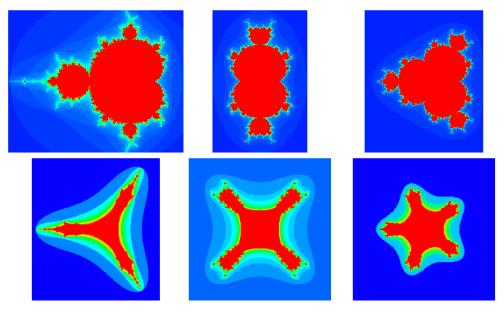
Generalizations of the Mandelbrot set can be constructed by replacing  with
 or
 , where
 is a positive integer
and
 denotes the complex conjugate of
 . The above figures show the fractals
obtained for
 ,
3, and 4 (Dickau). The plots on the bottom have
 replaced with
 and are sometimes called "mandelbar
sets."
Taking the absolute values of the real and imaginary parts of  before each squaring instead gives the nonanalytic burning
ship fractal.
See also
Buddhabrot, Burning Ship Fractal, Cactus Fractal, Elephant Valley, Fractal, Julia Set, Mandelbar Set, Mandelbrot Set Lemniscate, Quadratic Map, Randelbrot Set, Sea Horse Valley Explore this topic in the MathWorld classroomExplore with Wolfram|Alpha

References
Alfeld, P. "The Mandelbrot Set." http://www.math.utah.edu/~alfeld/math/mandelbrot/mandelbrot.html.Bowen, J. P. "Virtual Museum of Computing Mandelbrot Exhibition." http://archive.comlab.ox.ac.uk/other/museums/computing/mandelbrot.html.Branner, B. "The Mandelbrot Set." In Chaos and Fractals: The Mathematics behind the Computer Graphics, Proc. Sympos. Appl. Math., Vol. 39 (Ed. R. L. Devaney and L. Keen). Providence, RI: Amer. Math. Soc., 75-105, 1989.Devaney, R. "The Mandelbrot Set and the Farey Tree, and the Fibonacci Sequence." Amer. Math. Monthly 106, 289-302, 1999.Dickau, R. M. "Mandelbrot (and Similar) Sets." https://www.robertdickau.com/mandelbrot.html.Douady, A. "Julia Sets and the Mandelbrot Set." In The Beauty of Fractals: Images of Complex Dynamical Systems (Ed. H.-O. Peitgen and D. H. Richter). Berlin, Germany: Springer-Verlag, p. 161, 1986.Dudko, D. "On the MLC Conjecture and the Renormalization Theory in Complex Dynamics." 30 Dec 2025. https://arxiv.org/abs/2512.24171.Elenbogen, B. and Kaeding, T. "A Weak Estimate of the Fractal Dimension of the Mandelbrot Boundary." Phys. Lett. A 136, 358-362, 1989.Eppstein, D. "Area of the Mandelbrot Set." https://ics.uci.edu/~eppstein/junkyard/mand-area.html.Ewing, J. H. and Schober, G. "The Area of the Mandelbrot Set." Numer. Math. 61, 59-72, 1992.Fisher, Y. and Hill, J. "Bounding the Area of the Mandelbrot Set." Submitted to Numer. Math..Giffin, N. "The 'Main Seahorse Valley Series' from Bengt Månsson." http://spanky.triumf.ca/www/fractint/bm/shv1/shv1.html.Gleick, J. Chaos: Making a New Science. New York: Penguin Books, center plate (following p. 114), 1988.Hill, J. R. "Fractals and the Grand Internet Parallel Processing Project." Ch. 15 in Fractal Horizons: The Future Use of Fractals. New York: St. Martin's Press, pp. 299-323, 1996.Lauwerier, H. Fractals: Endlessly Repeated Geometric Figures. Princeton, NJ: Princeton University Press, pp. 148-151 and 179-180, 1991.Lei, T. (Ed.). The Mandelbrot Set, Theme and Variations. Cambridge, England: Cambridge University Press, 2000.Lesmoir-Gordon, N.; Rood, W.; and Edney, R. Introducing Fractal Geometry. Cambridge, England: Icon Books, p. 97, 2000.Mandelbrot, B. B. The Fractal Geometry of Nature. New York: W. H. Freeman, pp. 188-189, 1983.Mitchell, K. "A Statistical Investigation of the Area of the Mandelbrot Set." 2001. http://www.fractalus.com/kerry/articles/area/mandelbrot-area.html.Munafo, R. "Mu-Ency--The Encyclopedia of the Mandelbrot Set." https://www.mrob.com/pub/muency.html.Munafo, R. "Area of the Mandelbrot Set." https://www.mrob.com/pub/muency/areaofthemandelbrotset.html.Munafo, R. "Pixel Counting." https://www.mrob.com/pub/muency/pixelcounting.html.Peitgen, H.-O. and Saupe, D. (Eds.). The Science of Fractal Images. New York: Springer-Verlag, pp. 178-179, 1988.Shishikura, M. "The Boundary of the Mandelbrot Set Has Hausdorff Dimension Two." Astérisque, No. 222, 389-405, 1994. https://numdam.org/item/AST_1994__222__389_0/.Sloane, N. J. A. Sequences A054670, A054671, A098403, and A114448 in "The On-Line Encyclopedia of Integer Sequences."Taylor, M. "Deep into the Seahorse Valley." http://www.princeton.edu/~mstaylor/fractals/seahorse.htm.Wells, D. The Penguin Dictionary of Curious and Interesting Geometry. London, England: Penguin, pp. 146-148, 1991.Referenced on Wolfram|Alpha
Mandelbrot SetCite this as:
Weisstein, Eric W. "Mandelbrot Set." From MathWorld--A Wolfram Resource. https://mathworld.wolfram.com/MandelbrotSet.html