 TOPICS

Julia Set

Let  be a rational
function
 |
(1)
|
where  ,
 is the Riemann sphere
 , and
 and
 are polynomials without common divisors. The "filled-in"
Julia set
 is the set of points
 which do not approach infinity after
 is repeatedly applied (corresponding to a strange
attractor). The true Julia set
 is the boundary of the filled-in set (the set of "exceptional
points"). There are two types of Julia sets: connected sets (Fatou
set) and Cantor sets (Fatou
dust).
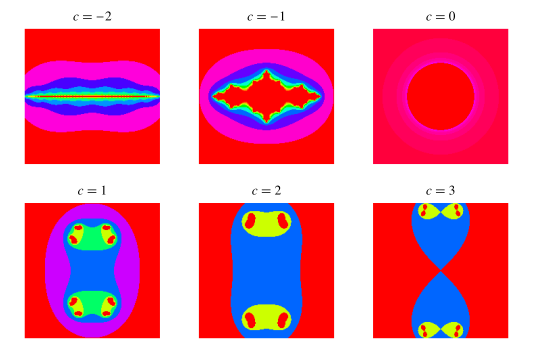
Quadratic Julia sets are generated by the quadratic mapping
 |
(2)
|
for fixed  .
For almost every
 ,
this transformation generates a fractal. Examples are
shown above for various values of
 . The resulting object is not a fractal for
 (Dufner et al. 1998, pp. 224-226) and
 (Dufner et al. 1998, pp. 125-126),
although it does not seem to be known if these two are the only such exceptional
values.
|
|
|
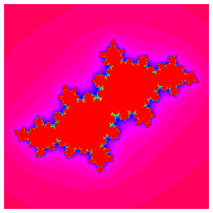
|
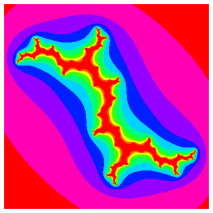
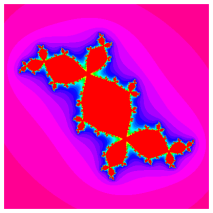
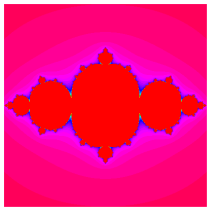
The special case of  on the boundary of the Mandelbrot set is called
a dendrite fractal (top left figure),
 is called Douady's
rabbit fractal (top right figure),
 is called the San Marco
fractal (bottom left figure), and
 is the Siegel
disk fractal (bottom right figure).
The equation for the quadratic Julia set is a conformal mapping, so angles are preserved. Let  be the Julia set, then
 leaves
 invariant. If a point
 is on
 ,
then all its iterations are on
 . The transformation has a two-valued inverse. If
 and
 is started at 0, then the map is equivalent to the logistic
map. The set of all points for which
 is connected is known as the Mandelbrot
set.
For a Julia set  with
 , the capacity
dimension is
 |
(3)
|
For small  ,
 is also a Jordan
curve, although its points are not computable.
See also
Dendrite Fractal, Douady's Rabbit Fractal, Fatou Dust, Fatou Set, Fractal, Mandelbrot Set, Newton's Method, San Marco Fractal, Siegel Disk Fractal, Strange AttractorExplore with Wolfram|Alpha

References
Dickau, R. M. "Julia Sets." https://www.robertdickau.com/julias.html.Dickau, R. M. "Another Method for Calculating Julia Sets." https://www.robertdickau.com/inversejulia.html.Douady, A. "Julia Sets and the Mandelbrot Set." In The Beauty of Fractals: Images of Complex Dynamical Systems (Ed. H.-O. Peitgen and D. H. Richter). Berlin, Germany: Springer-Verlag, p. 161, 1986.Dufner, J.; Roser, A.; and Unseld, F. Fraktale und Julia-Mengen. Harri Deutsch, 1998.Lauwerier, H. Fractals: Endlessly Repeated Geometric Figures. Princeton, NJ: Princeton University Press, pp. 124-126, 138-148, and 177-179, 1991.Mendes-France, M. "Nevertheless." Math. Intell. 10, 35, 1988.Peitgen, H.-O. and Saupe, D. (Eds.). "The Julia Set," "Julia Sets as Basin Boundaries," "Other Julia Sets," and "Exploring Julia Sets." §3.3.2 to 3.3.5 in The Science of Fractal Images. New York: Springer-Verlag, pp. 152-163, 1988.Schroeder, M. Fractals, Chaos, Power Laws. New York: W. H. Freeman, p. 39, 1991.Wagon, S. "Julia Sets." §5.4 in Mathematica in Action. New York: W. H. Freeman, pp. 163-178, 1991.Wells, D. The Penguin Dictionary of Curious and Interesting Geometry. London, England: Penguin, pp. 126-127, 1991.Referenced on Wolfram|Alpha
Julia SetCite this as:
Weisstein, Eric W. "Julia Set." From MathWorld--A Wolfram Resource. https://mathworld.wolfram.com/JuliaSet.html