 TOPICS

Laurent Series
If  is analytic
throughout the annular region between and on the concentric circles
is analytic
throughout the annular region between and on the concentric circles  and
and  centered at
  and of radii
  and
and  respectively, then there exists a unique series expansion
in terms of positive and negative powers of
respectively, then there exists a unique series expansion
in terms of positive and negative powers of  ,
,
 |
(1)
|
where
 |  | 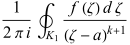 |
(2)
|
 |  | 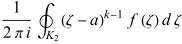 |
(3)
|
(Korn and Korn 1968, pp. 197-198).
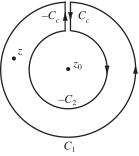
Let there be two circular contours  and
and  , with the radius of
  larger than that of
  . Let
. Let  be at the center of
  and
and  , and
, and  be between
  and
and  . Now create a cut line
  between
  and
and  , and integrate around the path
  , so that the plus and minus contributions
of
, so that the plus and minus contributions
of  cancel one another, as illustrated above. From the Cauchy
integral formula,
cancel one another, as illustrated above. From the Cauchy
integral formula,
 |  | 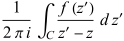 |
(4)
|
 |  |  |
(5)
|
 |  |  |
(6)
|
Now, since contributions from the cut line in opposite directions cancel out,
 |  |  |
(7)
|
 |  |  |
(8)
|
 |  |  |
(9)
|
For the first integral,  .
For the second,
.
For the second,  .
Now use the Taylor series (valid for
.
Now use the Taylor series (valid for  )
)
 |
(10)
|
to obtain
 |  | ![1/(2pii)[int_(C_1)(f(z^'))/(z^'-z_0)sum_(n=0)^(infty)((z-z_0)/(z^'-z_0))^ndz^'+int_(C_2)(f(z^'))/(z-z_0)sum_(n=0)^(infty)((z^'-z_0)/(z-z_0))^ndz^']](https://mathworld.wolfram.com/images/equations/LaurentSeries/Inline52.svg) |
(11)
|
 |  |  |
(12)
|
 |  |  |
(13)
|
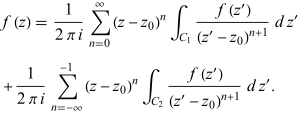
where the second term has been re-indexed. Re-indexing again,
 |
(14)
|
Since the integrands, including the function  , are analytic in the annular region defined by
  and
and  , the integrals are independent of the path of integration
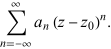
in that region. If we replace paths of integration
, the integrals are independent of the path of integration
in that region. If we replace paths of integration  and
and  by a circle
  of radius
  with
with  , then
 |  |  |
(15)
|
 |  |  |
(16)
|
 |  |  |
(17)
|
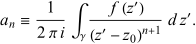
Generally, the path of integration can be any path  that lies in the annular region and encircles
  once in the positive (counterclockwise) direction.
The complex residues  are therefore defined by
 |
(18)
|
Note that the annular region itself can be expanded by increasing  and decreasing
  until singularities of
  that lie just outside
  or just inside
  are reached. If
  has no singularities inside
  , then all the
  terms in (◇) equal zero and the Laurent series of
(◇) reduces to a Taylor series with coefficients
terms in (◇) equal zero and the Laurent series of
(◇) reduces to a Taylor series with coefficients
 .
.
See also
Complex Residue, Maclaurin Series, Principal Part, Taylor SeriesPortions of this entry contributed by David Goodmanson
Explore with Wolfram|Alpha

References
Arfken, G. "Laurent Expansion." §6.5 in Mathematical Methods for Physicists, 3rd ed. Orlando, FL: Academic Press, pp. 376-384, 1985.Knopp, K. "The Laurent Expansion." Ch. 10 in Theory of Functions Parts I and II, Two Volumes Bound as One, Part I. New York: Dover, pp. 117-122, 1996.Korn, G. A. and Korn, T. M. Mathematical Handbook for Scientists and Engineers. New York: McGraw-Hill, p. 198, 1968.Krantz, S. G. "Laurent Series." §4.2.1 in Handbook of Complex Variables. Boston, MA: Birkhäuser, p. 43, 1999.Morse, P. M. and Feshbach, H. "Derivatives of Analytic Functions, Taylor and Laurent Series." §4.3 in Methods of Theoretical Physics, Part I. New York: McGraw-Hill, pp. 374-398, 1953.Referenced on Wolfram|Alpha
Laurent SeriesCite this as:
Goodmanson, David and Weisstein, Eric W. "Laurent Series." From MathWorld--A Wolfram Resource. https://mathworld.wolfram.com/LaurentSeries.html