 TOPICS

Inverse Tangent

The inverse tangent is the multivalued function  (Zwillinger 1995, p. 465),
also denoted
 (Abramowitz and Stegun 1972, p. 79; Harris and Stocker 1998, p. 311; Jeffrey
2000, p. 124) or
 (Spanier and Oldham 1987, p. 333; Gradshteyn and Ryzhik 2000, p. 208; Jeffrey
2000, p. 127), that is the inverse function
of the tangent. The variants
 (e.g., Bronshtein and Semendyayev, 1997, p. 70)
and
 are sometimes used to refer to explicit principal
values of the inverse tangent, although this distinction is not always made (e.g.,
Zwillinger 1995, p. 466).
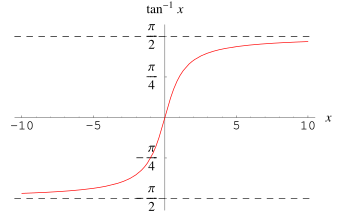
The inverse tangent function  is plotted above along the real
axis.
Worse yet, the notation  is sometimes used for the principal value, with
 being used for the multivalued
function (Abramowitz and Stegun 1972, p. 80). Note that in the notation
 (commonly used in North America
and in pocket calculators worldwide),
 denotes the tangent and
 the inverse
function, not the multiplicative
inverse.
The principal value of the inverse tangent is implemented as ArcTan[z] in the Wolfram Language. In the GNU C library, it is implemented as atan(double x).
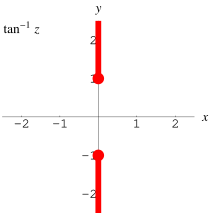
The inverse tangent is a multivalued function and hence requires a branch cut in the complex
plane, which the Wolfram Language's
convention places at ![(-iinfty,-i]](https://mathworld.wolfram.com/images/equations/InverseTangent/Inline12.svg) and
 .
This follows from the definition of
 as
 |
(1)
|
In the Wolfram Language (and in this work), this branch cut definition determines the range of  for a real number
 as
 . Other continuous
real branches differ by integer
multiples of
 (NIST 2026, eq. 4.23.33).
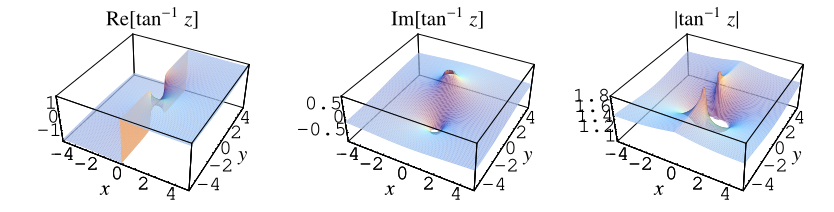
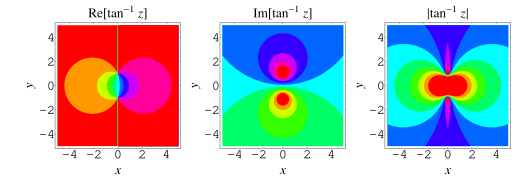
The inverse tangent function  is plotted above in the complex
plane.
 has the special values
 |  |  |
(2)
|
 |  |  |
(3)
|
 |  |  |
(4)
|
 |  |  |
(5)
|
 |  |  |
(6)
|
The derivative of  is
 |
(7)
|
and the indefinite integral is
 |
(8)
|
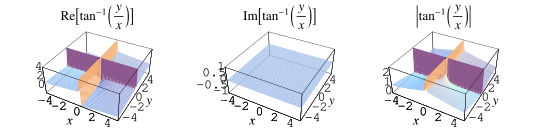
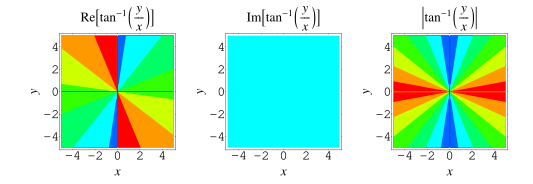
For a complex number  with real numbers
 and
 , its complex argument
is
 |
(9)
|
where  ,
sometimes also denoted
 ,
corresponds to the counterclockwise angle from the positive real axis, i.e., the value of
 such that
 and
 , where
 . Plots of
 are illustrated above for real
number values of
 and
 .
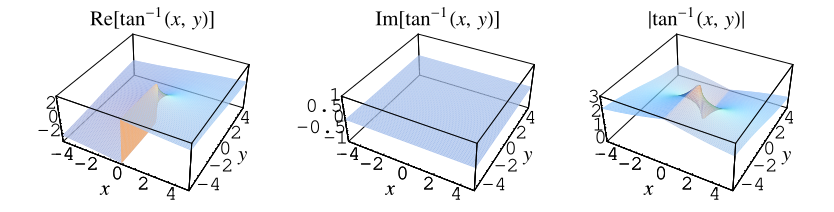
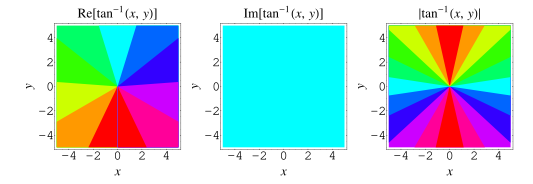
The two-argument inverse tangent takes into account the quadrant in which  lies. It is returned by the FORTRAN command ATAN2(y, x), the GNU
C library command atan2(double y, double x), and the Wolfram
Language command ArcTan[x,
y], with the range
 . In the degenerate case when
 ,
 |
(10)
|
For  ,
the usual
 has the Maclaurin series
 |  |  |
(11)
|
 |  |  |
(12)
|
(OEIS A033999 and A005408). The series also converges at the real endpoints  . A more rapidly converging form
due to Euler is given by
 |
(13)
|
for a real number  (Castellanos 1988). This is related to the formula
of Euler given by
 |
(14)
|
where
 |
(15)
|
and  ,
with the value at 0 obtained by a limit.
Abrarov and Quine (2018) give the series
 |
(16)
|
for a real number  . Each of the two complex component series
is absolutely convergent, with limiting ratio of successive term absolute
values
 ,
compared with
 for Euler's series.
The inverse tangent formulas are connected with many interesting approximations to pi. For  ,
 |  |  |
(17)
|
 |  |  |
(18)
|
The inverse tangent satisfies
 |
(19)
|
for  ,
 |
(20)
|
for all complex number arguments  ,
 |  |  |
(21)
|
 |  |  |
(22)
|
 |  |  |
(23)
|
for all real number arguments  , where equality for the last equation is understood to be
in the limit as
 , and
 |  |  |
(24)
|
 |  |  |
(25)
|
 |  |  |
(26)
|
 |  |  |
(27)
|
 |  |  |
(28)
|
In terms of the hypergeometric function,
 |
(29)
|
for complex number arguments  , and
 |
(30)
|
for a real number  (Castellanos 1988).
Castellanos (1986, 1988) also gives some curious formulas in terms of the Fibonacci numbers,
 |  |  |
(31)
|
 |  |  |
(32)
|
 |  |  |
(33)
|
where  ,
 , and
 is the largest positive root of
 |
(34)
|
The first series is valid for a real number  with
 .
The second and third series are valid for
 .
The inverse tangent satisfies the addition formula
 |
(35)
|
for  ,
as well as the more complicated formula
 |
(36)
|
valid for a real number  . For general complex number
arguments, a multiple of
 may be required to account for the branches.
An additional identity known to Euler is given by
 |
(37)
|
for  or
 .
Another interesting inverse tangent identity attributed
to Charles Dodgson (Lewis Carroll) by Lehmer (1938; Castellanos 1988; Bromwich 1991)
is
 |
(38)
|
where
 |
(39)
|
and  .
The inverse tangent has continued fraction representations
 |
(40)
|
(Lambert 1770; Lagrange 1776; Wall 1948, p. 343; Olds 1963, p. 138) and
 |
(41)
|
due to Euler and sometimes known as Euler's continued fraction (Borwein et al. 2004, p. 30).
To find  numerically for a real number
 , the following arithmetic-geometric
mean-like algorithm can be used. Let
 |  |  |
(42)
|
 |  |  |
(43)
|
Then compute
 |  |  |
(44)
|
 |  |  |
(45)
|
and the inverse tangent is given by
 |
(46)
|
(Acton 1990).
An inverse tangent  with a positive integer
 is called reducible if it is expressible as a finite sum of the form
 |
(47)
|
where  are positive or negative integers and
 are positive integers
 .
 is reducible iff all the prime factors of
 occur among the prime factors
of
 for
 ,
...,
 .
A second necessary and sufficient
condition is that the largest prime factor of
 is less than
 . Equivalent to the second condition is the statement that
every Gregory number
 can be uniquely expressed as a sum
in terms of
 s
for which
 is a Størmer number (Conway and Guy 1996).
To find this decomposition, write
 |
(48)
|
so the ratio
 |
(49)
|
is a rational number. Equation (49) can also be written
 |
(50)
|
Writing (47) in the form
 |
(51)
|
allows a direct conversion to a corresponding inverse cotangent formula
 |
(52)
|
where
 |
(53)
|
Todd (1949) gives a table of decompositions of  for
 . Conway and Guy (1996) give a similar table in terms
of Størmer numbers.
Arndt and Gosper give the inverse tangent identity (Gosper 1997), valid for real numbers  and a nonnegative integer
 ,
 |
(54)
|
There is an amazing set of BBP-type formulas for  :
 |  |  |
(55)
|
 |  |  |
(56)
|
 |  |  |
(57)
|
 |  |  |
(58)
|
One of these formulas is requested as a problem by Bailey et al. (2007, p. 225).
See also
Euler's Machin-Like Formula, Gauss's Machin-Like Formula, Inverse Cotangent, Inverse Trigonometric Functions, Machin-Like Formulas, Machin's Formula, TangentRelated Wolfram sites
https://functions.wolfram.com/ElementaryFunctions/ArcTan/Explore with Wolfram|Alpha

References
Abramowitz, M. and Stegun, I. A.(Eds.). "Inverse Circular Functions." §4.4 in Handbook of Mathematical Functions with Formulas, Graphs, and Mathematical Tables, 9th printing. New York: Dover, pp. 79-83, 1972.Abrarov, S. M. and Quine, B. M. "A Formula for Pi Involving Nested Radicals." Ramanujan J. 46, 657-665, 2018. https://doi.org/10.1007/s11139-018-9996-8.Acton, F. S. "The Arctangent." In Numerical Methods that Work, upd. and rev. Washington, DC: Math. Assoc. Amer., pp. 6-10, 1990.Apostol, T. M. Calculus, 2nd ed., Vol. 1: One-Variable Calculus, with an Introduction to Linear Algebra. Waltham, MA: Blaisdell, pp. 255-256, 1967.Arndt, J. "Completely Useless Formulas." https://www.jjj.de/hfloat/hfloatpage.html#formulas.Bailey, D. H.; Borwein, J. M.; Calkin, N. J.; Girgensohn, R.; Luke, D. R.; and Moll, V. H. Experimental Mathematics in Action. Wellesley, MA: A K Peters, 2007.Beyer, W. H. CRC Standard Mathematical Tables, 28th ed. Boca Raton, FL: CRC Press, pp. 142-143 and 220, 1987.Borwein, J.; Bailey, D.; and Girgensohn, R. "Euler's Continued Fraction." §1.8.2 in Experimentation in Mathematics: Computational Paths to Discovery. Wellesley, MA: A K Peters, p. 30, 2004.Bromwich, T. J. I. and MacRobert, T. M. An Introduction to the Theory of Infinite Series, 3rd ed. New York: Chelsea, 1991.Bronshtein, I. N. and Semendyayev, K. A. Handbook of Mathematics, 3rd ed. New York: Springer-Verlag, p. 70, 1997.Castellanos, D. "Rapidly Converging Expansions with Fibonacci Coefficients." Fib. Quart. 24, 70-82, 1986.Castellanos, D. "The Ubiquitous Pi. Part I." Math. Mag. 61, 67-98, 1988.Conway, J. H. and Guy, R. K. "Størmer's Numbers." The Book of Numbers. New York: Springer-Verlag, pp. 245-248, 1996.GNU C Library. "Mathematics: Inverse Trigonometric Functions." https://sourceware.org/glibc/manual/latest/html_node/Inverse-Trig-Functions.html.Gosper, R. W. "Joerg Arndt kindly forwarded me." math-fun@cs.arizona.edu posting, Jan.14, 1997.Gradshteyn, I. S. and Ryzhik, I. M. Tables of Integrals, Series, and Products, 6th ed. San Diego, CA: Academic Press, 2000.Harris, J. W. and Stocker, H. Handbook of Mathematics and Computational Science. New York: Springer-Verlag, p. 311, 1998.Hildebrand, J. D. "Arctan() Appreciation Home Page!" https://www.opensky.ca/~jdhildeb/arctan/.Jeffrey, A. "Inverse Trigonometric and Hyperbolic Functions." §2.7 in Handbook of Mathematical Formulas and Integrals, 2nd ed. Orlando, FL: Academic Press, pp. 124-128, 2000.Lagrange, J.-L. "Sur l'usage des fractions continues dans le calcul intégral." Nouv. mém. de l'académie royale des sciences et belles-lettres Berlin, 236-264, 1776. Reprinted in Oeuvres, Vol. 4, pp. 301-302.Lambert, J. L. Beiträge zum Gebrauch der Mathematik und deren Anwendung. Theil 2. Berlin, Germany, 1770.Lehmer, D. H. "On Arccotangent Relations for ." Amer. Math. Monthly 45, 657-664, 1938.NIST.
"Inverse Trigonometric Functions." §4.23 in Digital Library of
Mathematical Functions. 2026. https://dlmf.nist.gov/4.23.Olds,
C. D. Continued
Fractions. New York: Random House, 1963.Salamin, G. Item 137
in Beeler, M.; Gosper, R. W.; and Schroeppel, R. HAKMEM. Cambridge, MA:
MIT Artificial Intelligence Laboratory, Memo AIM-239, pp. 67-68, Feb.1972. https://www.inwap.com/pdp10/hbaker/hakmem/pi.html#item137.Sloane,
N. J. A. Sequences A005408/M2400,
A033999, A075553,
and A075554 in "The On-Line Encyclopedia
of Integer Sequences."Spanier, J. and Oldham, K. B. "Inverse
Trigonometric Functions." Ch. 35 in An
Atlas of Functions. Washington, DC: Hemisphere, pp. 331-341, 1987.Todd,
J. "A Problem on Arc Tangent Relations." Amer. Math. Monthly 56,
517-528, 1949.Wall, H. S. Analytic
Theory of Continued Fractions. New York: Chelsea, 1948.Zwillinger,
D.(Ed.). "Inverse Circular Functions." §6.3 in CRC
Standard Mathematical Tables and Formulae. Boca Raton, FL: CRC Press, pp. 465-467,
1995.
Referenced on Wolfram|Alpha
Inverse TangentCite this as:
Weisstein, Eric W. "Inverse Tangent." From MathWorld--A Wolfram Resource. https://mathworld.wolfram.com/InverseTangent.html