 TOPICS

Series

A series is an infinite ordered set of terms combined together by the addition operator. The term "infinite series" is sometimes used to emphasize the fact that series contain an infinite number of terms. The order of the terms in a series can matter, since the Riemann series theorem states that, by a suitable rearrangement of terms, a so-called conditionally convergent series may be made to converge to any desired value, or to diverge.
Conditions for convergence of a series can be determined in the Wolfram Language using SumConvergence[a, n].
If the difference between successive terms of a series is a constant, then the series is said to be an arithmetic series. A series
for which the ratio of each two consecutive terms  is a constant function of the summation index
  is called a geometric
series. The more general case of the ratio a rational
function of
is called a geometric
series. The more general case of the ratio a rational
function of  produces a series called a hypergeometric series.
A series may converge to a definite value, or may not, in which case it is called divergent. Let the terms in a series be denoted  , let the
  th partial sum be given by
 |
(1)
|
and let the sequence of partial sums be given by  . If the sequence of
partial sums converges to a definite value, the series is said to converge. On the
other hand, if the sequence of partial sums does not converge to a limit
(e.g., it oscillates or approaches
. If the sequence of
partial sums converges to a definite value, the series is said to converge. On the
other hand, if the sequence of partial sums does not converge to a limit
(e.g., it oscillates or approaches  ), the series is said to diverge. An example of a convergent
series is the geometric series
), the series is said to diverge. An example of a convergent
series is the geometric series
 |
(2)
|
and an example of a divergent series is the harmonic series
 |
(3)
|
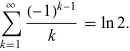
Interestingly, while the harmonic series diverges to infinity, the alternating harmonic series converges to the natural logarithm of 2,
 |
(4)
|
Another well-known convergent infinite series is Brun's constant.
A number of methods known as convergence tests can be used to determine whether a given series converges. Although terms of a series
can have either sign, convergence properties can often be computed in the "worst
case" of all terms being positive, and then applied
to the particular series at hand. A series of terms  is said to be absolutely
convergent if the series formed by taking the absolute values of the
is said to be absolutely
convergent if the series formed by taking the absolute values of the  ,
,
 |
(5)
|
converges.
An especially strong type of convergence is called uniform convergence, and series which are uniformly convergent have particularly "nice" properties. For example, the sum of a uniformly convergent series of continuous functions is continuous. A convergent series can be differentiated term by term, provided that the functions of the series have continuous derivatives and that the series of derivatives is uniformly convergent. Finally, a uniformly convergent series of continuous functions can be integrated term by term.
For a table listing the coefficients for various series operations, see Abramowitz and Stegun (1972, p. 15).
While it can be difficult to calculate analytical expressions for arbitrary convergent infinite series, many algorithms can handle a variety of common series types. The Wolfram Language computational system implements many of these algorithms. General techniques also exist for computing the numerical values of any but the most pathological series (Braden 1992).
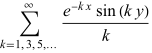
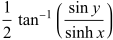
A particular infinite series identity is given by
 |  | ![1/2i[coth^(-1)(e^(x+iy))-coth^(-1)(e^(x-iy))]](https://mathworld.wolfram.com/images/equations/Series/Inline12.svg) |
(6)
|
 |  |  |
(7)
|
for  .
.
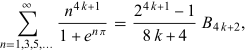
Apostol (1997, p. 25) gives the analytic sum
 |
(8)
|
where  is a Bernoulli
number.
is a Bernoulli
number.
Ramanujan found the interesting series identity
![sum_(n=0)^infty(-1)^n((3n)!)/([n!(3n)!]^3)x^(2n) =[sum_(n=0)^infty(x^n)/((n!)^3)][sum_(n=0)^infty(-1)^n(x^n)/((n!)^3)]](https://mathworld.wolfram.com/images/equations/Series/NumberedEquation7.svg) |
(9)
|
(Preece 1928; Hardy 1999, p. 7), which can be written as the hypergeometric identity
 |
(10)
|
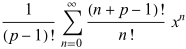
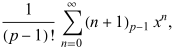
Infinite series of the following type (power sums) can also be computed analytically,
 |  |  |
(11)
|
 |  |  |
(12)
|
 |  |  |
(13)
|
where  is a Pochhammer
symbol.
is a Pochhammer
symbol.
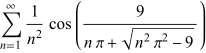
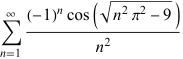
Gosper noted the sum
 |  |  |
(14)
|
 |  |  |
(15)
|
 |  |  |
(16)
|
(OEIS A100074).
An infinite series of the following form can be done in closed form.
![sum_(k=1)^infty1/([1+k^2pi^2]^n)=(P_n(e^2))/(2^n(n-1)!(e^2-1)^n),](https://mathworld.wolfram.com/images/equations/Series/NumberedEquation9.svg) |
(17)
|
where  is an
is an  th order polynomial in
  . The first few polynomials are
 |  |  |
(18)
|
 |  |  |
(19)
|
 |  |  |
(20)
|
 |  |  |
(21)
|
(OEIS A085470).
The related infinite series
![sum_(k=1)^infty1/([1+(k+1/2)^2pi^2]^n)=(Q_n(e))/(2^(n+1)n!(e^2+1)^n)-(4^n)/((4+pi^2)^n)](https://mathworld.wolfram.com/images/equations/Series/NumberedEquation10.svg) |
(22)
|
can also be done in closed form, where  is an
is an  th order polynomial in
  . The first few polynomials are
 |  |  |
(23)
|
 |  |  |
(24)
|
 |  |  |
(25)
|
 |  |  |
(26)
|
 |  |  |
(27)
|
(OEIS A085471).
See also
Absolute Convergence, Alternating Series, Arithmetic Series, Asymptotic Series, Convergence Improvement, Convergence Tests, Convergent Series, Divergent Series, Double Series, Euler-Maclaurin Integration Formulas, FoxTrot Series, Generating Function, Geometric Series, Harmonic Series, Infinite Product, Laurent Series, Maclaurin Series, Partial Sum, Power Sum, q-Series, Riemann Series Theorem, Sequence, Series Bias, Series Expansion, Series Reversion, Taylor Series Explore this topic in the MathWorld classroomExplore with Wolfram|Alpha

References
Abramowitz, M. and Stegun, I. A. (Eds.). "Infinite Series." §3.6 in Handbook of Mathematical Functions with Formulas, Graphs, and Mathematical Tables, 9th printing. New York: Dover, p. 14, 1972.Apostol, T. M. Modular Functions and Dirichlet Series in Number Theory, 2nd ed. New York: Springer-Verlag, p. 25, 1997.Arfken, G. "Infinite Series." Ch. 5 in Mathematical Methods for Physicists, 3rd ed. Orlando, FL: Academic Press, pp. 277-351, 1985.Boas, R. P. Jr. "Partial Sums of Infinite Series, and How They Grow." Amer. Math. Monthly 84, 237-258, 1977.Boas, R. P. Jr. "Estimating Remainders." Math. Mag. 51, 83-89, 1978.Borwein, J. M. and Borwein, P. B. "Strange Series and High Precision Fraud." Amer. Math. Monthly 99, 622-640, 1992.Braden, B. "Calculating Sums of Infinite Series." Amer. Math. Monthly 99, 649-655, 1992.Bromwich, T. J. I'A. and MacRobert, T. M. An Introduction to the Theory of Infinite Series, 3rd ed. New York: Chelsea, 1991.Gardner, M. "Limits of Infinite Series." Ch. 17 in The Sixth Book of Mathematical Games from Scientific American. Chicago, IL: University of Chicago Press, pp. 163-172, 1984.Hansen, E. R. A Table of Series and Products. Englewood Cliffs, NJ: Prentice-Hall, 1975.Hardy, G. H. Divergent Series. Oxford, England: Clarendon Press, 1949.Hardy, G. H. A Course of Pure Mathematics, 10th ed. London, England: Cambridge University Press, 1952.Hardy, G. H. Ramanujan: Twelve Lectures on Subjects Suggested by His Life and Work, 3rd ed. New York: Chelsea, 1999.Jeffreys, H. and Jeffreys, B. S. "Series." §1.05 in Methods of Mathematical Physics, 3rd ed. Cambridge, England: Cambridge University Press, pp. 14-17, 1988.Jolley, L. B. W. Summation of Series, 2nd rev. ed. New York: Dover, 1961.Knopp, K. Theory and Application of Infinite Series. New York: Dover, 1990.Mangulis, V. Handbook of Series for Scientists and Engineers. New York: Academic Press, 1965.Natanson, I. P. Summation of Infinitely Small Quantities. Boston, MA: Heath, 1963.Preece, C. T. "Theorems Stated by Ramanujan (III): Theorems on Transformation of Series and Integrals." J. London Math. Soc. 3, 274-282, 1928.Press, W. H.; Flannery, B. P.; Teukolsky, S. A.; and Vetterling, W. T. "Series and Their Convergence." §5.1 in Numerical Recipes in FORTRAN: The Art of Scientific Computing, 2nd ed. Cambridge, England: Cambridge University Press, pp. 159-163, 1992.Rainville, E. D. Infinite Series. New York: Macmillan, 1967.Sloane, N. J. A. Sequences A85470, A85471, and A100074 in "The On-Line Encyclopedia of Integer Sequences."Weisstein, E. W. "Books about Series." http://www.ericweisstein.com/encyclopedias/books/Series.html.Referenced on Wolfram|Alpha
SeriesCite this as:
Weisstein, Eric W. "Series." From MathWorld--A Wolfram Resource. https://mathworld.wolfram.com/Series.html