 TOPICS

Root

The roots (sometimes also called "zeros") of an equation
 |
are the values of  for which the equation is satisfied.
Roots  which belong to certain sets
are usually preceded by a modifier to indicate such, e.g.,
which belong to certain sets
are usually preceded by a modifier to indicate such, e.g.,  is called a rational root,
  is called a real root, and
  is called a complex root.
The fundamental theorem of algebra states that every polynomial equation of degree
 has exactly
  complex roots, where some roots may have a multiplicity greater
than 1 (in which case they are said to be degenerate). In the Wolfram
Language, the expression Root[p(x),
k] represents the
complex roots, where some roots may have a multiplicity greater
than 1 (in which case they are said to be degenerate). In the Wolfram
Language, the expression Root[p(x),
k] represents the  th
root of the polynomial
th
root of the polynomial  , where
  , ...,
  is an index indicating the root number in the Wolfram
Language's ordering.
is an index indicating the root number in the Wolfram
Language's ordering.
The similar concept of the " th
root"
th
root"  of a complex
number
of a complex
number  is known as an nth
root.
is known as an nth
root.
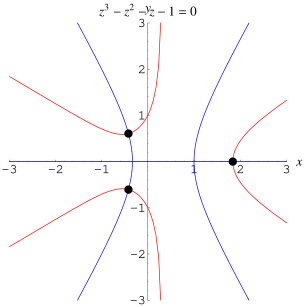
The roots of a complex function can be obtained by separating it into its real and imaginary plots and plotting these curves (which are related by the Cauchy-Riemann
equations) separately. Their intersections give the complex roots of the original
function. For example, the plot above shows the curves representing the real and
imaginary parts of  ,
with the three roots indicated as black points.
,
with the three roots indicated as black points.
Householder (1970) gives an algorithm for constructing root-finding algorithms with an arbitrary order of convergence. Special root-finding techniques can often be applied when the function in question is a polynomial.
See also
13th Root, Airy Function Zeros, Bessel Function Zeros, Descartes' Sign Rule, Fundamental Theorem of Symmetric Functions, Inside-Outside Theorem, Isograph, Multiplicity, nth Root, Polynomial, Polynomial Roots, Root Dragging Theorem, Root Extraction, Root Graph, Root Separation, Rouché's Theorem, Simple Root, Square Root, Sturm Function, Sturm Theorem, Vanishing, Weierstrass Approximation Theorem, Zero, Zero Set Explore this topic in the MathWorld classroomExplore with Wolfram|Alpha

References
Arfken, G. "Appendix 1: Real Zeros of a Function." Mathematical Methods for Physicists, 3rd ed. Orlando, FL: Academic Press, pp. 963-967, 1985.Boyer, C. B. A History of Mathematics. New York: Wiley, 1968.Householder, A. S. The Numerical Treatment of a Single Nonlinear Equation. New York: McGraw-Hill, 1970.Kravanja, P. and van Barel, M. Computing the Zeros of Analytic Functions. Berlin: Springer-Verlag, 2000.McNamee, J. M. "A Bibliography on Roots of Polynomials." J. Comput. Appl. Math. 47, 391-394, 1993. https://doi.org/10.1016/0377-0427(93)90064-I.Press, W. H.; Flannery, B. P.; Teukolsky, S. A.; and Vetterling, W. T. "Roots of Polynomials." §9.5 in Numerical Recipes in FORTRAN: The Art of Scientific Computing, 2nd ed. Cambridge, England: Cambridge University Press, pp. 362-372, 1992.Whittaker, E. T. and Robinson, G. "The Numerical Solution of Algebraic and Transcendental Equations." Ch. 6 in The Calculus of Observations: A Treatise on Numerical Mathematics, 4th ed. New York: Dover, pp. 78-131, 1967.Referenced on Wolfram|Alpha
RootCite this as:
Weisstein, Eric W. "Root." From MathWorld--A Wolfram Resource. https://mathworld.wolfram.com/Root.html