 TOPICS

Rule 222

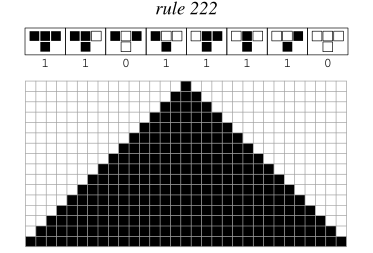
Rule 222 is one of the elementary cellular automaton rules introduced by Stephen Wolfram in 1983 (Wolfram 1983, 2002). It
specifies the next color in a cell, depending on its color and its immediate neighbors.
Its rule outcomes are encoded in the binary representation
 . This rule is illustrated
above together with the evolution of a single black cell it produces after 15 steps
(Wolfram 2002, p. 55).
. This rule is illustrated
above together with the evolution of a single black cell it produces after 15 steps
(Wolfram 2002, p. 55).
Rule 222 is amphichiral, and its complement is rule 132.
Starting with a single black cell, successive generations  , 1, ... are given by interpreting the numbers 1, 7, 31,
127, 511, 2047, 8191, ... (OEIS A083420) in
binary, namely 1, 111, 11111, 1111111, 111111111, .... The
, 1, ... are given by interpreting the numbers 1, 7, 31,
127, 511, 2047, 8191, ... (OEIS A083420) in
binary, namely 1, 111, 11111, 1111111, 111111111, .... The  th term is given by
 |
which are Mersenne numbers, so rule 222 is computationally reducible for an initial configuration consisting of a single black cell.
See also
Elementary Cellular Automaton, Rule 30, Rule 50, Rule 54, Rule 60, Rule 62, Rule 90, Rule 94, Rule 102, Rule 110, Rule 126, Rule 150, Rule 158, Rule 188, Rule 190, Rule 220Related Wolfram sites
https://atlas.wolfram.com/01/01/222/Explore with Wolfram|Alpha

References
Sloane, N. J. A. Sequence A083420 in "The On-Line Encyclopedia of Integer Sequences."Wolfram, S. "Statistical Mechanics of Cellular Automata." Rev. Mod. Phys. 55, 601-644, 1983.Wolfram, S. A New Kind of Science. Champaign, IL: Wolfram Media, pp. 55, 90, and 952, 2002.Referenced on Wolfram|Alpha
Rule 222Cite this as:
Weisstein, Eric W. "Rule 222." From MathWorld--A Wolfram Resource. https://mathworld.wolfram.com/Rule222.html