 TOPICS

Binary

The base 2 method of counting in which only the digits 0 and 1 are used. In this base, the number 1011 equals  .
This base is used in computers, since all numbers can be
simply represented as a string of electrically
pulsed ons and offs. In computer parlance, one binary digit is called a bit,
two digits are called a crumb, four digits are called a
nibble, and eight digits are called a byte.
.
This base is used in computers, since all numbers can be
simply represented as a string of electrically
pulsed ons and offs. In computer parlance, one binary digit is called a bit,
two digits are called a crumb, four digits are called a
nibble, and eight digits are called a byte.
An integer  may be represented in binary in the Wolfram
Language using the command BaseForm[n,
2], and the first
may be represented in binary in the Wolfram
Language using the command BaseForm[n,
2], and the first  digits of a real number
  may be obtained in binary using RealDigits[x,
2, d]. Finally, a list of binary digits
may be obtained in binary using RealDigits[x,
2, d]. Finally, a list of binary digits  can be converted to a decimal rational number or integer using
FromDigits[l,
2].
can be converted to a decimal rational number or integer using
FromDigits[l,
2].

The illustration above shows the binary numbers from 0 to 63 represented graphically (Wolfram 2002, p. 117), and the following table gives the binary equivalents of the first few decimal numbers.
| 1 | 1 | 11 | 1011 | 21 | 10101 |
| 2 | 10 | 12 | 1100 | 22 | 10110 |
| 3 | 11 | 13 | 1101 | 23 | 10111 |
| 4 | 100 | 14 | 1110 | 24 | 11000 |
| 5 | 101 | 15 | 1111 | 25 | 11001 |
| 6 | 110 | 16 | 10000 | 26 | 11010 |
| 7 | 111 | 17 | 10001 | 27 | 11011 |
| 8 | 1000 | 18 | 10010 | 28 | 11100 |
| 9 | 1001 | 19 | 10011 | 29 | 11101 |
| 10 | 1010 | 20 | 10100 | 30 | 11110 |
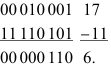
A negative number  is most commonly represented in binary using the complement
of the positive number
is most commonly represented in binary using the complement
of the positive number  , so
, so  would be written as the complement of
  , or 11110101. This allows addition to be carried
out with the usual carrying and the leftmost digit discarded, so
, or 11110101. This allows addition to be carried
out with the usual carrying and the leftmost digit discarded, so  gives
gives
 |
The number of times  that a given binary number
  is divisible by 2 is given by the position of the first
  counting from the right. For example,
  is divisible by 2 twice, and
  is divisible by 2 zero times. The number of times that
1, 2, ... are divisible by 2 are 0, 1, 0, 2, 0, 1, 0, 3, 0, 1, 0, 2, 0, 1, 0, 4,
0, 1, 0, 2, ... (OEIS A007814), which is the
binary carry sequence.
is divisible by 2 zero times. The number of times that
1, 2, ... are divisible by 2 are 0, 1, 0, 2, 0, 1, 0, 3, 0, 1, 0, 2, 0, 1, 0, 4,
0, 1, 0, 2, ... (OEIS A007814), which is the
binary carry sequence.
Real numbers can also be represented using binary notation by interpreting digits past the "decimal" point as negative powers of two, so the binary digits
 would represent
the number
would represent
the number
 |
Therefore, 1/2 would be represented as  , 1/4 as
  , 3/4 as
  , and so on. The sequence of binary digits for the integers
 , 1, ... concatenated together and
interpreted as a binary constant give the binary Champernowne
constant
, 1, ... concatenated together and
interpreted as a binary constant give the binary Champernowne
constant  (OEIS A030190).
Unfortunately, the storage of binary numbers in computers is not entirely standardized. Because computers store information in 8-bit bytes (where a bit is a single binary digit), depending on the "word size" of the machine, numbers requiring more than 8 bits must be stored in multiple bytes. The usual FORTRAN77 integer size is 4 bytes long. However, a number represented as (byte1 byte2 byte3 byte4) in a VAX would be read and interpreted as (byte4 byte3 byte2 byte1) on a Sun. The situation is even worse for floating-point (real) numbers, which are represented in binary as a mantissa and characteristic, and worse still for long (8-byte) reals!
Binary multiplication of single bit numbers (0 or 1) is equivalent to the AND operation, as can be seen in the following multiplication table.
 | 0 | 1 |
| 0 | 0 | 0 |
| 1 | 0 | 1 |
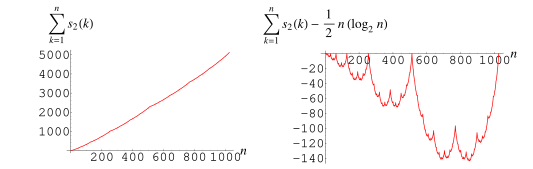
Consider the cumulative digit sum of all binary numbers up to 1, 2, ...,  .
The first few terms are then 1, 2, 4, 5, 7, 9, 12, 13, 15, 17, 20, 22, ... (OEIS
A000788). This sequence in monotonic increasing
(left figure), but if the main asymptotic term is removed, a sequence of humped curves
(right figure; Trott 2004, p. 218) tending towards the blancmange
function is obtained.
.
The first few terms are then 1, 2, 4, 5, 7, 9, 12, 13, 15, 17, 20, 22, ... (OEIS
A000788). This sequence in monotonic increasing
(left figure), but if the main asymptotic term is removed, a sequence of humped curves
(right figure; Trott 2004, p. 218) tending towards the blancmange
function is obtained.
See also
Base, Binary Carry Sequence, Bit, Blancmange Function, Byte, Champernowne Constant, Crumb, Decimal, Digit Count, Eye of Horus Fraction, Factorial, Hexadecimal, Moser-de Bruijn Sequence, Negabinary, Nibble, Octal, Quaternary, Rudin-Shapiro Sequence, Russian Multiplication, Stolarsky-Harborth Constant, Ternary Explore this topic in the MathWorld classroomExplore with Wolfram|Alpha

References
Graham, R. L.; Knuth, D. E.; and Patashnik, O. "Factorial Factors." §4.4 in Concrete Mathematics: A Foundation for Computer Science, 2nd ed. Reading, MA: Addison-Wesley, pp. 111-115, 1994.Heath, F. G. "Origin of the Binary Code." Sci. Amer. 227, 76-83, Aug. 1972.Lauwerier, H. Fractals: Endlessly Repeated Geometric Figures. Princeton, NJ: Princeton University Press, pp. 6-9, 1991.Pappas, T. "Computers, Counting, & Electricity." The Joy of Mathematics. San Carlos, CA: Wide World Publ./Tetra, pp. 24-25, 1989.Press, W. H.; Flannery, B. P.; Teukolsky, S. A.; and Vetterling, W. T. "Error, Accuracy, and Stability" and "Diagnosing Machine Parameters." §1.2 and §20.1 in Numerical Recipes in FORTRAN: The Art of Scientific Computing, 2nd ed. Cambridge, England: Cambridge University Press, pp. 18-21, 276, and 881-886, 1992.Sloane, N. J. A. Sequences A000788/M0964, A007814, and A030190 in "The On-Line Encyclopedia of Integer Sequences."Trott, M. The Mathematica GuideBook for Programming. New York: Springer-Verlag, 2004. https://www.mathematicaguidebooks.org/.Wells, D. The Penguin Dictionary of Curious and Interesting Numbers. Middlesex, England: Penguin Books, pp. 42-44, 1986.Wolfram, S. A New Kind of Science. Champaign, IL: Wolfram Media, p. 117, 2002.Referenced on Wolfram|Alpha
BinaryCite this as:
Weisstein, Eric W. "Binary." From MathWorld--A Wolfram Resource. https://mathworld.wolfram.com/Binary.html