 TOPICS

Rogers-Ramanujan Continued Fraction

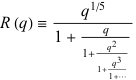
The Rogers-Ramanujan continued fraction is a generalized continued fraction defined by
 |
(1)
|
(Rogers 1894, Ramanujan 1957, Berndt et al. 1996, 1999, 2000). It was discovered by Rogers (1894), independently by Ramanujan around 1913, and again independently
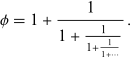
by Schur in 1917. Modulo the factor of  added for convenience, it provides a geometric series
q-analog of the golden
ratio
added for convenience, it provides a geometric series
q-analog of the golden
ratio
 |
(2)
|
The convergents  of
of  are given by
 |  |  |
(3)
|
 |  |  |
(4)
|
 |  |  |
(5)
|
 |  |  |
(6)
|
 |  |  |
(7)
|
 |  |  |
(8)
|
(OEIS A128915 and A127836; Sills 2003, p. 25, identity 3-14).
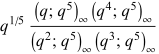
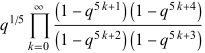
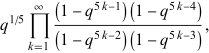
The fraction can be expressed in closed form in terms of q-series by
 |  |  |
(9)
|
 |  |  |
(10)
|
 |  |  |
(11)
|
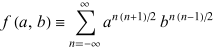
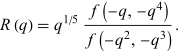
and in terms of the Ramanujan theta function
 |
(12)
|
by
 |
(13)
|
In the upper half-plane and modulo branch cuts, it can also be expressed exactly in terms of the Dedekind
eta function  by
by
 |
(14)
|
where
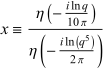 |
(15)
|
(Trott 2004).
The coefficients of  in the Maclaurin series
of
in the Maclaurin series
of  for
for  ,
1, 2, ... are 1,
,
1, 2, ... are 1,  , 1, 0,
  , 1,
, 1,  , 1, 0,
  , 2,
, 2,  , ... (OEIS A007325).
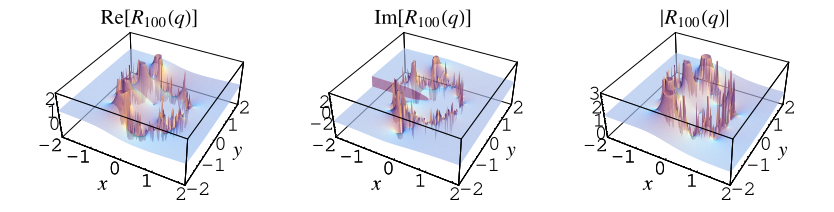
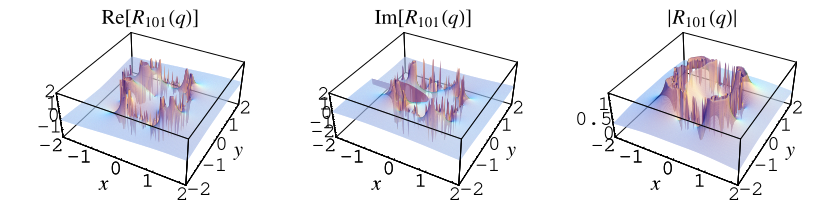
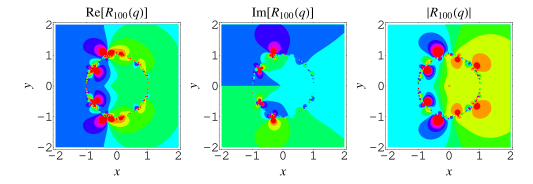
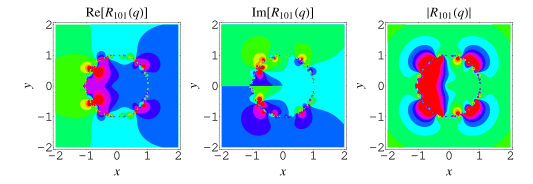
The fraction converges quickly for points sufficiently far from the unit circle in the complex plane. For values  , the series converges to a unique value, while for
 ,
it converges to two possible values. The value of the
,
it converges to two possible values. The value of the  th convergent of the continued fraction
  can be expressed in terms of the unique value inside
the unit disk as
can be expressed in terms of the unique value inside
the unit disk as
![R_n(q)={q^(1/5)(-q^(-1))^(-1/5)[R_n(-q^(-1))]^(-1) for n even; q^(-4/5)(q^(-4))^(-1/5)R(q^(-4)) for n odd](https://mathworld.wolfram.com/images/equations/Rogers-RamanujanContinuedFraction/NumberedEquation7.svg) |
(16)
|
(Andrews et al. 1992, Trott 2004).
Amazingly, Ramanujan showed that  is an algebraic
number for all positive rational
is an algebraic
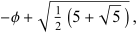
number for all positive rational  . Special cases include
 |  |  |
(17)
|
 |  |  |
(18)
|
 |  |  |
(19)
|
where  is the root of
  near 0.51142....
  can be written as
![r_1=1/8(3+sqrt(5))(RadicalBox[5, 4]-1)(sqrt(10+2sqrt(5))-(3+RadicalBox[5, 4])(RadicalBox[5, 4]-1))](https://mathworld.wolfram.com/images/equations/Rogers-RamanujanContinuedFraction/NumberedEquation8.svg) |
(20)
|
(Yi 2001, Trott 2004). The values of  have been computed by Trott for all values of
  , and the algebraic degrees of
  ,
,  , ... are 8, 4, 32, 8, 40, 16, 64, 16, 96, 20, ... (OEIS
A082682; Trott 2004).
, ... are 8, 4, 32, 8, 40, 16, 64, 16, 96, 20, ... (OEIS
A082682; Trott 2004).
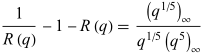
 satisfies the amazing equalities
 |
(21)
|
![1/([R(q)]^5)-11-[R(q)]^5=((q)_infty^6)/(q(q^5)_infty^6),](https://mathworld.wolfram.com/images/equations/Rogers-RamanujanContinuedFraction/Inline64.svg) |
(22)
|
where  is a q-Pochhammer
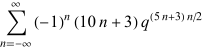
symbol. It also satisfies
is a q-Pochhammer
symbol. It also satisfies
 |  | ![[3/([R(q)]^2)+[R(q)]^3]q^(2/5)(q^5)_infty^3](https://mathworld.wolfram.com/images/equations/Rogers-RamanujanContinuedFraction/Inline68.svg) |
(23)
|
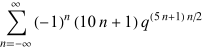 |  | ![[1/([R(q)]^3)-3[R(q)]^2]q^(3/5)(q^5)_infty^3](https://mathworld.wolfram.com/images/equations/Rogers-RamanujanContinuedFraction/Inline71.svg) |
(24)
|
(Watson 1929ab; Berndt 1991, pp. 265-267; Berndt et al. 1996, 2000; Son 1998).
Defining
 |  |  |
(25)
|
 |  |  |
(26)
|
 |  |  |
(27)
|
 |  |  |
(28)
|
these quantities satisfy the modular equations
 |  |  |
(29)
|
 |  |  |
(30)
|
 |  |  |
(31)
|
 |  |  |
(32)
|
 |  |  |
(33)
|
 |  |  |
(34)
|
 |  |  |
(35)
|
 |  |  |
(36)
|
(Berndt et al. 1996, 2000). Trott (2004) gives modular equations of orders 2 to 15 and the primes 17, 19, and 23.
As discussed by Hardy (Ramanujan 1962, pp. xxvii and xxviii), Berndt and Rankin (1995), and Berndt et al. (1996, 2000), Ramanujan also defined the generalized continued fraction
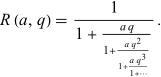 |
(37)
|
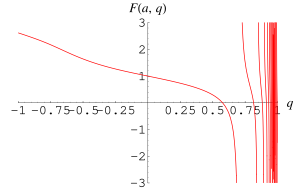
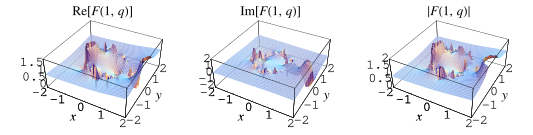
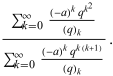
Ramanujan also considered the continued fraction
 |  |  |
(38)
|
 |  |  |
(39)
|
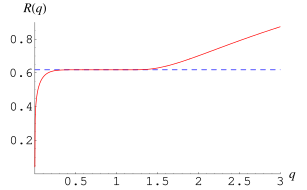
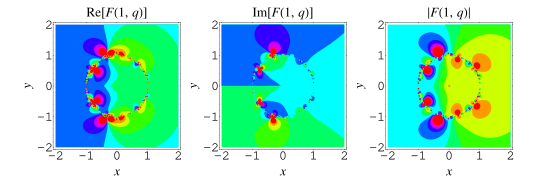
(Berndt 1991, p. 30; Berndt et al. 1996, 2000), of which the special case  is plotted above.
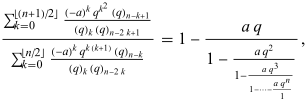
Terminating at a term  gives
gives
 |
(40)
|
(Berndt et al. 1996, 2000).
The real roots of  are 0.576149, 0.815600, 0.882493, 0.913806, 0.931949, 0.943785,
0.952125, ..., the smallest of which was found by Ramanujan (Berndt et al. ).
are 0.576149, 0.815600, 0.882493, 0.913806, 0.931949, 0.943785,
0.952125, ..., the smallest of which was found by Ramanujan (Berndt et al. ).
 and its smallest positive root are related to the enumeration of coins in a fountain
(Berndt 1991, Berndt et al. 1996, 2000) and the study of birth and death processes
(Berndt et al. 1996, 2000; Parthasarathy et al. 1998). In general,
the least positive root
and its smallest positive root are related to the enumeration of coins in a fountain
(Berndt 1991, Berndt et al. 1996, 2000) and the study of birth and death processes
(Berndt et al. 1996, 2000; Parthasarathy et al. 1998). In general,
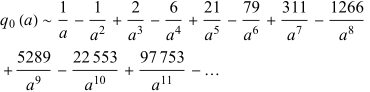
the least positive root  of
of  is given as
  by
by
 |
(41)
|
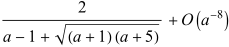
(OEIS A050203; Berndt et al. 1996, 2000). Ramanujan gave the amazing approximations
 |  |  |
(42)
|
 |  | ![1/((a-1+sqrt((a+1)(a+5)))/2+[(a+3-sqrt((a+1)(a+5)))/(a-1+sqrt((a+1)(a+5)))]^3)+O(a^(-11)).](https://mathworld.wolfram.com/images/equations/Rogers-RamanujanContinuedFraction/Inline126.svg) |
(43)
|
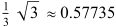
For  , these approximations give
 |  |  |
(44)
|
 |  |  |
(45)
|
More generally, for the broad class of  defined as
  ,
,  can be evaluated in terms of the j-function
  and the icosahedral equation as
 |
(46)
|
with one of the  as
as  (Duke 2004). As an example,
  has
has  , so
, so  . Substituting
  into the equation, one of its factors will be a quartic
with the root
into the equation, one of its factors will be a quartic
with the root  .
.
Furthermore, the numerator and the denominator (with a constant) can be combined to form a perfect square,
 |
(47)
|
which are in fact polynomial invariants of the icosahedral group.
See also
Bauer-Muir Transformation, Fountain, Generalized Continued Fraction, Golden Ratio, q-Series, Ramanujan Theta Functions, Rogers-Ramanujan IdentitiesPortions of this entry contributed by Tito Piezas III
Explore with Wolfram|Alpha

References
Andrews, G. On the General Rogers-Ramanujan Theorem. Providence, RI: Amer. Math. Soc., 1974.Andrews, G. E.; Berndt, B. C.; Jacobsen, L.; and Lamphere, R. L. The Continued Fractions Found in the Unorganized Portion of Ramanujan's Notebooks. Providence, RI: Amer. Math. Soc., 1992.Bailey, D. H.; Borwein, J. M.; Kapoor, V.; and Weisstein, E. W. "Ten Problems in Experimental Mathematics." Amer. Math. Monthly 113, 481-509, 2006.Berndt, B. C. Ramanujan's Notebooks, Part III. New York: Springer-Verlag, 1991.Berndt, B. C. "Continued Fractions." Ch. 32 in Ramanujan's Notebooks, Part V. New York: Springer-Verlag, pp. 9-88, 1998.Berndt, B. C. and Chan, H. H. "Some Values for the Rogers-Ramanujan Continued Fraction." Canad. J. Math. 47, 897-914, 1995.Berndt, B. C.; Chan, H. H.; Huang, S.-S.; Kang, S.-Y.; Sohn, J.; and Son, S. H. "The Rogers-Ramanujan Continued Fraction." J. Comput. Appl. Math. 105, 9-24, 1999.Berndt, B. C.; Chan, H. H.; and Zhang, L.-C. "Explicit Evaluations of the Rogers-Ramanujan Continued Fraction." J. reine angew. Math. 480, 141-159, 1996.Berndt, B. C.; Huang, S.-S.; Sohn, J.; and Son, S. H. "Some Theorems on the Rogers-Ramanujan Continued Fraction in Ramanujan's Lost Notebook." Trans. Amer. Math. Soc. 352, 2157-2177, 2000.Berndt, B. C. and Rankin, R. A. Ramanujan: Letters and Commentary. Providence, RI: Amer. Math. Soc, 1995.Duke, W. "Continued Fractions and Modular Functions." Bull. Amer. Math. Soc. 42, 137-162, 2005.Joyce, G. S. "Exact Results for the Activity and Isothermal Compressibility of the Hard-Hexagon Model." J. Phys. A: Math. Gen. 21, L983-L988, 1988.Parthasarathy, P. R.; Lenin, R. B.; Schoutens, W.; and van Assche, W. "A Birth and Death Process Related to the Rogers-Ramanujan Continued Fraction." J. Math. Anal. Appl. 224, 297-315, 1998.Ramanathan, K. G. "On Ramanujan's Continued Fraction." Acta Arith. 43, 209-226, 1984a.Ramanathan, K. G. "On the Rogers-Ramanujan Continued Fraction." Proc. Indian Acad. Sci. (Math. Sci.) 93, 67-77, 1984b.Ramanathan, K. G. "Ramanujan's Continued Fraction." Indian J. Pure Appl. Math. 16, 695-724, 1985.Ramanathan, K. G. "Some Applications of Kronecker's Limit Formula." J. Indian Math. Soc. 52, 71-89, 1987.Ramanujan, S. Notebooks (2 Volumes). Bombay, India: Tata Institute, 1957.Ramanujan, S. Collected Papers. New York: Chelsea, 1962.Rogers, L. J. "Second Memoir on the Expansion of Certain Infinite Products." Proc. London Math. Soc. 25, 318-343, 1894.Rogers, L. J. "On a Type of Modular Equations." Proc. London Math. Soc. 19, 387-397, 1920.Sills, A. V. "Finite Rogers-Ramanujan Type Identities." Elec. J. Combin. 10, No. 13, 2003.Sloane, N. J. A. Sequences A007325/M0415, A050203, A082682, A127836, and A128915 in "The On-Line Encyclopedia of Integer Sequences."Son, S. H. "Some Theta Function Identities Related to the Rogers-Ramanujan Continued Fraction." Proc. Amer. Math. Soc. 126, 2895-2902, 1998.Trott, M. "Modular Equations of the Rogers-Ramanujan Continued Fraction." Mathematica J. 9,314-333, 2004.Watson, G. N. "Theorems Stated by Ramanujan (VII): Theorems on Continued Fractions." J. London Math. Soc. 4, 39-48, 1929a.Watson, G. N. "Theorems Stated by Ramanujan (IX): Two Continued Fractions." J. London Math. Soc. 4, 231-237, 1929b.Yi, J. "Evaluations of the Rogers-Ramanujan Continued Fraction by Modular Equations." Acta Arith. 97,
103-127, 2001.Yi, J. "Modular Equations for the Rogers-Ramanujan
Continued Fraction and the Dedekind Eta-Function." Ramanujan J. 5,
377-384, 2002.
by Modular Equations." Acta Arith. 97,
103-127, 2001.Yi, J. "Modular Equations for the Rogers-Ramanujan
Continued Fraction and the Dedekind Eta-Function." Ramanujan J. 5,
377-384, 2002.Referenced on Wolfram|Alpha
Rogers-Ramanujan Continued FractionCite this as:
Piezas, Tito III and Weisstein, Eric W. "Rogers-Ramanujan Continued Fraction." From MathWorld--A Wolfram Resource. https://mathworld.wolfram.com/Rogers-RamanujanContinuedFraction.html