 TOPICS

Generalized Continued Fraction
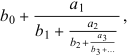
A generalized continued fraction is an expression of the form
 |
(1)
|
where the partial numerators  and partial denominators
  may in general be integers, real numbers, complex numbers, or functions (Rockett
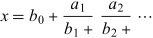
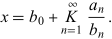
and Szüsz, 1992, p. 1). Generalized continued fractions may also be written
in the forms
may in general be integers, real numbers, complex numbers, or functions (Rockett
and Szüsz, 1992, p. 1). Generalized continued fractions may also be written
in the forms
 |
(2)
|
or
 |
(3)
|
Note that letters other than  are sometimes also used; for example, the documentation
for ContinuedFractionK[f,
g,
are sometimes also used; for example, the documentation
for ContinuedFractionK[f,
g,  i,
imin, imax
i,
imin, imax ] in the Wolfram
Language uses
] in the Wolfram
Language uses  .
.
Padé approximants provide another method of expanding functions, namely as a ratio of two power series. The quotient-difference algorithm allows interconversion of continued fraction, power series, and rational function approximations.
A small sample of closed-form continued fraction constants is given in the following table (cf. Euler 1775). The Ramanujan continued fractions provide another fascinating class of continued fraction constants, and the Rogers-Ramanujan continued fraction is an example of a convergent generalized continued fraction function where a simple definition leads to quite intricate structure.
| continued fraction | value | approximate | OEIS |
 |  | 0.697774... | A052119 |
 |  | 0.581976... | A073333 |
 | ![sqrt(2/(epi))[erfc(2^(-1/2))]^(-1)](https://mathworld.wolfram.com/images/equations/GeneralizedContinuedFraction/Inline12.svg) | 1.525135... | A111129 |
 |  | 1.541494... | A113011 |
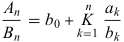
The value
 |
(4)
|
is known as the  th convergent of the continued
fraction.
th convergent of the continued
fraction.
A regular continued fraction representation (which is usually what is meant when the term "continued fraction" is used
without qualification) of a number  is one for which the partial
quotients are all unity (
is one for which the partial
quotients are all unity ( ),
),  is an integer, and
  ,
,  , ... are positive integers (Rockett and Szüsz, 1992,
p. 3).
, ... are positive integers (Rockett and Szüsz, 1992,
p. 3).
Euler showed that if a convergent series can be written in the form
 |
(5)
|
then it is equal to the continued fraction
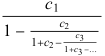 |
(6)
|
(Borwein et al. 2004, p. 30).
To "round" a regular continued fraction, truncate the last term unless it is  ,
in which case it should be added to the previous term (Gosper 1972, Item 101A). To
take one over a simple continued fraction, add (or possibly delete) an initial 0
term. To negate, take the negative of all terms, optionally
using the identity
,
in which case it should be added to the previous term (Gosper 1972, Item 101A). To
take one over a simple continued fraction, add (or possibly delete) an initial 0
term. To negate, take the negative of all terms, optionally
using the identity
![[-a,-b,-c,-d,...]=[-a-1,1,b-1,c,d,...].](https://mathworld.wolfram.com/images/equations/GeneralizedContinuedFraction/NumberedEquation7.svg) |
(7)
|
A particularly beautiful identity involving the terms of the continued fraction is
![([a_0,a_1,...,a_n])/([a_0,a_1,...,a_(n-1)])=([a_n,a_(n-1),...,a_1,a_0])/([a_n,a_(n-1),...,a_1]).](https://mathworld.wolfram.com/images/equations/GeneralizedContinuedFraction/NumberedEquation8.svg) |
(8)
|
There are two possible representations for a finite simple fraction:
![[a_0,...,a_n]={[a_0,...,a_(n-1),a_n-1,1] for a_n>1; [a_0,...,a_(n-2),a_(n-1)+1] for a_n=1.](https://mathworld.wolfram.com/images/equations/GeneralizedContinuedFraction/NumberedEquation9.svg) |
(9)
|
See also
Continued Fraction, Continued Fraction Constants, Convergent, Lehner Continued Fraction, Padé Approximant, Partial Denominator, Partial Numerator, Ramanujan Continued Fractions, Regular Continued Fraction, Rogers-Ramanujan Continued Fraction, Simple Continued FractionExplore with Wolfram|Alpha

References
Borwein, J.; Bailey, D.; and Girgensohn, R. Experimentation in Mathematics: Computational Paths to Discovery. Wellesley, MA: A K Peters, 2004.Gosper, R. W. "Continued fractions query." math-fun@cs.arizona.edu posting, Dec. 27, 1996.Gosper, R. W. Item 101a in Beeler, M.; Gosper, R. W.; and Schroeppel, R. HAKMEM. Cambridge, MA: MIT Artificial Intelligence Laboratory, Memo AIM-239, pp. 37-39, Feb. 1972. https://www.inwap.com/pdp10/hbaker/hakmem/cf.html#item101a.Rockett, A. M. and Szüsz, P. Continued Fractions. New York: World Scientific, 1992.Referenced on Wolfram|Alpha
Generalized Continued FractionCite this as:
Weisstein, Eric W. "Generalized Continued Fraction." From MathWorld--A Wolfram Resource. https://mathworld.wolfram.com/GeneralizedContinuedFraction.html