 TOPICS

Odd Function

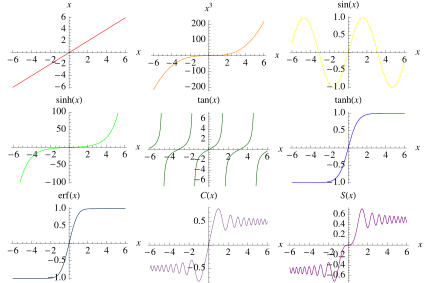
An odd function is a univariate function  satisfying
 .
Geometrically, such functions are symmetric
about the origin. Examples of odd functions
include
 ,
 , the sine
 , hyperbolic
sine
 ,
tangent
 , hyperbolic tangent
 , error function erf
 , inverse
erf
 ,
and the Fresnel integrals
 , and
 .
For any univariate function  whose domain is symmetric
about 0, the odd part
 is defined by
 |
It is odd, and  is the even part of
 . For a univariate polynomial,
the odd part is the sum of the
monomials containing odd powers
of the variable.
An even function times an odd function is odd, and the product of two odd functions is even and the sum or difference of two odd functions is odd. The converse need not hold. The quotient of two odd functions, where the denominator is nonzero, is an even function.
If an even function is differentiable, then its derivative is an odd function.
If an odd function is integrable
over a symmetric interval  , where
 , then its integral
over
 is identically zero. If an even
function is integrable over
 , then its integral over
 is twice its integral
over the interval
 . For
 , the two one-sided improper
integrals must each be finite.
The same notion extends to multivariate functions  by saying that such
a function is odd iff
 |
On a domain symmetric about the origin, each partial
derivative of a differentiable odd multivariate
function is even under simultaneous sign reversal.
The integral of an integrable
odd function over such a domain
in  is zero.
If an odd function has a Maclaurin series, that series contains only odd
powers of  .
See also
Even Function, Even Part, Odd Part, Odd PowerPortions of this entry contributed by Christopher Stover
Explore with Wolfram|Alpha

Cite this as:
Weisstein, Eric W., with contributions by Christopher Stover. "Odd Function." From MathWorld--A Wolfram Resource. https://mathworld.wolfram.com/OddFunction.html