 TOPICS

Wynn's Epsilon Method
Wynn's  -method
is a method for numerical evaluation of sums and products
that samples a number of additional terms in the series and then tries to extrapolate
them by fitting them to a polynomial multiplied by
a decaying exponential.
-method
is a method for numerical evaluation of sums and products
that samples a number of additional terms in the series and then tries to extrapolate
them by fitting them to a polynomial multiplied by
a decaying exponential.
In particular, the method provides an efficient algorithm for implementing transformations of the form
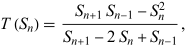 |
(1)
|
where
 |
(2)
|
is the  th
partial sum of a sequence
th
partial sum of a sequence  , which are useful for yielding series convergence
improvement (Hamming 1986, p. 205). In particular, letting
, which are useful for yielding series convergence
improvement (Hamming 1986, p. 205). In particular, letting  ,
,  , and
, and
 |
(3)
|
for  ,
2, ... (correcting the typo of Hamming 1986, p. 206). The values of
,
2, ... (correcting the typo of Hamming 1986, p. 206). The values of  are there equivalent to the results of applying
 transformations to the sequence
  (Hamming 1986, p. 206).
Wynn's epsilon method can be applied to the terms of a series using the Wolfram Language command SequenceLimit[l]. Wynn's method may also be invoked in numerical summation and multiplication using Method -> Fit in the Wolfram Language's NSum and NProduct commands. It is also utilized in the routine NLimit[expr, x -> x0] in the Wolfram Language package NumericalCalculus` .
Wynn's epsilon method is a member of a large family of similar so-called lozenge, or rhombus, transformations (Hamming 1986, p. 207).
See also
Convergence Improvement, Euler-Maclaurin Integration FormulasExplore with Wolfram|Alpha

References
Brezinski, C. "Convergence Acceleration During the 20th Century." J. Comput. Appl. Math. 122, 1-21, 2000.Hamming, R. W. Numerical Methods for Scientists and Engineers, 2nd ed. New York: Dover, pp. 206-207, 1986.Shanks, D. "Nonlinear Transformations of Divergent and Slowly Convergent Sequences." J. Math. Phys. 34, 1-42, 1955.Weniger, E. J. "Nonlinear Sequence Transformations for the Acceleration of Convergence and the Summation of Divergent Series." 19 Jun 2003. https://arxiv.org/abs/math/0306302.Wynn, P. "On a Device for Computing the Transformation." Math Tables Aids Comput. 10,
91-96, 1956.Wynn, P. "Acceleration Techniques in Numerical Analysis,
with Particular Reference to Problems in One Independent Variable." Proc.
IFIPS, Munich. Munich, pp. 149-156, 1962.
Transformation." Math Tables Aids Comput. 10,
91-96, 1956.Wynn, P. "Acceleration Techniques in Numerical Analysis,
with Particular Reference to Problems in One Independent Variable." Proc.
IFIPS, Munich. Munich, pp. 149-156, 1962.Referenced on Wolfram|Alpha
Wynn's Epsilon MethodCite this as:
Weisstein, Eric W. "Wynn's Epsilon Method." From MathWorld--A Wolfram Resource. https://mathworld.wolfram.com/WynnsEpsilonMethod.html