 TOPICS

Vertex Cover

A vertex cover, or hitting set, of a collection  of subsets
of a finite set
 is a subset
 of
 that meets every member of
 .
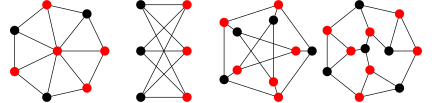
A vertex cover of a graph  can also more simply be thought of as a set
 of vertices
of
 such that every edge
of
 has at least one member of
 as an endpoint. The vertex set
of a graph is therefore always a vertex cover. The smallest
possible vertex cover for a given graph
 is known as a minimum vertex
cover (Skiena 1990, p. 218), and its size is called the vertex
cover number, denoted
 .
Vertex covers, indicated with red coloring, are shown above for a number of graphs.
In a complete k-partite graph with
 nonempty parts, every vertex cover contains
all the vertices of at least
 parts.
A set of vertices is a vertex cover iff its complement forms an independent vertex set (Skiena 1990, p. 218). The counts of vertex covers and independent vertex sets in a graph are therefore the same.
A minimum vertex cover of a graph can be found in the Wolfram Language using FindVertexCover[g].
A list of vertices can be tested in the Wolfram Language to see if it is a vertex cover of a graph using VertexCoverQ[g, vlist]. Precomputed vertex covers for many named graphs can be looked up using GraphData[graph, "VertexCovers"].
Vertex cover counts for some families of graphs are summarized in the following table. The index of each value list in the table starts at 1. An X indicates a parameter value excluded by the family conventions used in that row.
| graph family | OEIS | number of vertex covers |
antiprism
graph for  | X, X, 10, 21, 46, 98, 211, 453, 973, 2090, ... | |
 bishop graph | A201862 | 2, 9, 70, 729, 9918, 167281, ... |
 black
bishop graph | 2, 3, 10, 27, 114, 409, 2066, ... | |
 -folded cube graph | X, 3, 5, 31, 393, ... | |
grid graph  for  | A006506 | X, 7, 63, 1234, 55447, 5598861, ... |
grid graph  for  | X, 35, 70633, ... | |
 -halved cube graph | 2, 3, 5, 13, 57, ... | |
 -Hanoi graph | 4, 52, 108144, ... | |
hypercube graph  | A027624 | 3, 7, 35, 743, 254475, 19768832143, ... |
 king
graph | A063443 | 2, 5, 35, 314, 6427, ... |
 knight
graph | A141243 | 2, 16, 94, 1365, 55213, ... |
 -Möbius
ladder | A182143 | X, X, 15, 33, 83, 197, 479, 1153, 2787, ... |
 -Mycielski graph | 2, 3, 11, 103, 7407, ... | |
odd
graph  | 2, 4, 76, ... | |
prism graph  for  | A051927 | X, X, 13, 35, 81, 199, 477, 1155, 2785, ... |
 queen graph | 2, 5, 18, 87, 462, ... | |
 rook graph | A002720 | 2, 7, 34, 209, 1546, 13327, 130922, ... |
 -Sierpiński gasket
graph | 4, 14, 440, ... | |
 -triangular graph | X, 2, 4, 10, 26, 76, 232, 764, ... | |
 -web graph for  | X, X, 68, 304, 1232, 5168, 21408, ... | |
 white bishop graph | X, 3, 7, 27, 87, 409, 1657, ... |
Many families of graphs have simple closed forms for counts of vertex covers, as summarized in the following table. Here  is a positive integer.
The formulas for the antiprism graph, cycle
graph, gear graph, helm
graph, Möbius ladder, pan
graph, prism graph, sun
graph, and sunlet graph assume
 . The formula for the wheel
graph assumes
 ,
and that for the
 -crossed prism graph assumes
 . Here,
 is a Fibonacci number,
 is a Lucas
number,
 is a Laguerre polynomial,
 is the golden ratio, and
 ,
 ,
 are the roots of
 .


 -





See also
Clique, Edge Cover, Hungarian Maximum Matching Algorithm, Independent Set, Maximum Independent Vertex Set, Minimum Vertex Cover, Vertex Cover Number, Vertex Cover PolynomialExplore with Wolfram|Alpha

References
Pemmaraju, S. and Skiena, S. "Minimum Vertex Cover." §7.5.2 in Computational Discrete Mathematics: Combinatorics and Graph Theory with Mathematica. Cambridge, England: Cambridge University Press, p. 317, 2003.Skiena, S. "Minimum Vertex Cover." §5.6.2 in Implementing Discrete Mathematics: Combinatorics and Graph Theory with Mathematica. Reading, MA: Addison-Wesley, p. 218, 1990.Skiena, S. S. "Vertex Cover." §8.5.3 in The Algorithm Design Manual. New York: Springer-Verlag, pp. 317-318, 1997.Sloane, N. J. A. Sequences A002720, A006506, A027624, A051927, A063443, A141243, A182143, and A201862 in "The On-Line Encyclopedia of Integer Sequences."Referenced on Wolfram|Alpha
Vertex CoverCite this as:
Weisstein, Eric W. "Vertex Cover." From MathWorld--A Wolfram Resource. https://mathworld.wolfram.com/VertexCover.html