 TOPICS

Triangle Line Picking

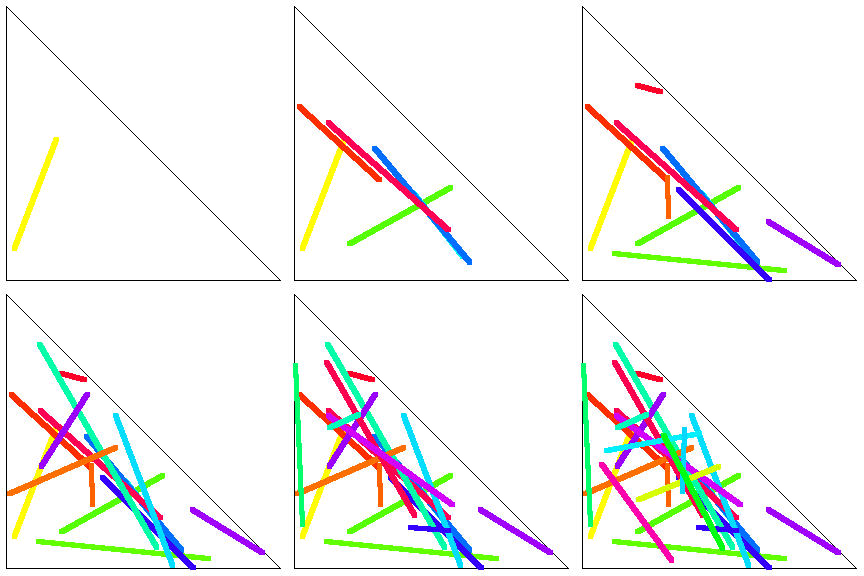
Consider the average length of a line segment determined by two points picked at random in the interior of an arbitrary triangle  with side lengths
  ,
,  , and
, and  . This problem is not affine, but
a simple formula in terms of the area or linear properties
of the original triangle can be found using Borel's overlap technique to collapse
the quadruple integral to a double integral and then convert to polar
coordinates, leading to the beautiful general formula
. This problem is not affine, but
a simple formula in terms of the area or linear properties
of the original triangle can be found using Borel's overlap technique to collapse
the quadruple integral to a double integral and then convert to polar
coordinates, leading to the beautiful general formula
 |  | ![(4ss_as_bs_c)/(15)[1/(a^3)ln(s/(s_a))+1/(b^3)ln(s/(s_b))+1/(c^3)ln(s/(s_c))]+(a+b+c)/(15)+((b+c)(b-c)^2)/(30a^2)+((c+a)(c-a)^2)/(30b^2)+((a+b)(a-b)^2)/(30c^2)](https://mathworld.wolfram.com/images/equations/TriangleLinePicking/Inline7.svg) |
(1)
|
(A. G. Murray, pers. comm., Apr. 4, 2020), where  is the semiperimeter
and
is the semiperimeter
and  .
The formulas for odd moments have a similar form to that of the mean but with higher
powers of
.
The formulas for odd moments have a similar form to that of the mean but with higher
powers of  ,
,
 ,
,
 ,
and the triangle area
,
and the triangle area 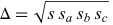 .
.
This formula immediately gives the special cases obtained below originally using brute-force computer algebra.
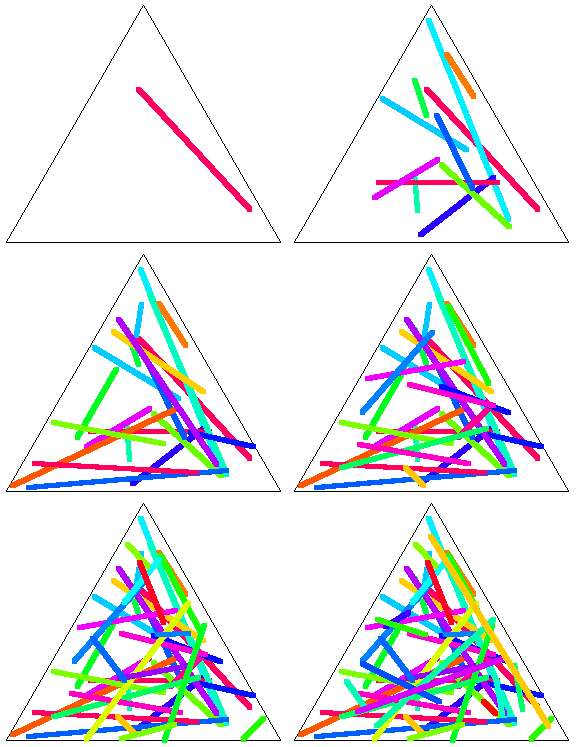
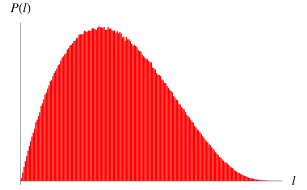
If the original triangle is chosen to be an equilateral triangle with unit side lengths, then the average length of a line with endpoints chosen at random inside it is given by
 |  |  |
(2)
|
 |  |  |
(3)
|
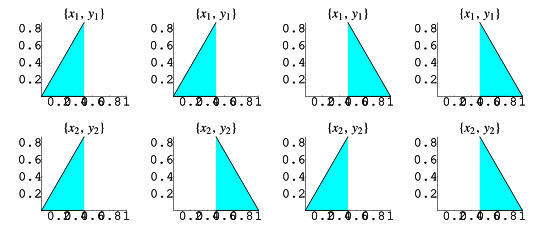
The integrand can be split up into the four pieces
 |  |  |
(4)
|
 |  |  |
(5)
|
 |  |  |
(6)
|
 |  |  |
(7)
|
As illustrated above, symmetry immediately gives  and
and  , so
, so
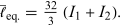 |
(8)
|
With some effort, the integrals  and
and  can be done analytically to give the final beautiful result
 |  |  |
(9)
|
 |  |  |
(10)
|
(OEIS A093064; E. W. Weisstein, Mar. 16, 2004).
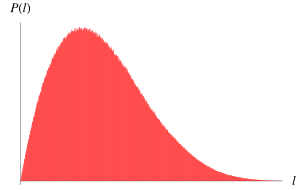
If the original triangle is chosen to be an isosceles right triangle with unit legs, then the average length of a line with endpoints chosen at random inside it is given by
 |  |  |
(11)
|
 |  | ![1/(30)[2+4sqrt(2)+(4+sqrt(2))sinh^(-1)1]](https://mathworld.wolfram.com/images/equations/TriangleLinePicking/Inline47.svg) |
(12)
|
 |  |  |
(13)
|
 |  |  |
(14)
|
(OEIS A093063; M. Trott, pers. comm., Mar. 10, 2004), which is numerically surprisingly close to  .
.
The mean length of a line segment picked at random in a 3, 4, 5 triangle is given by
 |  |  |
(15)
|
 |  | 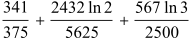 |
(16)
|
 |  |  |
(17)
|
(E. W. Weisstein, Aug. 6-9, 2010; OEIS A180307).
The mean length of a line segment picked at random in a 30-60-90 triangle with unit hypotenuse was computed by E. W. Weisstein (Aug. 5, 2010) as a complicated analytic expression involving sums of logarithms. After simplification, the result can be written as
 |  |  |
(18)
|
 |  |  |
(19)
|
(E. Weisstein, M. Trott, A. Strzebonski, pers. comm., Aug. 25, 2010; OEIS A180308).
The expected distance from a random point in a general triangle to the vertex  opposite the side of length
  is
is
 |
(20)
|
(A. G. Murray, pers. comm., Apr. 4, 2020), with analogous expressions for  and
and  .
These give the beautiful identity
.
These give the beautiful identity
![l_(Delta(a,b,c))=1/5[d_(Delta(a,b,c),A)+d_(Delta(a,b,c),B)+d_(Delta(a,b,c),C)]](https://mathworld.wolfram.com/images/equations/TriangleLinePicking/NumberedEquation3.svg) |
(21)
|
(A. G. Murray, pers. comm., Apr. 4, 2020).
See also
Equilateral Triangle, Isosceles Right Triangle, Square Line Picking, Triangle Point Picking, Triangle Triangle PickingExplore with Wolfram|Alpha

References
Pure, R.; Durrani, S.; Tong, F.; and Pan, J. "Distance Distribution Between Two Random Points in Arbitrary Polygons." Math. Meth. Appl. Sci. 45, 2760-2775, 2022. https://doi.org/10.1002/mma.7951.Sheng, T. .K. "The Distance between Two Random Points in Plane Regions." Adv. Appl. Prob. 17, 748-773, 1985.Sloane, N. J. A. Sequences A093063, A093064, A180307, and A180308 in "The On-Line Encyclopedia of Integer Sequences."Referenced on Wolfram|Alpha
Triangle Line PickingCite this as:
Weisstein, Eric W. "Triangle Line Picking." From MathWorld--A Wolfram Resource. https://mathworld.wolfram.com/TriangleLinePicking.html