 TOPICS

Statistical Range

The term "range" has two completely different meanings in statistics.
Given order statistics  ,
,  , ...,
  ,
, 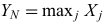 , the range of the random sample is defined by
 |
(1)
|
(Hogg and Craig 1995, p. 152).
For small samples, the range is a good estimator of the population standard deviation (Kenney and Keeping 1962, pp. 213-214).
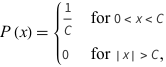
For a continuous uniform distribution
 |
(2)
|
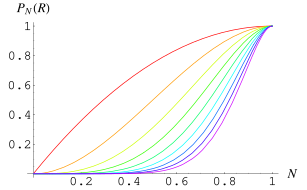
the distribution of the range is given by
 |
(3)
|
This is illustrated above for  and values of
  from
from  (red) to
  (violet).
Given two samples with sizes  and
and  and ranges
  and
and  , let
, let  . Then
![D(u)={(m(m-1)n(n-1))/((m+n)(m+n-1)(m+n-2))[(m+n)u^(m-2)-(m+n-2)u^(m-1)]; for 0<=u<=1; (m(m-1)n(n-1))/((m+n)(m+n-1)(m+n-2))[(m+n)u^(-n)-(m+n-2)u^(-n-1)]; for 1<=u<infty.](https://mathworld.wolfram.com/images/equations/StatisticalRange/NumberedEquation4.svg) |
(4)
|
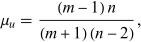
The mean is
 |
(5)
|
and the mode is
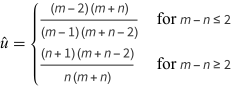 |
(6)
|
(Kenney and Keeping 1962).
See also
Midrange, Range, Statistical MedianExplore with Wolfram|Alpha

References
Feller, W. An Introduction to Probability Theory and Its Applications, Vol. 1, 3rd ed. New York: Wiley, 1968.Hogg, R. V. and Craig, A. T. Introduction to Mathematical Statistics, 5th ed. New York: Macmillan, p. 152, 1995.Kenney, J. F. and Keeping, E. S. "The Range." §6.2 in Mathematics of Statistics, Pt. 1, 3rd ed. Princeton, NJ: Van Nostrand, pp. 75-76, 213-214, 1962.Referenced on Wolfram|Alpha
Statistical RangeCite this as:
Weisstein, Eric W. "Statistical Range." From MathWorld--A Wolfram Resource. https://mathworld.wolfram.com/StatisticalRange.html