 TOPICS

Self-Conjugate Partition

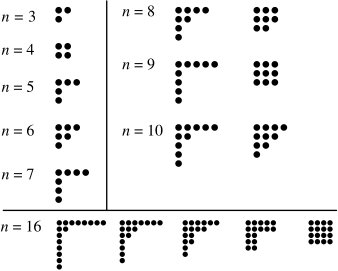
A self-conjugate partition is a partition whose conjugate partition is equal to itself. The Ferrers diagrams corresponding to the self-conjugate
partitions for  are illustrated above. The numbers of self-conjugate partitions of
 , 2, ... are 1, 0, 1, 1, 1, 1, 1, 2, 2, 2, 2, 3, 3, 3, 4,
5, 5, 5, 6, 7, ... (OEIS A000700).
The number  of self-conjugate partitions of a nonnegative
integer
 equals the number of partitions of
 into distinct odd parts, with
 for the empty partition. Its generating
function is
 |  |  |
(1)
|
 |  |  |
(2)
|
 |  |  |
(3)
|
and  has generating function
 |  |  |
(4)
|
 |  |  |
(5)
|
 |  |  |
(6)
|
where  is a q-Pochhammer symbol. The identities
hold as formal power series and for
 .
See also
Conjugate Partition, Core Partition, Ferrers Diagram, Partition Function PExplore with Wolfram|Alpha

References
Hardy, G. H. and Wright, E. M. An Introduction to the Theory of Numbers, 5th ed. Oxford, England: Clarendon Press, p. 277, 1979.Osima, M. "On the Irreducible Representations of the Symmetric Group." Canad. J. Math. 4, 381-384, 1952. https://doi.org/10.4153/cjm-1952-034-x.Sloane, N. J. A. Sequence A000700 in "The On-Line Encyclopedia of Integer Sequences."Watson, G. N. "Two Tables of Partitions." Proc. London Math. Soc. 42, 550-556, 1937. https://doi.org/10.1112/plms/s2-42.1.550.Referenced on Wolfram|Alpha
Self-Conjugate PartitionCite this as:
Weisstein, Eric W. "Self-Conjugate Partition." From MathWorld--A Wolfram Resource. https://mathworld.wolfram.com/Self-ConjugatePartition.html