 TOPICS

Regular Polygon

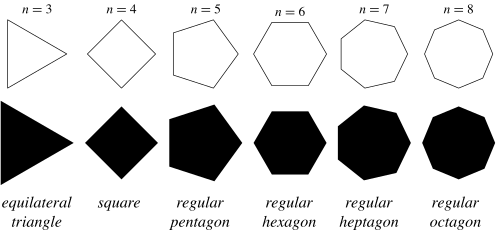
A regular polygon is an  -sided
polygon in which the sides are all the same length and
are symmetrically placed about a common center (i.e., the polygon is both equiangular
and equilateral). Only certain regular polygons
are "constructible" using the
classical Greek tools of the compass and straightedge.
-sided
polygon in which the sides are all the same length and
are symmetrically placed about a common center (i.e., the polygon is both equiangular
and equilateral). Only certain regular polygons
are "constructible" using the
classical Greek tools of the compass and straightedge.
The terms equilateral triangle and square refer to the regular 3- and 4-polygons, respectively. The words for polygons
with  sides (e.g., pentagon, hexagon,
heptagon, etc.) can refer to either regular or non-regular
polygons, although the terms generally refer to regular
polygons in the absence of specific wording.
sides (e.g., pentagon, hexagon,
heptagon, etc.) can refer to either regular or non-regular
polygons, although the terms generally refer to regular
polygons in the absence of specific wording.
A regular  -gon
is implemented in the Wolfram Language
as RegularPolygon[n],
or more generally as RegularPolygon[r,
n], RegularPolygon[
-gon
is implemented in the Wolfram Language
as RegularPolygon[n],
or more generally as RegularPolygon[r,
n], RegularPolygon[ x, y
x, y , rspec, n], etc.
The sum of perpendiculars from any point to the sides of a regular polygon of  sides is
  times the apothem.
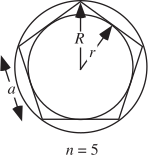
Let  be the side length,
  be the inradius, and
  the circumradius of a regular
polygon. Then
the circumradius of a regular
polygon. Then
 |  |  |
(1)
|
 |  |  |
(2)
|
 |  |  |
(3)
|
 |  |  |
(4)
|
 |  |  |
(5)
|
 |  |  |
(6)
|
 |  |  |
(7)
|
 |  |  |
(8)
|
 |  | 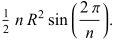 |
(9)
|
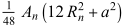
The area moments of inertia about axes along an inradius and a circumradius
of a regular  -gon
are given by
-gon
are given by
 |  | 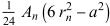 |
(10)
|
 |  | ![(a^4)/(192)n[cos((2pi)/n)+2]cos(pi/n)csc^2(pi/n)](https://mathworld.wolfram.com/images/equations/RegularPolygon/Inline44.svg) |
(11)
|
 |  |  |
(12)
|
 |  | ![(a^4)/(192)ncot(pi/n)[3cos^2(pi/n)+1]](https://mathworld.wolfram.com/images/equations/RegularPolygon/Inline50.svg) |
(13)
|
(Roark 1954, p. 70).
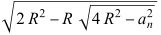
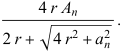
If the number of sides is doubled, then
 |  |  |
(14)
|
 |  |  |
(15)
|
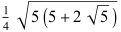
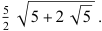
The area of the first few regular  -gon with unit edge lengths are
 |  |  |
(16)
|
 |  |  |
(17)
|
 |  |  |
(18)
|
 |  |  |
(19)
|
 |  |  |
(20)
|
 |  |  |
(21)
|
 |  |  |
(22)
|
 |  |  |
(23)
|
The algebraic degrees of these for  , 4, ... are 2, 1, 4, 2, 6, 2, 6, 4, 10, 2, 12, 6, 8, 4,
16, 6, 18, 4, ... (OEIS A089929).
, 4, ... are 2, 1, 4, 2, 6, 2, 6, 4, 10, 2, 12, 6, 8, 4,
16, 6, 18, 4, ... (OEIS A089929).
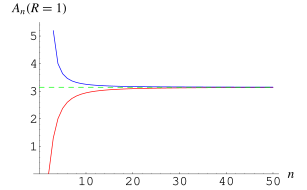
The plot above shows how the areas of the regular  -gons with unit inradius (blue) and unit circumradius (red)
approach that of a unit disk (i.e.,
-gons with unit inradius (blue) and unit circumradius (red)
approach that of a unit disk (i.e.,  ).
).
If  and
and  are the perimeters of the regular polygons inscribed
in and circumscribed around a given circle and
are the perimeters of the regular polygons inscribed
in and circumscribed around a given circle and  and
and  their areas, then
 |  |  |
(24)
|
 |  |  |
(25)
|
and
 |  |  |
(26)
|
 |  |  |
(27)
|
(Beyer 1987, p. 125).
The sum of interior angles in any  -gon is given by
  radians, or
 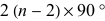 (Zwillinger 1995, p. 270).
The following table gives parameters for the first few regular polygons of unit edge length  ,
where
,
where  is the interior (vertex) angle,
  is the exterior angle,
 is the inradius,
 is the circumradius,
and
is the circumradius,
and  is the area (Williams 1979, p. 33).
| polygon |  |  |  |  |  |  |
| equilateral triangle |  |  |  |  |  |  |
| square |  |  |  |  |  | 1 |
| pentagon |  |  |  | 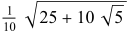 | 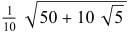 | 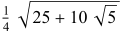 |
| hexagon |  |  |  |  | 1 |  |
| heptagon |  |  |  |  |  |  |
| octagon |  |  |  |  | 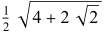 |  |
| nonagon |  |  |  |  |  |  |
| decagon |  |  |  | 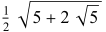 |  | 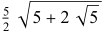 |
| hendecagon |  |  |  |  |  |  |
| dodecagon |  |  |  |  | 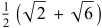 |  |
| tridecagon |  |  |  |  |  |  |
| tetradecagon |  |  |  |  |  |  |
Only some of the regular polygons can be built by geometric construction using a compass and straightedge. The numbers of sides for which regular polygons are constructible are those having central angles corresponding to so-called trigonometry angles.
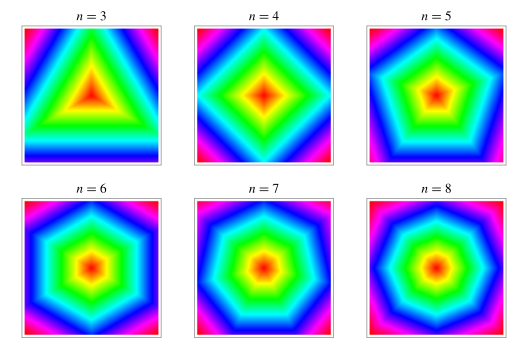
It is possible to construct relatively simple two-dimensional functions  that have the symmetry of a regular
  -gon (i.e., whose level curves
are regular
-gon (i.e., whose level curves
are regular  -gons).
Examples, illustrated above, include
-gons).
Examples, illustrated above, include
 |  |  |
(28)
|
 |  |  |
(29)
|
 |  |  |
(30)
|
 |  |  |
(31)
|
See also
257-gon, 65537-gon, Apeirogon, Bill Picture, Chaos Game, Constructible Polygon, de Moivre Number, Equilateral Triangle, Heptadecagon, Hexagon, Hexagram, Octagon, Pentagon, Pentagram, Polygon, Polygon Circumscribing, Polygon Inscribing, Regular Polygon Division by Diagonals, Square, Star Polygon, Trigonometry Angles Explore this topic in the MathWorld classroomExplore with Wolfram|Alpha

References
Beyer, W. H. CRC Standard Mathematical Tables, 28th ed. Boca Raton, FL: CRC Press, 1987.Bishop, W. "How to Construct a Regular Polygon." Amer. Math. Monthly 85, 186-188, 1978.Conway, J. H. and Guy, R. K. The Book of Numbers. New York: Springer-Verlag, pp. 140 and 197-202, 1996.Courant, R. and Robbins, H. "Regular Polygons." §3.2 in What Is Mathematics?: An Elementary Approach to Ideas and Methods, 2nd ed. Oxford, England: Oxford University Press, pp. 122-125, 1996.Coxeter, H. S. M. Introduction to Geometry, 2nd ed. New York: Wiley, 1969.DeTemple, D. W. "Carlyle Circles and the Lemoine Simplicity of Polygonal Constructions." Amer. Math. Monthly 98, 97-108, 1991.Dickson, L. E. "Constructions with Ruler and Compasses; Regular Polygons." Ch. 8 in Monographs on Topics of Modern Mathematics Relevant to the Elementary Field (Ed. J. W. A. Young). New York: Dover, pp. 352-386, 1955.Gardner, M. Mathematical Carnival: A New Round-Up of Tantalizers and Puzzles from Scientific American. New York: Vintage Books, p. 207, 1977.Gauss, C. F. §365 and 366 in Disquisitiones Arithmeticae. Leipzig, Germany, 1801. Translated by A. A. Clarke. New Haven, CT: Yale University Press, 1965.Harris, J. W. and Stocker, H. "Regular -gons
(Polygons)." §3.7 in Handbook
of Mathematics and Computational Science. New York: Springer-Verlag, pp. 86-89,
1998.Math Forum. "Naming Polygons and Polyhedra." https://web.archive.org/web/20080516214558/http://mathforum.org/dr.math/faq/faq.polygon.names.html.Rawles,
B. Sacred
Geometry Design Sourcebook: Universal Dimensional Patterns. Nevada City,
CA: Elysian Pub., p. 238, 1997.Richmond, H. W. "A Construction
for a Regular Polygon of Seventeen Sides." Quart. J. Pure Appl. Math. 26,
206-207, 1893.Roark, R. J. Formulas
for Stress and Strain, 3rd ed. New York: McGraw-Hill, 1954.Sloane,
N. J. A. Sequences A003401/M0505,
A004729, and A089929
in "The On-Line Encyclopedia of Integer Sequences."Smith,
D. E. A
Source Book in Mathematics. New York: Dover, p. 350, 1994.Tietze,
H. Ch. 9 in Famous
Problems of Mathematics. New York: Graylock Press, 1965.Wantzel,
M. L. "Recherches sur les moyens de reconnaître si un Problème
de Géométrie peut se résoudre avec la règle et le compas."
J. Math. pures appliq. 1, 366-372, 1836.Williams, R. "Polygons."
§2-1 in The
Geometrical Foundation of Natural Structure: A Source Book of Design. New
York: Dover, pp. 31-33, 1979.Zwillinger, D. (Ed.). CRC
Standard Mathematical Tables and Formulae. Boca Raton, FL: CRC Press, 1995.
-gons
(Polygons)." §3.7 in Handbook
of Mathematics and Computational Science. New York: Springer-Verlag, pp. 86-89,
1998.Math Forum. "Naming Polygons and Polyhedra." https://web.archive.org/web/20080516214558/http://mathforum.org/dr.math/faq/faq.polygon.names.html.Rawles,
B. Sacred
Geometry Design Sourcebook: Universal Dimensional Patterns. Nevada City,
CA: Elysian Pub., p. 238, 1997.Richmond, H. W. "A Construction
for a Regular Polygon of Seventeen Sides." Quart. J. Pure Appl. Math. 26,
206-207, 1893.Roark, R. J. Formulas
for Stress and Strain, 3rd ed. New York: McGraw-Hill, 1954.Sloane,
N. J. A. Sequences A003401/M0505,
A004729, and A089929
in "The On-Line Encyclopedia of Integer Sequences."Smith,
D. E. A
Source Book in Mathematics. New York: Dover, p. 350, 1994.Tietze,
H. Ch. 9 in Famous
Problems of Mathematics. New York: Graylock Press, 1965.Wantzel,
M. L. "Recherches sur les moyens de reconnaître si un Problème
de Géométrie peut se résoudre avec la règle et le compas."
J. Math. pures appliq. 1, 366-372, 1836.Williams, R. "Polygons."
§2-1 in The
Geometrical Foundation of Natural Structure: A Source Book of Design. New
York: Dover, pp. 31-33, 1979.Zwillinger, D. (Ed.). CRC
Standard Mathematical Tables and Formulae. Boca Raton, FL: CRC Press, 1995.Referenced on Wolfram|Alpha
Regular PolygonCite this as:
Weisstein, Eric W. "Regular Polygon." From MathWorld--A Wolfram Resource. https://mathworld.wolfram.com/RegularPolygon.html