 TOPICS

Rectilinear Crossing Number

The rectilinear crossing number of a graph  is the minimum number of crossings in a straight
line embedding of
is the minimum number of crossings in a straight
line embedding of  in a plane. It is variously denoted
  ,
,  (Schaefer 2017),
  ,
,  , or
, or  (Pach and Tóth 2000).
It is sometimes claimed that the rectilinear crossing number is also known as the linear or geometric(al) crossing number, but evidence for that is slim (Schafer 2017).
A disconnected graph has a rectilinear crossing number equal to the sums of the rectilinear crossing numbers of its connected components.
When the (non-rectilinear) graph crossing number satisfies  ,
,
 |
(1)
|
(Bienstock and Dean 1993). While Bienstock and Dean don't actually prove equality for the case  ,
they state it can be established analogously to
,
they state it can be established analogously to  . The result cannot be extended to
  , since there exist graphs
  with
with  but
but  for any
  (Bienstock and Dean 1993; Schaefer 2017, p. 54).
G. Exoo (pers. comm., May 11-12, 2019) has written a program which can compute rectilinear crossing numbers for cubic graphs up to around 20 vertices and up to 11 or 12 vertices for arbitrary simple graphs.
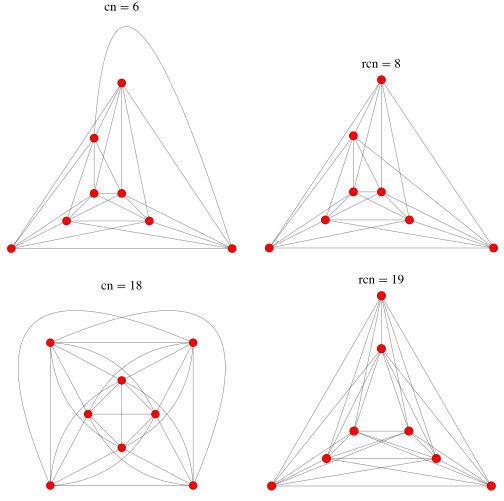
The smallest simple graphs for which  occur on 8 nodes. The four such examples are
summarized in the following table. Minimal crossing and rectilinear crossing embeddings
for the 16-cell graph and complete
graph
occur on 8 nodes. The four such examples are
summarized in the following table. Minimal crossing and rectilinear crossing embeddings
for the 16-cell graph and complete
graph  (Harary and Hill 1962-1963) are illustrated above.
| graph |  |  |
16-cell
graph  | 6 | 8 |
 -Turán graph -Turán graph | 9 | 10 |
| 8-double toroidal graph 8 | 9 | 10 |
complete
graph  | 18 | 19 |
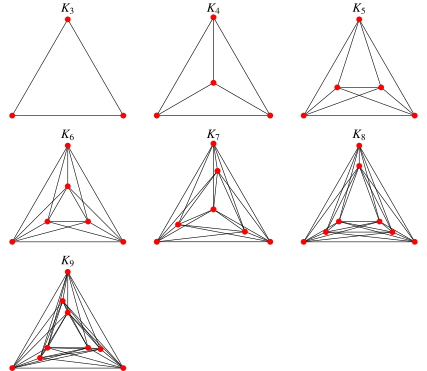
For a complete graph  of order
  , the rectilinear crossing number is always larger than
the general graph crossing number. Embeddings with minimal rectilinear crossing numbers
are illustrated above for
, the rectilinear crossing number is always larger than
the general graph crossing number. Embeddings with minimal rectilinear crossing numbers
are illustrated above for  to 9 (Read and Wilson 1998, pp. 282-283, with the erroneous
embedding for
to 9 (Read and Wilson 1998, pp. 282-283, with the erroneous
embedding for  corrected).
For the complete graph  with
with  , 2, ...,
  is 0, 0, 0, 0, 1, 3, 9, 19, 36, 62, 102, 153, 229,
324, 447, 603, 798, 1029, 1318, 1657, 2055, 2528, 3077, 3699, 4430, 5250, 6180, ...
(OEIS A014540; White and Beineke 1978, Scheinerman
and Wilf 1994, Ábrego et al. 2008). Although it had long been known
that
is 0, 0, 0, 0, 1, 3, 9, 19, 36, 62, 102, 153, 229,
324, 447, 603, 798, 1029, 1318, 1657, 2055, 2528, 3077, 3699, 4430, 5250, 6180, ...
(OEIS A014540; White and Beineke 1978, Scheinerman
and Wilf 1994, Ábrego et al. 2008). Although it had long been known
that  was either 61 or 62 (Singer 1971, Gardner 1986), it was finally proven to be 62 by
Brodsky et al. (2000, 2001). The case
was either 61 or 62 (Singer 1971, Gardner 1986), it was finally proven to be 62 by
Brodsky et al. (2000, 2001). The case  was settled in 2004, and found to be 102. The Rectilinear
Crossing Number Project (http://www.ist.tugraz.at/staff/aichholzer/crossings.html)
has found all values for
was settled in 2004, and found to be 102. The Rectilinear
Crossing Number Project (http://www.ist.tugraz.at/staff/aichholzer/crossings.html)
has found all values for  , 20, and 22 through 27. At the moment, the smallest value
remaining unsettled is
, 20, and 22 through 27. At the moment, the smallest value
remaining unsettled is  , which has value either 7233 or 7234.
Upper limits have been provided by Singer (1971), who showed that
 |
(2)
|
and Jensen (1971), who showed that
 |
(3)
|
The best known bounds are given by
 |
(4)
|
where  .
The upper bound is due to Aichholzer et al. (2002) and the lower bound to
Lovász et al. (2004). A slightly weaker bound of
.
The upper bound is due to Aichholzer et al. (2002) and the lower bound to
Lovász et al. (2004). A slightly weaker bound of  was independently proved by Ábrego and Fernández-Merchand
(2003). The small
was independently proved by Ábrego and Fernández-Merchand
(2003). The small  term in the lower bound is significant because it shows
that the crossing number and the rectilinear crossing number of complete graphs differ
in the leading term. In particular, it is known that there are non-rectilinear embeddings
of
term in the lower bound is significant because it shows
that the crossing number and the rectilinear crossing number of complete graphs differ
in the leading term. In particular, it is known that there are non-rectilinear embeddings
of  with
with  crossings (Moon 1965, Guy 1967).
Letting
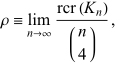 |
(5)
|
the best bounds known are
 |
(6)
|
where  is a binomial coefficient and the exact value
of
is a binomial coefficient and the exact value
of  is not known (Finch 2003).
The rectilinear crossing number has an unexpected connection with Sylvester's four-point problem (Finch 2003).
See also
Graph Crossing Number, Planar Straight Line Embedding, Projective Plane Crossing Number, Sylvester's Four-Point Problem, Toroidal Crossing NumberPortions of this entry contributed by Uli Wagner
Explore with Wolfram|Alpha

References
Ábrego, B. M. and Fernández-Merchant, S. "A Lower Bound for the Rectilinear Crossing Number." Graphs and Comb. 21, 293-300, 2005.Ábrego, B. M.; Fernández-Merchant, S.; and Salazar, G. "the Maximum Number of Halving Lines and the Rectilinear Crossing Number of for
for  ." Elect. Notes Discr. Math 30, 261-266,
2008.Aichholzer, O. "On the Rectilinear Crossing Number."
http://www.ist.tugraz.at/staff/aichholzer/research/rp/triangulations/crossing/.Aichholzer,
O.; Aurenhammer, F.; and Krasser, H. "On the Crossing Number of Complete Graphs."
In Proc. 18th Ann. ACM Symp. Comp. Geom., Barcelona, Spain, pp. 19-24,
2002.Bienstock, D. and Dean, N. "New Results on Rectilinear Crossing
Numbers and Plane Embeddings." J. Graph Th. 16, 389-398, 1992.Bienstock,
D. and Dean, N. "Bounds for Rectilinear Crossing Numbers." J. Graph
Th. 17, 333-348, 1993.Brodsky, A.; Durocher, S.; and Gethner,
E. "The Rectilinear Crossing Number of
." Elect. Notes Discr. Math 30, 261-266,
2008.Aichholzer, O. "On the Rectilinear Crossing Number."
http://www.ist.tugraz.at/staff/aichholzer/research/rp/triangulations/crossing/.Aichholzer,
O.; Aurenhammer, F.; and Krasser, H. "On the Crossing Number of Complete Graphs."
In Proc. 18th Ann. ACM Symp. Comp. Geom., Barcelona, Spain, pp. 19-24,
2002.Bienstock, D. and Dean, N. "New Results on Rectilinear Crossing
Numbers and Plane Embeddings." J. Graph Th. 16, 389-398, 1992.Bienstock,
D. and Dean, N. "Bounds for Rectilinear Crossing Numbers." J. Graph
Th. 17, 333-348, 1993.Brodsky, A.; Durocher, S.; and Gethner,
E. "The Rectilinear Crossing Number of  is 62." 22 Sep 2000. https://arxiv.org/abs/cs/0009023.Brodsky,
A.; Durocher, S.; and Gethner, E. "The Rectilinear Crossing Number of
is 62." 22 Sep 2000. https://arxiv.org/abs/cs/0009023.Brodsky,
A.; Durocher, S.; and Gethner, E. "The Rectilinear Crossing Number of  is 62." Elec. J. Combin. 8, No. 1,
R23, 1-30, 2001. https://doi.org/10.37236/1567.Brodsky,
A.; Durocher, S.; and Gethner, E. "Toward the Rectilinear Crossing Number of
is 62." Elec. J. Combin. 8, No. 1,
R23, 1-30, 2001. https://doi.org/10.37236/1567.Brodsky,
A.; Durocher, S.; and Gethner, E. "Toward the Rectilinear Crossing Number of
 :
New Drawings, Upper Bounds, and Asymptotics." http://www.cs.ubc.ca/spider/abrodsky/papers/reccr_n.ps.gz.Finch,
S. R. "Rectilinear Crossing Constant." §8.18 in Mathematical
Constants. Cambridge, England: Cambridge University Press, pp. 532-534,
2003.Gardner, M. Knotted
Doughnuts and Other Mathematical Entertainments. New York: W. H. Freeman,
1986.Guy, R. K. "A Combinatorial Problem." NABLA (Bull.
Malayan Math. Soc.) 7, 68-72, 1967.Guy, R. K. "Crossing
Numbers of Graphs." In Graph
Theory and Applications: Proceedings of the Conference at Western Michigan University,
Kalamazoo, Mich., May 10-13, 1972 (Ed. Y. Alavi, D. R. Lick,
and A. T. White). New York: Springer-Verlag, pp. 111-124, 1972.Harary,
F. and Hill, A. "On the Number of Crossings in a Complete Graph." Proc.
Edinburgh Math. Soc. 13, 333-338, 1962/1963.Harary, F. and
Palmer, E. M. "A Survey of Graph Enumeration Problems." In A Survey
of Combinatorial Theory (Ed. J. N. Srivastava). Amsterdam, Netherlands:
North-Holland, pp. 259-275, 1973.Jensen, H. F. "An Upper
Bound for the Rectilinear Crossing Number of the Complete Graph." J. Combin.
Th. B 10, 212-216, 1971.Klee, V. "What is the Expected
Volume of a Simplex Whose Vertices are Chosen at Random from a Given Convex Body."
Amer. Math. Monthly 76, 286-288, 1969.Lovász, L.;
Vesztergombi, K.; Wagner, U.; and Welzl, E. "Convex Quadrilaterals and
:
New Drawings, Upper Bounds, and Asymptotics." http://www.cs.ubc.ca/spider/abrodsky/papers/reccr_n.ps.gz.Finch,
S. R. "Rectilinear Crossing Constant." §8.18 in Mathematical
Constants. Cambridge, England: Cambridge University Press, pp. 532-534,
2003.Gardner, M. Knotted
Doughnuts and Other Mathematical Entertainments. New York: W. H. Freeman,
1986.Guy, R. K. "A Combinatorial Problem." NABLA (Bull.
Malayan Math. Soc.) 7, 68-72, 1967.Guy, R. K. "Crossing
Numbers of Graphs." In Graph
Theory and Applications: Proceedings of the Conference at Western Michigan University,
Kalamazoo, Mich., May 10-13, 1972 (Ed. Y. Alavi, D. R. Lick,
and A. T. White). New York: Springer-Verlag, pp. 111-124, 1972.Harary,
F. and Hill, A. "On the Number of Crossings in a Complete Graph." Proc.
Edinburgh Math. Soc. 13, 333-338, 1962/1963.Harary, F. and
Palmer, E. M. "A Survey of Graph Enumeration Problems." In A Survey
of Combinatorial Theory (Ed. J. N. Srivastava). Amsterdam, Netherlands:
North-Holland, pp. 259-275, 1973.Jensen, H. F. "An Upper
Bound for the Rectilinear Crossing Number of the Complete Graph." J. Combin.
Th. B 10, 212-216, 1971.Klee, V. "What is the Expected
Volume of a Simplex Whose Vertices are Chosen at Random from a Given Convex Body."
Amer. Math. Monthly 76, 286-288, 1969.Lovász, L.;
Vesztergombi, K.; Wagner, U.; and Welzl, E. "Convex Quadrilaterals and  -Sets."
In Towards a Theory of Crossing Numbers (Ed. J. Pach). Providence, RI:
Amer. Math. Soc., pp. 139-148, 2004.Moon, J. "On the Distribution
of Crossings in Random Complete Graphs." J. Soc. Indust. Appl. Math. 13,
506-510, 1965.Pach, J. and Tóth, G., "Which Crossing Number
Is It Anyway?" J. Combin. Theory Ser. B 80, 225-246, 2000.Read,
R. C. and Wilson, R. J. An
Atlas of Graphs. Oxford, England: Oxford University Press, 1998.Rectilinear
Crossing Number Project. http://dist.ist.tugraz.at/cape5/.Schaefer,
M. "The Graph Crossing Number and its Variants: A Survey." Elec. J.
Combin., DS21, Version 3, Dec. 22, 2017.Schaefer, M. Crossing
Numbers of Graphs. Boca Raton, FL: CRC Press, 2018.Scheinerman,
E. and Wilf, H. S. "The Rectilinear Crossing Number of a Complete Graph
and Sylvester's 'Four Point' Problem of Geometric Probability." Amer. Math.
Monthly 101, 939-943, 1994.Singer, D. "The Rectilinear
Crossing Number of Certain Graphs." Unpublished manuscript, 1971. Quoted in
Gardner, M. Knotted
Doughnuts and Other Mathematical Entertainments. New York: W. H. Freeman,
1986.Sloane, N. J. A. Sequence A014540
in "The On-Line Encyclopedia of Integer Sequences."White,
A. T. and Beineke, L. W. "Topological Graph Theory." In Selected
Topics in Graph Theory (Ed. L. W. Beineke and R. J. Wilson).
New York: Academic Press, pp. 15-49, 1978.Wilf, H. "On Crossing
Numbers, and Some Unsolved Problems." In Combinatorics,
Geometry, and Probability: A Tribute to Paul Erdős. Papers from the Conference
in Honor of Erdős' 80th Birthday Held at Trinity College, Cambridge, March 1993
(Ed. B. Bollobás and A. Thomason). Cambridge, England: Cambridge
University Press, pp. 557-562, 1997.
-Sets."
In Towards a Theory of Crossing Numbers (Ed. J. Pach). Providence, RI:
Amer. Math. Soc., pp. 139-148, 2004.Moon, J. "On the Distribution
of Crossings in Random Complete Graphs." J. Soc. Indust. Appl. Math. 13,
506-510, 1965.Pach, J. and Tóth, G., "Which Crossing Number
Is It Anyway?" J. Combin. Theory Ser. B 80, 225-246, 2000.Read,
R. C. and Wilson, R. J. An
Atlas of Graphs. Oxford, England: Oxford University Press, 1998.Rectilinear
Crossing Number Project. http://dist.ist.tugraz.at/cape5/.Schaefer,
M. "The Graph Crossing Number and its Variants: A Survey." Elec. J.
Combin., DS21, Version 3, Dec. 22, 2017.Schaefer, M. Crossing
Numbers of Graphs. Boca Raton, FL: CRC Press, 2018.Scheinerman,
E. and Wilf, H. S. "The Rectilinear Crossing Number of a Complete Graph
and Sylvester's 'Four Point' Problem of Geometric Probability." Amer. Math.
Monthly 101, 939-943, 1994.Singer, D. "The Rectilinear
Crossing Number of Certain Graphs." Unpublished manuscript, 1971. Quoted in
Gardner, M. Knotted
Doughnuts and Other Mathematical Entertainments. New York: W. H. Freeman,
1986.Sloane, N. J. A. Sequence A014540
in "The On-Line Encyclopedia of Integer Sequences."White,
A. T. and Beineke, L. W. "Topological Graph Theory." In Selected
Topics in Graph Theory (Ed. L. W. Beineke and R. J. Wilson).
New York: Academic Press, pp. 15-49, 1978.Wilf, H. "On Crossing
Numbers, and Some Unsolved Problems." In Combinatorics,
Geometry, and Probability: A Tribute to Paul Erdős. Papers from the Conference
in Honor of Erdős' 80th Birthday Held at Trinity College, Cambridge, March 1993
(Ed. B. Bollobás and A. Thomason). Cambridge, England: Cambridge
University Press, pp. 557-562, 1997.Referenced on Wolfram|Alpha
Rectilinear Crossing NumberCite this as:
Wagner, Uli and Weisstein, Eric W. "Rectilinear Crossing Number." From MathWorld--A Wolfram Resource. https://mathworld.wolfram.com/RectilinearCrossingNumber.html