 TOPICS

Power Tower

The power tower of order  is defined as
 |
(1)
|
where  is Knuth
up-arrow notation (Knuth 1976), which in turn is defined by
is Knuth
up-arrow notation (Knuth 1976), which in turn is defined by
![a^^nk=a^^(n-1)[a^^n(k-1)]](https://mathworld.wolfram.com/images/equations/PowerTower/NumberedEquation2.svg) |
(2)
|
together with
 |  |  |
(3)
|
 |  |  |
(4)
|
Rucker (1995, p. 74) uses the notation
 |
(5)
|
and refers to this operation as "tetration."
A power tower can be implemented in the Wolfram Language as
PowerTower[a_, k_Integer] := Nest[Power[a, #]&, 1, k]
or
PowerTower[a_, k_Integer] := Power @@ Table[a, {k}]
The following table gives values of  for
for  , 2, ... for small
  .
.
 | OEIS |  |
| 1 | A000027 | 1, 2, 3, 4, 5, 6, 7, 8, 9, 10, ... |
| 2 | A000312 | 1, 4, 27, 256, 3125, 46656, ... |
| 3 | A002488 | 1, 16, 7625597484987, ... |
| 4 | 1, 65536, ... |
The following table gives  for
for  , 2, ... for small
  .
.
 | OEIS |  |
| 1 | A000012 | 1, 1, 1, 1, 1, 1, ... |
| 2 | A014221 | 2,
4, 16, 65536, 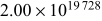 ,
... ,
... |
| 3 | A014222 | 3, 27, 7625597484987, ... |
| 4 | 4, 256,  , ... , ... |
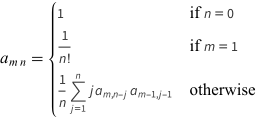
Consider  and let
  be defined as
 |
(6)
|
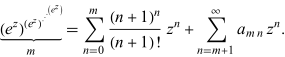
(Galidakis 2004). Then for  ,
,
 is entire with series expansion:
 |
(7)
|
Similarly, for  ,
,
 is analytic for
  in the domain of the principal branch of
  , with series expansion:
 |
(8)
|
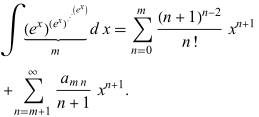
For  , and
, and  ,
,
 |
(9)
|
For  , and
, and  , and
, and 
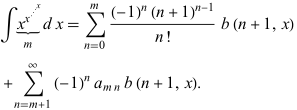 |
(10)
|
The value of the infinite power tower 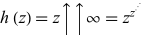 , where
  is an abbreviation for
  , can be computed analytically by writing
 |
(11)
|
taking the logarithm of both sides and plugging back in to obtain
![z^(z^(·^(·^·)))lnz=h(z)lnz=ln[h(z)].](https://mathworld.wolfram.com/images/equations/PowerTower/NumberedEquation10.svg) |
(12)
|
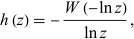
Solving for  gives
gives
 |
(13)
|
where  is the Lambert W-function (Corless et al.
1996).
is the Lambert W-function (Corless et al.
1996).  converges iff
  (
( ; OEIS A073230
and A073229), as shown by Euler (1783) and
Eisenstein (1844) (Le Lionnais 1983; Wells 1986, p. 35).
; OEIS A073230
and A073229), as shown by Euler (1783) and
Eisenstein (1844) (Le Lionnais 1983; Wells 1986, p. 35).
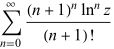
Knoebel (1981) gave the following series for 
 |  |  |
(14)
|
 |  |  |
(15)
|
(Vardi 1991).
The special value  is given by
 |  |  |
(16)
|
 |  |  |
(17)
|
 |  |  |
(18)
|
(OEIS A077589 and A077590; Macintyre 1966).
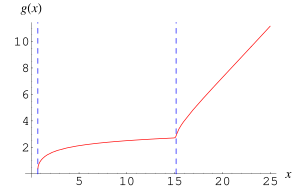
The related function
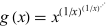 |
(19)
|
converges only for  ,
that is,
,
that is,  (OEIS A072364). The value it converges to is
the inverse of
(OEIS A072364). The value it converges to is
the inverse of  which can be found by taking the logarithm of both sides of (19),
 |
(20)
|
rearranging to
 |
(21)
|
and then substituting to obtain
 |
(22)
|
Solving the resulting equation for  then gives the partial solution
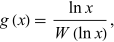 |
(23)
|
which is valid for  (i.e.,
  ;
OEIS A072364 and A073226).
Taking
;
OEIS A072364 and A073226).
Taking  then gives
  ,
where
,
where  is the omega constant.
A continued fraction due to Khovanskii (1963) for the single iteration of  is given by
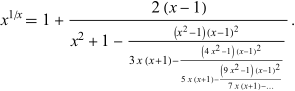 |
(24)
|
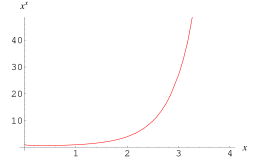
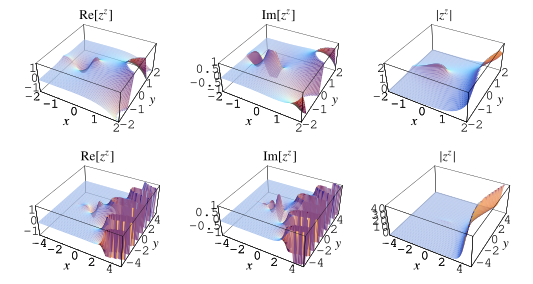
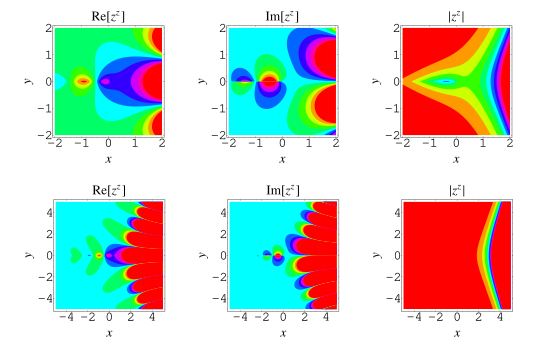
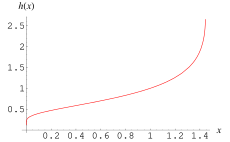
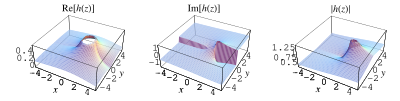
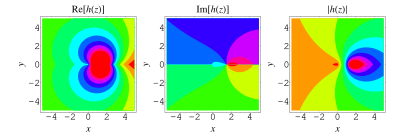
The function  is plotted above along the real line and in the complex plane. It has series
expansion
is plotted above along the real line and in the complex plane. It has series
expansion
 |
(25)
|
(Trott 2004, p. 59). It has a minimum where
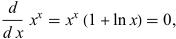 |
(26)
|
which has solution  .
At this point, the function takes on the value
.
At this point, the function takes on the value  .
.
 |
(27)
|
cannot be expressed in terms of a finite number of elementary functions, but some interesting definite integrals
of  are
are
 |  |  |
(28)
|
 |  |  |
(29)
|
 |  |  |
(30)
|
 |  |  |
(31)
|
(OEIS A083648 and A073009; Spiegel 1968; Abramowitz and Stegun 1972; Havil 2003, pp. 44-45; Borwein et al. 2004, p. 5). Borwein et al. (2004, pp. 5 and 44) call these two integrals "a sophomore's dream."
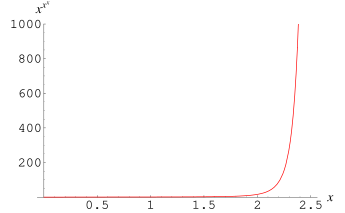
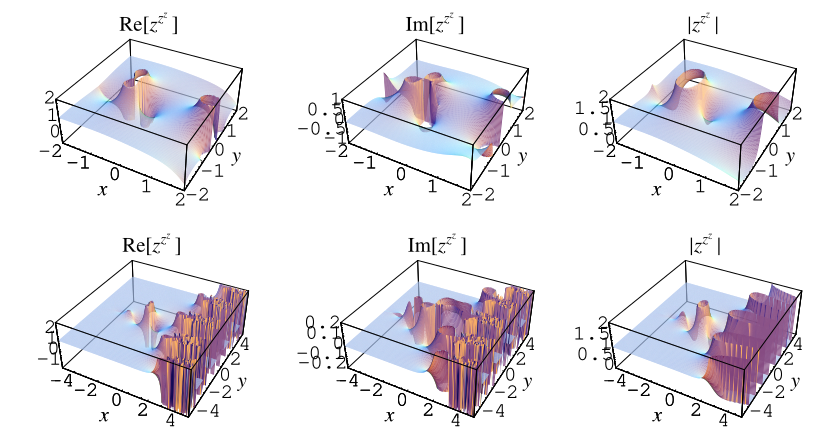
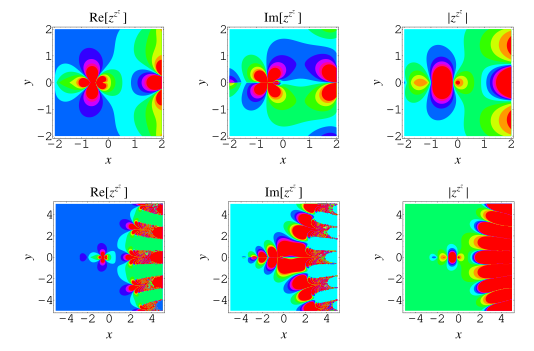
The function  is plotted above along the real line and in the complex plane, where it shows beautiful
structure.
is plotted above along the real line and in the complex plane, where it shows beautiful
structure.
See also
Ackermann Function, Exponential Factorial, Exponential Function, Fermat Number, Joyce Sequence, Knuth Up-Arrow Notation, Lambert W-Function, Mills' Constant, MRB Constant, Nested Radical, Omega Constant, Power, Sophomore's Dream, Steiner's ProblemPortions of this entry contributed by Ioannis Galidakis
Explore with Wolfram|Alpha

References
Abramowitz, M. and Stegun, I. A. (Eds.). Handbook of Mathematical Functions with Formulas, Graphs, and Mathematical Tables, 9th printing. New York: Dover, 1972.Ash, J. M. "The Limit of as
as  Tends to Infinity." Math. Mag. 69, 207-209,
1996.Baker, I. N. and Rippon, P. J. "Convergence of Infinite
Exponentials." Ann. Acad. Sci. Fennicæ Ser. A. I. Math. 8,
179-186, 1983.Baker, I. N. and Rippon, P. J. "Iteration
of Exponential Functions." Ann. Acad. Sci. Fennicæ Ser. A. I. Math. 9,
49-77, 1984.Baker, I. N. and Rippon, P. J. "A Note on
Complex Iteration." Amer. Math. Monthly 92, 501-504, 1985.Barrow,
D. F. "Infinite Exponentials." Amer. Math. Monthly 43,
150-160, 1936.Borwein, J.; Bailey, D.; and Girgensohn, R. Experimentation
in Mathematics: Computational Paths to Discovery. Wellesley, MA: A K Peters,
pp. 61-62, 2004.Corless, R. M.; Gonnet, G. H.; Hare,
D. E. G.; Jeffrey, D. J.; and Knuth, D. E. "On the Lambert
Tends to Infinity." Math. Mag. 69, 207-209,
1996.Baker, I. N. and Rippon, P. J. "Convergence of Infinite
Exponentials." Ann. Acad. Sci. Fennicæ Ser. A. I. Math. 8,
179-186, 1983.Baker, I. N. and Rippon, P. J. "Iteration
of Exponential Functions." Ann. Acad. Sci. Fennicæ Ser. A. I. Math. 9,
49-77, 1984.Baker, I. N. and Rippon, P. J. "A Note on
Complex Iteration." Amer. Math. Monthly 92, 501-504, 1985.Barrow,
D. F. "Infinite Exponentials." Amer. Math. Monthly 43,
150-160, 1936.Borwein, J.; Bailey, D.; and Girgensohn, R. Experimentation
in Mathematics: Computational Paths to Discovery. Wellesley, MA: A K Peters,
pp. 61-62, 2004.Corless, R. M.; Gonnet, G. H.; Hare,
D. E. G.; Jeffrey, D. J.; and Knuth, D. E. "On the Lambert
 Function." Adv. Comput. Math. 5,
329-359, 1996.Creutz, M. and Sternheimer, R. M. "On the Convergence
of Iterated Exponentiation, Part I." Fib. Quart. 18, 341-347,
1980.Creutz, M. and Sternheimer, R. M. "On the Convergence
of Iterated Exponentiation, Part II." Fib. Quart. 19, 326-335,
1981.de Villiers, J. M. and Robinson, P. N. "The Interval
of Convergence and Limiting Functions of a Hyperpower Sequence." Amer. Math.
Monthly 93, 13-23, 1986.Eisenstein, G. "Entwicklung
von
Function." Adv. Comput. Math. 5,
329-359, 1996.Creutz, M. and Sternheimer, R. M. "On the Convergence
of Iterated Exponentiation, Part I." Fib. Quart. 18, 341-347,
1980.Creutz, M. and Sternheimer, R. M. "On the Convergence
of Iterated Exponentiation, Part II." Fib. Quart. 19, 326-335,
1981.de Villiers, J. M. and Robinson, P. N. "The Interval
of Convergence and Limiting Functions of a Hyperpower Sequence." Amer. Math.
Monthly 93, 13-23, 1986.Eisenstein, G. "Entwicklung
von  ." J.
reine angew. Math. 28, 49-52, 1844.Elstrodt, J. "Iterierte
Potenzen." Math. Semesterber. 41, 167-178, 1994.Euler,
L. "De serie Lambertina Plurimisque eius insignibus proprietatibus." Acta
Acad. Scient. Petropol. 2, 29-51, 1783. Reprinted in Euler, L. Opera
Omnia, Series Prima, Vol. 6: Commentationes Algebraicae. pp. 350-369.Finch,
S. R. "Iterated Exponential Constants." §6.11 in Mathematical
Constants. Cambridge, England: Cambridge University Press, pp. 448-452,
2003.Galidakis, I. N. "On An Application of Lambert's
." J.
reine angew. Math. 28, 49-52, 1844.Elstrodt, J. "Iterierte
Potenzen." Math. Semesterber. 41, 167-178, 1994.Euler,
L. "De serie Lambertina Plurimisque eius insignibus proprietatibus." Acta
Acad. Scient. Petropol. 2, 29-51, 1783. Reprinted in Euler, L. Opera
Omnia, Series Prima, Vol. 6: Commentationes Algebraicae. pp. 350-369.Finch,
S. R. "Iterated Exponential Constants." §6.11 in Mathematical
Constants. Cambridge, England: Cambridge University Press, pp. 448-452,
2003.Galidakis, I. N. "On An Application of Lambert's  Function to Infinite Exponentials."
Complex Variables Th. Appl. 49, 759-780, 2004.Ginsburg,
J. "Iterated Exponentials." Scripta Math. 11, 340-353, 1945.Havil,
J. Gamma:
Exploring Euler's Constant. Princeton, NJ: Princeton University Press, 2003.Khovanskii,
A. N. The
Application of Continued Fractions and Their Generalizations to Problems in Approximation
Theory. Groningen, Netherlands: P. Noordhoff, 1963.Knoebel,
R. A. "Exponentials Reiterated." Amer. Math. Monthly 88,
235-252, 1981.Knuth, D. E. "Mathematics and Computer Science:
Coping with Finiteness. Advances in our Ability to Compute are Bringing us Substantially
Closer to Ultimate Limitations." Science 194, 1235-1242, 1976.Länger,
H. "An Elementary Proof of the Convergence of Iterated Exponentials." Elem.
Math. 51, 75-77, 1996.Le Lionnais, F. Les
nombres remarquables. Paris, France: Hermann, pp. 22 and 39, 1983.Macdonnell,
J. "Some Critical Points on the Hyperpower Function
Function to Infinite Exponentials."
Complex Variables Th. Appl. 49, 759-780, 2004.Ginsburg,
J. "Iterated Exponentials." Scripta Math. 11, 340-353, 1945.Havil,
J. Gamma:
Exploring Euler's Constant. Princeton, NJ: Princeton University Press, 2003.Khovanskii,
A. N. The
Application of Continued Fractions and Their Generalizations to Problems in Approximation
Theory. Groningen, Netherlands: P. Noordhoff, 1963.Knoebel,
R. A. "Exponentials Reiterated." Amer. Math. Monthly 88,
235-252, 1981.Knuth, D. E. "Mathematics and Computer Science:
Coping with Finiteness. Advances in our Ability to Compute are Bringing us Substantially
Closer to Ultimate Limitations." Science 194, 1235-1242, 1976.Länger,
H. "An Elementary Proof of the Convergence of Iterated Exponentials." Elem.
Math. 51, 75-77, 1996.Le Lionnais, F. Les
nombres remarquables. Paris, France: Hermann, pp. 22 and 39, 1983.Macdonnell,
J. "Some Critical Points on the Hyperpower Function  ." Int. J. Math.
Educ. Sci. Technol. 20, 297-305, 1989.Macintyre, A. J.
"Convergence of
." Int. J. Math.
Educ. Sci. Technol. 20, 297-305, 1989.Macintyre, A. J.
"Convergence of  ."
Proc. Amer. Math. Soc. 17, 67, 1966.Mauerer, H. "Über
die Funktion
."
Proc. Amer. Math. Soc. 17, 67, 1966.Mauerer, H. "Über
die Funktion  für ganzzahliges Argument (Abundanzen)." Mitt. Math. Gesell. Hamburg 4,
33-50, 1901.Meyerson, M. D. "The
für ganzzahliges Argument (Abundanzen)." Mitt. Math. Gesell. Hamburg 4,
33-50, 1901.Meyerson, M. D. "The  Spindle." Math. Mag. 69, 198-206, 1996.Rippon,
P. J. "Infinite Exponentials." Math. Gaz. 67, 189-196,
1983.Rucker, R. Infinity
and the Mind: The Science and Philosophy of the Infinite. Princeton, NJ:
Princeton University Press, 1995.Sloane, N. J. A. Sequences
A072364, A073009,
A073226, A073229,
A073230, A077589,
A077590, and A083648
in "The On-Line Encyclopedia of Integer Sequences."Spiegel,
M. R. Mathematical
Handbook of Formulas and Tables. New York: McGraw-Hill, 1968.Trott,
M. The
Mathematica GuideBook for Programming. New York: Springer-Verlag, 2004. https://www.mathematicaguidebooks.org/.Vardi,
I. Computational
Recreations in Mathematica. Reading, MA: Addison-Wesley, pp. 11-12 and
226-229, 1991.Weber, R. O. and Roumeliotis, J. "
Spindle." Math. Mag. 69, 198-206, 1996.Rippon,
P. J. "Infinite Exponentials." Math. Gaz. 67, 189-196,
1983.Rucker, R. Infinity
and the Mind: The Science and Philosophy of the Infinite. Princeton, NJ:
Princeton University Press, 1995.Sloane, N. J. A. Sequences
A072364, A073009,
A073226, A073229,
A073230, A077589,
A077590, and A083648
in "The On-Line Encyclopedia of Integer Sequences."Spiegel,
M. R. Mathematical
Handbook of Formulas and Tables. New York: McGraw-Hill, 1968.Trott,
M. The
Mathematica GuideBook for Programming. New York: Springer-Verlag, 2004. https://www.mathematicaguidebooks.org/.Vardi,
I. Computational
Recreations in Mathematica. Reading, MA: Addison-Wesley, pp. 11-12 and
226-229, 1991.Weber, R. O. and Roumeliotis, J. " ^
^ ^
^ ^
^ ^...." Austral. Math. Soc. Gaz. 22, 182-184,
1995.Wells, D. The
Penguin Dictionary of Curious and Interesting Numbers. Middlesex, England:
Penguin Books, p. 35, 1986.
^...." Austral. Math. Soc. Gaz. 22, 182-184,
1995.Wells, D. The
Penguin Dictionary of Curious and Interesting Numbers. Middlesex, England:
Penguin Books, p. 35, 1986.Referenced on Wolfram|Alpha
Power TowerCite this as:
Galidakis, Ioannis and Weisstein, Eric W. "Power Tower." From MathWorld--A Wolfram Resource. https://mathworld.wolfram.com/PowerTower.html