 TOPICS

Natural Logarithm of 10 Continued Fraction

The continued fraction for  is [0; 1, 2, 3, 1, 6, 3, 1, 1, 2, 1, 1, 1, 1, 3, 10, ...]
(OEIS A016730).
is [0; 1, 2, 3, 1, 6, 3, 1, 1, 2, 1, 1, 1, 1, 3, 10, ...]
(OEIS A016730).
The Engel expansion is 2, 3, 7, 9, 104, 510, 1413, ... (OEIS A059180).
The incrementally largest terms in the continued fraction of  are 2, 3, 6, 26, 716, 774, 982, 1324, 4093, 10322, ...
(OEIS A228346), which occur at positions 0,
1, 7, 17, 30, 136, 962, 1163, 1261, 1293, ... (OEIS A228345).
are 2, 3, 6, 26, 716, 774, 982, 1324, 4093, 10322, ...
(OEIS A228346), which occur at positions 0,
1, 7, 17, 30, 136, 962, 1163, 1261, 1293, ... (OEIS A228345).
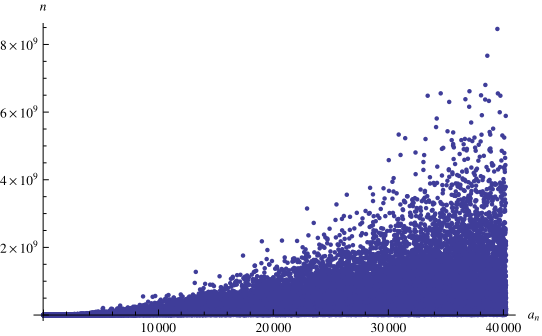
The plot above shows the positions of the first occurrences of 1, 2, 3, ... in the continued fraction, the first few of which are 4, 0, 1, 11, 18, 7, 44, 159, 74, 212,
260, 182, 43, 152, 59, 84, 40, 86, 27, 89, ... (OEIS A228270).
The smallest number not occurring in the first  terms of the continued fraction are 40230, 45952,
46178, 46530, ... (E. Weisstein, Aug. 18, 2013).
terms of the continued fraction are 40230, 45952,
46178, 46530, ... (E. Weisstein, Aug. 18, 2013).
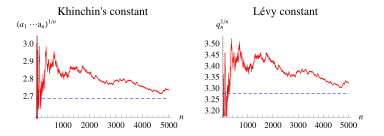
Let the continued fraction of  be denoted
 ![[a_0;a_1,a_2,...]](https://mathworld.wolfram.com/images/equations/NaturalLogarithmof10ContinuedFraction/Inline5.svg) and let the denominators of the convergents
be denoted
and let the denominators of the convergents
be denoted  ,
,  , ...,
  . Then plots above show successive values of
  ,
,  ,
, 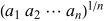 , which appear to converge to Khinchin's
constant (left figure) and
, which appear to converge to Khinchin's
constant (left figure) and  , which appear to converge to the Lévy
constant (right figure), although neither of these limits has been rigorously
established.
, which appear to converge to the Lévy
constant (right figure), although neither of these limits has been rigorously
established.
See also
Natural Logarithm of 10, Natural Logarithm of 10 DigitsExplore with Wolfram|Alpha

References
Sloane, N. J. A. Sequences A016730, A059180, A228270, A228345, and A228346 in "The On-Line Encyclopedia of Integer Sequences."Referenced on Wolfram|Alpha
Natural Logarithm of 10 Continued FractionCite this as:
Weisstein, Eric W. "Natural Logarithm of 10 Continued Fraction." From MathWorld--A Wolfram Resource. https://mathworld.wolfram.com/NaturalLogarithmof10ContinuedFraction.html