 TOPICS

Moving Sofa Problem

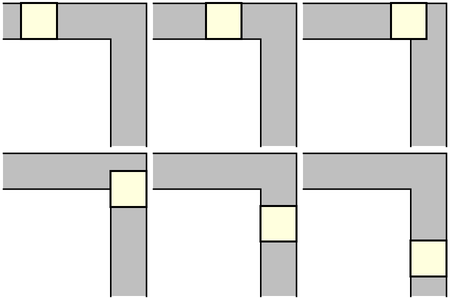
The moving sofa problem asks for the plane figure ("sofa") of largest area  that can be moved around a right-angled corner in a two-dimensional
hallway of unit width (Moser 1966). A unit square
with
 can be trivially moved "around" the corner simply by pushing it along the
hall until it hits the far wall, then pulling it along the perpendicular
hallway, as illustrated above (Romik 2016).
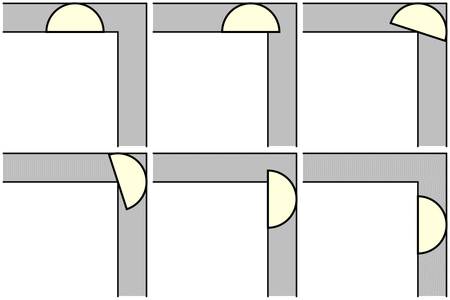
While the unit square can be moved "around" the corner without rotation, moving larger shapes is
possible when they are allowed to rotate. The simplest such shape to consider is
a filled semicircle of radius
1 with  ,
which can be slid around the corner as shown above (Romik 2016).
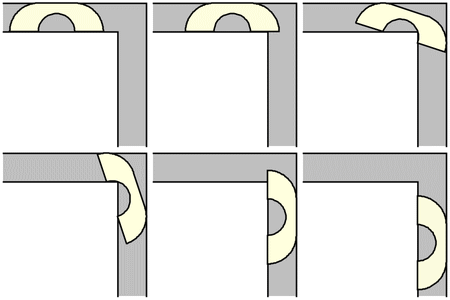
Hammersley (Croft et al. 1994, Romik 2016) increased the area further by cutting the half-disk into two quarter-disks,
separating them horizontally by a distance  while filling in the gap between them. Additionally, he removed
a smaller half-disk of radius
 from the bottom, yielding a shape that
may be termed the Hammersley sofa. Its area
is maximized when
 ,
giving an area
 |
(OEIS A086118; Croft et al. 1994, Romik 2016). As it turns out, the Hammersley sofa can move around the corner for any value
 ,
including the radius
 giving a maximum area. The process is illustrated above
for the maximal Hammersley sofa (Romik 2016).
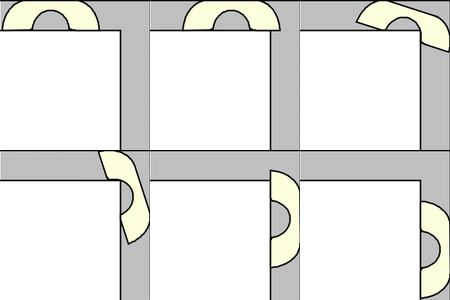
Gerver (1992) found a sofa with area 2.219531...(OEIS A128463; a number that may be called the moving sofa constant), slightly larger than the 2.207416... (OEIS A086118) area for Hammersley's optimal sofa. This sofa can be moved around a corner, and Gerver (1992) provided arguments indicating that it is either optimal or close to it. The boundary of Gerver's sofa is a complicated shape composed of 3 straight line segments and 15 curved pieces, each of which is described by an analytic expression. An animation of the Gerver sofa rounding the turn is shown above (Romik 2016).
Assuming convex trajectories and envelopes, Deng (2024) used the calculus of variations to formulate an integral functional on a set of parametric equations for curves that determined the sofa shape by solving the Euler-Lagrange differential equation. Using numerical methods, this gave a shape with area 2.2195316, consistent with Gerver's sofa. Baek (2024) showed that Gerver's construction attains the maximum area 2.2195...using a proof that does not require computer assistance except for numerical computations that can be done on a scientific calculator.
See also
Gerver Sofa, Hammersley Sofa, Moving Sofa Constant, Piano Mover's ProblemExplore with Wolfram|Alpha

References
Baek, J. "Optimality of Gerver's Sofa." 29 Nov 2024. https://arxiv.org/abs/2411.19826.Croft, H. T.; Falconer, K. J.; and Guy, R. K. Unsolved Problems in Geometry. New York: Springer-Verlag, 1994.Deng, Z. "Calculus of Variation Approach and Euler-Lagrange Equations for the Moving Sofa Problem." Aug. 2024. https://community.wolfram.com/t/24356.Deng, Z. "Solving Moving Sofa Problem Using Calculus of Variations." 2 Jul 2024. https://arxiv.org/abs/2407.02587.Finch, S. R. "Moving Sofa Constant." §8.12 in Mathematical Constants. Cambridge, England: Cambridge University Press, pp. 519-523, 2003.Gerver, J. L. "On Moving a Sofa around a Corner." Geometriae Dedicata 42, 267-283, 1992.Green, R. "The Largest Sofa You Can Move around a Corner." Quanta. Feb. 14, 2025. https://www.quantamagazine.org/the-largest-sofa-you-can-move-around-a-corner-20250214/.Kallus, Y. and Romik, D. "Improved Upper Bounds in the Moving Sofa Problem." Adv. in Math. 340, 960-982, 2018.Moser, L. "Problem 66-11: Moving Furniture Through a Hallway." SIAM Rev. 8, 381, 1966.Prieto-Martínez, L. F. "A List of Problems in Plane Geometry with Simple Statement That Remain Unsolved." 16 Apr 2021. https://arxiv.org/abs/2104.09324.Romik, D. "MovingSofas: A Companion Mathematica Package to the Paper 'Differential Equations and Exact Solutions in the Moving Sofa Problem.' " Package version: 1.3. July 10, 2016. https://www.math.ucdavis.edu/~romik/data/uploads/software/movingsofas-v1.3.nb.Romik, D. "Differential Equations and Exact Solutions in the Moving Sofa Problem." Exper. Math. 27, 316-330, 2018.Romik, D. "Dan Romik's Home Page: The Moving Sofa Problem." https://www.math.ucdavis.edu/~romik/movingsofa/.Sloane, N. J. A. Sequences A086118 and A128463 in "The On-Line Encyclopedia of Integer Sequences."Stewart, I. Another Fine Math You've Got Me Into.... New York: W. H. Freeman, 1992.Trott, M. The Mathematica GuideBook for Programming. New York: Springer-Verlag, p. 104, 2004. https://www.mathematicaguidebooks.org/.Referenced on Wolfram|Alpha
Moving Sofa ProblemCite this as:
Weisstein, Eric W. "Moving Sofa Problem." From MathWorld--A Wolfram Resource. https://mathworld.wolfram.com/MovingSofaProblem.html