 TOPICS

Measure
The terms "measure," "measurable," etc. have very precise technical definitions (usually involving sigma-algebras) that can make them appear difficult to understand. However, the technical nature of the definitions is extremely important, since it gives a firm footing to concepts that are the basis for much of analysis (including some of the slippery underpinnings of calculus).
For example, every definition of an integral is based on a particular measure: the Riemann integral is based on Jordan measure, and the Lebesgue integral is based on Lebesgue measure. The study of measures and their application to integration is known as measure theory.
A measure is defined as a nonnegative real function from a delta-ring  such that
 |
(1)
|
where  is the empty
set, and
is the empty
set, and
 |
(2)
|
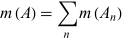
for any finite or countable collection of pairwise disjoint sets  in
in  such that
  is also in
  .
.
If  is
is  -finite and
  is bounded, then
  can be extended uniquely to a measure defined on the
  -algebra generated by
  .
.
 is said to be a probability
measure on a set
is said to be a probability
measure on a set  if
if  and
and  is a
is a  -algebra.
In the usual definition of a probability measure (or, more precisely a nontrivial  -additive measure), a measure is a real-valued function
 on the Power
Set
on the Power
Set  of an infinite set
  that satisfies the following properties:
1.  and
and  ,
,
2. If  then
then  ,
,
3.  for all
  (nontriviality),
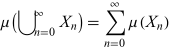
4. If  , are pairwise disjoint,
then
, are pairwise disjoint,
then
 |
(3)
|
(Jech 1997).
A measure  may be extended by completion. The subsets of sets with measure zero form a
  -ring
-ring  . By "changing" sets in
  on a set from
  , a
, a  -ring
-ring
 which is the completion of
  with respect to
  is obtained.
The measure  is called complete if
  .
If
.
If  is not complete, it may be extended
to
is not complete, it may be extended
to  by setting
  , where
  and
and  .
.
See also
Almost Everywhere, Borel Measure, Ergodic Measure, Euler Measure, Gauss Measure, Haar Measure, Hausdorff Measure, Helson-Szegö Measure, Integral, Jordan Measure, Lebesgue Measure, Liouville Measure, Mahler Measure, Measurable Space, Measure Algebra, Measure Space, Minkowski Measure, Natural Measure, Probability Measure, Radon Measure, Wiener Measure Explore this topic in the MathWorld classroomPortions of this entry contributed by Allan Cortzen
Explore with Wolfram|Alpha

References
Czyz, J. Paradoxes of Measures and Dimensions Originating in Felix Hausdorff's Ideas. Singapore: World Scientific, 1994.Jech, T. J. Set Theory, 2nd ed. Berlin: Springer-Verlag, p. 295, 1997.Referenced on Wolfram|Alpha
MeasureCite this as:
Cortzen, Allan and Weisstein, Eric W. "Measure." From MathWorld--A Wolfram Resource. https://mathworld.wolfram.com/Measure.html