 TOPICS

Mean Deviation

The mean deviation (also called the mean absolute deviation) is the mean of the absolute deviations of a set of data
about the data's mean. For a sample
size  ,
the mean deviation is defined by
 |
(1)
|
where  is the mean of the distribution. The mean deviation of a
list of numbers is implemented in the Wolfram
Language as MeanDeviation[data].
The mean deviation for a discrete distribution  defined for
 , 2, ...,
 is given by
 |
(2)
|
Mean deviation is an important descriptive statistic that is not frequently encountered in mathematical statistics. This is essentially because while mean deviation has a natural intuitive definition as the "mean deviation from the mean," the introduction of the absolute value makes analytical calculations using this statistic much more complicated than the standard deviation
 |
(3)
|
As a result, least squares fitting and other standard statistical techniques rely on minimizing the sum of square residuals instead of the sum of absolute residuals.
For example, consider the discrete uniform distribution consisting of  possible outcomes with
 for
 , 2, ...,
 . The mean is given by
 |
(4)
|
The variance (and therefore its square root, namely the standard deviation) is also straightforward to obtain as
 |
(5)
|
On the other hand, the mean deviation is given by
 |
(6)
|
This can be obtained in closed form, but is much more unwieldy since it requires breaking up the summand into two pieces and treating the cases of  even and odd separately.
For a random variable  satisfying
 , let
 be its cumulative
distribution function and
 its mean. The mean absolute deviation
about a real number
 can be written without an absolute
value inside the integral as
 |
(7)
|
(Pinsky 2025, p. 3). In particular,  is the mean deviation defined above. If
 is the quantile function,
then
 |
(8)
|
for  (Pinsky and Kundu 2026, pp. 8-9). The choice
 gives the mean absolute deviation about a median.
The following table summarizes the mean absolute deviations for some named continuous distributions, where  is an incomplete
beta function,
 is a beta function,
 is a gamma function,
 is the upper incomplete
gamma function,
 is the Euler-Mascheroni constant,
 is a Meijer
G-function,
 is the exponential integral function,
 is erf,
and
 is erfc.


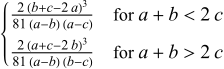


For the F-distribution,  and
 are the numerator and denominator degrees
of freedom, and
 .
For the generalized Pareto distribution,
 and
 are the scale parameter
and shape parameter. At
 , the tabulated expression is interpreted as its limit
 (Pinsky 2025, pp. 7 and
10). For the two Student's t-distribution
rows,
 is the number of degrees of freedom. The first
row is the standard case and the second has scale
parameter
 .
The mean deviation is independent of the location
parameter. For the Weibull distribution,
 is the shape
parameter and
 is the scale parameter (Pinsky 2025, p. 11;
Zhang et al. 2026, p. 3).
For the Pareto distribution in the table,  is the minimum value and
 is the shape parameter.
Its mean is
 , so splitting the integral
at
 gives (Pinsky 2025, p. 9)
 |
(9)
|
For  ,
the mean is infinite and the mean deviation about a finite
mean is not defined.
The following table summarizes the mean absolute deviations for some named discrete distributions, where  .


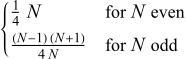


For the log-series distribution,  ,
 , and
 , where
 is the floor function. The probability mass function is
 for
 , 2, .... Summing its truncated first moment gives
 | (10) |
so the tabulated result follows from  , where
 is the cumulative distribution function. For the negative binomial distribution,
 ,
 , and
 , with probability mass function
 for
 , 1, ... (Pinsky 2025, p. 12).
Mean absolute deviations about a median must be distinguished from those about the mean. For the Gumbel distribution, Fréchet distribution, and Weibull distribution, respectively, the deviations about a median are
 |  |  | (11) |
 |  |  | (12) |
 |  |  | (13) |
where  is the scale parameter. The shape parameter satisfies
 for the Fréchet distribution and
 for the Weibull distribution (Pinsky and Kundu 2026, p. 12; Zhang et al. 2026, p. 3).
See also
Absolute Deviation, QuantileFunction, Standard Deviation, VarianceExplore with Wolfram|Alpha

References
Havil, J. "Ways of Means." §13.1 in Gamma: Exploring Euler's Constant. Princeton, NJ: Princeton University Press, pp. 119-121, 2003.Kenney, J. F. and Keeping, E. S. "Mean Absolute Deviation." §6.4 in Mathematics of Statistics, Pt. 1, 3rd ed. Princeton, NJ: Van Nostrand, pp. 76-77 1962.Pinsky, E. "Computation and Interpretation of Mean Absolute Deviations by Cumulative Distribution Functions." Front. Appl. Math. Stat. 11, Art. 1487331, 2025. https://doi.org/10.3389/fams.2025.1487331.Pinsky, E. and Kundu, T. "Skewness and Kurtosis for Heavy-Tailed Distributions: A Comparison of Mean Absolute Deviation and L-Moment Approaches for Pareto and Extreme-Value Families." Mathematics 14, Art. 3656, 2026. https://doi.org/10.3390/math14203656.Zhang, W.; Wang, Z.; and Pinsky, E. "Mean Absolute Deviations for the Weibull Distribution: Applications in Survival Analysis and Insurance Claims." Statistics in Transition new series 27, 1-14, 2026. https://doi.org/10.59139/stattrans-2026-013.Referenced on Wolfram|Alpha
Mean DeviationCite this as:
Weisstein, Eric W. "Mean Deviation." From MathWorld--A Wolfram Resource. https://mathworld.wolfram.com/MeanDeviation.html