 TOPICS

Interspersion
An array  ,
,  of positive integers
is called an interspersion if
of positive integers
is called an interspersion if
1. The rows of  comprise a partition of the positive
integers,
comprise a partition of the positive
integers,
2. Every row of  is an increasing sequence,
3. Every column of  is a (possibly finite) increasing
sequence,
is a (possibly finite) increasing
sequence,
4. If  and
and  are distinct rows of
  and if
  and
and  are any indices for which
 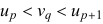 , then
  .
.
If an array  is an interspersion, then it is a sequence dispersion.
If an array
is an interspersion, then it is a sequence dispersion.
If an array  is an interspersion, then the sequence
  given by
  for some
  is a fractal sequence.
Examples of interspersion are the Stolarsky array
and Wythoff array.
is a fractal sequence.
Examples of interspersion are the Stolarsky array
and Wythoff array.
See also
Fractal Sequence, Sequence Dispersion, Stolarsky ArrayExplore with Wolfram|Alpha

References
Kimberling, C. "Interspersions and Dispersions." Proc. Amer. Math. Soc. 117, 313-321, 1993.Kimberling, C. "The First Column of an Interspersion." Fib. Quart. 32, 301-314, 1994.Kimberling, C. "Fractal Sequences and Interspersions." Ars Combin. 45, 157-168, 1997.Kimberling, C. "Interspersions and Dispersions." https://faculty.evansville.edu/ck6/integer/intersp.html.Referenced on Wolfram|Alpha
InterspersionCite this as:
Weisstein, Eric W. "Interspersion." From MathWorld--A Wolfram Resource. https://mathworld.wolfram.com/Interspersion.html