 TOPICS

Heronian Triangle

A Heronian triangle is a triangle having rational side lengths and rational area. The triangles are so named because such triangles are related to Heron's formula
 |
(1)
|
giving a triangle area  in terms of its side lengths
 ,
 ,
 and semiperimeter
 . Finding a Heronian triangle is therefore equivalent
to solving the Diophantine equation
 |
(2)
|
A Heronian triangle can be scaled to have integer side lengths and integer area. Choose
a common multiple  of the denominators, multiply the side lengths by
 , and multiply the area
by
 .
The complete set of solutions for integer Heronian triangles
was found by Euler (Buchholz 1992; Dickson 2005, p. 193), and parametric versions
were given by Brahmagupta and Carmichael (1952) as
 |  |  |
(3)
|
 |  |  |
(4)
|
 |  |  |
(5)
|
 |  |  |
(6)
|
 |  |  |
(7)
|
This produces one member of each similarity class of Heronian triangles for integers  ,
 , and
 such that
 ,
 ,
 , and
 (Buchholz 1992).

The first few integer Heronian triangles sorted first by increasing longest side, then by second-longest side, and then by shortest side,
are (3, 4, 5), (5, 5, 6), (5, 5, 8), (6, 8, 10), (10, 10, 12), (5, 12, 13), (10,
13, 13), (9, 12, 15), (4, 13, 15), (13, 14, 15), (10, 10, 16), ... (OEIS A055594,
A055593, and A055592),
having areas 6, 12, 12, 24, 48, 30, 60, 54, ... (OEIS A055595).
The first few integer Heronian scalene
triangles, sorted first by increasing longest side, then by second-longest side,
and then by shortest side, are (3, 4, 5), (6, 8, 10), (5, 12, 13), (9, 12, 15), (4,
13, 15), (13, 14, 15), (9, 10, 17), ... (OEIS A046128,
A046129, and A046130),
having areas 6, 24, 30, 54, 24, 84, 36, ... (OEIS A046131).
R. Rathbun has cataloged all integer Heronian triangles
with perimeters smaller than  (Peterson 2003).
Schubert (1905) claimed that Heronian triangles with two rational triangle medians do not exist (Dickson 2005). This
was shown to be incorrect by Buchholz and Rathbun (1997), who discovered the triangles
given in the following table, where  are triangle median lengths
and
 is the area.
 |  |  |  |  |  |
| 73 | 51 | 26 |  |  | 420 |
| 626 | 875 | 291 | 572 |  | 55440 |
| 4368 | 1241 | 3673 | 1657 |  | 2042040 |
| 14791 | 14384 | 11257 |  | 11001 | 75698280 |
| 28779 | 13816 | 15155 |  | 21937 | 23931600 |
| 1823675 | 185629 | 1930456 |  |  | 142334216640 |
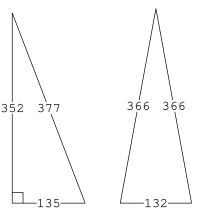
D. Borris (pers. comm., Oct. 22, 2003) considered primitive pairs of Heronian triangles, one a right triangle with sides  and the other an isosceles
triangle with sides
 , such that the two triangles share a common area
and a common perimeter. Here primitive means that the
greatest common divisor of all the side
lengths in the pair is 1. Borris found the pair
 and
 (corresponding to area
 and perimeter
864), with no other such pairs with right triangle
smallest side length less than
 .
See also
Heron's Formula, Heronian Tetrahedron, Integer Triangle, Perfect Cuboid, Pythagorean Quadruple, Pythagorean Triple, Rational Triangle, Soddyian Triangle, Triangle, Triangle MedianExplore with Wolfram|Alpha

References
Buchholz, R. H. "On Triangles with Rational Altitudes, Angle Bisectors or Medians." Doctoral dissertation. Newcastle, Australia: Newcastle University, 1989.Buchholz, R. H. "Perfect Pyramids." Bull. Austral. Math. Soc. 45, 353-368, 1992.Buchholz, R. H. and Rathbun, R. L. "An Infinite Set of Heron Triangles with Two Rational Medians." Amer. Math. Monthly 104, 107-115, 1997.Carmichael, R. D. The Theory of Numbers and Diophantine Analysis. New York: Dover, 1952.Dickson, L. E. History of the Theory of Numbers, Vol. 2: Diophantine Analysis. New York: Dover, pp. 199 and 208, 2005.Fleenor, C. R. "Heronian Triangles with Consecutive Integer Sides." J. Recr. Math. 28, 113-115, 1996-96.Guy, R. K. "Simplexes with Rational Contents." §D22 in Unsolved Problems in Number Theory, 2nd ed. New York: Springer-Verlag, pp. 190-192, 1994.Kraitchik, M. "Heronian Triangles." §4.13 in Mathematical Recreations. New York: W. W. Norton, pp. 104-108, 1942.MacLeod, A. J. "On Integer Relations between the Area and Perimeter of Heron Triangles." Forum Geom. 9, 41-46, 2009. https://web.archive.org/web/20240529003808/https://forumgeom.fau.edu/FG2009volume9/FG200904index.html.Peterson, I. "MathTrek: Perfect Pyramids." July 26, 2003. https://www.sciencenews.org/article/perfect-pyramids.Rabinowitz, S. "Problem 2006: Heronian Properties." J. Recr. Math. 24, 309, 1992.Sastry, K. R. S. "Heron Triangles: A Gergonne-Cevian-and-Median Perspective." Forum Geometricorum 1, 17-24, 2001. https://web.archive.org/web/20240306115415/https://forumgeom.fau.edu/FG2001volume1/FG200104index.html.Schubert, H. "Die Ganzzahligkeit in der algebraischen Geometrie." In Festgabe 48 Versammlung d. Philologen und Schulmänner zu Hamburg. Leipzig, Germany, pp. 1-16, 1905.Sloane, N. J. A. Sequences A046128, A046129, A046130, A046131, A055592, A055593, A055594, and A055595 in "The On-Line Encyclopedia of Integer Sequences."Somos, M. "Heronian Triangle Table." http://grail.csuohio.edu/~somos/tritab.html.Wells, D. G. The Penguin Dictionary of Curious and Interesting Puzzles. London, England: Penguin Books, p. 34, 1992.Yiu, P. "Construction of Indecomposable Heronian Triangles." Rocky Mountain J. Math. 28, 1189-1202, 1998.Referenced on Wolfram|Alpha
Heronian TriangleCite this as:
Weisstein, Eric W. "Heronian Triangle." From MathWorld--A Wolfram Resource. https://mathworld.wolfram.com/HeronianTriangle.html