 TOPICS

Hamilton-Connected Graph

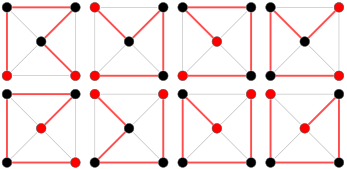
A Hamilton-connected graph  is a graph in which every two vertices are connected by a Hamiltonian
path (Bondy and Murty 1976, p. 61). In other words, it has a
 Hamiltonian path for
all pairs of vertices
 and
 . The illustration above shows a set
of Hamiltonian paths that make the wheel
graph
 hamilton-connected.
By definition, a graph with vertex count  having a detour matrix whose off-diagonal elements
are all equal to
 is Hamilton-connected. Conversely, any graph
having a detour matrix with an off-diagonal element
less than
 is not Hamilton-connected.
Every Hamilton-connected graph on at least three vertices is Hamiltonian. All complete
graphs on at least two vertices are Hamilton-connected.
A bipartite graph on at least three vertices
is not Hamilton-connected;  is Hamilton-connected but is not Hamiltonian.
Every Hamilton-connected graph on at least four vertices has vertex connectivity at least 3. Indeed, deleting one or two chosen vertices from a Hamiltonian path having the chosen vertices among its endpoints leaves a path spanning all remaining vertices. Consequently, a graph on at least four vertices with vertex connectivity less than 3 cannot be Hamilton-connected.
Dupuis and Wagon (2015) conjectured that all non-bipartite Hamiltonian vertex-transitive
graphs are Hamilton-connected except for odd cycle
graphs  with
 and the dodecahedral graph (Dupuis and Wagon
2015, Gregor et al. 2024).
A simple algorithm for determining if a graph is Hamilton-connected proceeds as follows. For all pairs  of vertices:
1. Add a new vertex  .
2. Add new edges  and
 .
3. If this graph is not Hamiltonian, return false; otherwise, continue to next pair.
If the algorithm checks all pairs without returning false, return true.
For a graph  on
 vertices, the strong
closure of
 is the graph obtained by repeatedly adding an edge
between nonadjacent vertices
 and
 whenever their vertex degrees
satisfy
 ,
stopping when no such pair remains. The graph
 is Hamilton-connected iff its strong
closure is Hamilton-connected (Wong 1997). In particular, if the strong closure is
a complete graph, then
 is Hamilton-connected.
A small modification of a theorem due to Chvátal and Erdős establishes that if  for a graph
 , where
 is the independence
number and
 the vertex connectivity,
then
 is Hamilton-connected (A. E. Brouwer, pers. comm., Dec. 17, 2012).
As a result of the theorem that for a connected regular graph  on
 vertices with vertex
degree
 and smallest graph eigenvalue
 ,
 |
it therefore follows that if
 |
for a connected regular graph, the graph is Hamilton-connected (A. E. Brouwer, pers. comm., Dec. 17, 2012).
Every 8-connected claw-free graph is Hamilton-connected (Hu et al. 2005), as is every Johnson graph (Alspach 2013). Chen and Quimpo (1981) proved that a connected Cayley graph on a finite Abelian group of odd order with vertex degree at least three is Hamilton-connected.
Pensaert (2002) conjectured that for  with
 , the generalized
Petersen graph
 is Hamilton-laceable if
 is even and
 is odd, and Hamilton-connected otherwise.
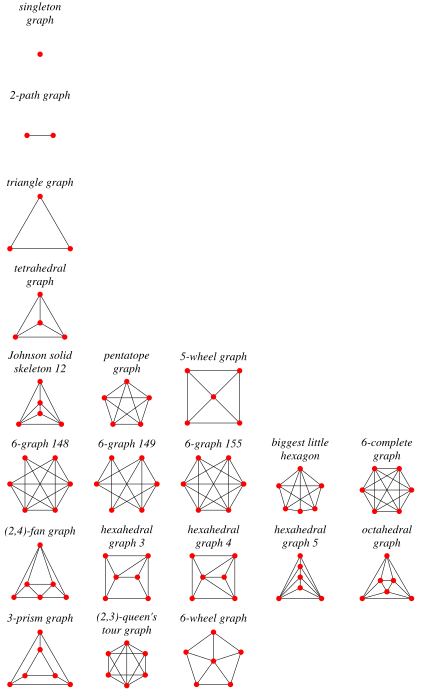
The numbers of Hamilton-connected simple graphs on  ,
2, ... nodes are 1, 1, 1, 1, 3, 13, 116, ... (OEIS
A057865), the first few of which are illustrated
above.
Examples of Hamilton-connected graphs include antiprism graphs, complete graphs, Möbius ladders, prism graphs of odd order, wheel graphs, the truncated prism graph, truncated cubical graph, truncated tetrahedral graph, Grötzsch graph, Frucht graph, and Hoffman-Singleton graph.
See also
Detour Matrix, H*-Connected Graph, Hamilton Decomposable Graph, Hamilton-Laceable Graph, Hamiltonian Graph, Hamiltonian Path, Hypotraceable Graph, Maximally Nonhamiltonian Graph, Traceable GraphExplore with Wolfram|Alpha

References
Alspach, B. "Johnson Graphs are Hamilton-Connected." Ars Math. Contemporanea 6, 21-23, 2013.Bondy, J. A. and Murty, U. S. R. Graph Theory with Applications. New York: North Holland, p. 61, 1976.Chen, C. C. and Quimpo, N. F. "On Strongly Hamiltonian Abelian Group Graphs." In Combinatorial Mathematics. VIII. Proceedings of the Eighth Australian Conference Held at Deakin University, Geelong, August 25-29, 1980 (Ed. K. L. McAvaney). Berlin, Germany: Springer-Verlag, pp. 23-34, 1981.Dupuis, M. and Wagon, S. "Laceable Knights." Ars Math. Contemp. 9, 115-124, 2015.Gregor, P.; Hoang, H. P.; Merino, A.; and Mička, O. "Generating All Invertible Matrices by Row Operations." 3 May 2024. https://arxiv.org/abs/2405.01863.Hu, Z.; Tian, F.; and Wei, B. "Hamilton Connectivity of Line Graphs and Claw-Free Graphs." J. Graph Th. 50, 130-141, 2005.Pensaert, W. P. J. "Hamilton Paths in Generalized Petersen Graphs." Master's thesis. Waterloo, Ontario, Canada: University of Waterloo, January 2002. https://uwspace.uwaterloo.ca/handle/10012/1198.Wong, P.-K. "Hamiltonian-Connected Graphs and Their Strong Closures." Internat. J. Math. Math. Sci. 20, 745-748, 1997. https://doi.org/10.1155/S0161171297001026.Sloane, N. J. A. Sequence A057865 in "The On-Line Encyclopedia of Integer Sequences."Referenced on Wolfram|Alpha
Hamilton-Connected GraphCite this as:
Weisstein, Eric W. "Hamilton-Connected Graph." From MathWorld--A Wolfram Resource. https://mathworld.wolfram.com/Hamilton-ConnectedGraph.html