 TOPICS

Euler Polynomial

The Euler polynomial  is given by the Appell sequence with
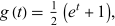 |
(1)
|
giving the generating function
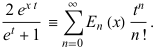 |
(2)
|
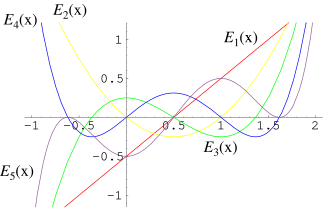
The first few Euler polynomials are
 |  |  |
(3)
|
 |  |  |
(4)
|
 |  |  |
(5)
|
 |  |  |
(6)
|
 |  |  |
(7)
|
 |  |  |
(8)
|
Roman (1984, p. 100) defines a generalization  for which
 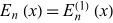 . Euler polynomials are related to the Bernoulli numbers by
 |  | ![(2^n)/n[B_n((x+1)/2)-B_n(x/2)]](https://mathworld.wolfram.com/images/equations/EulerPolynomial/Inline24.svg) |
(9)
|
 |  | ![2/n[B_n(x)-2^nB_n(x/2)]](https://mathworld.wolfram.com/images/equations/EulerPolynomial/Inline27.svg) |
(10)
|
 |  | ![2(n; 2)^(-1)sum_(k=0)^(n-2)(n; k)[(2^(n-k)-1)B_(n-k)B_k(x)],](https://mathworld.wolfram.com/images/equations/EulerPolynomial/Inline30.svg) |
(11)
|
where  is a binomial coefficient. Setting
  and normalizing by
  gives the Euler number
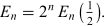 |
(12)
|
The first few values of  are
are  , 0, 1/4,
  , 0, 17/8, 0, 31/2, 0, .... The terms are the same but with
the signs reversed if
, 0, 17/8, 0, 31/2, 0, .... The terms are the same but with
the signs reversed if  . These values can be computed using the double
series
. These values can be computed using the double
series
![E_n(0)=2^(-n)sum_(j=1)^n[(-1)^(j+n+1)j^nsum_(k=0)^(n-j)(n+1; k)].](https://mathworld.wolfram.com/images/equations/EulerPolynomial/NumberedEquation4.svg) |
(13)
|
The Bernoulli numbers  for
for  can be expressed in terms of
  by
by
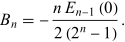 |
(14)
|
The Newton expansion of the Euler polynomials is given by
 |
(15)
|
where  is a binomial coefficient,
  is a falling factorial,
and
is a falling factorial,
and  is a Stirling number of the second
kind (Roman 1984, p. 101).
is a Stirling number of the second
kind (Roman 1984, p. 101).
The Euler polynomials satisfy the identities
 |
(16)
|
and
 |
(17)
|
for  a nonnegative integer.
See also
Appell Sequence, Bernoulli Polynomial, Euler Number, Genocchi Number, Prime-Generating PolynomialRelated Wolfram sites
https://functions.wolfram.com/Polynomials/EulerE2/Explore with Wolfram|Alpha

References
Abramowitz, M. and Stegun, I. A. (Eds.). "Bernoulli and Euler Polynomials and the Euler-Maclaurin Formula." §23.1 in Handbook of Mathematical Functions with Formulas, Graphs, and Mathematical Tables, 9th printing. New York: Dover, pp. 804-806, 1972.Gradshteyn, I. S. and Ryzhik, I. M. Tables of Integrals, Series, and Products, 6th ed. San Diego, CA: Academic Press, 2000.Prudnikov, A. P.; Marichev, O. I.; and Brychkov, Yu. A. "The Generalized Zeta Function , Bernoulli Polynomials
  , Euler Polynomials
  , and Polylogarithms
  ." §1.2 in Integrals
and Series, Vol. 3: More Special Functions. Newark, NJ: Gordon and Breach,
pp. 23-24, 1990.Roman, S. "The Euler Polynomials." §4.2.3
in The
Umbral Calculus. New York: Academic Press, pp. 100-106, 1984.Spanier,
J. and Oldham, K. B. "The Euler Polynomials
." §1.2 in Integrals
and Series, Vol. 3: More Special Functions. Newark, NJ: Gordon and Breach,
pp. 23-24, 1990.Roman, S. "The Euler Polynomials." §4.2.3
in The
Umbral Calculus. New York: Academic Press, pp. 100-106, 1984.Spanier,
J. and Oldham, K. B. "The Euler Polynomials  ." Ch. 20 in An
Atlas of Functions. Washington, DC: Hemisphere, pp. 175-181, 1987.
." Ch. 20 in An
Atlas of Functions. Washington, DC: Hemisphere, pp. 175-181, 1987.Referenced on Wolfram|Alpha
Euler PolynomialCite this as:
Weisstein, Eric W. "Euler Polynomial." From MathWorld--A Wolfram Resource. https://mathworld.wolfram.com/EulerPolynomial.html