 TOPICS

EKG Sequence

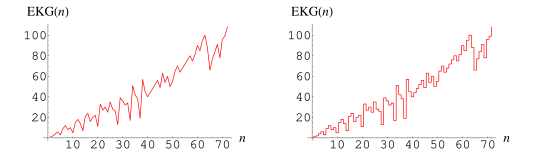
The EKG sequence is the integer sequence having 1 as its first term, 2 as its second, and with each succeeding term being the smallest number not already used that shares a factor with the preceding term. This results in the sequence 1, 2, 4, 6, 3, 9, 12, 8, 10, 5, 15, ... (OEIS A064413). When plotted as a connect-the-dots plot (left figure), the sequence looks somewhat like an electrocardiogram (abbreviated "EKG" in medical circles), so this sequence became known as the EKG sequence. Lagarias et al. have computed the first 10 million terms of the sequence (Lagarias et al. 2002, Peterson 2002).
Every term appears exactly once in this sequence, and the primes occur in increasing order (Lagarias et al. 2002). The inverse permutation of the integers giving the sequence is 1, 2, 5, 3, 10, 4, 14, 8, 6, 9, 20, 7, 28, ... (OEIS A064664).
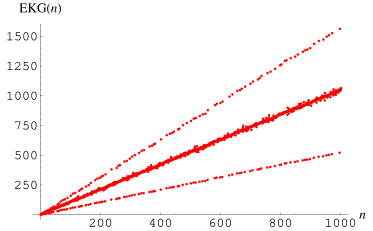
Lagarias et al. (2002) established the bounds
 |
for the  term
term  . For the first
  terms, whenever a prime
  occurs, it is immediately preceded by
  and followed by
  . This results in a three lines of points when the sequence
is plotted without connecting the dots.
. This results in a three lines of points when the sequence
is plotted without connecting the dots.
Explore with Wolfram|Alpha

References
Lagarias, J. C.; Rains, E. M.; and Sloane, N. J. A. "The EKG Sequence." 11 Jun 2002. https://arxiv.org/abs/math/0204011.Peterson, I. "MathTrek: The EKG Sequence." Apr. 6, 2002. https://www.sciencenews.org/article/ekg-sequence.Sloane, N. J. A. Sequences A064413 and A064664 in "The On-Line Encyclopedia of Integer Sequences."Referenced on Wolfram|Alpha
EKG SequenceCite this as:
Weisstein, Eric W. "EKG Sequence." From MathWorld--A Wolfram Resource. https://mathworld.wolfram.com/EKGSequence.html