 TOPICS

Differential Operator

The operator representing the computation of a derivative,
 |
(1)
|
sometimes also called the Newton-Leibniz operator. The second derivative is then denoted  ,
the third
,
the third  ,
etc. The integral is denoted
,
etc. The integral is denoted  .
.
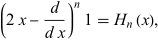
The differential operator satisfies the identity
 |
(2)
|
where  is a Hermite polynomial (Arfken 1985, p. 718),
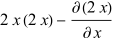
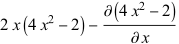
where the first few cases are given explicitly by
is a Hermite polynomial (Arfken 1985, p. 718),
where the first few cases are given explicitly by
 |  |  |
(3)
|
 |  |  |
(4)
|
 |  |  |
(5)
|
 |  |  |
(6)
|
 |  |  |
(7)
|
 |  |  |
(8)
|
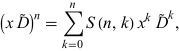
The symbol  can be used to denote the operator
 |
(9)
|
(Bailey 1935, p. 8). A fundamental identity for this operator is given by
 |
(10)
|
where  is a Stirling number of the second
kind (Roman 1984, p. 144), giving
is a Stirling number of the second
kind (Roman 1984, p. 144), giving
 |  |  |
(11)
|
 |  |  |
(12)
|
 |  |  |
(13)
|
 |  |  |
(14)
|
and so on (OEIS A008277). Special cases include
 |  | 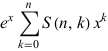 |
(15)
|
 |  |  |
(16)
|
 |  |  |
(17)
|
A shifted version of the identity is given by
![[(x-a)D^~]^n=sum_(k=0)^nS(n,k)(x-a)^kD^~^k](https://mathworld.wolfram.com/images/equations/DifferentialOperator/NumberedEquation5.svg) |
(18)
|
(Roman 1984, p. 146).
See also
Convective Derivative, Derivative, Fractional Derivative, GradientExplore with Wolfram|Alpha

References
Arfken, G. Mathematical Methods for Physicists, 3rd ed. Orlando, FL: Academic Press, 1985.Bailey, W. N. Generalised Hypergeometric Series. Cambridge, England: University Press, 1935.Roman, S. The Umbral Calculus. New York: Academic Press, pp. 59-63, 1984.Sloane, N. J. A. Sequence A008277 in "The On-Line Encyclopedia of Integer Sequences."Referenced on Wolfram|Alpha
Differential OperatorCite this as:
Weisstein, Eric W. "Differential Operator." From MathWorld--A Wolfram Resource. https://mathworld.wolfram.com/DifferentialOperator.html