 TOPICS

Degree Sequence
A degree sequence of an undirected graph is a monotonic nonincreasing sequence of the vertex degrees (valencies) of its graph vertices. The number of degree sequences for a graph of a given order is closely related to graphical partitions. The sum of the elements of a degree sequence of a graph is always even due to the fact that each edge connects two vertices and is thus counted twice (Skiena 1990, p. 157).
A sequence of nonnegative integers that is the degree sequence of some simple graph is called a graphic sequence. The Erdős-Gallai theorem gives a necessary and sufficient criterion for this property.
The minimum vertex degree in a graph  is denoted
 , and the maximum
vertex degree is denoted
 (Skiena 1990, p. 157). A graph
whose degree sequence contains only multiple copies of a single integer
is called a regular graph. A graph
corresponding to a given degree sequence
 can be constructed in the Wolfram
Language using RandomGraph[DegreeGraphDistribution[d]].
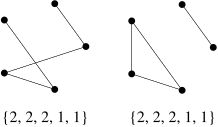
It is possible for two topologically distinct graphs to have the same degree sequence. Moreover, two distinct convex polyhedra can even have the same degree sequence for their skeletons, as exemplified by the triangular cupola and tridiminished icosahedron Johnson solids, both of which have 8 faces, 9 vertices, 15 edges, and degree sequence (4, 4, 4, 3, 3, 3, 3, 3, 3).
A graph determined up to graph isomorphism by its degree sequence is said to be unigraphic or called a "unigraph" (Tyshkevich 2000, Barrus et al. 2025).
The number of distinct degree sequences for graphs of  , 2, ... nodes
are given by 1, 2, 4, 11, 31, 102, 342, 1213, 4361, ... (OEIS A004251),
compared with the total number of nonisomorphic simple
graphs with
 graph vertices of 1, 2, 4, 11, 34, 156, 1044, ... (OEIS
A000088). The first order
having fewer degree sequences than number of nonisomorphic graphs
is therefore
 .
For the graphs illustrated above, the degree sequences
are given in the following table.
| 1 |  |
| 2 |  ,  |
| 3 |  ,  ,  ,  |
| 4 |  ,  ,  ,  , |
 ,  ,  ,  , | |
 ,  ,  |
The possible sums of elements for a degree sequence of order  are 0, 2, 4, 6, ...,
 .
A degree sequence is said to be  -connected if there exists some k-connected
graph corresponding to the degree sequence. For example, while the degree sequence
 is 1- but not 2-connected,
 is 2-connected.
See also
Degree Set, Erdős-Gallai Theorem, Graphic Sequence, Graphical Partition, k-Connected Graph, Regular Graph, Unigraphic Graph, Unswitchable Graph, Vertex DegreeExplore with Wolfram|Alpha

References
Barrus, M. D.; Trenk, A. N.; and Whitman, R. "The Hereditary Closure of the Unigraphs." Disc. Math. 348, 114444, 2025. https://doi.org/10.1016/j.disc.2025.114444.Ruskey, F. "Information on Degree Sequences." https://web.archive.org/web/20120719205312/http://www.theory.csc.uvic.ca/~cos/inf/nump/DegreeSequences.html.Ruskey, F.; Cohen, R.; Eades, P.; and Scott, A. "Alley CATs in Search of Good Homes." Congres. Numer. 102, 97-110, 1994.Skiena, S. "Realizing Degree Sequences." §4.4.2 in Implementing Discrete Mathematics: Combinatorics and Graph Theory with Mathematica. Reading, MA: Addison-Wesley, pp. 157-160, 1990.Sloane, N. J. A. Sequences A000088 and A004251/M1250 in "The On-Line Encyclopedia of Integer Sequences."Tyshkevich, R. "Decomposition of Graphical Sequences and Unigraphs." Disc. Math. 220, 201-238, 2000. https://doi.org/10.1016/S0012-365X(99)00381-7.Referenced on Wolfram|Alpha
Degree SequenceCite this as:
Weisstein, Eric W. "Degree Sequence." From MathWorld--A Wolfram Resource. https://mathworld.wolfram.com/DegreeSequence.html