 TOPICS

(0,2)-Graph

A  -graph is a connected
graph such that any two distinct vertices have
0 or 2 common neighbors.
 -graphs are regular, and
the numbers of
 -graphs
with vertex degree 0, 1, 2, ... are given by 1,
1, 1, 2, 3, 8, 24, 96, 302, ... (OEIS A202592;
Brouwer).
A  -graph with
 vertices and vertex
degree
 satisfies
 |
To see this, fix a graph vertex  and count the
 two-step walks from
 that do not return to
 . Each other graph vertex is
the endpoint of either 0 or 2 such walks.
The graph Cartesian product of two  -graphs is again a
 -graph (Brouwer). If two distinct vertices
differ in only one coordinate, their common neighbors
are determined by that factor. If they differ in two coordinates, they have two common
neighbors exactly when the corresponding coordinates
are adjacent in both factors. In all other cases they have no common neighbors.
Consequently, a graph Cartesian product
 of path graphs, with each
 , is a
 -graph iff every
 is 1 or 2. In that case it is a hypercube
graph
 ,
where
 is the number of factors with
 . If some
 , two vertices that
differ by two consecutive steps in that factor and agree in all other coordinates
have exactly one common neighbor.
The only complete multipartite graphs that are  -graphs
are the singleton graph
 , the path graph
 , the square graph
 , and the tetrahedral
graph
 .
Indeed, regularity forces all nonempty parts to
have the same size
 .
With
 parts, two vertices
in different parts have
 common neighbors, while two distinct vertices
in the same part have
 common neighbors. For
 this gives
 or
 ,
and for
 it gives
 .
The remaining connected case is the singleton
graph.
In particular, the only cubic  -graphs are the tetrahedral
graph
 and cubical graph
 (Brouwer).
A subset of  -graphs are implemented in the Wolfram
Language as GraphData[
 "ZeroTwoBipartite",
 d, k

 ]
and GraphData[
 "ZeroTwoNonbipartite",
 d, k

 ].
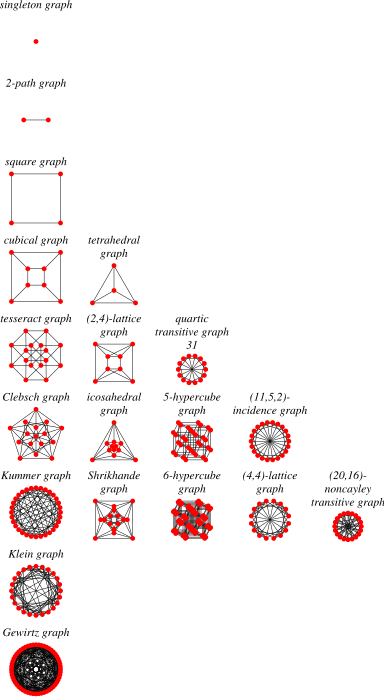
Classes of graphs that are  -graphs include the hypercube
graphs and the folded n-cube graphs
for
 , 3, or
 (Brouwer). The folded 4-cube is the complete
bipartite graph
 ,
which is not a
 -graph
because two vertices in the same part have four common
neighbors. Particular named
 -graphs are summarized in the following table, ordered
by vertex degree, and some of which are illustrated
above.
 | graphs |
| 0 | singleton graph  |
| 1 | 2-path graph  |
| 2 | square graph  |
| 3 | cubical graph  , tetrahedral graph  |
| 4 | (2,4)-rook graph, quartic
vertex-transitive graph Qt31, tesseract graph  |
| 5 | 5-hypercube graph  , Clebsch graph, icosahedral
graph |
| 6 | hexacode
graph, 6-hypercube graph  , Kummer graph, (4,4)-rook graph, Shrikhande
graph |
| 7 | 7-folded
cube graph, 7-hypercube graph  , 24-Klein graph |
| 8 | 8-folded
cube graph, 8-hypercube graph  |
| 9 | (1,1)-Doob graph, (3,4)-Hamming
graph, 9-folded cube graph, 9-hypercube
graph  |
| 10 | 10-folded
cube graph, 10-hypercube graph  , Gewirtz graph, Gewirtz
bipartite double graph |
| 12 | (1,2)-Doob graph, (4,4)-Hamming graph, Leonard graph |
Brouwer considers the unique 20-vertex  -graph whose local graphs
are all
 .
It can be constructed by letting the vertices be
the ordered pairs
 of distinct elements from
the 5-set
 , where
 is adjacent to
 whenever
 ,
 ,
 are distinct and
 is adjacent to
 when
 ,
 ,
 ,
 are distinct, so that
 for some
 , and the permutation that
maps
 to
 is an even permutation.
Equivalently, it can be constructed by letting the vertices
be the 20 vertices of the dodecahedron,
choosing a fixed set partition of the dodecahedron
into five tetrahedra, and letting two vertices
be adjacent whenever they either lie in a common tetrahedron,
or are joined by an graph edge of the dodecahedron.
See also
Complete Multipartite Graph, Graph Cartesian Product, Hexacode Graph, Path Graph, Regular GraphExplore with Wolfram|Alpha

References
Brouwer, A. E. "Classification of Small -Graphs." J. Combin. Th. Ser. A 113,
1636-1645, 2006.Brouwer, A. E. "
 -Graphs: This Page's Graph [Dodecahedral
 Graph]." https://aeb.win.tue.nl/graphs/Dodecahedral-02.html.Brouwer,
A. E. "
 -Graphs."
https://aeb.win.tue.nl/graphs/recta/02graphs.html.Brouwer,
A. E. and Östergård, P. R. J. "Classification of the
 -Graphs of Valency 8." Disc.
Math. 309, 532-547, 2009. https://doi.org/10.1016/j.disc.2008.07.037.Sloane,
N. J. A. Sequence A202592 in "The
On-Line Encyclopedia of Integer Sequences."
Referenced on Wolfram|Alpha
(0,2)-GraphCite this as:
Weisstein, Eric W. "(0,2)-Graph." From MathWorld--A Wolfram Resource. https://mathworld.wolfram.com/02-Graph.html