skip to main |
skip to sidebar

Version 15.1 of the Unicode Standard is now available. This minor version update includes updated code charts, data files and annexes. The core specification is unchanged from Unicode Version 15.0.
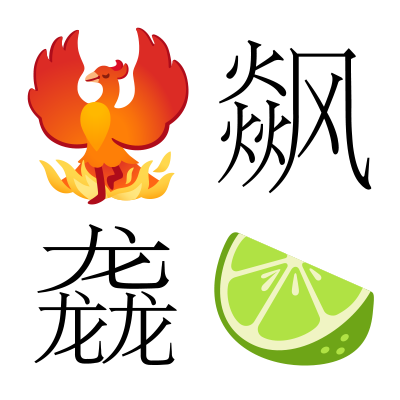
This version adds 627 characters, bringing the total number of characters to 149,813. The additions include 622 CJK unified ideographs in a new block, CJK Unified Ideographs Extension I. These new ideographs are urgently needed in China for use in public service databases, and are expected to be included in a forthcoming amendment to China’s GB 18030-2022 standard. The other new characters are five ideographic description characters that enhance the ability to describe rare or not-yet-encoded CJK ideographs.
There are six completely new emoji, such as for phoenix and lime and (finally) an edible mushroom. For 108 people emoji, you can now switch the direction that they are facing (for example, person walking facing right versus facing left).
Security-related updates have been made to UAX #9, Unicode Bidirectional Algorithm and UAX #31, Unicode Identifiers and Syntax along with updates to UTS #39, Unicode Security Mechanisms. These updates complement the release of a new Unicode Technical Standard, UTS #55, Unicode Source Code Handling.
The new characters are limited to three blocks, and the code charts for several other blocks have changed. The most significant change to charts is for the CJK Unified Ideographs, CJK Unified Ideographs Extension A and CJK Unified Ideographs Extension B blocks with the addition of representative glyphs and source references for over 24,000 KP-source (North Korea) ideographs. There are also many other glyph corrections and improvements—see the 15.1 delta code charts for details.
Significant updates have been made to UAX #14, Unicode Line Breaking Algorithm and UAX #29, Unicode Text Segmentation adding better support for scripts of South and Southeast Asia, including grapheme cluster support for aksaras and consonant conjuncts, and line breaking at orthographic syllable boundaries.
For complete details on Unicode Version 15.1, see https://www.unicode.org/versions/Unicode15.1.0/.
Support Unicode
To support Unicode’s mission to ensure everyone can communicate in their languages across all devices, please consider adopting a character, making a gift of stock, or making a donation. As Unicode, Inc. is a US-based open source, open standards, non-profit, 501(c)3 organization, your contribution may be eligible for a tax deduction. Please consult with a tax advisor for details.
Tuesday, September 12, 2023
Announcing The Unicode® Standard, Version 15.1
Version 15.1 of the Unicode Standard is now available. This minor version update includes updated code charts, data files and annexes. The core specification is unchanged from Unicode Version 15.0.
This version adds 627 characters, bringing the total number of characters to 149,813. The additions include 622 CJK unified ideographs in a new block, CJK Unified Ideographs Extension I. These new ideographs are urgently needed in China for use in public service databases, and are expected to be included in a forthcoming amendment to China’s GB 18030-2022 standard. The other new characters are five ideographic description characters that enhance the ability to describe rare or not-yet-encoded CJK ideographs.
There are six completely new emoji, such as for phoenix and lime and (finally) an edible mushroom. For 108 people emoji, you can now switch the direction that they are facing (for example, person walking facing right versus facing left).
Security-related updates have been made to UAX #9, Unicode Bidirectional Algorithm and UAX #31, Unicode Identifiers and Syntax along with updates to UTS #39, Unicode Security Mechanisms. These updates complement the release of a new Unicode Technical Standard, UTS #55, Unicode Source Code Handling.
The new characters are limited to three blocks, and the code charts for several other blocks have changed. The most significant change to charts is for the CJK Unified Ideographs, CJK Unified Ideographs Extension A and CJK Unified Ideographs Extension B blocks with the addition of representative glyphs and source references for over 24,000 KP-source (North Korea) ideographs. There are also many other glyph corrections and improvements—see the 15.1 delta code charts for details.
Significant updates have been made to UAX #14, Unicode Line Breaking Algorithm and UAX #29, Unicode Text Segmentation adding better support for scripts of South and Southeast Asia, including grapheme cluster support for aksaras and consonant conjuncts, and line breaking at orthographic syllable boundaries.
For complete details on Unicode Version 15.1, see https://www.unicode.org/versions/Unicode15.1.0/.
Support Unicode
To support Unicode’s mission to ensure everyone can communicate in their languages across all devices, please consider adopting a character, making a gift of stock, or making a donation. As Unicode, Inc. is a US-based open source, open standards, non-profit, 501(c)3 organization, your contribution may be eligible for a tax deduction. Please consult with a tax advisor for details.
Labels:
CJK,
emoji,
Extension I,
Unicode,
unicode 15.1
Links of Interest
Blog Archive
Labels
CLDR
(78)
emoji
(75)
Unicode
(42)
ICU
(36)
AAC
(18)
beta
(17)
alpha
(13)
IUC
(12)
UTR #51
(11)
adopt-a-character
(11)
9.0
(10)
POD
(10)
conference
(10)
LDML
(9)
The Unicode Standard
(9)
UTS #51
(9)
Gold Sponsor
(8)
ICU4X
(8)
bidi
(8)
paperback
(8)
Arabic
(7)
IVD
(7)
UTC
(7)
UTS #18
(7)
UTS #46
(7)
Unicode 16.0
(7)
cover art
(7)
Collation
(6)
Survey Tool
(6)
UTS #10
(6)
UTS #39
(6)
Unicode 14
(6)
board of directors
(6)
cldr 43
(6)
locales
(6)
10646
(5)
7.0
(5)
8.0
(5)
SEI
(5)
emoji 12.0
(5)
membership
(5)
regular expression
(5)
security
(5)
unicode 15.1
(5)
10.0
(4)
CJK
(4)
CLDR 26
(4)
CLDR 36
(4)
CLDR 37
(4)
CLDR 39
(4)
CLDR 44
(4)
IDNA
(4)
Mayan
(4)
Rust
(4)
UAX #9
(4)
UTR #50
(4)
UTW
(4)
Unicode 12
(4)
Unicode 13.0
(4)
cldr 38
(4)
cldr 40
(4)
cldr 41
(4)
cldr 42
(4)
emoji 15.0
(4)
regex
(4)
repertoire
(4)
vertical text
(4)
11.0
(3)
12.0
(3)
Bob Jung
(3)
CLDR 35
(3)
CLDR 45
(3)
CLDR 46
(3)
FFI
(3)
Greg Welch
(3)
I18n
(3)
Jennifer Daniel
(3)
Mark Davis
(3)
UAX #29
(3)
UCA
(3)
UTS #37
(3)
Unicode 11
(3)
Unicode 12.1
(3)
Unicode 13
(3)
adoption
(3)
board
(3)
candidates
(3)
cldr 32
(3)
cldr 33
(3)
cldr 34
(3)
core specification
(3)
diversity
(3)
emoji 11.0
(3)
emoji 5.0
(3)
flags
(3)
keynote
(3)
officers
(3)
properties
(3)
reiwa
(3)
schedule
(3)
spoofing
(3)
tutorial
(3)
webinar
(3)
13.0
(2)
14.0
(2)
Addison Phillips
(2)
Adobe-Japan1
(2)
Alolita Sharma
(2)
Anshuman Pandey
(2)
BCP47
(2)
Berkeley
(2)
Beta Review
(2)
CLDR 24
(2)
CLDR 30
(2)
Cherokee
(2)
DDL
(2)
ESC
(2)
Egyptian hieroglyphs
(2)
Elymaic
(2)
Emoji2019
(2)
Extension G
(2)
Georgian
(2)
Google
(2)
Hanifi Rohingya
(2)
ICU 62
(2)
ICU 72
(2)
ICU 73
(2)
IUC 37
(2)
IUC 38
(2)
IUC 41
(2)
IUC 42
(2)
IUC 43
(2)
IUC 45
(2)
Japanese era
(2)
Kristi Lee
(2)
MSARG
(2)
Message Format Working Group
(2)
Microsoft
(2)
Moji Jōhō Kiban
(2)
Moji_Joho
(2)
Nandinagari
(2)
PDAM
(2)
Peter Constable
(2)
RGI
(2)
Roozbeh Pournader
(2)
Salesforce
(2)
Sunuwar
(2)
Teresa Marshall
(2)
Toral Cowieson
(2)
UAX
(2)
UAX #31
(2)
UAX #38
(2)
UAX #44
(2)
UTR #36
(2)
UTR #53
(2)
UTW2024
(2)
Unicode 15
(2)
Unicode Technology Workshop
(2)
Unihan
(2)
Vint Cerf
(2)
World Emoji Day
(2)
award
(2)
bidirectional
(2)
bulldog
(2)
calendar
(2)
candidate
(2)
design
(2)
egyptian
(2)
emoji 13.0
(2)
emoji 13.1
(2)
event
(2)
frequency
(2)
grant
(2)
holiday
(2)
ideographic
(2)
internationalization
(2)
keyboard
(2)
message format 2
(2)
person names
(2)
script
(2)
script_extensions
(2)
scripts
(2)
source code
(2)
standards
(2)
unicode 14.0
(2)
15.0
(1)
2021
(1)
6.3
(1)
AMTRA
(1)
Adlam
(1)
Adobe
(1)
Andy Heninger
(1)
Anne Gundelfinger
(1)
Apple
(1)
Arika Okrent
(1)
Babel
(1)
Bhojpuri
(1)
Bravanese
(1)
Brent Getlin
(1)
CJK Radical
(1)
CLDR 23
(1)
CLDR 25
(1)
CLDR 27
(1)
CLDR 28
(1)
CLDR 29
(1)
CLDR 33.1
(1)
CLDR 36.1
(1)
CLDR 47
(1)
CLDR 48
(1)
CLDR 50
(1)
CLDR-TC
(1)
Caddo
(1)
CanadaDay
(1)
Carlos Pallan Gayol
(1)
Carrier
(1)
Cathy Wissink
(1)
Chorasmian
(1)
Chuvash
(1)
DAM 1
(1)
DNS
(1)
Dachuan Zhang
(1)
David Singer
(1)
Dhives-Akuru
(1)
Dives Akuru
(1)
Dogri
(1)
Du Lilyu
(1)
Ebrima
(1)
Elango Cheran
(1)
Emoji 14.0
(1)
Emoji One
(1)
Emoji12
(1)
Eric Muller
(1)
Extension I
(1)
FAQ
(1)
Facebook
(1)
French
(1)
Fulani
(1)
Gabee Ayres
(1)
Gabrielle Vail
(1)
Garay
(1)
Georgian Mtavruli
(1)
GivingTuesday
(1)
Gonggong
(1)
Gretchen McCulloch
(1)
Gurung Khema
(1)
Hanyo Denshi
(1)
Harald Alvestrand
(1)
Haryanvi
(1)
Haumea
(1)
Hindi
(1)
Hinglish
(1)
Huijun Shan
(1)
IAU
(1)
IBM
(1)
ICU 58
(1)
ICU 59
(1)
ICU 63
(1)
ICU 64
(1)
ICU 65
(1)
ICU 66
(1)
ICU 67
(1)
ICU 68
(1)
ICU 69
(1)
ICU 70
(1)
ICU 71
(1)
ICU 74
(1)
ICU 75
(1)
ICU 76
(1)
ICU 78
(1)
ICU4X 1.3
(1)
IDC
(1)
IDS
(1)
IRG
(1)
IUC 39
(1)
IUC 40
(1)
IUC IUC 39
(1)
Igbo
(1)
Indigenous
(1)
Iris Orriss
(1)
JSON
(1)
Japan
(1)
Jennifer 8 Lee
(1)
Jeremy Burge
(1)
John H. Jenkins
(1)
KRName
(1)
Kaktovik Numerals
(1)
Kangxi
(1)
Kashmiri
(1)
Kawi
(1)
Khitan
(1)
Khwarezmian
(1)
Kirat Rai
(1)
Kulpreet Chilana
(1)
LDML Keyboard
(1)
LanguagePreservation
(1)
Lari
(1)
Linkification
(1)
Luce Foundation
(1)
Macao
(1)
Maithili
(1)
Makemake
(1)
Malayalam
(1)
Manat
(1)
Manipuri
(1)
Mark Jamra
(1)
Mazahua
(1)
Medefaidrin
(1)
Michele Coady
(1)
Monica Tang
(1)
NEH
(1)
Nag Mundari
(1)
Naija
(1)
National Endowment for the Humanities
(1)
Nattilik
(1)
Ned Holbrook
(1)
Nepal Bhasa
(1)
Neptune
(1)
Netflix
(1)
New Tai Lue
(1)
Nigerian Pidgin
(1)
Nigerian-Pidgin
(1)
Norbert Lindenberg
(1)
Norwegian
(1)
Nyiakeng Puachue Hmong
(1)
Ojibway
(1)
Ol Onal
(1)
Orcus
(1)
Osage
(1)
PDAM 2.2
(1)
PRI #359
(1)
PRI #365
(1)
PRI #366
(1)
PRI #408
(1)
PRI #418
(1)
PRI #435
(1)
Pahlavi
(1)
Peter Edberg
(1)
Phoreus
(1)
Pluto
(1)
Public Review Issues
(1)
QID
(1)
Quaoar
(1)
RBNF
(1)
Rajasthani
(1)
Rathna Ramanathan
(1)
Rohingya
(1)
Ruble
(1)
SC2
(1)
SCWG
(1)
Saagar Setu
(1)
Salvatore Giammarresi
(1)
Sanskrit
(1)
Santali
(1)
Sayisi
(1)
SignWriting
(1)
Sindhi
(1)
Sinhala
(1)
Siyaq
(1)
Sogdian
(1)
Stanford
(1)
Stanford SILICON
(1)
Support Unicode
(1)
Swiftkey
(1)
Syloti Nagri
(1)
TNO
(1)
Tableaux des caractères
(1)
Tangsa
(1)
Tayfun Karadeniz
(1)
Thomas Mullaney
(1)
Todhri
(1)
Tom Mullaney
(1)
Toto
(1)
Tulu-Tigalari
(1)
Typotheque
(1)
UAX #14
(1)
UAX #15
(1)
UAX #45
(1)
UCA UCD
(1)
UCD
(1)
UTC #175
(1)
UTC #177
(1)
UTC #179
(1)
UTC #180
(1)
UTC #181
(1)
UTC #182
(1)
UTR #23
(1)
UTS #35
(1)
UTS #52
(1)
UTS #55
(1)
Uighur
(1)
Unicode 15.0
(1)
Unicode 16
(1)
Unicode 17.0
(1)
Unicode Fellows
(1)
Unicode Technical Committee
(1)
UnicodeEmoji
(1)
UnicodeEmojiMirror
(1)
Vithkuqi
(1)
Wancho
(1)
Warsh
(1)
Webdings
(1)
Wingdings
(1)
Xhosa
(1)
Yezidi
(1)
Youtube
(1)
ZWJ
(1)
Zawgyi
(1)
Znamenny
(1)
alpha review
(1)
amendment
(1)
annotations
(1)
art
(1)
astronomy
(1)
beta 6.3 bidi
(1)
bloomberg
(1)
cambridge
(1)
character property model
(1)
cldr 31
(1)
cldr 35.1
(1)
community engagement
(1)
compatibility
(1)
conjoining form
(1)
corrigendum
(1)
currency
(1)
customization
(1)
directionality
(1)
document register
(1)
domain names
(1)
donations
(1)
draft
(1)
dwarf planets
(1)
emoji 12.1
(1)
emoji 16.0
(1)
emoji proposal
(1)
emojixpress
(1)
era name
(1)
executive director
(1)
family
(1)
feedback
(1)
flag
(1)
font
(1)
française
(1)
gender
(1)
general category
(1)
general counsel
(1)
glyphs
(1)
grafematik
(1)
graphemics
(1)
guide
(1)
hashtag
(1)
hentaigana
(1)
hieroglyphs
(1)
highlights
(1)
icu 60
(1)
icu 61
(1)
icu 64.2
(1)
ideographic description characters
(1)
interview
(1)
iuc 44
(1)
keyboards
(1)
language
(1)
locale
(1)
maya
(1)
mongolian
(1)
myanmar
(1)
noncharacters
(1)
oman
(1)
participation
(1)
person-names
(1)
phone
(1)
planning
(1)
playlist
(1)
policies
(1)
publication
(1)
publishing
(1)
quick start
(1)
reference code
(1)
release
(1)
resources
(1)
segmentation
(1)
shopify
(1)
smiley face
(1)
soyombo
(1)
space
(1)
speaker
(1)
sponsor
(1)
stability policies
(1)
submission
(1)
syllabics
(1)
symbol
(1)
technical preview
(1)
text segmentation
(1)
turkey
(1)
typography
(1)
unicodeaac
(1)
valentines day
(1)
variation
(1)
workshop
(1)
文字情報盤
(1)