

| Part of a series on |
| Christian eschatology |
|---|
| Christianity portal |
The War in Heaven is a mythic conflict between supernatural forces in traditional Christian cosmology, attested in the Book of Revelation alongside proposed parallels in the Hebrew Bible and the Dead Sea Scrolls. It is described as the result of Satan, who is often identified as the angel Lucifer, rebelling against God and leading to a war between his followers and those still loyal to God, led by the Archangel Michael.[1][2] Within the New Testament, the War in Heaven provides basis for the concept of the fallen angels and for Satan's banishment to Hell. The War is frequently featured in works of Christian art, such as John Milton's epic poem Paradise Lost, which describes it as occurring over the course of three days as a result of God the Father announcing Jesus Christ as his Son.
Revelation 12:7–10
The War in Heaven is attested to only in the Book of Revelation:
Interpretations
The Christian tradition has stories about angelic beings cast down from heaven by God, often presenting the punishment as inflicted in particular on Satan. As a result of linking this motif with the cited passage of the Book of Revelation, the casting of Satan down from heaven, which other versions of the motif present as an action of God himself, has become attributed to the archangel Michael at the conclusion of a war between two groups of angels, of whom (because of the mention of the dragon's tail casting a third of the stars of heaven to the earth) one third are supposed to have been on the side of Satan, in spite of the fact that the casting down of the stars (Revelation 12:4)[4][non-scripture source needed] is recounted as occurring before the start of the "war in heaven" (Revelation 12:7).[5][non-scripture source needed].
Commentators have attributed Satan's rebellion to a number of motives, all of which stem from his great pride. These motives include:
- a refusal to bow down to mankind on the occasion of the creation of man—as in the Armenian, Georgian, and Latin versions of the Life of Adam and Eve.[6] Islamic tradition holds a similar view: Iblis refuses to bow down to Adam.[7]
- the culmination of a gradual distancing from God through rebellion (an idea of Origen of Alexandria).[8]
- a declaration by God that all were to be subject to his Son, the Messiah (as in Milton's Paradise Lost).[9]
Jonathan Edwards states in his sermon Wisdom Displayed in Salvation:
Satan and his angels rebelled against God in heaven, and proudly presumed to try their strength with his. And when God, by his almighty power, overcame the strength of Satan, and sent him like lightning from heaven to hell with all his army; Satan still hoped to get the victory by subtlety[.][10]
In the Catholic Encyclopedia (1911) article "St. Michael the Archangel", Frederick Holweck wrote: "St. John speaks of the great conflict at the end of time, which reflects also the battle in heaven at the beginning of time." He added that Michael's name "was the war-cry of the good angels in the battle fought in heaven against the enemy and his followers".[11]
Several modern Bible-commentators view the "war in heaven" in Revelation 12:7–13 as an eschatological vision of the end of time or as a reference to spiritual warfare within the church, rather than (as in Milton's Paradise Lost) "the story of the origin of Satan/Lucifer as an angel who rebelled against God in primeval times."[12][13][14][15] Some commentators have seen the war in heaven as "not literal" but symbolic of events on earth.[16][17]
The Church of Jesus Christ of Latter-day Saints
The Church of Jesus Christ of Latter-day Saints (LDS Church) teaches that Revelation 12 concerns an actual event in the pre-mortal existence of man. The Book of Moses, included in the LDS standard works canon, references the war in heaven and Satan's origin as a fallen angel of light.[18] The concept of a war in heaven at the end of time became an addendum to the story of Satan's fall at the genesis of time—a narrative which included Satan and a third of all of heaven's angels. Evidence for this interpretation comes from the phrase "the devil and his angels";[19] this specific phrasing became paramount to the reinforcement of the notion that people associated angels with the devil preceding the writing of Revelation.
The LDS Church believes that the war in heaven started in the premortal existence when Heavenly Father (Elohim) created the Plan of salvation to enable humanity to become like him. Jesus Christ as per the plan was the Savior and those who followed the plan would come to Earth to experience mortality and progress toward eternal life. Lucifer, another spirit son of God, rebelled against the plan's reliance on agency and proposed an altered plan that negated agency. Thus he became Satan, and he and his followers were cast out of heaven. This denied them participating in God's plan, the privileges of receiving a physical body, and experiencing mortality.[20][21]
Seventh-day Adventists
In Seventh-day Adventist theology, the Great Controversy theme refers to the cosmic battle between Jesus Christ and Satan, also played out on earth. One of the 28 fundamental beliefs (the eighth, the 'Great Controversy') of Seventh-day Adventists states:
All humanity is now involved in a great controversy between Christ and Satan regarding the character of God, His law, and His sovereignty over the universe. This conflict originated in heaven when a created being, endowed with freedom of choice, in self-exaltation became Satan, God's adversary. He led into rebellion a portion of the angels. He introduced the spirit of rebellion into this world when he led Adam and Eve into sin. This human sin resulted in the distortion of the image of God in humanity, the disordering of the created world, and its eventual devastation at the time of the worldwide flood. Observed by the whole creation, this world became the arena of the universal conflict, out of which the God of love will ultimately be vindicated. To assist His people in this controversy, Christ sends the Holy Spirit and the loyal angels to guide, protect, and sustain them in the way of salvation. (Rev. 12:4-9; Isa. 14:12-14; Eze. 28:12-18; Gen. 3; Rom. 1:19-32; 5:12-21; 8:19-22; Gen. 6-8; 2 Peter 3:6; 1 Cor. 4:9; Heb. 1:14.)[22]
The chief proponent of the "war in heaven" among SDAs was Ellen G. White, who expanded the concept in her book, Great Controversy between Christ and Satan (1884), where she reinterprets and extends Milton's portrayal in Paradise Lost as a metaphor for religious conflict throughout the Christian age.
Bible parallels
Parallels are drawn to the passage in Isaiah 14:4–17,[23] which mentions the "son of the morning" who had "fallen from heaven" and was "cast down to the earth". In verse 12 of this passage, the Hebrew word that referred to the morning star was translated into Latin as lucifer. With the application to the Devil of the morning-star story, "Lucifer" was then popularly applied to him as a proper name. The term lucifer, the Latin name (literally 'Light-Bearer' or 'Light-Bringer') for the morning star (the planet Venus in its morning appearances), is often given to the Devil in popular stories. The brilliancy of the morning star—which appears brighter than all other stars, but is not seen during the night proper—may have given rise to myths such as the Babylonian story of Ethana and Zu, who was led by his pride to strive for the highest seat among the star-gods on the northern mountain of the gods (an image present also in Ezekiel 28:14),[24] but was hurled down by the supreme ruler of the Babylonian Olympus.[25] Stars were then regarded as living celestial beings.[25][26]
The Jewish Encyclopedia states that the myth concerning the morning star was transferred to Satan by the first century before the Common Era, citing in support of this view the Life of Adam and Eve and the Slavonic Book of Enoch 29:4, 31:4, where Satan-Sataniel is described as having been one of the archangels. Because he contrived "to make his throne higher than the clouds over the earth and resemble 'My power' on high", Satan-Sataniel was hurled down, with his angels, and since then he has been flying in the air continually above the abyss. According to Jewish thought, the passage in Isaiah was used to prophesy the fate of the King of Babylon, who is described as aiming to rival God.[27]
Dead Sea Scrolls
Some scholars discern the concept of a war in heaven in certain Dead Sea Scrolls: namely, the War of the Sons of Light Against the Sons of Darkness (also known as the War Scroll; 1QM and 4Q491–497), Song 5 of the Songs of the Sabbath Sacrifice (4Q402), and the Melchizedek document (11Q13).
In the War Scroll, according to Menahem Mansoor, the angels of light, who are identified with Michael, the prince of light, will fight in heaven against the angels of darkness, who are identified with Belial, while the Sons of Light fight the Sons of Darkness on earth, and during the last of the seven battles described in the scroll will come and help the Sons of Light win the final victory.[28]
James R. Davila speaks of Song 5 of the Songs of the Sabbath Sacrifice as describing "an eschatological war in heaven similar to that found in 11Q13 and to traditions about the archangel Michael in the War Rule and the book of Revelation". He suggests that Melchizedek, who is mentioned both in the Melchizedek document and the fifth song of the Songs of the Sabbath Sacrifice, may be a divine warrior who is involved in the conflict with the archangel Michael in the futurist sense.[29]
However, that the Melchizedek document (11Q13) concerns a war in heaven is denied by Fred L. Horton, who remarks that "there is no hint in the extant portion of the 11Q Melchizedek of a revolt of heavenly beings against the heavenly council, and the only dissenting spirit is the traditional Belial";[30] the view of Davila, however, is that the document originally was about an eschatological war in heaven, with Melchizedek as angelic high priest and military redeemer.[31]
Depiction
The motif of the fall of Satan and his angels can be found in Christian angelology and Christian art, and the concept of fallen angels (who, for rebelling against God, were downgraded and condemned to being earthbound) is widespread.[32]
Literature
Anatole France in the 1914 novel La Révolte des Anges adapted the Christian references to make a parable about revolts and revolutionary movements.
In Milton's Paradise Lost (1674), the angel Lucifer leads a rebellion against God before the Fall of Man, refusing to bow down to the Son of God. He flees northward in Heaven, attempting to build his own palace and challenge the Father. A terrible battle ensues. Initially, Michael and Lucifer fight on the first day. This contest ends in the retreat of the rebellious angels. On the second day, the rebels use cannon and other engines of war against the angels, gaining an initial victory. However, the heavenly forces respond by casting hills on the rebels. On the third day, God sends His own Son Messiah to defeat the angels and cast them into the abyss. A third of the angels, including pagan gods such as Moloch and Belial, are hurled by God from Heaven.[33]
Art
The subject of the War in Heaven has been depicted by many noted artists, both in paintings and in sculptures, including works by Pieter Paul Rubens, Guido Reni and Jacob Epstein.
- War in Heaven
 War in Heaven by Pieter Paul Rubens, 1619
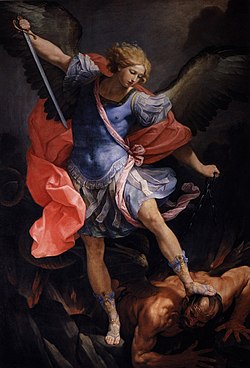 Michael and Satan, by Guido Reni, c. 1636
 St Michael's Victory over the Devil, by Jacob Epstein at Coventry Cathedral
 The fall of the rebel angels, by Charles Le Brun, after 1680
 Michael battles the rebel angels, by Sebastiano Ricci, c. 1720
 Michael battles the rebel angels, by Johann Georg Unruhe 1793
 Detail, Georg Unruhe
 Michael and the Dragon. Die Bibel in Bildern (Revelation) engraving by Julius Schnorr von Carolsfeld, 1860.
 1866 Gustave Doré illustration for Paradise Lost, depicting a melee between the angels.


Music
A choral antiphon for the feast of Michaelmas, Factum est Silentium, paraphrases the events described in Revelation 8:1[34] and Revelation 12:7–12:[35]
Factum est silentium in caelo,
Dum committeret bellum draco cum Michaele Archangelo.
Audita est vox millia millium dicentium:
Salus, honor et virtus omnipotenti Deo.
Millia millium minestrabant ei et decies centena millia assistebant ei.
Alleluia.
Dum draco committeret bellum et Michael pugnavit cum eo et fecit victoriam.
There was silence in heaven
When the dragon fought with the Archangel Michael.
The voice of a thousand thousand was heard saying:
Salvation, honour and power be to almighty God.
A thousand thousand ministered to him and ten hundreds of thousands stood before him.
Alleluia.
For a serpent was waging war; and Michael fought with him and emerged victorious.
The antiphon has been set as a choral motet by a number of composers including Felice Anerio, Richard Dering, Melchior Franck, Alessandro Grandi and Costanzo Porta.[36][37] A hymn written by the German poet and hymnodist Friedrich Spee in 1621, Unüberwindlich starker Held ("Invincible strong hero"), also makes reference to the Archangel Michael overcoming the dragon.[38] Bach's cantata Es erhub sich ein Streit, BWV 19 is on this subject.
Other
Other pieces of media to have referenced the War in Heaven, either as direct depictions or textual allusions, include Warhammer 40K, Babylon 5 and the Doom series. The War in Heaven is a 1999 Christian-themed Doom clone developed by Eternal Warriors and published by ValuSoft.[39]
See also
References
- ↑ Revelation 12:7–9
- ↑ Joan Young Gregg (1997). Devils, Women, and Jews: Reflections of the Other in Medieval Sermon Stories. State University of New York. p. 28. ISBN 0-7914-3417-6.
- ↑ Revelation 12:7–10
- ↑ Revelation 12:4
- ↑ Revelation 12:7
- ↑ Sections 14–15 of the Armenian Archived 2 October 2020 at the Wayback Machine, Georgian, and Latin versions of the Life of Adam and Eve
- ↑ Quran 7:11–12 Archived 22 February 2012 at the Wayback Machine
- ↑ Oxford Dictionary of the Christian Church (Oxford University Press 2005 ISBN 978-0-19-280290-3), article Origen
- ↑ Book 5, lines 654–668 "Paradise Lost: Book V (1667)". Archived from the original on 16 May 2008. Retrieved 29 June 2008.
[...] but not so wak'd / Satan, so call him now, his former name / Is heard no more [in] Heav'n; he of the first, / If not the first Arch-Angel, great in Power, / In favour and præeminence, yet fraught / With envie against the Son of God, that day / Honourd by his great Father, and proclaimd / Messiah King anointed, could not beare / Through pride that sight, and thought himself impaird. / Deep malice thence conceiving & disdain, / Soon as midnight brought on the duskie houre / Friendliest to sleep and silence, he resolv'd / With all his Legions to dislodge, and leave / Unworshipt, unobey'd the Throne supream / Contemptuous [...].
- ↑ Jonathan Edwards; Sereno Edwards Dwight; David Brainerd (1830). The Works of President Edwards: With a Memoir of His Life ... G. & C. & H. Carvill. p. 87.
- ↑ Holweck, Frederick (1911). "St. Michael the Archangel". The Catholic Encyclopedia. Vol. 10. New York. Retrieved 28 January 2010.
{{cite encyclopedia}}: CS1 maint: location missing publisher (link) - ↑ M. Eugene Boring; Fred B. Craddock (2004). The People's New Testament Commentary. Louisville, Kentucky: Westminster John Knox Press. pp. 799–800. ISBN 0-664-22754-6.
The ejection of the Accuser from heaven is not (as in Milton's Paradise Lost) the story of the origin of Satan as an angel who rebelled against God in primeval times. Neither here nor elsewhere do biblical authors give speculative 'explanations' about the origin of Satan or evil. Such a myth had developed in pre-Christian Judaism (1–2 En.), and there are fragmentary echoes of it in the New Testament (Jude 6; 2 Pet. 2:4). That is not the picture in this story, which does not take place in primeval times but at the eschatological time of the establishment of God's kingdom by the life, death, and exaltation of Jesus [...].
- ↑ Compare: "Revelation 12 Matthew Henry's Commentary on the Whole Bible". Archived from the original on 21 May 2008. Retrieved 28 July 2008.
It is generally agreed by the most learned expositors that the narrative we have in this and the two following chapters, from the sounding of the seventh trumpet to the opening of the vials, is not a prediction of things to come, but rather a recapitulation and representation of things past [...].
- ↑ Compare: "Revelation 12 Jamieson-Fausset-Brown Bible Commentary". Archived from the original on 21 May 2008. Retrieved 19 June 2008.
It is generally agreed by the most learned expositors that the narrative we have in this and the two following chapters, from the sounding of the seventh trumpet to the opening of the vials, is not a prediction of things to come, but rather a recapitulation and representation of things past, which, as God would have the apostle to foresee while future, he would have him to review now that they were passed, that he might have a more perfect idea of them in his mind, and might observe the agreement between the prophecy and that Providence that is always fulfilling the scriptures.
- ↑ "Revelation 12 Matthew Henry's Commentary". Mhc.biblecommenter.com. Retrieved 1 December 2016.
12:7–11 The attempts of the dragon proved unsuccessful against the church, and fatal to his own interests. The seat of this war was in heaven; in the church of Christ, the kingdom of heaven on earth. The parties were Christ, the great Angel of the covenant, and his faithful followers; and Satan and his instruments. The strength of the church is in having the Lord Jesus for the Captain of their salvation. Pagan idolatry, which was the worship of devils, was cast out of the empire by the spreading of Christianity. [...] The servants of God overcame Satan by the blood of the Lamb, as the cause. By the word of their testimony: the powerful preaching of the gospel is mighty, through God, to pull down strongholds. By their courage and patience in suffering: they loved not their lives so well but they could lay them down in Christ's cause. These were the warriors and the weapons by which Christianity overthrew the power of pagan idolatry; and if Christians had continued to fight with these weapons, and such as these, their victories would have been more numerous and glorious, and the effects more lasting. The redeemed overcame by a simple reliance on the blood of Christ, as the only ground of their hopes.
- ↑ One hundred and seventy-three sermons on several subjects: Volume 1, p. 137 Samuel Clarke, John Clarke, J. Leathley ((Dublin)), 1751 "7. that X. there was War in Heaven; Michael and his Angels *- fought against the Dragon, and the Dragon fought and his Angels [...] But the Meaning of this Passage is not literal, as if the Devil had the power to fight against the Angels or Ministers of God's government"
- ↑
Smith, Charles Edward (1890). "The Church and the Dragon". The World Lighted: A Study of the Apocalypse. New York: Funk & Wagnalls. pp. 128–129.
What, now, is the war in heaven? Of course not literal war, nor literally in heaven; not the actual clash of arms between Michael and his angels, and Satan and his wicked cohorts. But something on earth worthy to be represented by such a Titanic contest. What can that be, if not the contest in the visible church concerning true and false doctrine?
- ↑ Top, Brent L. (1992). "War in Heaven". In Ludlow, Daniel H (ed.). Encyclopedia of Mormonism. New York: Macmillan Publishing. pp. 1546–1547. ISBN 0-02-879602-0. OCLC 24502140.
- ↑ Matthew 25:41
- ↑ "War in Heaven". The Church of Jesus Christ of Latter-day Saints. Retrieved 31 May 2020.
- ↑ "Plan of Salvation".
- ↑ "Fundamental Beliefs". Seventh-day Adventist Church. Archived from the original on 10 March 2006. Retrieved 15 September 2006.
- ↑ Isaiah 14:4–17
- ↑ Ezekiel 28:14
- 1 2 "Lucifer". JewishEncyclopedia.com. Retrieved 1 December 2016.
The brilliancy of the morning star, which eclipses all other stars, but is not seen during the night, may easily have given rise to a myth such as was told of Ethana and Zu: he was led by his pride to strive for the highest seat among the star-gods on the northern mountain of the gods (comp. Ezek. xxviii. 14; Ps. xlviii. 3 [A.V. 2]), but was hurled down by the supreme ruler of the Babylonian Olympus. Stars were regarded throughout antiquity as living celestial beings (Job xxxviii. 7).
- ↑ Job 38:7
- ↑ "Lucifer". JewishEncyclopedia.com. Retrieved 1 December 2016.
- ↑ MANṠŪR, Menahem (1964). The Dead Sea Scrolls: A College Textbook and a Study Guide. Brill Archive. p. 107.
- ↑ James R. Davila (2003). The Dead Sea scrolls as background to postbiblical Judaism and early Christianity: papers from an international conference at St. Andrews in 2001. Leiden: Brill Publishers. p. 252. ISBN 978-90-04-12678-7.
- ↑ Fred L. Horton (2005). The Melchizedek Tradition. Cambridge University Press. p. 81. ISBN 978-0-521-01871-5.
- ↑ Joseph L. Angel (2010). Otherworldly and Eschatological Priesthood in the Dead Sea Scrolls. Brill. pp. 153–154. ISBN 978-90-04-18145-8.
- ↑ "Fall of Angels". JewishEncyclopedia.com. Retrieved 1 December 2016.
- ↑ "Paradise Lost: Book 1". Archived from the original on 15 November 2016. Retrieved 15 July 2017.
- ↑ Revelation 8:1
- ↑ Revelation 12:7–12
- ↑ Shrock, Dennis (2009). "2. the Renaissance Era: Richard Dering (Deering) ca. 1580-1630". Choral Repertoire. Oxford University Press. ISBN 9780199716623.
- ↑ Gant, Andrew (2017). O Sing Unto the Lord: A History of English Church Music. University of Chicago Press. ISBN 9780226469621.
- ↑ Keller, Karl. "Das St. Michaelslied von Friedrich Spee und "Der deutsche Michel"" (PDF). historicum.net (in German). Archived from the original (PDF) on 20 December 2014. Retrieved 3 October 2017.
- ↑ "The War in Heaven". www.gamevortex.com. Retrieved 11 November 2020.
Further reading
- Christoph Auffarth, Loren T. Stuckenbruck (Eds.): The Fall of the Angels. Brill, Leiden 2004 (Themes in Biblical Narrative, 6), ISBN 90-04-12668-6.
- Mareike Hartmann: Höllen-Szenarien. Eine Analyse des Höllenverständnisses verschiedener Epochen anhand von Höllendarstellungen. Lit, Münster 2005 (Ästhetik – Theologie – Liturgik, 32), ISBN 3-8258-7681-0.
- Neil Forsyth, The Old Enemy: Satan & the Combat Myth (Princeton University Press) 1987.
External links
- The Fall of Satan, beliefnet.com
- The Fall of Angels, cfdevotionals.org
- A Rebellion in Heaven Archived 14 February 2021 at the Wayback Machine, christiancourier.com
- Lucifer, Jewish Encyclopedia
- Fall of Angels, Jewish Encyclopedia
- War in Heaven, warinheaven.com

