A voiceless bilabial trill is a type of consonantal sound, used in some spoken languages. The symbol in the International Phonetic Alphabet that represents this sound is ⟨ʙ̥⟩. Some sources use a para-IPA symbol ⟨ᴘ⟩ to transcribe this sound.[1][2]
This sound is typologically extremely rare. It occurs in languages such as Pará Arára.[3] Only a few languages contrast voiced and voiceless bilabial trills phonemically – e.g. Mangbetu and Dongo of Congo and Ninde of Vanuatu.[4][5][6]
Features
Features of a bilabial trill:
- Its manner of articulation is trill, which means it is produced by directing air over an articulator so that it vibrates.
- Its place of articulation is bilabial, which means it is articulated with both lips.
- Its phonation is voiceless, which means it is produced without vibrations of the vocal cords. In some languages the vocal cords are actively separated, so it is always voiceless; in others the cords are lax, so that it may take on the voicing of adjacent sounds.
- It is an oral consonant, which means that air is not allowed to escape through the nose.
- Because the sound is not produced with airflow over the tongue, the median–lateral dichotomy does not apply.
- Its airstream mechanism is pulmonic, which means it is articulated by pushing air only with the intercostal muscles and abdominal muscles, as in most sounds.
Occurrence
Plain
| Language | Word | IPA | Meaning | Notes |
|---|---|---|---|---|
| Ahamb[7] | [ŋãˈʙ̥̍s] | 'it foams' | Contrasts /ʙ̥, ᵐʙ, ⁿᵈr/. | |
| Lese[8] | [uk͡pʙ̥u] | 'head' | Allophone of /k͡p/. | |
| Neverver[9] | [naɣaᵐʙ̥] | 'fire, firewood' | Allophone of /p/ before /u/[10] | |
| Pará Arára[11] | [ʙ̥uta] | 'to throw away' | ||
| Dongo[6] | ppo̍ppo̍-kó | [ʙ̥ōʙ̥ōkó] | 'wings' | Contrasts with /ʙ/ and /p/; has allophone [pʰ]. |
Prestopped trills and stops with trill release
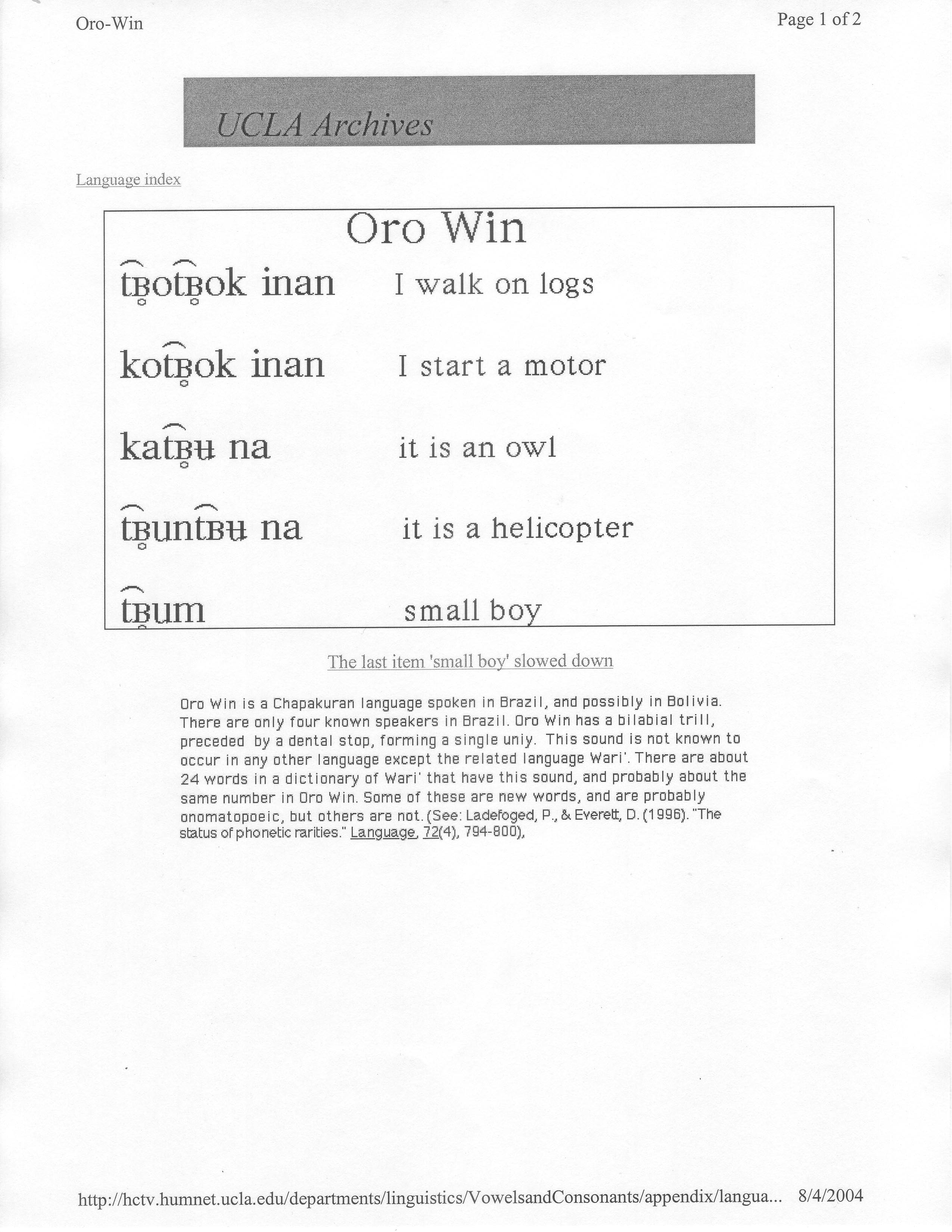
There is also a very rare voiceless bilabially post-trilled dental or alveolar stop, [t̪͡ʙ̥] (written ⟨tᵖ̃⟩ in Everett & Kern) reported from a few words in the Chapacuran languages Wariʼ, Itene (More),[12] and Oro Win, as well as Sangtam, a Naga language. The sound also appears as an allophone of the labialized voiceless alveolar stop /tʷ/ of Abkhaz and Ubykh, but in those languages it is more often realised by a doubly articulated stop [t͡p]. In the Chapacuran languages, [tʙ̥] is reported almost exclusively before rounded vowels such as [o] and [y].
Additionally, Lese has another rare trilled affricate, a labial–velar trilled affricate [k͡pʙ̥], which occurs as an allophone of the voiceless labial–velar plosive [k͡p].[8]
In some languages, the trill may be voiced, particularly when syllabic; see Voiced bilabial trill § Prestopped trills and stops with trill release.
| Language | Word | IPA | Meaning | Notes |
|---|---|---|---|---|
| Itene[12] | [ˈt𐞄̥u] | 'toad' | Phonemic; alveolar | |
| Oro Win[13] | [t̪͡ʙ̥um] | 'small boy' | Noted as 'a bilabial trill, preceded by a dental stop, forming a single uni[t]'[14] | |
| Sangtam[15] | [t̪͡ʙ̥ʰʌ] | 'plate' | Contrasts aspirated /t̪͡ʙ̥ʰ/ and unaspirated /t̪͡ʙ̥/, noted as 'prestopped trills'. The trill in the unaspirated consonant is typically voiced as [t̪͡ʙ] when word-medial.[16] | |
| Ubykh[17][full citation needed] | [t͡ʙ̥aχəbza] | 'Ubykh language' | Allophone of /tʷ/. See Ubykh phonology | |
| Wariʼ[18] | totowe' | [t̪͡ʙ̥ot̪͡ʙ̥oˈweʔ] | 'chicken' | Occurs only before /o/ and /y/, appearing almost exclusively in older speakers; often allophonic with [t] |
Notes
- ^ Olson, Kenneth S. (2022-05-05). "The Nonexistence of the Plain Bilabial Trill Phoneme". Proceedings of the Linguistic Society of America. 7 (1): 5239. doi:10.3765/plsa.v7i1.5239.
- ^ Rangelov, Tihomir; Walworth, Mary; Barbour, Julie (2023). "A multifaceted approach to understanding unexpected sound change: The bilabial trills of Vanuatu's Malekula Island". Diachronica. doi:10.1075/dia.21051.ran. hdl:10289/15510. ISSN 0176-4225. Retrieved 2023-05-07.
- ^ de Souza, Isaac Costa (2010). "3". A Phonological Description of "Pet Talk" in Arara (MA). University of North Dakota. S2CID 61247622.
- ^ Linguist Wins Symbolic Victory for 'Labiodental Flap'. NPR (2005-12-17). Retrieved on 2010-12-08.
- ^ LINGUIST List 8.45: Bilabial trill. Linguistlist.org. Retrieved on 2010-12-08.
- ^ a b Pasch, Helma (1986). Die Mba-Sprachen: Die Nominalklassensysteme und die genetische Gliederung einer Gruppe von Ubangi-Sprachen. Sprache und Geschichte in Afrika (SUGIA) (in German). Vol. Suplement 6. Köln: Rüdiger Köppe. p. 359. ISSN 0720-0986.
- ^ Rangelov, Tihomir (2019). "The bilabial trills of Ahamb (Vanuatu): Acoustic and articulatory properties" (PDF). In Calhoun, S.; Escudero, P.; Tabain, M.; Warren, P. (eds.). Proceedings of the 19th International Congress of Phonetic Sciences, Melbourne, Australia 2019. Canberra: Australasian Speech Science and Technology Association. pp. 1292–1296.
- ^ a b Demolin, Didier; Teston, Bernard (September 1997). "Phonetic characteristics of double articulations in some Mangbutu-Efe languages" (PDF). International Speech Communication Association: 803–806.
- ^ Barbour, Julie (2012). A Grammar of Neverver. Mouton de Gruyter. pp. 33–34. ISBN 9783110289619.
- ^ Barbour 2012, pp. 24–25.
- ^ de Souza, Isaac Costa (2010). "The Arara Language". A Phonological Description of "Pet Talk" in Arara (MA thesis). University of North Dakota. Retrieved 2014-01-09.
{{cite thesis}}: CS1 maint: url-status (link) - ^ a b Angenot-de-Lima, Geralda (2002). Description Phonologique, Grammaticale et Lexicale du Moré, Langue Amazonienne de Bolivie et du Brésil (PDF). Vol. 1. Rijksuniversiteit te Leiden dissertation. p. 67.
- ^ Lev, Michael; Stark, Tammy; Chang, Will (2012). "Phonological inventory of Oro Win". The South American Phonological Inventory Database (version 1.1.3 ed.). Berkeley: University of California: Survey of California and Other Indian Languages Digital Resource.
- ^ Oro-Win, UCLA Archives, p. 1, archived from the original on June 1, 2012
- ^ Coupe (2015) "Prestopped bilabial trills in Sangtam", Proceedings of the 18th International Congress of Phonetic Sciences, Glasgow, 10–14 August 2015
- ^ Coupe, Alexander (2020), "Northern Sangtam phonetics, phonology and word list" (PDF), Linguistics of the Tibeto-Burman Area, 43 (1): 148–189, doi:10.1075/ltba.19014.cou
- ^ Ladefoged (2005:165)
- ^ Everett, Daniel; Kern, Barbara (1997). Wariʼ: The Pacaas Novos language of western Brazil. London: Routledge. p. 385.