


A solar deity or sun deity is a deity who represents the Sun or an aspect thereof. Such deities are usually associated with power and strength. Solar deities and Sun worship can be found throughout most of recorded history in various forms. The English word sun derives from Proto-Germanic *sunnǭ.[1] The Sun is sometimes referred to by its Latin name Sol or by its Greek name Helios.
Overview

Predynasty Egyptian beliefs attribute Atum as the Sun god and Horus as a god of the sky and Sun. As the Old Kingdom theocracy gained influence, early beliefs were incorporated into the expanding popularity of Ra and the Osiris-Horus mythology. Atum became Ra-Atum, the rays of the setting Sun. Osiris became the divine heir to Atum's power on Earth and passed his divine authority to his son, Horus.[2][better source needed] Other early Egyptian myths imply that the Sun is incorporated with the lioness Sekhmet at night and is reflected in her eyes; or that the Sun is found within the cow Hathor during the night and reborn each morning as her son (bull).[3][better source needed]
Mesopotamian Shamash played an important role during the Bronze Age, and "my Sun" was eventually used to address royalty. Similarly, South American cultures have a tradition of Sun worship as with the Incan Inti.[4]
In Germanic mythology, the solar deity is Sol; in Vedic, Surya; and in Greek, Helios (occasionally referred to as Titan) and (sometimes) as Apollo. In Proto-Indo-European mythology the sun appears to be a multilayered figure manifested as a deity but also perceived as the eye of the sky father Dyeus.[5]
Solar myth
Three theories exercised great influence on nineteenth and early twentieth century mythography. The theories were the "solar mythology" of Alvin Boyd Kuhn and Max Müller, the tree worship of Mannhardt, and the totemism of J. F. McLennan.[6]
Müller's "solar mythology" was born from the study of Indo-European languages. Of them, Müller believed Archaic Sanskrit was the closest to the language spoken by the Aryans. Using the Sanskrit names for deities as a base, he applied Grimm's law to names for similar deities from different Indo-European groups to compare their etymological relationships to one another. In the comparison, Müller saw the similarities between the names and used these etymological similarities to explain the similarities between their roles as deities. Through the study, Müller concluded that the Sun having many different names led to the creation of multiple solar deities and their mythologies that were passed down from one group to another.[7]
R. F. Littledale criticized the Sun myth theory, pointing out that by his own principles, Max Müller was himself only a solar myth. Alfred Lyall delivered another attack on the same theory's assumption that tribal gods and heroes, such as those of Homer, were only reflections of the Sun myth by proving that the gods of certain Rajput clans were actual warriors who founded the clans a few centuries ago, and were the ancestors of the present chieftains.[6]
Solar vessels and chariots
Solar boats


The Sun was sometimes envisioned as traveling through the sky in a boat. A prominent example is the solar barque used by Ra in ancient Egyptian mythology.[8] The Neolithic concept of a "solar barge" (also "solar bark", "solar barque", "solar boat" and "sun boat", a mythological representation of the Sun riding in a boat) is found in the later myths of ancient Egypt, with Ra and Horus. Several Egyptian kings were buried with ships that may have been intended to symbolize the solar barque,[9] including the Khufu ship that was buried at the foot of the Great Pyramid of Giza.[10]
Solar boats and similar vessels also appear in Indo-European mythologies, such as a 'hundred-oared ship' of Surya in the Rig Veda, the golden boat of Saulė in Baltic mythology, and the golden bowl of Helios in Greek mythology.[11][12] Numerous depictions of solar boats are known from the Bronze Age in Europe.[13][14][15] Possible solar boat depictions have also been identified in Neolithic petroglyphs from the Megalithic culture in western Europe,[16] and in Mesolithic petroglyphs from northern Europe.[17]
Examples of solar vessels include:
- Neolithic petroglyphs which are interpreted as depicting solar barges.
- The many early Egyptian goddesses that were seen as sun deities, and the later gods Ra and Horus were depicted as riding in a solar barge. In Egyptian myths of the afterlife, Ra rides in an underground channel from west to east every night so that he can rise in the east the next morning.
- The Nebra sky disk, c. 1800–1600 BC, associated with the Unetice culture, which is thought to show a depiction of a gold solar boat.[18]
- Gold lunulae associated with the Bell Beaker culture, c. 2400–2000 BC, thought to represent solar boats.[19]
- Nordic Bronze Age petroglyphs, including those found in Tanumshede, often contain barges and sun crosses in different constellations. Solar boat imagery also appears on bronze razors from the period.
- Miniature gold boats from Nors in Denmark, dating from the Nordic Bronze Age.[20]
- The Caergwrle Bowl from Wales, dating from the British Bronze Age, c. 1300 BC.[21]
- Solar boat motifs depicted on bronze artefacts from the Urnfield culture and Lusatian culture, c. 1300–500 BC.
- Depictions of solar boats on Iron Age Celtic artefacts, such as the Petrie Crown from Ireland (1st century AD), and ornaments on the Vix grave wagon from France (500 BC).[22][23][24]
Gallery
 The 'sun-bird-boat' motif often found on Urnfield culture artefacts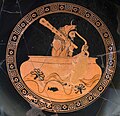


Solar chariots

The concept of the "solar chariot" is younger than that of the solar barge and is typically Indo-European, corresponding with the Indo-European expansion after the invention of the chariot in the 2nd millennium BC.[26] The reconstruction of the Proto-Indo-European religion features a "solar chariot" or "sun chariot" with which the Sun traverses the sky.[27]
Chariots were introduced to Egypt in the Hyksos period, and were seen as solar vehicles associated with the sun god in the subsequent New Kingdom period.[28] A gold solar boat model from the tomb of Queen Ahhotep, dating from the beginning of the New Kingdom (c. 1550 BC), was mounted on four-spoked chariot wheels.[29] Similarities have been noted with the Trundholm Sun Chariot from Denmark, dating from c. 1500–1400 BC, which was also mounted on four-spoked wheels.[18]
Examples of solar chariots include:
- In Norse mythology, the chariot of the goddess Sól, drawn by Árvakr and Alsviðr (‘early awake’ and ‘all-swift’). The Trundholm sun chariot dates to the Nordic Bronze Age, about 2,500 years earlier than written attestations of the Norse myth, but is often associated with it.
- Greek Helios (or Apollo) riding in a chariot.[30] (See also Phaëton)[31]
- Sol Invictus depicted riding a quadriga on the reverse of a Roman coin.[32]
- Hindu Surya riding in a chariot drawn by seven horses.
In Chinese culture, the sun chariot is associated with the passage of time. For instance, in the poem Suffering from the Shortness of Days, Li He of the Tang dynasty is hostile towards the legendary dragons that drew the sun chariot as a vehicle for the continuous progress of time.[33] The following is an excerpt from the poem:
Gender

Solar deities are often thought of as male (and lunar deities as being female) but the opposite has also been the case.[34] In Germanic mythology, the Sun is female, and the Moon is male. Other European cultures that have sun goddesses include the Lithuanians (Saulė) and Latvians (Saule), the Finns (Päivätär, Beiwe) and the related Hungarians. Sun goddesses are found around the world in Australia (Bila, Wala); in Indian tribal religions (Bisal-Mariamma, Bomong, 'Ka Sgni) and Sri Lanka (Pattini); among the Hittites (Wurusemu), Berbers (Tafukt), Egyptians (Hathor, Sekhmet), and Canaanites (Shapash); in the Canary Islands (Chaxiraxi, Magec); in Native America, among the Cherokee (Unelanuhi), Natchez (Oüa Chill/Uwahci∙ł), Inuit (Siqiniq), and Miwok (He'-koo-lās); and in Asia among the Japanese (Amaterasu).[34]
The cobra (of Pharaoh, son of Ra), the lioness (daughter of Ra), and the cow (daughter of Ra), are the dominant symbols of the most ancient Egyptian deities. They were female and carried their relationship to the sun atop their heads, and their cults remained active throughout the history of the culture. Later another sun god (Aten) was established in the eighteenth dynasty on top of the other solar deities, before the "aberration" was stamped out and the old pantheon re-established. When male deities became associated with the sun in that culture, they began as the offspring of a mother (except Ra, King of the Gods who gave birth to himself).[citation needed][35]
Africa
Ancient Egypt

Sun worship was prevalent in ancient Egyptian religion. From at least the 4th Dynasty of ancient Egypt, the Sun was worshiped as the deity Ra (meaning simply 'the sun'), and portrayed as a falcon-headed god surmounted by the solar disk, and surrounded by a serpent. Ra supposedly gave warmth to the living body, symbolized as an ankh: a "☥" shaped amulet with a looped upper half. The ankh, it was believed, was surrendered with death, but could be preserved in the corpse with appropriate mummification and funerary rites. The supremacy of Ra in the Egyptian pantheon was at its highest with the Fifth Dynasty, when open-air solar temples became common.
In the Middle Kingdom of Egypt, Ra lost some of his preeminence to Osiris, lord of the west, and judge of the dead. In the New Empire period, the Sun became identified with the dung beetle, whose spherical ball of dung was identified with the Sun. In the form of the sun disc Aten, the Sun had a brief resurgence during the Amarna Period when it again became the preeminent, if not only, divinity for the pharaoh, Akhenaten.[36][37]
The Sun's movement across the sky represents a struggle between the pharaoh's soul and an avatar of Osiris. Ra travels across the sky in his solar-boat; at dawn he drives away the god of chaos, Apep.[38][39] The "solarisation" of several local gods (Khnum-Ra, Min-Ra, Amun-Ra) reached its peak in the period of the Fifth Dynasty.[40]
| ||
| Akhet (horizon) in hieroglyphs | ||
|---|---|---|


Rituals to the god Amun, who became identified with the sun god Ra, were often carried out on the top of temple pylons. A pylon mirrored the hieroglyph for 'horizon' or akhet, which was a depiction of two hills "between which the sun rose and set",[41] associated with recreation and rebirth. On the first pylon of the temple of Isis at Philae, the pharaoh is shown slaying his enemies in the presence of Isis, Horus, and Hathor.[42]
In the Eighteenth Dynasty, the earliest-known monotheistic head of state, Akhenaten, changed the polytheistic religion of Egypt to a monotheistic one, Atenism. All other deities were replaced by the Aten, including Amun-Ra, the reigning sun god of Akhenaten's own region. Unlike other deities, Aten did not have multiple forms. His only image was a disk—a symbol of the Sun.[43]
Soon after Akhenaten's death, worship of the traditional deities was reestablished by the religious leaders (Ay the High-Priest of Amun-Ra, mentor of Tutankhaten/Tutankhamen) who had adopted the Aten during the reign of Akhenaten.[44]
Kongo

In Kongo religion, Nzambi Mpungu is the Sky Father and god of the Sun, while that his female counterpart, Nzambici, is Sky Mother and the god of the Moon and Earth.[45] The Sun is very significant to Bakongo people, who believe that the position of the sun marks the different seasons of a Kongo person's life as they transition between the four moments of life: conception (musoni), birth (kala), maturity (tukula), and death (luvemba). The Kongo cosmogram, a sacred symbol in Bakongo culture, depicts these moments of the sun.[45][46]
Kalenjin
Kalenjin mythology was based upon the belief in a supreme god, Asis or Cheptalel, represented in the form of the sun (asista), although the sun itself was not considered to be God. He lives in the sky and is supreme, omnipotent, and the guarantor of right.[47] Among the Northern sections of the Kalenjin he is also commonly referred to as Tororut.[48] Beneath Asis is Elat, who controls thunder and lightning.
Akan
In Akan mythology, Nyame is the creator of all things, including the sun. One of Nyame's titles is Amowia, meaning giver/creator of the sun.[49] Awia, also spelt Owia, was the personification of the sun, an ewim abosom, older twin brother of Osrane (moon), and brother of Esum (darkness).[50] Due to the climate of Ghana, the Akan tribes viewed the sun as both capable of great heat and droughts and life - giving light that causes plant growth. Under his light, disputes were settled.[50]
He was also associated with the dry season, and an aetiological myth to explain the Seasons in Sub-Saharan Africa was that Awia split his dominion over the daylight hours with his wife, Nsuoto (rain), in half, leading to his half being the dry season and her half being the rain season. The aetiological myth explaining the day and night cycle explains that when Awia and Osrane were both interested in marrying the Morning Star (Anopa Nsoromma), she chose Osrane, and Awia was upset and fled west to hide in shame, whilst Osrane was forced to provide light on his own. When Nyame offered him marriage to Nsuoto as reconciliation, they married in the east and Awia rose again, however whenever he sees Osrane and his wife together he flees in shame, causing Osrane to briefly take his place. By Nsuoto, Awia sired the cloud spirits (Motiamununkum), and Nyantunkom, personification of the rainbow, who was part of the royal retinue of Nyame or Awia depending on the source, although in others Awia was given Nyantunkom as a promise that his reward for answering Nyame's riddle correctly with the help of Anansi would not be stolen by his brothers.[50]
Americas
Aztec mythology


In Aztec mythology, Tonatiuh (Nahuatl languages: Ollin Tonatiuh, "Movement of the Sun") was the sun god. The Aztec people considered him the leader of Tollan (heaven). He was also known as the fifth sun, because the Aztecs believed that he was the sun that took over when the fourth sun was expelled from the sky. According to their cosmology, each sun was a god with its own cosmic era. According to the Aztecs, they were still in Tonatiuh's era. According to the Aztec creation myth, the god demanded human sacrifice as tribute and without it would refuse to move through the sky. The Aztecs were fascinated by the Sun and carefully observed it, and had a solar calendar similar to that of the Maya. Many of today's remaining Aztec monuments have structures aligned with the Sun.[51]
In the Aztec calendar, Tonatiuh is the lord of the thirteen days from 1 Death to 13 Flint. The preceding thirteen days are ruled over by Chalchiuhtlicue, and the following thirteen by Tlaloc.[citation needed]
Navajo mythology
Tsohanoai is the Navajo sun god, who carries the sun on his back during the day, and hangs it on a peg on the West wall of his house at night.[52]
Incan mythology
Inti is the ancient Incan sun god. He is revered as the national patron of the Inca state. Although most consider Inti the sun god, he is more appropriately viewed as a cluster of solar aspects, since the Inca divided his identity according to the stages of the sun.[53] Inti is represented as a golden disk with rays and a human face.
The Inca dedicated many ceremonies to the Sun in order to ensure the Sapa Inca's welfare.[54] The Incas would set aside large quantities of natural and human resources throughout the empire for Inti. Each conquered province was supposed to dedicate a third of their lands and herds to Inti as mandated by the Inca. Each major province would also have a Sun Temple in which male and female priests would serve.[54]
Asia
Armenian mythology
In Armenian mythology and in the vicinity of Carahunge, the ancient site of interest in the field of archaeoastronomy, people worshiped a powerful deity or intelligence called Ara, embodied as the sun (Ar[55] or Arev). The ancient Armenians called themselves "children of the sun".[56] (Russian and Armenian archaeoastronomers have suggested that at Carahunge seventeen of the stones still standing were associated with observations of sunrise or sunset at the solstices and equinoxes.[57])
Chinese mythology


Chinese mythology features multiple sun gods, including Shang Jia, a Predynastic Shang ruler-turned-deity,[58] and Xihe, the sun goddess who governs time, and her ten sun sons born to her, and Di Jun, one of the highest deities. These ten suns can transform into a three-legged crow. There is also Dongjun, the sun and moon god who governs spring and the east, and the Tai Yang Xing Jun, who governs the celestial body itself, the Sun.
In Chinese mythology (cosmology), there were originally ten suns in the sky, who were all brothers. They were supposed to emerge one at a time as commanded by the Di Jun. They were all very young and loved to fool around. Once they decided to all go into the sky to play, all at once. This made the world too hot for anything to grow. A hero named Hou Yi, honored to this day, shot down nine of them with a bow and arrow to save the people of the Earth.[59]
In another myth, a solar eclipse was said to be caused by a magical dog or dragon biting off a piece of the Sun. The referenced event is said to have occurred around 2136 BC; two royal astronomers, Ho and Hi, were executed for failing to predict the eclipse. There was a tradition in China to make lots of loud celebratory sounds during a solar eclipse to scare the sacred beast away.[60]
The Deity of the Sun in Chinese mythology is Ri Gong Tai Yang Xing Jun (Tai Yang Gong/Grandfather Sun) or Star Lord of the Solar Palace, Lord of the Sun. Tai Yang Xing Jun is usually depicted with the Star Lord of the Lunar Palace, Lord of the Moon, Yue Gong Tai Yin Xing Jun (Tai Yin Niang Niang/Lady Tai Yin).[61]
Pre-Islamic Arabia
The concept of the sun as a deity in Pre-Islamic Arabia, was abolished only under Muhammad.[62] The Arabian solar deity appears to have been a goddess, Shams/Shamsun, most likely related to the Canaanite Shapash and broader middle-eastern Shamash. She was the patron goddess of Himyar, and possibly exalted by the Sabaeans.[63][unreliable source?][64][65]
Yazidism
In Yazidism, the angel Şêşims is venerated as the Xudan or Lord of sun and light. He is also linked with fire, which is his terrestrial counterpart, and oaths, which are sworn by the doorway of his shrine. Annually, during the Feast of the Assembly, a ceremonial bull sacrifice is performed in front of his shrine at Lalish.[66][67][68][69] Yazidi religious texts refer to the light of the sun as a manifestation of God's light, therefore, Yazidis direct their faces in the sun's direction while praying. There are daily Yazidi prayers that are recited during the daytime, divided into three main phases of the day, the morning prayers include "Dua Şifaqê" (the dawn prayer), "Dua Sibê" (the morning prayer), "Duaya Rojhelatî" (the sunrise prayer). For the noon there is "Dua Nîvro" (the noon prayer) and at evening there is the "Duaya Hêvarî" (the evening prayer).[69]
Europe
Albanian paganism


The Sun (Albanian: Diell-i) holds the primary role in Albanian pagan customs, beliefs, rituals, myths, and legends. Albanian major traditional festivities and calendar rites are based on the Sun, worshiped as the god of light, sky and weather, giver of life, health and energy, and all-seeing eye.[72] In Albanian tradition the fire – zjarri, evidently also called with the theonym Enji – worship and rituals are particularly related to the cult of the Sun. Ritual calendar fires or bonfires are traditionally kindled before sunrise in order to give strength to the Sun and to ward off evil.[73] Many rituals are practiced before and during sunrise, honoring this moment of the day as it is believed to give energy and health to the body.[74] As the wide set of cultic traditions dedicated to him indicates, the Albanian Sun-god appears to be an expression of the Proto-Indo-European Sky-god (Zot or Zojz in Albanian).[75]
Albanians were firstly described in written sources as worshippers of the Sun and the Moon by German humanist Sebastian Franck in 1534,[76] but the Sun and the Moon have been preserved as sacred elements of Albanian tradition since antiquity. Illyrian material culture shows that the Sun was the chief cult object of the Illyrian religion.[77] Finding correspondences with Albanian folk beliefs and practices, the Illyrian Sun-deity is figuratively represented on Iron Age plaques from Lake Shkodra as the god of the sky and lightning, also associated with the fire altar where he throws lightning bolts.[78] The symbolization of the cult of the Sun, which is often combined with the crescent Moon, is commonly found in a variety of contexts of Albanian folk art, including traditional tattooing, grave art, jewellery, embroidery, and house carvings.[79] Solemn oaths (Besa), good omens, and curse formulas, involve and are addressed to, or taken by, the Sun.[80] Prayers to the Sun, ritual bonfires, and animal sacrifices have been common practices performed by Albanians during the ritual pilgrimages on mountain tops.[81]
In Albanian pagan beliefs and mythology the Sun is a personified male deity, and the Moon (Hëna) is his female counterpart.[82][83] In pagan beliefs the fire hearth (vatra e zjarrit) is the symbol of fire as the offspring of the Sun.[84] In some folk tales, myths and legends the Sun and the Moon are regarded as husband and wife, also appearing as the parents of E Bija e Hënës dhe e Diellit ("the Daughter of the Moon and the Sun"); in others the Sun and the Moon are regarded as brother and sister, but in this case they are never considered consorts.[82][83] Nëna e Diellit ("the Mother of the Sun" or "the Sun's Mother") also appears as a personified deity in Albanian folk beliefs and tales.[85]
Albanian beliefs, myths and legends are organized around the dualistic struggle between good and evil, light and darkness, which cyclically produces the cosmic renewal.[86] The most famous representation of it is the constant battle between drangue and kulshedra, which is seen as a mythological extension of the cult of the Sun and the Moon, widely observed in Albanian traditional art.[87] In Albanian traditions, kulshedra is also fought by the Daughter of the Moon and the Sun, who uses her light power against pride and evil,[88] or by other heroic characters marked in their bodies by the symbols of celestial objects,[89] such as Zjermi (lit. 'the Fire'), who notably is born with the Sun on his forehead.[90]
Baltic mythology
Those who practice Dievturība, beliefs of traditional Latvian culture, worship the Sun goddess Saule, known in traditional Lithuanian beliefs as Saulė. Saule is among the most important deities in Baltic mythology and traditions.[91]
Celtic mythology
The sun in Insular Celtic culture is assumed to have been feminine,[92][93] and several goddesses have been proposed as possibly solar in character.[94] In Continental Celtic culture, the sun gods, like Belenus, Grannus, and Lugus, were masculine.[95][96]
In Irish, the name of the Sun, Grian, is feminine. The figure known as Áine is generally assumed to have been either synonymous with her, or her sister, assuming the role of Summer Sun while Grian was the Winter Sun.[97] Similarly, Étaín has at times been considered to be another theonym associated with the Sun; if this is the case, then the pan-Celtic Epona might also have been originally solar in nature.[97]
The British Sulis has a name cognate with that of other Indo-European solar deities such as the Greek Helios and Indic Surya,[98][99] and bears some solar traits like the association with the eye as well as epithets associated with light. The theonym Sulevia, which is more widespread and probably unrelated to Sulis,[100] is sometimes taken to have suggested a pan-Celtic role as a solar goddess.[92]
The Welsh Olwen has at times been considered a vestige of the local sun goddess, in part due to the possible etymological association[101] with the wheel and the colors gold, white and red.[92]
Brighid has at times been argued as having had a solar nature, fitting her role as a goddess of fire and light.[92]
Germanic mythology
In Germanic mythology the Sun is personified as a woman, Old Norse Sól, Old High German Sunna. In the Norse tradition, the Sun is driven through the sky on a chariot pulled by two horses named Árvakr and Alsviðr ("Early-awake" and "All-swift").[102]
First century historian Tacitus, in his book Germania, mentioned that "beyond the Suiones [tribe]" a sea was located where the sun maintained its brilliance from its rising to its sunset, and that "[the] popular belief" was that "the sound of its emergence was audible" and "the form of its horses visible".[103][104][105]
In Norway, Sun worship was common until the last century, usually as a simple ritual of leaving butter in a saucer on a windowsill, so the Sun can melt it, when its light comes into the window. Alternatively, the glass on the window itself could be smeared by butter, or the butter could be put on the roof or wall. Similar rituals are attested among the Sami people. Usually, the ritual was connected to the day, when the sun shows up from horizon or mountain (or in the eastern window of the main house of the farm) after the period of polar night, when there is no sun at all, or the sun is so low, that it is hidden behind mountains. Because of these reasons, the date of the ritual varied from farm to farm, or wasn’t practiced at all (e.g. in Oslo area, which is flat and has no real polar night).[106][107][108][109]
A ritual of greeting the first sun after the polar night while standing on top of a mountain is mentioned by Procopius in his description of the Northerners, but is also attested in modern time in area of Glomfjord, and a similar one in southern Vest-Agder. Another ritual is known from southern Vest-Agder, when small round stones are supposed to be taken up to a mountain top and put in a heap as an offering to the Spring Sun. The stone offering heaps itself are very common in Scandinavia, but only in Vest-Agder they are connected to the Sun worship.[109]
Among famous people, who were practicing the butter-in-saucer ritual were poets Ivar Mortensson-Egnund and Astrid Krog Halse.[107][109]
Greco-Roman world
Hellenistic mythology
In Greek mythology, Helios, a Titan, was the personification of the Sun; however, with the notable exception of the island of Rhodes and nearby parts of southwestern Anatolia,[a] he was a relatively minor deity. The Ancient Greeks also associated the Sun with Apollo, the god of enlightenment, and Hyperion, father of Helios.
The Greek astronomer Thales of Miletus described the scientific properties of the Sun and Moon, making their godship unnecessary.[110] Anaxagoras was arrested in 434 BC and banished from Athens for denying the existence of a solar or lunar deity.[111] The titular character of Sophocles' Electra refers to the Sun as "All-seeing". Hermetic author Hermes Trismegistus calls the Sun "God Visible".[112]
The Minotaur has been interpreted as a solar deity (as Moloch or Chronos),[113] including by Arthur Bernard Cook, who considers both Minos and Minotaur as aspects of the sun god of the Cretans, who depicted the sun as a bull.[114]
Roman mythology
During the Roman Empire, a festival of the birth of the Unconquered Sun (or Dies Natalis Solis Invicti) was celebrated on the winter solstice—the "rebirth" of the Sun—which occurred on 25 December of the Julian calendar. In late antiquity, the theological centrality of the Sun in some Imperial religious systems suggests a form of a "solar monotheism". The religious commemorations on 25 December were replaced under Christian domination of the Empire with the birthday of Christ.[115]
Much more ancient was the cult of Sol Indiges, supposed to have been introduced among Roman deities by the Sabines at the times of Titus Tatius.
Modern influence
Copernicus describing the Sun mythologically, drawing from Greco-Roman examples:
In the middle of all sits the Sun on his throne. In this loveliest of temples, could we place the luminary in any more appropriate place so that he may light the whole simultaneously. Rightly is he called the Lamp, the Mind, the Ruler of the Universe: Hermes Trismegistus entitles him the God Visible. Sophocles' Electra names him the All-seeing. Thus does the Sun sit as upon a royal dais ruling his children the planets which circle about him.[112]
World religions
Christianity
The comparison of Christ with the astronomical Sun is common in ancient Christian writings.[116] By "the sun of righteousness" in Malachi 4[117] "the fathers, from Justin downward, and nearly all the earlier commentators understand Christ, who is supposed to be described as the rising sun".[118] The New Testament itself contains a hymn fragment in Ephesians 5: "Awake, O sleeper, and arise from the dead, and Christ will shine on you."[119] Clement of Alexandria wrote of "the Sun of the Resurrection, he who was born before the dawn, whose beams give light".[120]

The pseudodocumentary Zeitgeist: The Movie (2007) asserts that Judas Iscariot is an allegory of Scorpio (with Jesus being a personification of the sun passing through the twelve constellations).[121] When the sun transits Scorpio, Judas schemes with the Sanhedrin to arrest Jesus by kissing him.[122] In the metaphorical sense, as the sun exited Libra in late autumn it enters Scorpio to be "kissed" by its stinger, which signifies the sun getting weaker as winter approaches.[123][124][125] The three days after 21 December are the darkest as the sun is low in the sky, under Sagittarius's arrow, and therefore it is allegorized that, at this time, Jesus (the sun) dies for three days.[126] After 25 December, the Sun moves 1 degree north, which indicate longer days or Jesus's resurrection.[127]
American theosophist Alvin Boyd Kuhn had postulated that Jesus or the Abrahamic God is a sun god, with other figures in the Old Testament such as Samson (whose name means "sun" in Hebrew), King David, Solomon, Saul (meaning soul, or sol, the sun), Abraham, Moses, Gideon and Jephtha also being solar allegories. To corroborate his argument about God being a solar deity, Kuhn cites the Psalm's verses such as, "Our God is a living fire," "Our God is a consuming fire", "The Lord God is a sun", in addition to Jesus's "Christ will shine upon thee!", "I am come to send fire on earth" and "I am the light of the world".[128]
Christianization of Natalis Invicti

According to one hypothesis about Christmas, the date was set to 25 December because it was the date of the festival of Sol Invictus. The idea became popular especially in the 18th[130][131] and 19th centuries.[132][133]
The Philocalian calendar of AD 354 marks a festival of Natalis Invicti on 25 December. There is limited evidence that the festival was celebrated at around the time before the mid-4th century.[134][135]
The earliest-known example of the idea that Christians chose to celebrate the birth of Jesus on 25 December because it was the date of an already existing festival of the Sol Invictus was expressed in an annotation to a manuscript of a work by 12th-century Syrian bishop Jacob Bar-Salibi. The scribe who added it wrote: "It was a custom of the Pagans to celebrate on the same 25 December the birthday of the Sun, at which they kindled lights in token of festivity. In these solemnities and revelries the Christians also took part. Accordingly when the doctors of the Church perceived that the Christians had a leaning to this festival, they took counsel and resolved that the true Nativity should be solemnized on that day."[136][137][138]
Christian iconography
The charioteer in the mosaic of Mausoleum M has been interpreted by some as Christ by those who argue that Christians adopted the image of the Sun (Helios or Sol Invictus) to represent Christ. In this portrayal, he is a beardless figure with a flowing cloak in a chariot drawn by four white horses, as in the mosaic in Mausoleum M discovered under Saint Peter's Basilica and in an early-4th-century catacomb fresco.[139] The nimbus of the figure under Saint Peter's Basilica is rayed, as in traditional pre-Christian representations.[139] Clement of Alexandria had spoken of Christ driving his chariot across the sky.[140] This interpretation is doubted by others: "Only the cross-shaped nimbus makes the Christian significance apparent".[141] and the figure is seen by some simply as a representation of the sun with no explicit religious reference whatever, pagan or Christian.[142]
Hinduism

Worship of Surya
The sun is prayed to by South Indians during the harvest festival.[143]
In Tamil Nadu, the Tamil people worship the sun god during the Tamil month of Thai, after a year of crop farming. The month is known as the harvesting month and people pay respects to the sun on the first day of the Thai month known as Thai pongal, or Pongal, which is a four-day celebration.[144] It is one of the few indigenous worships by the Tamil people.[145]
In other parts of India, the festival is celebrated as Makar Sankranti and is mostly worshiped by Hindu diaspora.[146]
New religious movements
Solar deities are revered in certain new religious movements.
Theosophy
The primary local deity in Theosophy is the Solar Logos, "the consciousness of the sun".[147]

Anthroposophy
Also in anthroposophy, the Sun is not merely a physical celestial body, but a supreme spiritual entity.[148] Rudolf Steiner identifies it as the spiritual home of Christ, the cosmic Logos who united with the Earth through the event of Golgotha.[148]
In this sense, the Sun represents the macrocosmic image of the human I,[149] source of life, will, and individual consciousness, playing a central role in the Earth's evolution.[150] The Sun also evolves, having passed through previous stages according to anthroposophical cosmogony.[151] During the Old Sun stage, human beings received the seed of their etheric body (life forces) precisely through the action of the solar hierarchies.[152]
Currently the Sun in anthroposophy symbolizes the warmth of knowledge, associated with the heart, often contrasted with the cold, lunar forces corresponding to the brain, which paralyze the solar impulse to make it bearable for humans.[153]
Thelema
Thelema adapts its gods and goddesses from Ancient Egyptian religion, particularly those named in the Stele of Revealing, among whom is the Sun god Ra-Hoor-Khuit, a form of Horus. Ra-Hoor-Khuit is one of the principal deities described in Aleister Crowley's Liber AL vel Legis.[154]
In Thelema, Ra-Hoor-Khuit represents the active, warlike aspect of the solar deity Horus, embodying the principles of strength and power. The Stele of Revealing, a funerary tablet from the 26th dynasty of Egypt, plays a central role in Crowley's cosmology, symbolizing the New Aeon of Horus. This Aeon is characterized by the themes of individualism, self-realization, and the discovery of one's True Will.[155]
One of the key practices in Thelema is the daily performance of Liber Resh vel Helios, a set of solar adorations composed by Crowley. These rituals are performed at dawn, noon, sunset, and midnight, each directed towards different aspects of the Sun—Ra, Ahathoor, Tum, and Khephra, respectively. The practice aims to align the practitioner with the natural cycles of the Sun and to integrate the physical and spiritual dimensions of existence in accordance with Thelemic principles.[156]

The adoration of Ra-Hoor-Khuit and the performance of Liber Resh are intended to serve as daily reminders of the central Thelemic tenet, "Do what thou wilt shall be the whole of the Law."[157] By engaging in these rituals, Thelemites seek to harmonize their personal will with the divine will, achieving greater spiritual enlightenment and alignment with the cosmic order.[155]
Kurozumikyō
Kurozumikyō, founded by Kurozumi Munetada in 1814, is a Shinto-based Japanese new religion centered on solar worship. The solar deity Amaterasu is worshipped. Everyday at sunrise, the sun is worshipped at the Kurozumikyō headquarters on Shintō-zan (神道山, or "Mount Shinto") in Okayama, Japan.[158]
See also
Footnotes
- ↑ see Colossus of Rhodes.
References
- ↑ In most romance languages the word for "sun" is masculine (e.g. le soleil in French, el sol in Spanish, Il Sole in Italian). In most Germanic languages it is feminine (e.g. Die Sonne in German). In Proto-Indo-European, its gender was inanimate.
- ↑ Ancient Civilizations- Egypt- Land and lives of Pharaohs revealed. Global Book Publishing. 30 October 2005. p. 79. ISBN 1740480562.
- ↑ "Ancient Egyptian Gods & Goddesses Facts For Kids". History for kids. 18 June 2019. Retrieved 20 January 2021.
- ↑ Minster, Christopher (30 May 2019). "All About the Inca Sun God". ThoughtCo.
- ↑ Sick, David (2004). "Mit(h)ra(s) and the Myths of the Sun". Numen. 51 (4): 432–467. doi:10.1163/1568527042500140.
- 1 2 Ridgeway, William (1915). "Solar Myths, Tree Spirits, and Totems, The Dramas and Dramatic Dances of Non-European Races". Cambridge University Press. pp. 11–19. Retrieved 19 March 2015.
- ↑ Carrol, Michael P. (1985). "Some third thoughts on Max Müller and solar mythology". European Journal of Sociology / Archives Européennes de Sociologie / Europäisches Archiv für Soziologie. 26 (2): 263–281. JSTOR 23997047. Retrieved 2 October 2021.
- ↑ Baines, John R. (2004). "Visual Representation". In Johnston, Sarah Iles (ed.). Religions of the ancient world : a guide. Cambridge, Massachusetts : The Belknap Press of Harvard University Press. p. 600. ISBN 9780674015173. Retrieved 3 October 2021.
- ↑ "Egypt solar boats". solarnavigator.net.
- ↑ Siliotti, Alberto; Hawass, Zahi (1997). Guide to the Pyramids of Egypt. pp. 54–55.
- ↑ West, M.L. (2007). Indo-European Poetry and Myth. Oxford University Press. pp. 208–209. ISBN 9780199280759.
- ↑ Massetti, Laura (2019). "Antimachus's Enigma: On Erytheia, the Latvian Sun-goddess and a Red Fish". Journal of Indo-European Studies. 47: 223–240.
synchronic analysis of Greek passages dealing with the journey of Helios reveals that the poetic image of the golden 'cup, vessel' hints at the solar boat.
- ↑ Garrow, Duncan; Wilkin, Neil (June 2022). The World of Stonehenge. British Museum Press. pp. 147–148. ISBN 9780714123493. OCLC 1297081545.
- ↑ Gold und Kult der Bronzezeit. Germanisches Nationalmuseum, Nuremberg. 2003. ISBN 3-926982-95-0.
- ↑ Panchenko, Dmitri (2012). "Scandinavian Background of Greek Mythic Cosmography: The Sun's Water Transport". Hyperboreus. 18 (1): 5–20. doi:10.36950/hyperboreus.IRHD8028.
- ↑ McVeigh, Thor (2016). "5.4 Boats and the sun's daily journey". Calendars, feasting, cosmology and identities: later Neolithic-early Bronze Age Ireland in European context (PhD). University of Galway. pp. 168–174.
- ↑ Lahelma, Antti (2017). "The Circumpolar Context of the 'Sun Ship' Motif in South Scandinavian Rock Art". North Meets South: Theoretical Aspects on theNorthern and Southern Rock Art Traditions in Scandinavia. Oxbow Books. pp. 144–171. ISBN 978-1-78570-820-6.
- 1 2 Meller, Harald (2021). "The Nebra Sky Disc – astronomy and time determination as a source of power". Time is power. Who makes time?: 13th Archaeological Conference of Central Germany. Landesmuseum für Vorgeschichte Halle (Saale). ISBN 978-3-948618-22-3.
- ↑ Cahill, Mary (Spring 2015). "'Here comes the sun....: solar symbolism in Early Bronze Age Ireland'". Archaeology Ireland. 29 (1): 26–33.
- ↑ Meller, Harald (2022). The World of the Nebra Sky Disc: The Nors Boats. Halle State Museum of Prehistory.
- ↑ Meller, Harald (2022). The World of the Nebra Sky Disc: The Caergwrle Ship. Halle State Museum of Prehistory.
- ↑ Waddell, John (2012). "Tal-y-Llyn and the nocturnal voyage of the sun". In Britnell, W.J.; Silvester, R.J. (eds.). Reflections on the Past. Essays in honour of Frances Lynch. Cambrian Archaeological Association. pp. 337–350. ISBN 9780947846084.
- ↑ Waddell, John (2022). l'Archeologie et la Mythologie Celtique. Sidestone Press. ISBN 9789464260595.
- ↑ Waddell, John (2014). 2014 Rhind Lecture 2: "The Otherworld Hall on the Boyne". Society of Antiquaries of Scotland.
- ↑ "Photo of queen Ahhotep's gold boat model".
- ↑ Feldman, Marian H.; Sauvage, Caroline (2010). "Objects of Prestige? Chariots in the Late Bronze Age Eastern Mediterranean and Near East". Ägypten und Levante / Egypt and the Levant. 20. Austrian Academy of Sciences Press: 67–181. doi:10.1553/AEundL20s67. JSTOR 23789937. Retrieved 2 October 2021.
- ↑ Kristiansen, Kristian (2005). "The Nebra find and early Indo-European religion". Congresses of the Halle State Museum for Prehistory. 5. Halle State Museum of Prehistory – via Academia.edu.
- ↑ Calvert, Amy (2012). "Vehicle of the Sun: The Royal Chariot in the New Kingdom". Chasing Chariots. Proceedings of the First International Chariot Conference. Sidestone Press. pp. 45–71.
- ↑ Wachsmann, Shelley (2010). "Ahhotep's Silver Ship Model: The Minoan Context". Journal of Ancient Egyptian Interconnections. 2 (3): 31–41. doi:10.2458/azu_jaei_v02i3_wachsmann.
- ↑ "Helios". Theoi.com. Retrieved 22 September 2010.
- ↑ "Helios & Phaethon". Thanasis.com. Retrieved 18 September 2010.
- ↑ Image of Probus Coin
- 1 2 Bien, Gloria (2012). Baudelaire in China a Study in Literary Reception. Lanham: University of Delaware. p. 20. ISBN 9781611493900.
- 1 2 Monaghan 2010, pp. xix–xxi.
- ↑ Haikal, Fayza (2023). "Ra, The Creator God of Ancient Egypt". American Research Center in Egypt.
- ↑ Teeter, Emily (2011). Religion and Ritual in Ancient Egypt. New York: Cambridge University Press. ISBN 9780521848558.
- ↑ Frankfort, Henri (2011). Ancient Egyptian Religion: an Interpretation. Dover Publications. ISBN 978-0486411385.
- ↑ Assman, Jan (2004). "Monotheism and Polytheism". In Johnston, Sarah Iles (ed.). Religions of the ancient world : a guide. Cambridge, Massachusetts : The Belknap Press of Harvard University Press. p. 18. ISBN 9780674015173. Retrieved 3 October 2021.
- ↑ Collins, John J. (2004). "Cosmology: Time and History". In Johnston, Sarah Iles (ed.). Religions of the ancient world : a guide. Cambridge, Massachusetts : The Belknap Press of Harvard University Press. p. 61. ISBN 9780674015173. Retrieved 3 October 2021.
- ↑ Kockel, Ullrich (2010), "Fifth Journey — Towards Castalia: To Re-Place Europe", Re-Visioning Europe, London: Palgrave Macmillan UK, pp. 155–188, doi:10.1057/9780230282988_6, ISBN 978-1-349-52060-2, retrieved 17 October 2022
- ↑ Wilkinson, op. cit., p.195
- ↑ "Temple of Isis at Philae | Ancient Egypt Online". Retrieved 5 June 2021.
- ↑ Mark, Joshua J. (3 August 2017). "Amarna Period of Egypt". World History Encyclopedia. Retrieved 5 June 2021.
- ↑ Silverman, David (1997). Ancient Egypt. New York, NY: Oxford University Press. pp. 128–9. ISBN 978-0-19-521952-4.
- 1 2 Asante, Molefi Kete; Mazama, Ama (2009). Encyclopedia of African Religion. SAGE. pp. 120–124, 165–166, 361. ISBN 978-1-4129-3636-1.
- ↑ Luyaluka, Kiatezua Lubanzadio (21 November 2016). "The Spiral as the Basic Semiotic of the Kongo Religion, the Bukongo". Journal of Black Studies. 48 (1). SAGE Publications: 91–112. doi:10.1177/0021934716678984. ISSN 0021-9347. JSTOR 26174215. S2CID 152037988.
- ↑ Kipkorir B.E, The Marakwet of Kenya: A preliminary study. East Africa Literature Bureau, 1973, p. 8-9.
- ↑ Robins, P, Red Spotted Ox: A Pokot Life. IWGIA, 2010, p. 14.
- ↑ Ost, Brad. "LibGuides: Traditional African Religions: Akan"
- 1 2 3 Rattray, Robert Sutherland (1930). Akan-Ashanti Folk-Tales; coll. & translated by R.S. Rattray, illustr. by Africans of the Gold Coast Colony. Oxford: Clarendon.
- ↑ Biblioteca Porrúa. Imprenta del Museo Nacional de Arqueología, Historia y Etnología, ed. (1905). Diccionario de Mitología Nahua (in Spanish). México. pp. 648, 649, 650. ISBN 978-9684327955.
{{cite book}}: ISBN / Date incompatibility (help)CS1 maint: location missing publisher (link) - ↑ "Tsohanoai". Oxford Reference. doi:10.1093/oi/authority.20110803110019291. Archived from the original on 20 May 2025. Retrieved 13 June 2026.
- ↑ Murra, John V.; Conrad, Geoffrey W.; Demarest, Arthur A. (1985–2009). "Religion and Empire: The Dynamics of Aztec and Inca Expansionism". Man. 20 (3): 553. doi:10.2307/2802453. ISSN 0025-1496. JSTOR 2802453.
- 1 2 D'Altroy 2003, p. 148.
- ↑ Herouni, Paris M. (2004). Armenians and old Armenia: archaeoastronomy, linguistics, oldest history. Tigran Metz Publishing House. p. 127. ISBN 9789994101016.
- ↑ Boettiger, Louis Angelo (1918). Armenian Legends and Festivals. University of Minnesota.
- ↑ González-Garcia, A. César (2015), "Carahunge - A Critical Assessment", in Ruggles, Clive L. N. (ed.), Handbook of Archaeoastronomy and Ethnoastronomy, New York: Springer Science+Business Media, pp. 1453–1460, doi:10.1007/978-1-4614-6141-8_140, ISBN 978-1-4614-6140-1
- ↑ Childs-Johnson, Elizabeth (2018). "Urban daemons of early Shang: Urbanism in ancient China". Archaeological Research in Asia. 14. Elsevier: 135–150. doi:10.1016/j.ara.2016.08.001.
- ↑ Hamilton, Mae. "Hou Yi". Mythopedia. Retrieved 29 July 2020.
- ↑ Waldek, Stefanie (30 August 2018). "How 5 Ancient Cultures Explaiined Solar Eclipses". History.com. Retrieved 29 July 2020.
- ↑ Hamilton, Mae. "Chang'e". Mythopedia. Retrieved 29 July 2020.
- ↑ "The Sun and the Moon are from among the evidences of God. They do not eclipse because of someone's death or life." Muhammad Husayn Haykal, Translated by Isma'il Razi A. al-Faruqi, The Life of Muhammad, American Trush Publications, 1976, ISBN 0-89259-002-5 Archived 5 September 2016 at the Wayback Machine
- ↑ Yoel Natan, Moon-o-theism, Volume I of II, 2006
- ↑ Julian Baldick (1998). Black God. Syracuse University Press. p. 20. ISBN 0815605226.
- ↑ Merriam-Webster, Merriam-Webster's Encyclopedia of World Religions, 1999 – 1181 páginas
- ↑ Fobbe, Sean; Navrouzov, Natia; Hopper, Kristen; Khudida Burjus, Ahmed; Philip, Graham; Nawaf, Maher G; Lawrence, Daniel; Walasek, Helen; Birjandian, Sara; Ali, Majid Hassan; Rashidani, Salim (2 August 2019). Destroying the Soul of the Yazidis: Cultural Heritage Destruction during the Islamic State's Genocide against the Yazidis (Report). pp. 55–109. doi:10.5281/zenodo.3826126.
- ↑ Murad, Jasim Elias (1993). The Sacred Poems of the Yazidis: An Anthropological Approach. University of California, Los Angeles. pp. 313–326.
- ↑ Kreyenbroek, Philip G. (1995). Yezidism--its Background, Observances, and Textual Tradition. E. Mellen Press. pp. 92–124, 127. ISBN 978-0-7734-9004-8.
- 1 2 Aysif, Rezan Shivan (2021). The role of nature in Yezidism poetic texts and living tradition. Georg-August-Universität Göttingen. Göttingen. pp. 49, 95, 107, 150. ISBN 978-3-86395-514-4. OCLC 1295094056.
{{cite book}}: CS1 maint: location missing publisher (link) - ↑ Murray-Aynsley 1891, pp. 29, 31.
- ↑ Treimer 1971, p. 32; Murray-Aynsley 1891, pp. 29, 31.
- ↑ Tirta 2004, pp. 68, 70–72, 249–254; Sokoli 2013, p. 181; Hysi 2006, pp. 349–361; Gjoni 2012, pp. 85–86.
- ↑ Qafleshi 2011, p. 49; Tirta 2004, pp. 68–69, 135, 176–181, 249–261, 274–282, 327.
- ↑ Gjoni 2012, pp. 86–87.
- ↑ Treimer 1971, p. 31.
- ↑ Elsie, Robert (ed.). "1534. Sebastian Franck: Albania: A Mighty Province of Europe". Texts and Documents of Albanian History.
- ↑ Galaty et al. 2013, p. 156; Dobruna-Salihu 2005, pp. 345–346; Tirta 2004, pp. 68–70; Egro 2003, p. 35; Stipčević 1974, p. 182.
- ↑ Brahaj 2007, pp. 16–18.
- ↑ Galaty et al. 2013, pp. 155–157; Tirta 2004, pp. 68–82; Elsie 2001, pp. 181, 244; Poghirc 1987, p. 178; Durham 1928a, p. 51; Durham 1928b, pp. 120–125.
- ↑ Tirta 2004, pp. 71–72; Elsie 2001, pp. 193, 244; Cook 1964, p. 197.
- ↑ Tirta 2004, p. 75; Gjoni 2012, pp. 81–87; Xhemaj 1983, pp. 104–121.
- 1 2 Tirta 2004, pp. 72, 128.
- 1 2 Dushi 2020, p. 21.
- ↑ Gjoni 2012, p. 90.
- ↑ Golan 1991, p. 55; Daum 1998, p. 236; Golan 2003, pp. 93–94; Tirta 2004, pp. 259–260; Neziri 2015, p. 124.
- ↑ Lelaj 2015, p. 97; Doja 2005, pp. 449–462; Elsie 1994, p. i; Poghirc 1987, p. 179
- ↑ Galaty et al. 2013, pp. 155–157; Lelaj 2015, pp. 91–118; Tirta 2004, pp. 68–82; Elsie 2001, pp. 181, 244; Poghirc 1987, p. 178; Durham 1928a, p. 51; Durham 1928b, pp. 120–125.
- ↑ Shuteriqi 1959, p. 66.
- ↑ Tirta 2004, pp. 72, 127–128.
- ↑ Schirò 1923, pp. 411–439.
- ↑ Editors of Encyclopedia Britannica. "Saule (Baltic deity)". Encyclopedia Britannica. Retrieved 29 July 2020.
- 1 2 3 4 Monaghan, Patricia (2014). The Encyclopedia of Celtic Mythology and Folklore. Facts on File. p. 433. ISBN 978-1438110370.
- ↑ Koch, John T., Celtic Culture: Aberdeen breviary-celticism, page 1636.
- ↑ "(...) the Celtic Sun-deities, however, were often (perhaps originally) feminine". Jones, Prudence; Pennick, Nigel (1995). A History of Pagan Europe. Routledge. p. 88. ISBN 978-1-136-14172-0.
- ↑ X., Delamarre (2003). Dictionnaire de la langue gauloise : une approche linguistique du vieux-celtique continental (2e éd. rev. et augm ed.). Paris: Errance. pp. 72 & 183 & 211. ISBN 9782877723695. OCLC 354152038.
- ↑ MacCulloch, J. A. (1 August 2005). The Celtic and Scandinavian Religions. Chicago Review Press. p. 31. ISBN 9781613732298.
- 1 2 MacKillop 1998, pp. 10, 70, 92.
- ↑ Delamarre, Xavier, Dictionnaire de la langue gauloise, Errance, 2003, p. 287
- ↑ Zair, Nicholas, Reflexes of the Proto-Indo-European Laryngeals in Celtic, Brill, 2012, p. 120
- ↑ Nicole Jufer & Thierry Luginbühl (2001). Les dieux gaulois : répertoire des noms de divinités celtiques connus par l'épigraphie, les textes antiques et la toponymie. Editions Errance, Paris. pp. 15, 64.
- ↑ Simon Andrew Stirling, The Grail: Relic of an Ancient Religion, 2015
- ↑ Simek, Rudolf (1993). Simek, Rudolf (2007). Dictionary of Northern Mythology. D.S. Brewer. p. 19. D.S. Brewer. ISBN 978-0-85991-369-0.
{{cite book}}:|website=ignored (help) - ↑ "TACITUS, Germania LCL 35: 206-20". www.loebclassics.com.
- ↑ Beare, W. (1964). "Tacitus on the Germans". Greece & Rome. 11 (1): 64–76. doi:10.1017/S0017383500012675. ISSN 0017-3835. JSTOR 642633. S2CID 163536034.
- ↑ O'Gorman, Ellen (1993). "No Place Like Rome: Identity and Difference in the Germania of Tacitus". Ramus. 22 (2): 135–154. doi:10.1017/S0048671X00002484. S2CID 131482053.
- ↑ Rise 1947.
- 1 2 Havdal 1968.
- ↑ Skar 1916.
- 1 2 3 Matlaus & Olrik 1905.
- ↑ Smith 1952, p. 143.
- ↑ Smith 1952, p. 145.
- 1 2 Gillispie, Charles Coulston (1960). The Edge of Objectivity: An Essay in the History of Scientific Ideas. Princeton University Press. p. 26. ISBN 0-691-02350-6.
{{cite book}}: ISBN / Date incompatibility (help) - ↑ Smith 1952, p. 137.
- ↑ Cook, Arthur Bernard (1914). Zues: A Study in Ancient Religion. Cambridge, MA: University Press. Archived from the original on 7 December 2025. Retrieved 22 September 2025.
- ↑ "Sun worship." Encyclopædia Britannica. Chicago: Encyclopædia Britannica, 2009
- ↑ Hartmut Miethe, Hilde Heyduck-Huth, Jesus (Taylor & Francis), p. 104
- ↑ Malachi 4:2
- ↑ Carl Friedrich Keil, Biblical Commentary on the Old Testament (Eerdmans 1969), vol. 25, p. 468;
- ↑ Ephesians 5:14
- ↑ Clement of Alexandria, Protreptius 9:84, quoted in David R. Cartlidge, James Keith Elliott, The Art of Christian Legend (Routledge 2001 ISBN 978-0-41523392-7), p. 64
- ↑ McKnight, Scot (2001). "Jesus and the Twelve" (PDF). Bulletin for Biblical Research. 11 (2): 203–231. doi:10.2307/26422271. JSTOR 26422271. Archived from the original (PDF) on 18 March 2016. Retrieved 11 September 2017.
- ↑ "Gospel Zodiac". The Unspoken Bible. Archived from the original on 28 August 2017. Retrieved 11 September 2017.
- ↑ Acharya S/D.M. Murdock (2011). "Origins of Christianity" (PDF). Stellar House Publishing. Retrieved 11 September 2017.
- ↑ Nicholas Campion, The Book of World Horoscopes, The Wessex Astrologer, 1999, p. 489 clearly refers to both conventions adopted by many astrologers basing the Ages on either the zodiacal constellations or the sidereal signs.
- ↑ Tester, Jim (1999). A History of Western Astrology. Suffolk, UK: Boydell Press.
- ↑ Elie, Benedict. "Aquarius Pisces Age". Astro Software. Retrieved 11 September 2017.
- ↑ Declercq, Georges (2000). Anno Domini: The Origins of the Christian Era. Brepols Essays in European Culture. Belgium: Turnhout. ISBN 9782503510507.
- ↑ Kuhn, Alvin Boyd (1996). "The Great Myth of the SUN-GODS". Mountain Man Graphics, Australia. Retrieved 11 September 2017. This is a reprint; Kuhn died in 1963.
- ↑ "The Vatican Necropolis - Scavi Tomb of St Peter". www.saintpetersbasilica.org. Archived from the original on 9 November 2007.
- ↑ Sir Edward Burnett Tylor, Researches Into the Development of Mythology, Philosophy, Religion, Art, and Custom, Volume 2, p. 270; John Murray, London, 1871; revised edition 1889.
- ↑ Philip Schaff, History of the Christian Church, Volume 3, 1885, T and T Clark, Edinburgh, page 396; see also Volume 4 in the 3rd edition, 1910 (Charles Scribner's Sons, NY).
- ↑ "The Day God Took Flesh". Melkite Eparchy of Newton of the Melkite Greek Catholic Church. 25 March 2012.
- ↑ Martindale, Cyril (1913). . In Herbermann, Charles (ed.). Catholic Encyclopedia. New York: Robert Appleton Company.
- ↑ Wallraff 2001: 174–177. Hoey (1939: 480) writes: "An inscription of unique interest from the reign of Licinius embodies the official prescription for the annual celebration by his army of a festival of Sol Invictus on December 19". The inscription (Dessau, Inscriptiones Latinae Selectae 8940) actually prescribes an annual offering to Sol on November 18 (die XIV Kal(endis) Decemb(ribus), i.e. on the fourteenth day before the Kalends of December).
- ↑ Text at Parts 6 and 12 respectively.
- ↑ (cited in Christianity and Paganism in the Fourth to Eighth Centuries, Ramsay MacMullen. Yale:1997, p. 155)
- ↑ "» Feast of the Annunciation". melkite.org.
- ↑ 1908 Catholic Encyclopedia: Christmas: Natalis Invicti
- 1 2 Weitzmann, Kurt (1979). Age of Spirituality. Metropolitan Museum of Art. p. 522. ISBN 978-0-87099179-0.
{{cite book}}: CS1 maint: location missing publisher (link) - ↑ Webb, Matilda (2001). The Churches and Catacombs of Early Christian Rome. Sussex Academic Press. p. 18. ISBN 978-1-90221058-2.
- ↑ Kemp, Martin (2000). The Oxford History of Western Art. Oxford University Press. p. 70. ISBN 978-0-19860012-1., emphasis added
- ↑ Hijmans 2009, pp. 567–578.
- ↑ Jain Chanchreek; K.L. Chanchreek; M.K. Jain (2007). Encyclopaedia of Great Festivals. Shree Publishers. pp. 36–38. ISBN 978-81-8329-191-0.
- ↑ "502 Bad Gateway nginx openresty 208.80.154.49". www.pongal-festival.com. Archived from the original on 30 August 2021. Retrieved 18 July 2019.
- ↑ "Tamizhs festival". ntyo.org. Archived from the original on 27 December 2001. Retrieved 3 July 2019.
- ↑ "Different festivals being celebrated today signify India's vibrant cultural diversity: PM Modi". The Hindu. PTI. 14 January 2022. ISSN 0971-751X. Retrieved 21 January 2022.
- ↑ Powell, A.E. The Solar System London:1930 The Theosophical Publishing House (A Complete Outline of the Theosophical Scheme of Evolution). Lucifer, represented by the sun, the light.
- 1 2 3 Steiner, Rudolf (1913). "Christ and the Spiritual World - The Search for the Holy Grail (GA 149)". Leipzig: The Rudolf Steiner Archive.
- ↑ "Christ". Anthrowiki.
- ↑ Sergei O. Prokofieff (2017). Rudolf Steiner and the Founding of the New Mysteries. Temple Lodge Publishing. pp. 259–260.
- ↑ "Old Sun". Anthrowiki.
- ↑ Steiner, Rudolf (1909). "Spiritual Hierarchies (GA 110)". Düsseldorf: The Rudolf Steiner Archive.
- ↑ Steiner, Rudolf (1923). "World History in the Light of Anthroposophy (GA 233)". Dornach: The Rudolf Steiner Archive.
- ↑ Crowley (1976); Crowley (1997).
- 1 2 Kaczynski 2012.
- ↑ DuQuette 2003.
- ↑ Crowley 1976, ch. I, v. 40..
- ↑ Hardacre, Helen (21 November 1988). Kurozumikyo and the New Religions of Japan. Princeton: Princeton University Press. ISBN 0-691-02048-5.
Works cited
- Brahaj, Jaho (2007). Flamuri i Kombit Shqiptar: origjina, lashtësia. Enti Botues "Gjergj Fishta". ISBN 9789994338849.
- Cook, Arthur Bernard (1964) [1914]. Zeus: Zeus, god of the bright sky. Zeus: A Study in Ancient Religion. Vol. 1. Biblo and Tannen.
- Crowley, Aleister (1976). The Book of the Law: Liber AL vel Legis. York Beach, Maine: Weiser Books. ISBN 978-0-87728-334-8.
- Crowley, Aleister (1997). Magick: Liber ABA, Book 4, Parts I-IV (2nd rev. ed.). Boston: Weiser. ISBN 0-87728-919-0.
- D'Altroy, Terence N. (2003). The Incas. Blackwell Publishing.
- Daum, Werner (1998). Albanien zwischen Kreuz und Halbmond. Staatliches Museum für Völkerkunde. ISBN 9783701624614.
- Dobruna-Salihu, Exhlale (2005). "Cult symbols and images on funerary monuments of the Roman Period in the central section in Dardania". In M. Sanadaer, A. Rendić-Miočević (ed.). Religija i mit kao poticaj rimskoj provincijalnoj plastici. Akti VIII. međunarodnog kolokvija o problemima rimskog provincijalnog umjetničkog stvaralaštva / Religion and myth as an impetus for the Roman provincial sculpture. The Proceedings of the 8th International Colloquium on Problems of Roman Provincial Art. Golden marketing-Tehniéka knjiga. Odsjek za arheologiju Filozofskog fakulteta u Zagrebu. pp. 343–350. ISBN 953-212-242-7.
- Doja, Albert (2005), "Mythology and Destiny" (PDF), Anthropos, 100 (2): 449–462, doi:10.5771/0257-9774-2005-2-449, JSTOR 40466549
- DuQuette, Lon Milo (2003). The Magick of Aleister Crowley: A Handbook of the Rituals of Thelema. Weiser. ISBN 1-57863-299-4.
- Durham, Edith (1928a). High Albania. LO Beacon Press. ISBN 978-0-8070-7035-2.
{{cite book}}: ISBN / Date incompatibility (help) - Durham, Edith (1928b). Some tribal origins, laws and customs of the Balkans.[permanent dead link]
- Dushi, Arbnora (2020). "The Sister-Brother Recognition Motif in the Albanian Folk Ballad: Meaning and Contexts within the National Culture". Tautosakos Darbai. 59: 17–29. doi:10.51554/TD.2020.28363. S2CID 253540847.
- Egro, Dritan (2003). Islam in Albanian Lands During the First Two Centuries of the Ottoman Rule. Department of History of Bilkent University.
- Elsie, Robert (1994). Albanian Folktales and Legends. Naim Frashëri Publishing Company. Archived from the original (pdf) on 28 July 2009.
- Elsie, Robert (2001). A Dictionary of Albanian Religion, Mythology and Folk Culture. London: Hurst & Company. ISBN 1-85065-570-7.
- Galaty, Michael; Lafe, Ols; Lee, Wayne; Tafilica, Zamir (2013). Light and Shadow: Isolation and Interaction in the Shala Valley of Northern Albania. The Cotsen Institute of Archaeology Press. ISBN 978-1931745710.
- Gjoni, Irena (2012). Marrëdhënie të miteve dhe kulteve të bregdetit të Jonit me areale të tjera mitike (PhD) (in Albanian). Tirana: University of Tirana, Faculty of History and Philology.
- Golan, Ariel (1991). Myth and Symbol: Symbolism in Prehistoric Religions. A. Golan. ISBN 9789652222459.
- Golan, Ariel (2003). Prehistoric Religion: Mythology, Symbolism. A. Golan. ISBN 9789659055500.
- Havdal, O. (1968). Meldal bygdebok : Bygdesoga til ikring 1700 (in Norwegian). Orkanger: AS K. Grytting.
- Hijmans, Steven E. (2009). Sol: the sun in the art and religions of Rome (PDF) (Thesis). ISBN 978-90-367-3931-3. Archived from the original (PDF) on 25 February 2012. Retrieved 3 April 2020.
- Hysi, Shyqyri (2006). "Kulte tradicionale shqiptare" [Albanian Traditional Cults]. Gjurmime Albanologjike - Folklor Dhe Etnologji (in Albanian) (36). Instituti Albanologjik i Prishtinës: 349–361.
- Kaczynski, Richard (2012). Perdurabo: The Life of Aleister Crowley (rev. & exp. ed.). North Atlantic Books. ISBN 978-1-58394-576-6.
- Lelaj, Olsi (2015). "Mbi tatuazhin në shoqërinë shqiptare" [On Tattoo in the Albanian Society]. Kultura Popullore. 34 (71–72). Centre of Albanological Studies: 91–118. ISSN 2309-5717.
- Matlaus, Ivar; Olrik, Axel (1905). Spor af Soldyrkelse i Norge (in Danish).
- MacKillop, James (1998). Dictionary of Celtic mythology. Oxford: Oxford University Press. ISBN 978-0-19-869157-0.
- Monaghan, Patricia (2010). Encyclopedia of Goddesses and Heroines. Santa Barbara, CA: Greenwood. ISBN 978-0-313-34990-4.
- Murray-Aynsley, J. C. (1891). "Swastika". Ars Quatuor Coronatorum. IV.
- Neziri, Zeqirja (2015). Lirika gojore shqiptare (in Albanian). Skopje: Interlingua. ISBN 978-9989-173-52-3.
- Poghirc, Cicerone (1987). "Albanian Religion". In Mircea Eliade (ed.). The Encyclopedia of Religion. Vol. 1. New York: MacMillan Publishing Co. pp. 178–180.
- Qafleshi, Muharrem (2011). Opoja dhe Gora ndër shekuj [Opoja and Gora During Centuries]. Albanological Institute of Pristina. ISBN 978-9951-596-51-0.
- Rise, O. J. (1947). Oppdalsboka (in Norwegian). Vol. 1. Oslo: J. G. Tanum.
- Schirò, Giuseppe (1923). Canti tradizionali ed altri saggi delle colonie albanesi di Sicilia [Traditional Songs and other Essays from the Albanian Colonies of Sicily] (in Albanian and Italian). Stab. tip. L. Pierro.
- Shuteriqi, Dhimitër S. (1959). Historia e letërsisë shqipe. Vol. 1. Universiteti Shtetëror i Tiranës, Instituti i Historisë dhe Gjuhësisë.
- Skar, Johannes (1916). Gamalt or Sætesdal, vol. 8 (in Norwegian).
- Smith, Homer W. (1952). Man and His Gods. New York: Grosset & Dunlap.
- Sokoli, Ramadan (2013) [1999]. "The Albanian World in the Folk Teller's Stories". In Margaret Read MacDonald (ed.). Traditional Storytelling Today: An International Sourcebook. Translated by Pranvera Xhelo. Routledge. ISBN 9781135917142.
- Stipčević, Aleksandar (1974). The Illyrians: history and culture (1977 ed.). Noyes Press. ISBN 978-0815550525.
- Tirta, Mark (2004). Petrit Bezhani (ed.). Mitologjia ndër shqiptarë (in Albanian). Tirana: Mësonjëtorja. ISBN 99927-938-9-9.
- Treimer, Karl (1971). "Zur Rückerschliessung der illyrischen Götterwelt und ihre Bedeutung für die südslawische Philologie". In Henrik Barić (ed.). Arhiv za Arbanasku starinu, jezik i etnologiju. Vol. I. R. Trofenik. pp. 27–33.
- Xhemaj, Ukë (1983). "Zjarri në besimet popullore shqiptare" [The Fire in Albanian Folk Beliefs]. In Mark Krasniqi, Ukë Xhemaj (ed.). Trashëgimia dhe tranformimi i kulturës popullore: materiala nga sesioni shkencor, mbajtur në Prishtinë më 7-8 shtator 1979. Albanological Institute of Prishtina. pp. 104–121.
Further reading
- Azize, Joseph (2005). The Phoenician Solar Theology: an investigation into the Phoenician opinion of the sun found in Julian's Hymn to King Helios (1st ed.). Piscataway, NJ: Gorgias Press. ISBN 1-59333-210-6.
- Frazer, James G. (1926). "Chapter XII: The Worship of the Sun Among the Aryan Peoples of Antiquity". The Worship of Nature. London: Macmillan & Co.
- Hawkes, Jacquetta (1962). Man and the Sun. Gaithersburg, MD: SolPub Co.
- Kaul, Flemming (1998). Ships on Bronzes: a study in Bronze Age religion and iconography. Copenhagen: National Museum of Denmark, Dept. of Danish Collections. ISBN 87-89384-66-0.
- McCrickard, Janet E. (1990). Eclipse of the Sun: an investigation into Sun and Moon myths. Glastonbury, Somerset: Gothic Image. ISBN 0-906362-13-X.
- Monaghan, Patricia (1994). O Mother Sun!: A New View of the Cosmic Feminine. Freedom, CA: Crossing Press. ISBN 0-89594-722-6.
- Olcott, William Tyler (2003) [1914]. Sun Lore of All Ages: A Collection of Myths and Legends Concerning the Sun and Its Worship. Adamant Media Corporation. ISBN 0-543-96027-7.
- Singh, Ranjan Kumar (2010). Surya: the God and His Abode (1st ed.). Patna, Bihar, India: Parijat. ISBN 978-81-903561-7-6.
- Zhu, Tianshu (2006). "The Sun God and the Wind Deity at Kizil". In Compareti, Matteo; Raffetta, Paola; Scarcia, Gianroberto (eds.). Ēran ud Anērān: Studies presented to Boris Ilich Marshak on the Occasion of His 70th Birthday. Venice: Cafoscarina. ISBN 88-7543-105-1.
External links

| By geography |
|
|---|---|
| By association |
|

| International | |
|---|---|
| Other | |

