Rosmerta (Gaulish for 'the great provider') was an ancient Celtic goddess worshipped in eastern Gaul and the Rhineland, generally understood as a goddess of abundance and prosperity. She is attested chiefly as the consort of the Roman Mercury under the interpretatio romana, and appears with him in a large group of Latin dedications and reliefs, though a minority of dedications name her alone. Her attributes are those of abundance, among them the cornucopia, the patera, the purse and a wooden bucket or tub. No classical author names her, the evidence for the goddess being epigraphic and iconographic, together with a single inscription in the Gaulish language.
Name

The goddess's name is recorded in Latin votive inscriptions from Gaul, the Germanies and beyond, where it appears as Rosmerta and, most often, as dea Rosmerta ('the goddess Rosmerta') in dedications shared with Mercury.[1][2][3] It also occurs once in the Gaulish language, on a potsherd from Lezoux (Puy-de-Dôme) which reads e[so] ieuri rigani rosmertiac.[4][5] The theonym is not attested in classical literature.[1][2]
The name is a Gaulish compound. Its first element is the prefix ro- ('very, great'), from an earlier *pro-, which forms augmentative names in Gaulish. The second is the stem smert-, usually understood in the sense 'provision' or 'provider', so that the whole is generally rendered 'the great provider'.[6][7][8][3] This stem is common in the onomastics of Gaul, above all in divine names, among them Adsmerius, Atesmerta, Cantismerta and the theonym Smertrios, an epithet of Mars, as well as in the northern British tribal name Smertae.[1][8][3] Mercury himself bears a surname of the same root, Adsmerius, in a dedication from Poitiers.[9][7]
The precise sense of smert- has been debated. John T. Koch lists a range of proposed meanings for the element, 'provisioning', 'foresight', 'brilliance' or 'anointed, smeared'.[3] Joseph Vendryes derived it from a root *smer- ('to think about, to take care of', also 'to obtain by lot'), which he connected with the idea of fate, comparing the Greek moira ('destiny').[1][8] Xavier Delamarre follows the same root in the sense 'to take care of, to provide', and notes as a Brittonic cognate the Welsh darmerth ('provision, preparation').[8] Bernhard Maier takes the name to refer to a protective function attributed to the goddess.[2] Paul-Marie Duval and Jan de Vries both settled on the gloss 'the great provider', de Vries adding that name may point to a deity of wealth and, probably, of fertility.[1][7]
Cult

Rosmerta is attested chiefly in eastern and north-eastern Gaul and in the Germanies. De Vries found her cult concentrated among the Lingones, the Treveri, the Mediomatrici and the Leuci, which he regarded as the heartland of Gaul, and on this basis treated the cult as a genuinely Gaulish one.[1] Dedications also come from the Aedui in the west and from the Rhineland civitates of Germania Superior, and isolated attestations reach Noricum and, at Sarmizegetusa, the province of Dacia.[3] In the great majority of the inscriptions she is paired with Mercury, whose principal role in Gaul and the Germanies was as a god of commerce, so that the pair suited the running of trade and estates.[2] The dedicants include magistrates, town councillors and seviri Augustales, among them the Treveran brothers Aprossus and Acceptus of the Doccius family, who set up dedications in the temple at Niederemmel.[10]
Where she is shown in relief, Rosmerta carries the emblems of plenty. She holds a cornucopia, a basket of fruit, a patera or a purse, in the manner of a mother goddess, and she sometimes carries a caduceus, the herald's staff of Mercury.[1][7][11] On a relief from Glanum in southern Gaul she accompanies a Mercury equipped with his usual attributes and bears a cornucopia.[11] On a relief from Bierstadt near Wiesbaden both figures hold a caduceus, and the accompanying Mercury is named Nundinator ('the trader'), which de Vries took as a mark of the closeness of the pair.[1] She is sometimes associated with, or assimilated to, the Roman Fortuna and may take over that goddess's attributes, such as the rudder and globe.[12][13]
For most of these reliefs the identification rests on the attributes and on the pairing with Mercury, since only a few carry an inscription that names the goddess. On a cippus from Eisenberg the divine couple is set above a dedication to Mercury and Rosmerta, and the goddess holds a patera in her lowered right hand and a purse against her breast.[14][15] On a relief from Metz Mercury, holding his caduceus, hands a purse to Rosmerta, who receives it and steadies a cornucopia on her left arm.[16] On the stele from Escolives-Sainte-Camille, where she is figured alone, she holds a patera in her right hand and a cornucopia full of fruit in her left.[17] Wilhelm Schleiermacher distinguished two original types behind these images, one in which Rosmerta carries the patera and cornucopia of plenty, the other in which she shares Mercury's purse and caduceus, the two being combined in later reliefs.[18][19] Colette Bémont noted that both sets of attributes are of Roman origin, so that they mark the goddess as a bringer of prosperity without pointing to anything specifically Celtic.[18]
A minority of dedications name Rosmerta alone, without Mercury. Among the Aedui, at Gissey-le-Vieil and Escolives, she is invoked in the form 'sacred to the Augustus, to the goddess Rosmerta', a formula Bémont found characteristic of that region, and elsewhere she bears the title Rosmerta Augusta.[20][2][3] On this ground it has been suggested that her cult was independent of, and perhaps older than, her pairing with Mercury.[a]
In Britain, Rosmerta is known from iconography rather than epigraphy. Miranda Aldhouse-Green notes that on certain continental altars Mercury and Rosmerta are named as well as depicted, which allows the pair to be recognised in British sculptures where no inscription survives.[10] Reliefs identified as Mercury and Rosmerta are known from Gloucester, including one from the Shakespeare Inn on which the goddess carries a double-axe, a patera and a stave-bound wooden bucket, and another from the Bon Marché site on which the pair appear together with Fortuna.[13] Further British images come from Bath and from the rural sanctuary at Nettleton.[22] Aldhouse-Green regards the wooden bucket as a distinctively British attribute, echoing the ale-buckets buried with high-status Britons in south-eastern England before the Roman conquest.[23]
Interpretation

The interpretation of Rosmerta rests mainly on her name, since her attributes of plenty are shared with many goddesses and give little indication of a more precise character.[1] On this basis she is generally read as a goddess of abundance, wealth and fertility, and, in her frequent pairing with the commercial Mercury, as a bringer of gain and prosperity.[6][1][24][13] Duval set her beside the personified Abundantia, and Aldhouse-Green took her to be a version of the Celtic fertility goddess.[12][13]
The nature of her relationship to Mercury has been debated. Pierre Lambrechts held that she was essentially the female doublet of the god, without an existence of her own and without an attribute that sets her apart.[1][25] De Vries thought this went too far, since Mercury is elsewhere paired with goddesses of various kinds and the worship of a divine couple was in any case widespread in Gaul.[1] Bémont likewise argued against it, since the dedications from Escolives and Gissey-le-Vieil name Rosmerta alone and show that she could be the object of a cult in her own right.[25] In these couples it is as a rule the goddess who keeps her Celtic name while the male partner takes a Roman one, a differential treatment that Maier suggests may express the subordination of the native goddess to the incoming Roman god.[26] Aldhouse-Green reads the same pattern the other way, as an interpretatio gallica in which an indigenous consort was attached to the most popular of the Roman gods in order to temper his romanitas.[23]
The Gaulish inscription from Lezoux pairs Rosmerta with a figure named Rigani ('the queen'), and has given rise to a further line of interpretation. Michel Lejeune read the text as a dedication 'to the queen and to Rosmerta', taking the two as distinct goddesses, while Maier notes that Rigani may instead be a byname or honorific title of Rosmerta herself.[4][2][b] Koch connects Rigani with the medieval Welsh figure Rhiannon, whose name continues an earlier *Rīgantonā ('the divine queen'), and observes that the same root smert- underlies the Welsh darmerth, the word used in the Mabinogi for the wedding feast that Rhiannon prepares for Pwyll.[28] He treats these correspondences as raising the question whether they reflect several goddesses with overlapping attributes or a single goddess known by several names.[5] Proinsias Mac Cana set the pairing of Mercury and Rosmerta alongside the Irish coupling of Lugh with a goddess of the land and its prosperity.[11] Attempts by Jean-Jacques Hatt to identify a sovereign goddess of this kind in pre-Roman iconography are regarded by Maier as requiring caution.[2]
Epigraphy
Rosmerta is named in around thirty Latin dedications, chiefly from eastern Gaul and the Germanies, and once in a Gaulish inscription from Lezoux. In most of the Latin texts she is paired with Mercury.[3][c]
| Text | Find-spot | Divine name(s) | Translation | Reference | Comments |
|---|---|---|---|---|---|
| e[so] ieuri rigani rosmertiac | Lezoux (Puy-de-Dôme) | Rigani, Rosmerta | 'I dedicated this to the queen and to Rosmerta' (Lejeune), or 'the queen and Rosmerta offered this'. | RIIG L-67 | On a terracotta bowl. First half of the 1st century AD. The only attestation in the Gaulish language. The reading is disputed. |
| deae Rosmertae Dubnocaratiaci Marossus Marulli filius v(otum) s(olvit) l(ibens) m(erito) d(e) s(uo) d(edit) | Champoulet (Loiret) | Rosmerta | To the goddess Rosmerta, Marossus son of Marullus fulfilled his vow willingly and deservedly and gave it from his own means. | AE 1980, 643 | Rosmerta named alone, with a further element Dubnocaratiaci. |
| Aug(usto) sacrum deae Rosmertae Iunianus(?) v(otum) s(olvit) l(ibens) m(erito) | Escolives-Sainte-Camille (Yonne) | Rosmerta | Sacred to the Augustus, to the goddess Rosmerta, Iunianus(?) fulfilled his vow willingly and deservedly. | AE 1968, 306 | Rosmerta named alone, with the living emperor. From the territory of the Aedui. The dedicant's name is read as Iunianus or Ianuarius. |
| Aug(usto) sacrum deae Rosmertae Cn(aeus) Cominius Candidus et Apronia Avitilla v(otum) s(olverunt) l(ibentes) m(erito) | Gissey-le-Vieil (Côte-d'Or) | Rosmerta | Sacred to the Augustus, to the goddess Rosmerta, Gnaeus Cominius Candidus and Apronia Avitilla fulfilled their vow willingly and deservedly. | CIL XIII, 2831 | Rosmerta named alone. From the territory of the Aedui. |
| In h(onorem) d(omus) d(ivinae) deo Mercurio et Rosmertae Docci Aprossus et Acceptus IIIIIIvir(i) Augustal(es) v(otum) s(olverunt) l(ibentes) m(erito) | Niederemmel (Treveri) | Mercury, Rosmerta | In honour of the divine house, to the god Mercury and Rosmerta, the Doccii Aprossus and Acceptus, seviri Augustales, fulfilled their vow willingly and deservedly. | CIL XIII, 4192 | Set up by two brothers who were seviri Augustales. |
| [In h(onorem) d(omus) d(ivinae)] deo Mercurio et Rosmertae Adiutorius Ursulus v(otum) s(olvit) l(ibens) m(erito) | Niederemmel (Treveri) | Mercury, Rosmerta | In honour of the divine house, to the god Mercury and Rosmerta, Adiutorius Ursulus fulfilled his vow willingly and deservedly. | CIL XIII, 4193 | |
| In h(onorem) d(omus) d(ivinae) deo Mercurio et deae Rosmertae Mercurialis Aug(usti) lib(ertus) adiutor tabularii v(otum) s(olvit) l(ibens) m(erito) | Niederemmel (Treveri) | Mercury, Rosmerta | In honour of the divine house, to the god Mercury and the goddess Rosmerta, Mercurialis, freedman of the Augustus, assistant record-keeper, fulfilled his vow willingly and deservedly. | CIL XIII, 4194 | Dedicated by an imperial freedman. |
| In h(onorem) d(omus) d(ivinae) deo Mercurio et Rosmertae [aed]em(?) [...]mius Pr[ud]ens(?) ex iu[ss]u posuit | Niederemmel (Treveri) | Mercury, Rosmerta | In honour of the divine house, to the god Mercury and Rosmerta, [...]mius Prudens set up the shrine by command. | CIL XIII, 4195 | |
| Deo Mercurio et deae Rosmertae aedem cum signis ornamentisque omnibus Doccius Acceptus tabularius IIIIIIvir Augustalis donavit [...] pro se liberisque suis dedicavit | Wasserbillig (Treveri) | Mercury, Rosmerta | To the god Mercury and the goddess Rosmerta, Doccius Acceptus, record-keeper and sevir Augustalis, gave the shrine with all its statues and ornaments and dedicated it on his own behalf and that of his children. | CIL XIII, 4208 | A shrine dedication. Dated to AD 232. |
| Mercurio et Rosmer(tae) Messor Cani libertus | Niedaltdorf (Treveri) | Mercury, Rosmerta | To Mercury and Rosmerta, Messor, freedman of Canus. | CIL XIII, 4237 | Dedicated by a freedman. |
| Deo Mercurio et Rosmertae Musicus Lilluti fil(ius) et sui(s) ex voto | Metz (Divodurum) | Mercury, Rosmerta | To the god Mercury and Rosmerta, Musicus son of Lillutus and his family, in fulfilment of a vow. | CIL XIII, 4311 | |
| Mercurio Rosmert(ae) sacr(um) vicani Solimariac(ae) | Soulosse-sous-Saint-Élophe (Leuci) | Mercury, Rosmerta | Sacred to Mercury and Rosmerta, the villagers of Solimariaca. | CIL XIII, 4683 | Set up by the inhabitants of a vicus. |
| D(eo) M(ercurio) et Rosmert(a)e dono dedit Albucia ex voto s(olvit) l(ibens) m(erito) | Soulosse-sous-Saint-Élophe (Leuci) | Mercury, Rosmerta | To the god Mercury and Rosmerta, Albucia gave this as a gift and fulfilled her vow willingly and deservedly. | CIL XIII, 4684 | |
| Mercurio et Rosmert(ae) Citusmus Samotali fil(ius) v(otum) s(olvit) l(ibens) m(erito) | Soulosse-sous-Saint-Élophe (Leuci) | Mercury, Rosmerta | To Mercury and Rosmerta, Citusmus son of Samotalus fulfilled his vow willingly and deservedly. | CIL XIII, 4685 | |
| Mercurio et Rosmertae sacrum Regalis et Augustus fra(tres) h(a)eredes Februarini v(otum) s(olverunt) l(ibentes) m(erito) | Morelmaison (Leuci) | Mercury, Rosmerta | Sacred to Mercury and Rosmerta, the brothers Regalis and Augustus, heirs of Februarinus, fulfilled their vow willingly and deservedly. | CIL XIII, 4705 | |
| Deo Mercurio et Rosmertae Carantus Sacri pro salute Urbici fil(ii) v(otum) s(olvit) l(ibens) m(erito) | Saxon-Sion (Leuci) | Mercury, Rosmerta | To the god Mercury and Rosmerta, Carantus son of Sacer, for the welfare of his son Urbicus, fulfilled his vow willingly and deservedly. | CIL XIII, 4732 | |
| Deo Mercurio et Rosmert(a)e Cantius Titi filius ex vot(o) | Langres (Lingones) | Mercury, Rosmerta | To the god Mercury and Rosmerta, Cantius son of Titus, in fulfilment of a vow. | CIL XIII, 5677 | From the territory of the Lingones. |
| [Merc]urio et [Ros]mertae [Cint]usmus [et] Ael(ius?) Vest(...) v(otum) s(olverunt) l(ibentes) m(erito) | Grand | Mercury, Rosmerta | To Mercury and Rosmerta, Cintusmus and Aelius Vest[...] fulfilled their vow willingly and deservedly. | CIL XIII, 5939 | |
| Deo Mercuri(o) et Rosmert(a)e L(ucius) Servandius Quietus ex voto in su(o) p(osuit) | Worms (Borbetomagus) | Mercury, Rosmerta | To the god Mercury and Rosmerta, Lucius Servandius Quietus set this up on his own land in fulfilment of a vow. | CIL XIII, 6222 | |
| [In hono]rem d(omus) d(ivinae) [deo Merc]urio et Ro[smertae Se]cundius [...] ex voto pos[uit laetu]s lib(ens) m(erito) | Alzey (Altiaia) | Mercury, Rosmerta | In honour of the divine house, to the god Mercury and Rosmerta, Secundius [...] set this up in fulfilment of a vow, gladly, willingly and deservedly. | CIL XIII, 6263 | |
| [Mercu]rio [et Ros]mert(a)e [sac(rum) vi]cani [vici N]ediens(is) | Spechbach (vicus Nediensis) | Mercury, Rosmerta | Sacred to Mercury and Rosmerta, the villagers of the vicus Nediensis. | CIL XIII, 6388 | Set up by the inhabitants of a vicus. |
| In h(onorem) d(omus) d(ivinae) Merc[urio et] Rosmertae a[ram cum] signis du[obus] Flavia Pri[...] v(otum) s(olvit) l(ibens) m(erito) | Andernach (Antunnacum) | Mercury, Rosmerta | In honour of the divine house, to Mercury and Rosmerta, Flavia Pri[...] set up the altar with two statues in fulfilment of a vow, willingly and deservedly. | CIL XIII, 7683 | An altar with two accompanying statues. |
| In honor(em) d(omus) d(ivinae) Mercur(io) Abgatiac(o) Rosmertae aedem qui filius | Kleinich | Mercury Abgatiacus, Rosmerta | In honour of the divine house, to Mercury Abgatiacus and Rosmerta, the shrine [...]. | Finke 80 | Mercury carries the epithet Abgatiacus. |
| In h(onorem) d(omus) d(ivinae) deo Mercurio Excingiorigiati et Rosmert(a)e C(aius) Satu[r]ninius Viriaucus v(otum) s(olvit) l(ibens) l(aetus) m(erito) aedem d(ono) d(edit) | Uess | Mercury Excingiorigiatis, Rosmerta | In honour of the divine house, to the god Mercury Excingiorigiatis and Rosmerta, Gaius Saturninius Viriaucus fulfilled his vow willingly, gladly and deservedly and gave the shrine. | AE 1935, 29 | Mercury carries the epithet Excingiorigiatis. |
| M(ercurio) et Ros(mertae) Oa[...]llu Vadarilla(e) fili(i) v(ota) s(olverunt) l(ibentes) m(erito) | (territory of the Lingones) | Mercury, Rosmerta | To Mercury and Rosmerta, the sons Oa[...]llus [and ...], children of Vadarilla, fulfilled their vows willingly and deservedly. | CIL XIII, 11263 | |
| Deo Mercu(rio) et Rosmer(tae) M(arcus) Adiutorius Memor d(ecurio) c(ivitatis) St(...) ex voto s(olvit) l(ibens) m(erito) | Eisenberg | Mercury, Rosmerta | To the god Mercury and Rosmerta, Marcus Adiutorius Memor, town councillor of the civitas St[...], fulfilled his vow willingly and deservedly in fulfilment of a vow. | CIL XIII, 11696 | Dedicated by a town councillor. On a relief of the pair. |
| Invicto Mithrae Marti Camulo Mercurio Rosmertae Q(uintus) Axius Aelianus v(ir) e(gregius) proc(urator) Aug(ustorum) | Sarmizegetusa (Dacia) | Mars Camulus, Mercury, Rosmerta (with Mithras) | To the Unconquered Mithras, to Mars Camulus, to Mercury and Rosmerta, Quintus Axius Aelianus, of equestrian rank, procurator of the emperors. | AE 1998, 1100 | Dedicated by the procurator Quintus Axius Aelianus. Dated to AD 235–238. |
| Rosmert(ae) Aug(ustae) ex stipibus | Dompierre-sur-Authie | Rosmerta Augusta | To Rosmerta Augusta, from the offerings. | AE 2002, 1003 | Rosmerta named alone, with the title Augusta, paid for from an offering-box. |
| Ros]mertai [...] | Sankt Michael am Zollfeld (Virunum, Noricum) | Rosmerta | To Rosmerta. | AE 2003, 1297 | Rosmerta named alone. Fragmentary. Dated to the 1st century AD. |
| Mercurio et [Rosmertae] Viturelius [...] v(otum) s(olvit) l(ibens) [l(aetus) m(erito)] | Rainbach | Mercury, Rosmerta | To Mercury and Rosmerta, Viturelius [...] fulfilled his vow willingly, gladly and deservedly. | AE 2019, 1132 | |
| R[o]sm[ertae?] [...] | Genainville (Val-d'Oise) | Rosmerta (?) | To Rosmerta (?). | AE 1996, 1078 | Fragmentary. The reading of the name is uncertain. |
Notes
- ↑ James MacKillop suggests that the appearance of Rosmerta alone may mean her cult predated that of either Mercury or Fortuna. The inference rests on the solo dedications and is not otherwise secured.[21]
- ↑ The reading of the Lezoux text is disputed. Lejeune rendered it as a dative, "hoc dicaui Reginae atque Rosmertae" ('I dedicated this to the Queen and to Rosmerta'). Miguel Villanueva Svensson instead took the endings as a third-person dual of the perfect, so that the queen and Rosmerta are the subjects who make the offering.[27]
- ↑ A further dedication naming Mercury and Rosmerta, from Hettange-Grande (Mediomatrici), is classed among the inscriptiones falsae at CIL XIII, 629* and is not included here.
References
- 1 2 3 4 5 6 7 8 9 10 11 12 de Vries 1961, pp. 118–119.
- 1 2 3 4 5 6 7 Maier 1997, pp. 238–239.
- 1 2 3 4 5 6 7 Koch 2006, pp. 1542–1543.
- 1 2 Delamarre 2003, p. 258.
- 1 2 Koch 2006, p. 1500.
- 1 2 Bémont 1960, p. 30.
- 1 2 3 4 Duval 1976, p. 57.
- 1 2 3 4 Delamarre 2003, p. 277.
- ↑ de Vries 1961, p. 41.
- 1 2 Aldhouse-Green 2018, pp. 153–154.
- 1 2 3 Mac Cana 1996, pp. 23–25.
- 1 2 Duval 1976, p. 104.
- 1 2 3 4 Aldhouse-Green 1986, pp. 97–99.
- ↑ Bémont 1960, pp. 31–32.
- ↑ Bémont 1969, p. 23.
- ↑ Bémont 1960, p. 32.
- ↑ Bémont 1969, p. 28.
- 1 2 Bémont 1960, p. 37.
- ↑ Bémont 1969, p. 24.
- ↑ Bémont 1969, pp. 27, 33.
- ↑ MacKillop 1998, p. 331.
- ↑ Aldhouse-Green 2018, pp. 61, 154.
- 1 2 Aldhouse-Green 2018, p. 154.
- ↑ Duval 1976, pp. 57, 70.
- 1 2 Bémont 1969, p. 33.
- ↑ Maier 2001, p. 77.
- ↑ Delamarre 2003, pp. 188, 258.
- ↑ Koch 2006, pp. 1500, 1542–1543.
Bibliography
- Aldhouse-Green, Miranda J. (1986). The Gods of the Celts. Gloucester: Alan Sutton.
- Aldhouse-Green, Miranda (2018). Sacred Britannia: The Gods and Rituals of Roman Britain. London: Thames & Hudson.
- Bémont, Colette (1960). "Rosmerta". Études Celtiques. 9 (1): 29–43. doi:10.3406/ecelt.1960.1335.
- Bémont, Colette (1969). "À propos d'un nouveau monument de Rosmerta". Gallia. 27 (1): 23–44. doi:10.3406/galia.1969.2517.
- Delamarre, Xavier (2003). Dictionnaire de la langue gauloise: Une approche linguistique du vieux-celtique continental (2nd ed.). Paris: Errance.
- de Vries, Jan (1961). Keltische Religion. Stuttgart: W. Kohlhammer.
- Duval, Paul-Marie (1976) [1957]. Les Dieux de la Gaule (2nd ed.). Paris: Payot.
- Koch, John T. (2006). Celtic Culture: A Historical Encyclopedia. Santa Barbara: ABC-CLIO. ISBN 1-85109-440-7.
- Mac Cana, Proinsias (1996). Celtic Mythology. New York: Peter Bedrick Books. ISBN 0-87226-002-X.
- MacKillop, James (1998). A Dictionary of Celtic Mythology. Oxford: Oxford University Press. ISBN 0-19-869157-2.
- Maier, Bernhard (1997). Dictionary of Celtic Religion and Culture. Translated by Cyril Edwards. Woodbridge: Boydell Press. ISBN 0-85115-660-6.
- Maier, Bernhard (2001). Die Religion der Kelten: Götter, Mythen, Weltbild. Munich: C. H. Beck. ISBN 3-406-48234-1.
Further reading
- Bauchhenß, Gerhard (1994). "Rosmerta". Lexicon Iconographicum Mythologiae Classicae. VII: 644–648.
- Keune, Johann Baptist (1914). "Rosmerta". Paulys Realencyclopädie der classischen Altertumswissenschaft. Vol. I A, 1. pp. 1129–1146.
- Jufer, Nicole; Luginbühl, Thierry (2001). Répertoire des dieux gaulois: Les noms des divinités celtiques connus par l'épigraphie, les textes antiques et la toponymie. Paris: Errance.
| Overview |  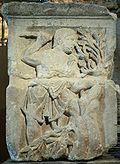 | |
|---|---|---|
| Priests and poets | ||
| Beliefs | ||
| Rites and practices | ||
| Sacred sites | ||
| Cult objects and monuments | ||
| Deities by region | ||
| International | |
|---|---|
| Other | |
