The Rijndael S-box is a substitution box (lookup table) used in the Rijndael cipher, on which the Advanced Encryption Standard (AES) cryptographic algorithm is based.[1]
Forward S-box
| x0 | x1 | x2 | x3 | x4 | x5 | x6 | x7 | x8 | x9 | xa | xb | xc | xd | xe | xf | |
|---|---|---|---|---|---|---|---|---|---|---|---|---|---|---|---|---|
| 0x | 63 | 7c | 77 | 7b | f2 | 6b | 6f | c5 | 30 | 01 | 67 | 2b | fe | d7 | ab | 76 |
| 1x | ca | 82 | c9 | 7d | fa | 59 | 47 | f0 | ad | d4 | a2 | af | 9c | a4 | 72 | c0 |
| 2x | b7 | fd | 93 | 26 | 36 | 3f | f7 | cc | 34 | a5 | e5 | f1 | 71 | d8 | 31 | 15 |
| 3x | 04 | c7 | 23 | c3 | 18 | 96 | 05 | 9a | 07 | 12 | 80 | e2 | eb | 27 | b2 | 75 |
| 4x | 09 | 83 | 2c | 1a | 1b | 6e | 5a | a0 | 52 | 3b | d6 | b3 | 29 | e3 | 2f | 84 |
| 5x | 53 | d1 | 00 | ed | 20 | fc | b1 | 5b | 6a | cb | be | 39 | 4a | 4c | 58 | cf |
| 6x | d0 | ef | aa | fb | 43 | 4d | 33 | 85 | 45 | f9 | 02 | 7f | 50 | 3c | 9f | a8 |
| 7x | 51 | a3 | 40 | 8f | 92 | 9d | 38 | f5 | bc | b6 | da | 21 | 10 | ff | f3 | d2 |
| 8x | cd | 0c | 13 | ec | 5f | 97 | 44 | 17 | c4 | a7 | 7e | 3d | 64 | 5d | 19 | 73 |
| 9x | 60 | 81 | 4f | dc | 22 | 2a | 90 | 88 | 46 | ee | b8 | 14 | de | 5e | 0b | db |
| ax | e0 | 32 | 3a | 0a | 49 | 06 | 24 | 5c | c2 | d3 | ac | 62 | 91 | 95 | e4 | 79 |
| bx | e7 | c8 | 37 | 6d | 8d | d5 | 4e | a9 | 6c | 56 | f4 | ea | 65 | 7a | ae | 08 |
| cx | ba | 78 | 25 | 2e | 1c | a6 | b4 | c6 | e8 | dd | 74 | 1f | 4b | bd | 8b | 8a |
| dx | 70 | 3e | b5 | 66 | 48 | 03 | f6 | 0e | 61 | 35 | 57 | b9 | 86 | c1 | 1d | 9e |
| ex | e1 | f8 | 98 | 11 | 69 | d9 | 8e | 94 | 9b | 1e | 87 | e9 | ce | 55 | 28 | df |
| fx | 8c | a1 | 89 | 0d | bf | e6 | 42 | 68 | 41 | 99 | 2d | 0f | b0 | 54 | bb | 16 |
| The column is determined by the least significant nibble, and the row by the most significant nibble. For example, the value 9a16 is converted into b816. | ||||||||||||||||
The S-box maps an 8-bit input, c, to an 8-bit output, s = S(c). Both the input and output are interpreted as polynomials over GF(2). First, the input is mapped to its multiplicative inverse in GF(28) = GF(2) [x]/(x8 + x4 + x3 + x + 1), Rijndael's finite field. Zero, as the identity, is mapped to itself. This transformation is known as the Nyberg S-box after its inventor Kaisa Nyberg.[2] The multiplicative inverse is then transformed using the following affine transformation:
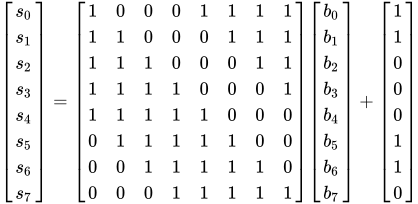
where [s7, ..., s0] is the S-box output and [b7, ..., b0] is the multiplicative inverse as a vector.
This affine transformation is the sum of multiple rotations of the byte as a vector, where addition is the XOR operation:

where b represents the multiplicative inverse, is the bitwise XOR operator, is a left bitwise circular shift, and the constant 6316 = 011000112 is given in hexadecimal.


An equivalent formulation of the affine transformation is

where s, b, and c are 8 bit arrays, c is 011000112, and subscripts indicate a reference to the indexed bit.[3]
Another equivalent is:

where is polynomial multiplication of and taken as bit arrays.


Inverse S-box
| x0 | x1 | x2 | x3 | x4 | x5 | x6 | x7 | x8 | x9 | xa | xb | xc | xd | xe | xf | |
|---|---|---|---|---|---|---|---|---|---|---|---|---|---|---|---|---|
| 0x | 52 | 09 | 6a | d5 | 30 | 36 | a5 | 38 | bf | 40 | a3 | 9e | 81 | f3 | d7 | fb |
| 1x | 7c | e3 | 39 | 82 | 9b | 2f | ff | 87 | 34 | 8e | 43 | 44 | c4 | de | e9 | cb |
| 2x | 54 | 7b | 94 | 32 | a6 | c2 | 23 | 3d | ee | 4c | 95 | 0b | 42 | fa | c3 | 4e |
| 3x | 08 | 2e | a1 | 66 | 28 | d9 | 24 | b2 | 76 | 5b | a2 | 49 | 6d | 8b | d1 | 25 |
| 4x | 72 | f8 | f6 | 64 | 86 | 68 | 98 | 16 | d4 | a4 | 5c | cc | 5d | 65 | b6 | 92 |
| 5x | 6c | 70 | 48 | 50 | fd | ed | b9 | da | 5e | 15 | 46 | 57 | a7 | 8d | 9d | 84 |
| 6x | 90 | d8 | ab | 00 | 8c | bc | d3 | 0a | f7 | e4 | 58 | 05 | b8 | b3 | 45 | 06 |
| 7x | d0 | 2c | 1e | 8f | ca | 3f | 0f | 02 | c1 | af | bd | 03 | 01 | 13 | 8a | 6b |
| 8x | 3a | 91 | 11 | 41 | 4f | 67 | dc | ea | 97 | f2 | cf | ce | f0 | b4 | e6 | 73 |
| 9x | 96 | ac | 74 | 22 | e7 | ad | 35 | 85 | e2 | f9 | 37 | e8 | 1c | 75 | df | 6e |
| ax | 47 | f1 | 1a | 71 | 1d | 29 | c5 | 89 | 6f | b7 | 62 | 0e | aa | 18 | be | 1b |
| bx | fc | 56 | 3e | 4b | c6 | d2 | 79 | 20 | 9a | db | c0 | fe | 78 | cd | 5a | f4 |
| cx | 1f | dd | a8 | 33 | 88 | 07 | c7 | 31 | b1 | 12 | 10 | 59 | 27 | 80 | ec | 5f |
| dx | 60 | 51 | 7f | a9 | 19 | b5 | 4a | 0d | 2d | e5 | 7a | 9f | 93 | c9 | 9c | ef |
| ex | a0 | e0 | 3b | 4d | ae | 2a | f5 | b0 | c8 | eb | bb | 3c | 83 | 53 | 99 | 61 |
| fx | 17 | 2b | 04 | 7e | ba | 77 | d6 | 26 | e1 | 69 | 14 | 63 | 55 | 21 | 0c | 7d |
The inverse S-box is simply the S-box run in reverse. For example, the inverse S-box of b816 is 9a16. It is calculated by first calculating the inverse affine transformation of the input value, followed by the multiplicative inverse. The inverse affine transformation is as follows:

The inverse affine transformation also represents the sum of multiple rotations of the byte as a vector, where addition is the XOR operation:

where is the bitwise XOR operator, is a left bitwise circular shift, and the constant 516 = 000001012 is given in hexadecimal.
Design criteria
The Rijndael S-box was specifically designed to be resistant to linear and differential cryptanalysis. This was done by minimizing the correlation between linear transformations of input/output bits, and at the same time minimizing the difference propagation probability.
The Rijndael S-box can be replaced in the Rijndael cipher,[1] which defeats the suspicion of a backdoor built into the cipher that exploits a static S-box. The authors claim that the Rijndael cipher structure is likely to provide enough resistance against differential and linear cryptanalysis even if an S-box with "average" correlation / difference propagation properties is used (cf. the "optimal" properties of the Rijndael S-box).
Example implementation in C language
The following C code calculates the S-box:
#include <stdint.h>

#define ROTL8(x,shift) ((uint8_t) ((x) << (shift)) | ((x) >> (8 - (shift))))

void initialize_aes_sbox(uint8_t sbox[256]) {
	uint8_t p = 1, q = 1;

	/* loop invariant: p * q == 1 in the Galois field */
	do {
		/* multiply p by 3 */
		p = p ^ (p << 1) ^ (p & 0x80 ? 0x1B : 0);

		/* divide q by 3 (equals multiplication by 0xf6) */
		q ^= q << 1;
		q ^= q << 2;
		q ^= q << 4;
		q ^= q & 0x80 ? 0x09 : 0;

		/* compute the affine transformation */
		uint8_t xformed = q ^ ROTL8(q, 1) ^ ROTL8(q, 2) ^ ROTL8(q, 3) ^ ROTL8(q, 4);

		sbox[p] = xformed ^ 0x63;
	} while (p != 1);

	/* 0 is a special case since it has no inverse */
	sbox[0] = 0x63;
}
References
- 1 2 "The Rijndael Block Cipher" (PDF). Retrieved 2013-11-11.
- ↑ Nyberg K. (1991) Perfect nonlinear S-boxes. In: Davies D.W. (eds) Advances in Cryptology – EUROCRYPT ’91. EUROCRYPT 1991. Lecture Notes in Computer Science, vol 547. Springer, Berlin, Heidelberg
- ↑ "The Advanced Encryption Standard" (PDF). FIPS PUB 197: the official AES standard. Federal Information Processing Standard. 2001-11-26. Retrieved 2010-04-29.
- ↑ Jörg J. Buchholz (2001-12-19). "Matlab implementation of the Advanced Encryption Standard" (PDF).
- ↑ Jie Cui; Liusheng Huang; Hong Zhong; Chinchen Chang; Wei Yang (May 2011). "An Improved AES S-box and Its Performance Analysis" (PDF). Archived from the original (PDF) on 2016-03-04.