Lingzhi (Ganoderma sichuanense), also known as reishi, is a polypore fungus ("bracket fungus") native to East Asia belonging to the genus Ganoderma.
Its reddish brown, varnished, kidney-shaped cap with bands and peripherally inserted stem give it a distinct fan-like appearance. When fresh, the lingzhi is soft, cork-like, and flat. It lacks gills on its underside, and instead releases its spores via fine pores (80–120 μm) in yellow colors.[2]
In nature, it grows at the base and stumps of deciduous trees, especially maples. Lingzhi may be cultivated on hardwood logs, sawdust, or woodchips.
The lingzhi mushroom is used in traditional Chinese medicine.[2][4]
Taxonomy
Lingzhi, also known as reishi from its Japanese pronunciation, is the ancient "mushroom of immortality", revered for over 2,000 years (with some evidence suggesting use in Neolithic China 6,800 years ago).[5] However, as of 2023 there is an ongoing debate on which one of the described Ganoderma species is the true lingzhi mushroom. It is also likely that a few similar Ganoderma species were considered interchangeable.
In the scientific literature, the lingzhi mushroom is ambiguously referred to as:
- Ganoderma sichuanense — the currently accepted name, described by Zhao and Zhang (1983).[1]
- Ganoderma lingzhi — described by Cao et al. (2012)[2] as a novel species that may be the best fit for traditional definitions of the lingzhi mushroom. However, Du et al. (2023)[3] found that it is the same species as G. sichuanense, so it is now treated as a later synonym.
- Ganoderma lucidum — the type species of Ganoderma was first described in 1781 by Curtis as Boletus lucidus based on European collections. In 1881 Karst designated it as the type species of his new genus Ganoderma, as Ganoderma lucidum. Early literature used G. lucidum for collections from China, but it was later established that Asian populations are distinct from European, both morphologically and phylogenetically.[6][3] As the lingzhi fungus is strongly rooted in culture, the old name persists, even though it is well established that G. sichuanense and G. lucidum are distinct species.
One source employed to solve the task of identifying the traditional lingzhi mushroom is the 16th century Chinese herbal compendium, the Bencao Gangmu (1578). There, a number of different lingzhi-like mushrooms defined by color were used for different purposes. No exact current species can be attached to these ancient lingzhi for certain, but according to Dai et al. (2017),[7] as well as other researchers, and based on molecular work, red lingzhi is most likely to be Ganoderma sichuanense.[8][2]
Ganoderma sichuanense is the most widely found species in Chinese herb shops today,[citation needed] and the fruiting bodies are widely cultivated in China and shipped to many other countries. About 7–10 other Ganoderma species are also sold in some shops, but have different Chinese and Latin names, and are considered different in their activity and functions. The differences are based on concentrations of triterpenes such as ganoderic acid and its derivatives, which vary widely among species. Research on the genus is ongoing, but a number of recent phylogenetic analyses have been published in recent years.[9]
Nomenclature
Petter Adolf Karsten first described the genus Ganoderma in 1881.[10][11] He designated as its type species a European fungus named Boletus lucidus by English botanist William Curtis in 1781. Since then, many other Ganoderma species have been described.
The lingzhi's botanical names have Greek and Latin roots. Ganoderma derives from the Greek ganos (γανος; 'brightness'), and derma (δερμα; 'skin; together; shining skin').[12] The specific epithet, sichuanense, comes from the Sichuan Chinese province. The common name, lingzhi, comes from Chinese, meaning 'divine mushroom'.
Varieties
It was once thought that G. lingzhi generally occurred in two growth forms: a large, sessile, specimen with a small or nonexistent stalk, found in North America, and a smaller specimen with a long, narrow stalk, found mainly in the tropics. However, recent molecular evidence has identified the former, stalkless, form as a distinct species called G. sessile, a name given to North American specimens by William Alfonso Murrill in 1902.[9][13]
Environmental conditions play a substantial role in the lingzhi's manifest morphological characteristics. For example, elevated carbon dioxide levels result in stem elongation in lingzhi. Other formations include antlers without a cap, which may also be related to carbon dioxide levels. The three main factors that influence fruit body development morphology are light, temperature, and humidity. While water and air quality play a role in fruit body development morphology, they do so to a lesser degree.[14]
Distribution and habitat
Ganoderma lingzhi is found in East Asia growing as a parasite or saprotroph on a variety of trees.[15] Ganoderma curtisii and Ganoderma ravenelii are the closest relatives of the lingzhi mushroom in North America.[16]
In the wild, lingzhi grows at the base and stumps of deciduous trees, especially maples.[17] Today, lingzhi is effectively cultivated on sawdust, woodchips, and hardwood logs.[18]
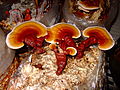 Grown lingzhi mushroom
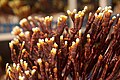 Depending on growing conditions, lingzhi may resemble antlers, with no umbrella cap.


Uses
Chemistry

Ganoderma lucidum contains diverse chemicals, including triterpenes (ganoderic acids), which have a molecular structure similar to that of steroid hormones.[19] It also contains phytochemicals found in fungal materials, including polysaccharides (such as beta-glucan), coumarin,[20] mannitol, and alkaloids.[19] Sterols isolated from the mushroom include ganoderol, ganoderenic acid, ganoderiol, ganodermanontriol, lucidadiol, and ganodermadiol.[19]
Folk medicine
Because of its bitter taste,[21] lingzhi is traditionally prepared as a hot water extract product for use in folk medicine.[22] Thinly sliced or pulverized lingzhi (either fresh or dried) is added to boiling water which is then reduced to a simmer, covered, and left for 2 hours.[23] The resulting liquid is dark and fairly bitter in taste. The red lingzhi is often more bitter than the black. The process is sometimes repeated to increase the concentration. Alternatively, it can be used as an ingredient in a formula decoction, or used to make an extract (in liquid, capsule, or powder form).[24]
Other uses
Lingzhi is commercially manufactured and sold. Since the early 1970s, most lingzhi is cultivated. Lingzhi can grow on substrates such as sawdust, grain, and wood logs. After formation of the fruiting body, lingzhi is most commonly harvested, dried, ground, and processed into tablets or capsules to be directly ingested or made into tea or soup. Other lingzhi products include processed fungal mycelia or spores.[23] Lingzhi is also used to create mycelium bricks.[25]
Cultural significance

In the chronicles of Shiji (1st century CE from Sima Qian), the initial use of nearby separately related words with Chinese: 芝 and Chinese: 靈 are attested to in the poems of Emperor Wu of Han. Later, in the 1st century CE through the poetry of Ban Gu, occurred the first combination of the characters 靈芝 together into a single word, in an ode dedicated to Lingzhi.[27][28]
Since ancient times, Taoist temples were called "the abode of mushrooms" and according to their mystical teachings, the use of woody mushrooms zhi (Ganoderma) or lingzhi "spirits mushroom", in particular making from it a concentrated decoction of hallucinogenic action,[27] gave followers the opportunity to see spirits or become spirits themselves by receiving the magical energy of the immortals xians, located on the "fields of grace" in the heavenly "mushroom fields" (zhi tian).[29]
In the philosophical work Huainanzi, it is said that the lingzhi mushroom is personification of nobility; from which shamans brewed a psychedelic drink.[30][31]
The Shennong bencao jing (Divine Farmer's Classic of Pharmaceutics) of c. 200–250 CE classifies zhi into six color categories, each of which is believed to benefit the qi, or "life force", in a different part of the body: qingzhi (青芝; 'green mushroom') for the liver, chizhi (赤芝; 'red mushroom') for the heart, huangzhi (黃芝; 'yellow mushroom') for the spleen, baizhi (白芝; 'white mushroom') for the lungs, heizhi (黑芝; 'black mushroom') for the kidneys, and zizhi (紫芝; 'purple mushroom') for the Essence. Commentators identify the red chizhi, or danzhi (丹芝; 'cinnabar mushroom'), as the lingzhi.[32][33]
References
- 1 2 Chao, Chi-ting. Taxonomic studies on the family Ganodermataceae of China II. OCLC 80615364.
- 1 2 3 4 5 Cao, Yun; Wu, Sheng-Hua; Dai, Yu-Cheng (2012). "Species clarification of the prize medicinal Ganoderma mushroom 'Lingzhi'". Fungal Diversity. 56 (1): 49–62. doi:10.1007/s13225-012-0178-5. S2CID 15239238.
- 1 2 3 Du, Zhuo; Li, Yi; Wang, Xin-Cun; Wang, Ke; Yao, Yi-Jian (2023). "Re-Examination of the Holotype of Ganoderma sichuanense (Ganodermataceae, Polyporales) and a Clarification of the Identity of Chinese Cultivated Lingzhi". Journal of Fungi. 9 (3): 323. doi:10.3390/jof9030323. ISSN 2309-608X. PMC 10051598. PMID 36983491.
- ↑ Kenneth, Jones (1990). Reishi: Ancient Herb for Modern Times. Sylvan Press. p. 6.
- ↑ Sun, Guoping; Cao, Lijuan; Huang, Luqi; Wang, Yajun; Yuan, Yuan; Han, Dong; Yuan, Bing; Wang, Yeran; Shen, Yueming (2018-05-01). "Archaeological evidence suggests earlier use of Ganoderma in Neolithic China". Chinese Science Bulletin. 63 (13): 1180–1188. doi:10.1360/n972018-00188. ISSN 0023-074X. S2CID 103581412.
- ↑ Pegler, D. N.; Yao, Y. J. (1996). "Oriental species of Ganoderma section Ganoderma". Botany and Mycology for the Next Millenium: Collection of Scientific Articles Devoted to the 70th Anniversary of Academician Sytnik KM. Kyiv: Kholodny NG Institute of Botany, National Academy of Sciences of Ukraine: 336–347.
- ↑ Dai, Y.-C. (2017). "Ganoderma lingzhi (Polyporales, Basidiomycota): the scientific binomial for the widely cultivated medicinal fungus Lingzhi". Mycological Progress. 16 (11–12): 1051–1055. Bibcode:2017MycPr..16.1051D. doi:10.1007/s11557-017-1347-4. S2CID 38561105.
- ↑ Dai, Yu-Cheng; Zhou, Li-Wei; Hattori, Tsutomu; Cao, Yun; Stalpers, Joost A.; Ryvarden, Leif; Buchanan, Peter; Oberwinkler, Franz; Hallenberg, Nils; Liu, Pei-Gui; Wu, Sheng-Hua (December 2017). "Ganoderma lingzhi (Polyporales, Basidiomycota): the scientific binomial for the widely cultivated medicinal fungus Lingzhi". Mycological Progress. 16 (11–12): 1051–1055. Bibcode:2017MycPr..16.1051D. doi:10.1007/s11557-017-1347-4. ISSN 1617-416X. S2CID 38561105.
- 1 2 Zhou, Li-Wei; Cao, Yun; Wu, Sheng-Hua; Vlasák, Josef; Li, De-Wei; Li, Meng-Jie; Dai, Yu-Cheng (2015). "Global diversity of the Ganoderma lucidum complex (Ganodermataceae, Polyporales) inferred from morphology and multilocus phylogeny". Phytochemistry. 114: 7–15. Bibcode:2015PChem.114....7Z. doi:10.1016/j.phytochem.2014.09.023. hdl:11104/0249077. PMID 25453909.
- ↑ Steyaert, R. L. (1961). "Note on the nomenclature of fungi and, incidentally, of Ganoderma lucidum" (PDF). Taxon. 10 (8): 251–252. Bibcode:1961Taxon..10..251S. doi:10.2307/1216350. JSTOR 1216350.
- ↑ Karsten, PA. (1881). "Enumeratio Boletinearum et Polyporearum Fennicarum, systemate novo dispositarum". Revue Mycologique, Toulouse (in Latin). 3 (9): 16–19.
- ↑ Liddell, Henry George; Scott, Robert (1980). A Greek-English Lexicon (Abridged ed.). United Kingdom: Oxford University Press. ISBN 978-0-19-910207-5.
- ↑ "Ganoderma sessile". MycoBank. International Mycological Association.
- ↑ Yajima, Yuka; Miyazaki, Minoru; Okita, Noriyasu; Hoshino, Tamotsu (2013). "Production of Ginkgo Leaf−Shaped Basidiocarps of the Lingzhi or Reishi Medicinal Mushroom Ganoderma lucidum (Higher Basidiomycetes), Containing High Levels of α- and β-D-Glucan and Ganoderic Acid A". International Journal of Medicinal Mushrooms. 15 (2): 175–182. doi:10.1615/IntJMedMushr.v15.i2.60. PMID 23557369.
- ↑ Loyd, Andrew L.; Richter, Brantlee S.; Jusino, Michelle A.; Truong, Camille; Smith, Matthew E.; Blanchette, Robert A.; Smith, Jason A. (2018). "Identifying the "Mushroom of Immortality": Assessing the Ganoderma Species Composition in Commercial Reishi Products". Frontiers in Microbiology. 9 1557. doi:10.3389/fmicb.2018.01557. PMC 6055023. PMID 30061872.
- ↑ Loyd, A. L.; Barnes, C. W.; Held, B. W.; Schink, M. J.; Smith, M. E.; Smith, J. A.; Blanchette, R. A. (2018). "Elucidating "lucidum": Distinguishing the diverse laccate Ganoderma species of the United States". PLOS ONE. 13 (7) e0199738. Bibcode:2018PLoSO..1399738L. doi:10.1371/journal.pone.0199738. PMC 6051579. PMID 30020945.
- ↑ National Audubon Society (1993). Field Guide to Mushrooms.
- ↑ Veena, S. S.; Pandey, Meera (2011). "Paddy Straw as a Substrate for the Cultivation of Lingzhi or Reishi Medicinal Mushroom, Ganoderma lucidum (W.Curt. :Fr.) P. Karst. in India". International Journal of Medicinal Mushrooms. 13 (4): 397–400. doi:10.1615/intjmedmushr.v13.i4.100. PMID 2164770.
- 1 2 3 Paterson, R. Russell M. (2006). "Ganoderma – A therapeutic fungal biofactory". Phytochemistry. 67 (18): 1985–2001. Bibcode:2006PChem..67.1985P. doi:10.1016/j.phytochem.2006.07.004. hdl:1822/5522. PMID 16905165.
- ↑ Kohguchi, Michihiro; Kunikata, Toshio; Watanabe, Hikaru; Kudo, Naoki; Shibuya, Takashi; Ishihara, Tatsuya; Iwaki, Kanso; Ikeda, Masao; Fukuda, Shigeharu; Kurimoto, Masashi (2014). "Immuno-potentiating Effects of the Antler-shaped Fruiting Body of (Rokkaku-Reishi)". Bioscience, Biotechnology, and Biochemistry. 68 (4): 881–887. doi:10.1271/bbb.68.881. PMID 15118318.
- ↑ Meuninck, Jim (2017). Foraging Mushrooms Oregon: Finding, Identifying, and Preparing Edible Wild Mushrooms. Falcon Guides. p. 56. ISBN 978-1-4930-2669-2.
- 1 2 Smith, John; Rowan, Neil; Sullivan, Richard (2001). "Medicinal mushrooms: their therapeutic properties and current medical usage with special emphasis on cancer treatments". Cancer Research UK: 28, 31. Archived from the original on 31 August 2009.
- 1 2 Wachtel-Galor, Sissi; Yuen, John; Buswell, John A.; Benzie, Iris F. F. (2011). "Ganoderma lucidum (Lingzhi or Reishi): A Medicinal Mushroom". In Benzie, Iris F. F.; Wachtel-Galor, Sissi (eds.). Herbal Medicine: Biomolecular and Clinical Aspects (2nd ed.). Boca Raton, FL: CRC Press/Taylor & Francis. ISBN 978-1-4398-0713-2. PMID 22593926.
- ↑ "How To Make A Medicinal Mushroom Double-Extraction Tincture". Herbal Academy. 2016-09-19. Retrieved 2021-01-05.
- ↑ Andy Corbley (2020-12-10). "Stanford Designer is Making Bricks Out of Fast-Growing Mushrooms That Are Stronger than Concrete". Good News Network. Retrieved 2021-01-05.
- ↑ Философско-эстетический смысл так называемого «божественного гриба» («линчжи») в искусстве Китая / Завадская Е. В. // Научные сообщения Государственного музея искусства народов Востока // М.: Наука, 1977. — Вып. 9. — (с. 40—46) — С. 44. (табл. III) С. 179.
- 1 2 Философско-эстетический смысл так называемого «божественного гриба» («линчжи») в искусстве Китая Archived 2021-11-17 at the Wayback Machine // Научные сообщения Государственного музея искусства народов Востока // М.: Наука, 1977. — Вып. 9. — С. 40—46.
- ↑ Soma: Divine Mushroom of Immortality / Wasson R. G. // New York: Harcourt Brace Jovanovich, 1972. — P. 85. — P. 89.
- ↑ Китай: колокольца в пыли. Странствия мага и интеллектуала// М.: Алетейа, 2005. — 376 с. — ISBN 5-98639-025-3 — С. 74, 356, 367.
- ↑ Философы из Хуайнани. Хуайнаньцзы / Пер. Л. Е. Померанцевой. Сост. И. В. Ушаков // М: Мысль, 2004. — 430 с. — ISBN 5-244-00984-2 — С. 267. «Шаманок (Ушань) — гора в пров. Сычуань. Из гриба цзычжи (другое название — линчжи) мудрецы делали дурманящий напиток. О дереве гаося аналогичных сведений как будто нет. Комментарий говорит, что это высокое дерево с плотной шелковистой древесиной белого цвета и что гаося и цзычжи символы благородства, а чернобыльники и полынь — символы ничтожества.» — С. 50: «На горе Шаманок послушны ветру и покорны огню как дерево гаося и гриб цзычжи, так и чернобыльник и полынь все погибают вместе.»
- ↑ Поздние даосы о природе, обществе и искусстве («Хуайнаньцзы» — II в. до н. э.) / Померанцева Л. Е. // М.: Издательство Московского университета, 1979. — 240 с. — С. 145, 220.
- 1 2 Ancient Chinese People's Knowledge of Macrofungi during the Period from 220 to 589 / Lu Di // «East Asian Science, Technology, and Medicine», № 37 (2013)/2014: 36-68.
- 1 2 Traditional uses, chemical components and pharmacological activities of the genus Ganoderma P. Karst.: a review / Li Wang, Jie-qing Li, Ji Zhang, Zhi-min Li, Hong-gao Liu, Yuan-zhong Wang // RSC Advances: Issue 69, 2020.
- ↑ The Divine Farmer's Materia Medica: A Translation of the Shen Nong Ben Cao Jing. Translated by Yang, Shouzhong. Blue Poppy Press. 1998. pp. 17–18. ISBN 978-0-936185-96-5.
- ↑ Li Bo Unkempt / Kidder Smith, Mike Zhai // Punctum Books, 2021. — ISBN 9781953035417, 9781953035424; doi:10.21983/P3.0322.1.00. — pp. 137, 405.
- ↑ Li, Shizhen. [Compendium of Materia Medica] (in Chinese) – via Wikisource.
胸中結, 益心氣, 補中, 增智慧, 不忘。久食, 輕身不老, 延年神仙。
- 1 2 Halpern, Georges M. (2007). Healing Mushrooms. Square One Publishers. p. 59. ISBN 978-0-7570-0196-3.
- 1 2 Stuart, G. A.; Smith, F. Porter (1911). Chinese Materia Medica, Pt. 1, Vegetable Kingdom. Presbyterian Mission Press. pp. 271, 274.
- 1 2 Pregadio, Fabrizio, ed. (2008). The Encyclopedia of Taoism. Routledge. p. 1271. ISBN 978-0-203-69548-7.
Zhi 芝 numinous mushrooms; excrescences
- ↑ Bretschneider, E. (1893). Botanicon Sinicum. Kelly & Walsh. p. 40.
- ↑ Groot, Johann Jacob Maria de (1892–1910). The Religious System of China. Its ancient forms, evolution, history and present aspect. Manners, customs and social institutions connected therewith. Vol. IV. Leiden: Brill Publishers. p. 307. Archived from the original on 2024-10-07. Retrieved 2010-11-30.
- ↑ Arora, David (1986). Mushrooms demystified: a comprehensive guide to the fleshy fungi (2nd ed.). Ten Speed Press. ISBN 978-0-89815-169-5.
- ↑ Hu, Shiu-ying (2006). Food Plants of China. Chinese University Press. p. 268. ISBN 978-962-996-229-6.
- ↑ Bedini, Silvio A. (1994). The Trail of Time. Cambridge University Press. p. 113. ISBN 978-0-521-37482-8.
- ↑ Knechtges, David R. (1996). Wen Xuan or Selections of Refined Literature. Vol. 3. Princeton University Press. pp. 201, 211. ISBN 978-0-691-02126-3.
- ↑ Schipper, Kristofer M. (1993). The Taoist Body. University of California Press. p. 174.
- ↑ Rogers, Robert (2011). "Ganoderma lucidum". The Fungal Pharmacy: The Complete Guide to Medicinal Mushrooms & Lichens of North America. BErkeley, CA: North Atlantic Books. pp. 172–185. ISBN 978-1-55643-953-7.
- ↑ "ling chih". Oxford English Dictionary. 4.0 (CD-ROM ed.). 2009.
- ↑ Bushell, Stephen Wootton (1904). Chinese Art. H.M. Stationery Office. p. 148. (Victoria and Albert Museum); This context describes the lingzhi fungus and ruyi scepter as Daoist symbols of longevity on a jade vase.
- ↑ "Names of a Selection of Asian Fungi". Multilingual Multiscript Plant Name Database. University of Melbourne. 18 February 1999.
| Animal products | |
|---|---|
| |
| Edible plants / roots | |
| Mushrooms | |
| |
|
|
| Resins | |
| Sap / gum / etc. | |
| Other | |
| Related | |

