The Indiana Portal

Indigenous resistance to American settlement was broken with their defeat in Battle of Tippecanoe in 1811, and the collapse of Tecumseh's confederacy in 1813. The new settlers were primarily Americans of British ancestry from the eastern seaboard and the Upland South, and Germans. After the Civil War, in which the state fought for the Union, natural gas attracted heavy industry and new European immigrants to its northern counties. In the first half of the 20th century, northern and central sections experienced a boom in goods manufacture and automobile production. Southern Indiana remained largely rural. After the rise and fall of the Klan in the 1920s, the state swung politically from the Republican to Democratic Party in the New Deal 1930s. Today, with a decades-long record of returning Republican majorities, Indiana is counted a "red state".
Indiana has a diverse economy with a gross state product in 2023 of 404.3 billion. Indianapolis is at the center of the state's largest metropolitan area, with a population of over two million. The Fort Wayne metro area follows with a population of 645,000. (Full article...)
Selected article -

The Battle of Tippecanoe (/ˌtɪpəkəˈnuː/ TIP-ə-kə-NOO) was fought on November 7, 1811, in Battle Ground, Indiana, between American forces led by then Governor William Henry Harrison of the Indiana Territory and tribal forces associated with Shawnee leader Tecumseh and his brother Tenskwatawa (commonly known as "The Prophet"), leaders of a confederacy of various tribes who opposed European-American settlement of the American frontier. As tensions and violence increased, Governor Harrison marched with an army of about 1,000 men to attack the confederacy's headquarters at Prophetstown, near the confluence of the Tippecanoe River and the Wabash River.
Tecumseh was not yet ready to oppose the United States by force and was away recruiting allies when Harrison's army arrived. Tenskwatawa was in charge of the Indian warriors during his brother's absence but he was a spiritual leader, not a military man. Harrison camped near Prophetstown on November 6 and arranged to meet with Tenskwatawa the following day. Early the next morning warriors from Prophetstown attacked Harrison's encampment. They took the army by surprise, but Harrison and his men stood their ground for more than two hours. After the battle, Harrison's men burned the abandoned village of Prophetstown to the ground, destroying the food supplies stored there for the winter. The soldiers then returned to their homes. (Full article...)
Selected image -
 |
Did you know -
- ... that an Indiana TV station promised to begin broadcasting New Year's Eve — but only made it in time for Chinese New Year's Eve?
- ... that an old gravel pit in Eagle Creek Park in Indiana is now part of an Important Bird Area?
- ... that Butt Drugs in Corydon, Indiana, had Butt Liquors and free parking in the rear?
- ... that Lick Creek, a settlement of freeborn Black people, used to exist in Hoosier National Forest?
- ... that frontier physician Isaac Coe is credited with saving Indianapolis from an 1821 outbreak of malaria?
- ... that an annual festival attracts fans of a defunct car company to its former manufacturing complex in Fort Wayne, Indiana?
Related portals


Selected geographic article -

Fort Wayne is a city in Allen County, Indiana, United States, and its county seat. Located in northeastern Indiana, the city is 18 miles (29 km) west of the Ohio border and 50 miles (80 km) south of the Michigan border. The city's population was 263,886 at the 2020 census, making it the 2nd-most populous city in Indiana after Indianapolis, and the 82nd-most populous city in the U.S. The Fort Wayne metropolitan area, consisting of Allen, Wells and Whitley counties, has an estimated population of 463,000. Fort Wayne is the cultural and economic center of northeastern Indiana.
Fort Wayne was built in 1794 by the United States Army under the direction of American Revolutionary War general Anthony Wayne, the last in a series of forts built near the Miami village of Kekionga. Named in Wayne's honor, the European-American settlement developed at the confluence of the St. Joseph, St. Marys, and Maumee rivers, known originally as Fort Miami, a trading post constructed by Jean Baptiste Bissot, Sieur de Vincennes around 1706. The modern city was platted in 1823 following its revitalization after the War of 1812 and its siege. It underwent tremendous growth after completion of the Wabash and Erie Canal and advent of the railroad. (Full article...)
Selected biography -

James Byron Dean (February 8, 1931 – September 30, 1955) was an American actor. He became one of the most influential figures in Hollywood in the 1950s, and his impact on cinema and popular culture was profound, although his career lasted only five years. He appeared in just three major films: Rebel Without a Cause (1955), in which he portrayed a disillusioned and rebellious teenager; East of Eden (1955), which showcased his intense emotional range; and Giant (1956), a sprawling drama. These have been preserved in the United States National Film Registry by the Library of Congress for their "cultural, historical, or aesthetic significance". He was killed in a car accident at the age of 24 in 1955, leaving him a lasting symbol of rebellion, youthful defiance, and the restless spirit.
For his role in East of Eden, Dean became the first actor to receive a posthumous Academy Award nomination for Best Actor. The following year, he earned a second nomination for his performance in Giant, making him the only actor to receive two posthumous acting nominations. In 1999, he was honored by the American Film Institute, being ranked as the 18th greatest male film star from Golden Age Hollywood on their "AFI's 100 Years...100 Stars" list. Time magazine recognized Dean in 2012 as one of the "All-Time Most Influential Fashion Icons". (Full article...)
Selected quote

General images
-
 The Circle in Indianapolis, circa 1898 (from History of Indiana)
 -
 Oliver Hazard Perry Morton, governor 1861 to 1867 (from History of Indiana)
 -
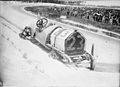 Driver Mel Marquette's wrecked McFarlan racing car at the 1912 Indianapolis 500 (from History of Indiana)
 -

-

-
 William Henry Harrison, the 1st Governor of Indiana Territory from 1801 to 1812, and the 9th President of the United States (from History of Indiana)
 -
 A restored Monon boxcar at the Linden Railroad Museum in Linden, Indiana (from History of Indiana)
 -
 View of Mound A at Angel Mounds (from History of Indiana)
 -
 The fifth Indiana Statehouse in Indianapolis built in 1888 on the site of the third statehouse (from History of Indiana)
 -
 A labor leader rallies striking steelworkers in Gary, Indiana (from History of Indiana)
 -
 80th Indiana Infantry Regiment and the 19th Indiana Light Artillery defending against the Confederates at the Battle of Perryville by H. Mosler (from History of Indiana)
 -
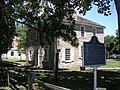
-
 Native Americans guide French explorers through Indiana as depicted by Maurice Thompson in Stories of Indiana. (from History of Indiana)
 -
 Clark's march to Vincennes, by F. C. Yohn (from History of Indiana)
 -
 The Constitution Elm in Corydon (from History of Indiana)
 -
 Madam C. J. Walker, Indianapolis entrepreneur and philanthropist (from History of Indiana)
 -

-
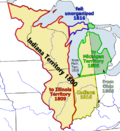 Map of the Indiana Territory (from History of Indiana)


Topics

- Economy: AM General - ATA Airlines - Casinos - Cummins - Delta - ITT - JayC - Lilly - Limestone - Manufacturing - NiSource - Shoe Carnival - Simon Property Group - Soybeans - Studebaker - Vectren - WellPoint
- Geography: Caves - Lakes - Rivers - State forests - Watersheds
| Executive |  | |
|---|---|---|
| Legislature | ||
| Judiciary | ||
| Departments | ||
| Local government | ||
| Law | ||


Categories

Attractions


 |

Recognized content
Featured articles
- 2005 United States Grand Prix
- Frank Borman
- William M. Branham
- Broad Ripple Park Carousel
- William Hayden English
- Benjamin Harrison
- John Hay
- USS Indiana (BB-1)
- Indiana-class battleship
- Janet Jackson
- Michael Jackson
- Harmon Killebrew
- Kenesaw Mountain Landis
- Abraham Lincoln
- Lochry's Defeat
- Thomas R. Marshall
- Ruth Norman
- On the Banks of the Wabash, Far Away
- Parks and Recreation season 1
- Pilot (Parks and Recreation)
- Ezra Pound
- Wiley Rutledge
- William S. Sadler
- Red Skelton
- John Gould Stephenson
- Tecumseh
- Battle of Tippecanoe
- Kurt Vonnegut
- WSNS-TV
- Warren County, Indiana
- Ryan White
- Wendell Willkie
Good articles
- 1925 Tri-State tornado
- 1963 Indiana State Fairgrounds Coliseum gas explosion
- 1984 Indiana's 8th congressional district election
- 2006 Brickyard 400
- 2008 Super Tuesday tornado outbreak
- Tornado outbreak sequence of June 3–11, 2008
- 2011 Brickyard 400
- 2011 South Bend mayoral election
- 2012 Henryville tornado
- 2015 South Bend mayoral election
- 2019 South Bend mayoral election
- 2021 NCAA Division I men's basketball championship game
- 2022 College Football Playoff National Championship
- 2023 Robinson–Sullivan tornado
- Marcus Adams (Canadian football)
- Spike Albrecht
- Vic Aldridge
- Jeff Allen (defensive back, born 1958)
- William Harrison Anderson
- Paul Bako
- Sean Bennett (gridiron football)
- Max Bielfeldt
- Blackford County Courthouse
- Blackford County, Indiana
- Bottleworks District
- Donald Brashear
- Brown County State Park
- Sergio Brown
- Willa Brown
- Eric Bruntlett
- Pete Buttigieg
- Canvassing (Parks and Recreation)
- Castleton Square
- Hélio Castroneves
- Chapter Three: The Case of the Missing Lifeguard
- Chapter Seven: The Lost Sister
- George Rogers Clark
- Clark State Forest
- Levi Coffin
- George R. Dale
- Frank Deig
- Chris Dittoe
- Maurice Douglass
- Duesenberg
- Kellen Dunham
- Irene Dunne
- Mary Beth Edelson
- Keith Elias
- Evan Bayh 2008 presidential campaign
- The Fault in Our Stars (film)
- Frank Fetter
- First Christian Church (Columbus, Indiana)
- Dario Franchitti
- Morgan Freeman
- Janie Fricke
- Crystal Gayle
- Hurley Goodall
- Governor of Indiana
- John Green
- Gus Grissom
- Rex Grossman
- Caroline Harrison
- Harrison County, Indiana
- William Henry Harrison III
- Hartford City Courthouse Square Historic District
- Hartford City Glass Company
- Gabby Hartnett
- LaTroy Hawkins
- Howard Hawks
- Kelly Hecking
- Bobby Heenan
- Mitch Henderson
- Chris Hill (basketball)
- History of slavery in Indiana
- Lauren Holiday
- Hoosier cabinet
- Sam Hornish Jr.
- Otto Frederick Hunziker
- USS Indiana (BB-58)
- Indiana General Assembly
- Indiana Glass Company
- Indiana Governor's Residence
- Indiana in the American Civil War
- Indiana State Road 930
- Indiana Statehouse
- Indiana Territory
- Indiana World War Memorial Plaza
- Indianapolis Museum of Art
- Indianapolis (Parks and Recreation)
- Indianapolis in the American Civil War
- Indianapolis streetcar strike of 1913
- Inland Steel Company
- International (Amtrak train)
- Interstate 469
- Zak Irvin
- Irwin Conference Center
- Rebbie Jackson
- Jonathan Jennings
- Tommy John
- Ezra Johnson
- James Jones (basketball, born 1980)
- Jim Jones
- Cato June
- Bob Kercher
- Ed Konopasek
- Lake James (Indiana)
- Earl Landgrebe
- Lieutenant Governor of Indiana
- Little Orphant Annie
- Kenny Lofton
- Carole Lombard
- Fletcher Loyer
- Rami Malek
- Peyton Manning
- Mayoralty of Pete Buttigieg
- Karen McDougal
- Mitch McGary
- Mary Harrison McKee
- Bo McMillin
- Miller House (Columbus, Indiana)
- R. Ames Montgomery
- E'Twaun Moore
- Steve Morrison (American football)
- Adrian Moss (basketball, born 1988)
- New Harmony Toll Bridge
- North Christian Church
- Northern cardinal
- Old Jeffersonville Historic District
- Joel Palmer
- Charles B. Pierce
- Emma Reaney
- Tony Renna
- The Republic Newspaper Office
- Richmond, Indiana, facility fire
- James Whitcomb Riley
- Oscar Robertson
- Glenn Robinson III
- Ned Rorem
- Axl Rose
- Gunther E. Rothenberg
- Clay Rush
- Lou Rymkus
- Lou Saban
- Salesforce Marketing Cloud
- Germany Schulz
- Everett Scott
- Seal of Indiana
- David M. Shoup
- Connie Smith
- Walter Bedell Smith
- Sneath Glass Company
- South Shore Line Airport Realignment
- Brad Stevens
- John Stonebraker
- Super Bowl XLVI halftime show
- Indiana Supreme Court
- Caleb Swanigan
- Andrew Tate
- William S. Taylor (Kentucky politician)
- Thomas Trueblood
- U.S. Route 30 in Indiana
- University Park Mall
- Harold Urey
- Jacques Villeneuve
- WBAA
- WCAE
- Steve Wariner
- WDRB
- WFYI (TV)
- WGBO-DT
- Ted Wheeler (Stranger Things)
- Dan Wheldon
- William P. Dole
- Leona Woods
- WSJV
- WXIN
- WXIX-TV
Featured pictures
-
 Baseball glass workers2
 -
 Carl Van Vechten - Shirley Graham Du Bois
 -
 GRESHAM, Walter Q-Treasury (BEP engraved portrait)
 -
 HARRISON, Benjamin-President (BEP engraved portrait)
 -
 HARRISON, William H-President (BEP engraved portrait)
 -
 Ida Husted Harper photograph by Aime Dupont
 -
 Indiana state coat of arms (illustrated, 1876)
 -
 James D Watson
 -
 Kenje Ogata 1943
 -
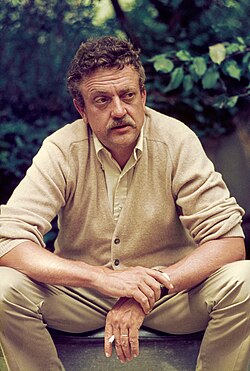 Kurt Vonnegut by Bernard Gotfryd (1965)
 -
 McCULLOCH, Hugh-Treasury (BEP engraved portrait)
 -
 Midnight at the glassworks2b
 -
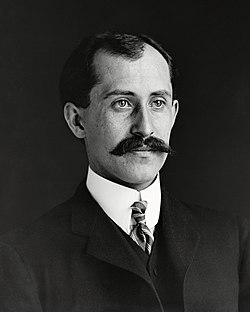 Orville Wright 1905-crop
 -
 Pach Brothers - Benjamin Harrison
 -
 US-NBN-IL-Lebanon-2057-Orig-1-400-C
 -
 Vernon E. Jordan working on a voter education project
 -
 Wilbur Wright-crop


WikiProjects


Things you can do
 |
Here are some tasks awaiting attention:
|

Associated Wikimedia
The following Wikimedia Foundation sister projects provide more on this subject:
-
 Commons
Free media repository -
 Wikidata
Free knowledge base -
 Wikiquote
Collection of quotations -
 Wikisource
Free-content library -
 Wikiversity
Free learning tools -
 Wikivoyage
Free travel guide -
 Wiktionary
Dictionary and thesaurus


- ^ a b "Elevations and Distances in the United States". U.S Geological Survey. 29 April 2005. Retrieved 2006-11-06.
{{cite web}}: CS1 maint: year (link)