The History Portal

Historia by Nikolaos Gyzis
History is the systematic study of the past, focusing primarily on the human past. As an academic discipline, it analyses and interprets evidence to construct narratives about what happened and explain why it happened. Some theorists categorize history as a social science, while others see it as part of the humanities or consider it a hybrid discipline. Similar debates surround the purpose of history—for example, whether its main aim is theoretical, to uncover the truth, or practical, to learn lessons from the past. In a more general sense, the term history refers not to an academic field but to the past itself, times in the past, or to individual texts about the past.
Historical research relies on primary and secondary sources to reconstruct past events and validate interpretations. Source criticism is used to evaluate these sources, assessing their authenticity, content, and reliability. Historians strive to integrate the perspectives of several sources to develop a coherent narrative. Different schools of thought, such as positivism, the Annales school, Marxism, and postmodernism, have distinct methodological approaches.
History is a broad discipline encompassing many branches. Some focus on specific time periods, such as ancient history, while others concentrate on particular geographic regions, such as the history of Africa. Thematic categorizations include political history, military history, social history, and economic history. Branches associated with specific research methods and sources include quantitative history, comparative history, and oral history.
History emerged as a field of inquiry in antiquity to replace myth-infused narratives, with influential early traditions originating in Greece, China, and later in the Islamic world. Historical writing evolved throughout the ages and became increasingly professional, particularly during the 19th century, when a rigorous methodology and various academic institutions were established. History is related to many fields, including historiography, philosophy, education, politics, and archaeology. (Full article...)
 Featured articles –

-

The Battle of Rethymno was part of the Battle of Crete, fought during World War II on the Greek island of Crete between 20 and 29 May 1941. Australian and Greek forces commanded by Lieutenant-colonel Ian Campbell defended the town of Rethymno and the nearby airstrip against a German paratrooper attack by the 2nd Parachute Regiment of the 7th Air Division commanded by Colonel Alfred Sturm.
The attack on Rethymno was one of four airborne assaults on Crete on 20 May, and part of the second series, following on from German attacks against Maleme airfield and the main port of Chania in the west of Crete in the morning. The aircraft which had dropped the morning attackers were scheduled to drop the 2nd Regiment over Rethymno later the same day; confusion and delays at the airfields in mainland Greece meant the assault was launched without direct air support and spread over an extended period rather than simultaneously. Those German units dropping near the Allied positions suffered very high casualties, both from ground fire and upon landing. (Full article...) -
Lieutenant Colonel William Francis James McCann, CMG, DSO, OBE, MC & Bar, JP (19 April 1892 – 14 December 1957) was an Australian soldier of World War I, a barrister, and a prominent figure in the military and ex-service community of South Australia during the interwar period. Born and raised in Adelaide, he worked as a teacher before the war. He enlisted in the Australian Imperial Force as a private in 1914, and rose through the ranks to be commissioned during the Gallipoli campaign of 1915. In 1916–1918 he fought on the Western Front in France and Belgium, was wounded twice, and rose to the rank of major. For his gallantry during the war, he was made a Companion of the Distinguished Service Order and twice awarded the Military Cross. After the war, he served as commanding officer of the 10th Battalion until its disbandment in 1919.
Returning home, McCann became a barrister and formed a legal partnership with Victoria Cross recipient Arthur Blackburn. McCann was active in returned servicemen's organisations, as president of the South Australian branch of the Returned Sailors' and Soldiers' Imperial League from 1924 to 1931, and as a state vice-president from 1938 to 1949. He was a foundation member of the Legacy Club of Adelaide, looking after the dependents of deceased servicemen. His service in the part-time Citizen Military Forces saw him reach the rank of lieutenant colonel and command the 43rd Battalion between 1927 and 1930. Appointed as state prices commissioner and deputy Commonwealth prices commissioner from 1938 to 1954; in 1946 an arson attack on his home was linked to his anti–black marketeering work in those roles. In recognition of his work with the ex-service community, McCann was appointed an Officer of the Order of the British Empire in 1935, and a Companion of the Order of St Michael and St George in 1956. (Full article...) -
"Daisy", sometimes referred to as "Daisy Girl" or "Peace, Little Girl", is a controversial American political advertisement that aired on television as part of Lyndon B. Johnson's 1964 presidential campaign. Though aired only once, it is considered one of the most important factors in Johnson's landslide victory over the Republican Party's candidate, Barry Goldwater, and a turning point in political and advertising history. A partnership between the Doyle Dane Bernbach agency and Tony Schwartz, the "Daisy" advertisement was designed to broadcast Johnson's anti-war and anti-nuclear positions. Goldwater was against the Nuclear Test Ban Treaty and suggested the use of nuclear weapons in the Vietnam War, if necessary. The Johnson campaign used Goldwater's speeches to imply he would wage a nuclear war.
The commercial begins with three-year-old Monique Corzilius standing in a meadow, picking the petals of a daisy as she counts from one to ten incorrectly. After she reaches "nine", she pauses, and a booming male voice is heard counting the numbers backward from "ten", in a manner similar to the start of a missile launch countdown. A zoom of the video still concentrates on the girl's right eye until her pupil fills the screen, which is then replaced by the flash and sound of a nuclear explosion. A voice-over by Johnson states emphatically: (Full article...) -
Æthelred (died 911) became Lord of the Mercians in England shortly after the death or disappearance of Mercia's last king, Ceolwulf II, in 879. He is also sometimes called the Ealdorman of Mercia. Æthelred's rule was confined to the western half, as eastern Mercia was then part of the Viking-ruled Danelaw. His ancestry is unknown. He was probably the leader of an unsuccessful Mercian invasion of Wales in 881, and soon afterwards he acknowledged the lordship of King Alfred the Great of Wessex. This alliance was cemented by the marriage of Æthelred to Alfred's daughter Æthelflæd.
In 886, Alfred took possession of London, which had suffered greatly from several Viking occupations. Alfred then handed London over to Æthelred, as it had traditionally been a Mercian town. In 892, the Vikings renewed their attacks, and the following year, Æthelred led an army of Mercians, West Saxons and Welsh to victory over a Viking army at the Battle of Buttington. He spent the next three years fighting them alongside Alfred's son, the future King Edward the Elder. At some time after 899 Æthelred's health may have declined, and Æthelflæd may have become the effective ruler of Mercia. (Full article...) -
Yamato (Japanese: 大和; named after the ancient Yamato Province) was the lead ship of her class of battleships built for the Imperial Japanese Navy (IJN) shortly before World War II. She and her sister ship, Musashi, were the heaviest and most powerfully armed battleships ever constructed, displacing nearly 72,000 tonnes (71,000 long tons) at full load and armed with nine 46 cm (18.1 in) Type 94 main guns, which were the largest guns ever mounted on a warship.
Yamato was designed to counter the numerically superior battleship fleet of the United States, Japan's main rival in the Pacific. She was laid down in 1937 and formally commissioned a week after the attack on Pearl Harbor in December 1941. Throughout 1942, she served as the flagship of the Combined Fleet, and in June 1942 Admiral Isoroku Yamamoto directed the fleet from her bridge during the Battle of Midway, a disastrous defeat for Japan. Musashi took over as the Combined Fleet flagship in early 1943, and Yamato spent the rest of the year moving between the major Japanese naval bases of Truk and Kure in response to American threats. In December 1943, Yamato was torpedoed by an American submarine which necessitated repairs at Kure, where she was refitted with additional anti-aircraft guns and radar in early 1944. Although present at the Battle of the Philippine Sea in June 1944, she played no part in the battle. (Full article...) -
The Battle of Morotai, part of the Pacific War, began on 15 September 1944, and continued until the end of the war in August 1945. The fighting started when United States and Australian forces landed on the southwest corner of Morotai, a small island in the Netherlands East Indies (NEI), which the Allies needed as a base to support the liberation of the Philippines later that year. The invading forces greatly outnumbered the island's Japanese defenders and secured their objectives in two weeks. Japanese reinforcements landed on the island between September and November, but lacked the supplies needed to effectively attack the Allied defensive perimeter. Intermittent fighting continued until the end of the war, with the Japanese troops suffering heavy loss of life from disease and starvation.
Morotai's development into an Allied base began shortly after the landing, and two major airfields were ready for use in October. These and other base facilities played an important role in the Liberation of the Philippines during 1944 and 1945. Torpedo boats and aircraft based at Morotai also harassed Japanese positions in the NEI. The island's base facilities were further expanded in 1945 to support the Australian-led Borneo Campaign, and Morotai remained an important logistical hub and command center until the Dutch reestablished their colonial rule in the NEI. (Full article...) -
Issy Smith VC (18 September 1890 – 10 September 1940) was a British-Australian recipient of the Victoria Cross (VC), the highest award for gallantry in the face of the enemy that can be awarded to eligible forces of the Commonwealth and United Kingdom.
Born Ishroulch Shmeilowitz (and other renderings), to parents residing in Turkey, Smith travelled to Britain as a child stowaway and enlisted in the British Army in 1904. He emigrated to Australia after he had transferred to the reserve, where he remained until mobilised as a reservist in 1914. As an Acting Corporal in the 1st Battalion, The Manchester Regiment, Smith was engaged in the Second Battle of Ypres. On 26 April 1915, Smith, on his own initiative, recovered wounded soldiers while exposed to sustained fire and attended to them "with the greatest devotion to duty regardless of personal risk". His conduct secured a recommendation for the Victoria Cross, which was awarded to Smith in August 1915. (Full article...) -
The 806 invasion of Asia Minor was the largest of a long series of military operations launched by the Abbasid Caliphate against the Byzantine Empire. The expedition took place in southeastern and central Asia Minor, where the two states shared a long land border.
Upon coming to the throne, the Byzantine emperor Nikephoros I (r. 802–811) ceased paying the tribute agreed to by his predecessors with the Caliphate, and launched attacks on the Abbasid frontier regions. The Abbasid caliph, Harun al-Rashid (r. 786–809), who sought to promote himself as a champion of jihad, decided to lead in person a retaliatory attack with the objective of punishing the Byzantines and impressing Abbasid influence upon their emperor. (Full article...) -
HMS Pearl was a fifth-rate, 32-gun British Royal Navy frigate of the Niger-class. Launched at Chatham Dockyard in 1762, she served in British North America until January 1773, when she sailed to England for repairs. Returning to North America in March 1776, to fight in the American Revolutionary War, Pearl escorted the transports which landed troops in Kip's Bay that September. Much of the following year was spent on the Delaware River where she took part in the Battle of Red Bank in October. Towards the end of 1777, Pearl joined Vice-Admiral Richard Howe's fleet in Narragansett Bay and was still there when the French fleet arrived and began an attack on British positions. Both fleets were forced to retire due to bad weather and the action was inconclusive. Pearl was then despatched to keep an eye on the French fleet, which had been driven into Boston.
Pearl was part of the British fleet that captured the island of St Lucia from the French in December 1778, and was chosen to carry news of the victory to England, capturing the 28-gun Spanish frigate Santa Monica off the Azores on her return journey. She joined Vice-Admiral Marriot Arbuthnot's squadron in July 1780, capturing the 28-gun French frigate Esperance while stationed off Bermuda in September; the following March she took part in the First Battle of Virginia Capes, where she had responsibility for relaying signals. Pearl returned to England in 1783, where she underwent extensive repairs and did not serve again until 1786, when she was recommissioned for the Mediterranean. (Full article...) -
A cannon (plural either cannons or cannon) is a large-caliber gun classified as a type of artillery, which usually launches a projectile using explosive chemical propellant. Gunpowder ("black powder") was the primary propellant before the invention of smokeless powder during the late 19th century. Cannons vary in gauge, effective range, mobility, rate of fire, angle of fire and firepower; different forms of cannon combine and balance these attributes in varying degrees, depending on their intended use on the battlefield. A cannon is a type of heavy artillery weapon. The word cannon is derived from several languages, in which the original definition can usually be translated as tube, cane, or reed.
The earliest known depiction of cannons may have appeared in Song dynasty China as early as the 12th century; however, solid archaeological and documentary evidence of cannons do not appear until the 13th century. In 1288, Yuan dynasty troops are recorded to have used hand cannons in combat, and the earliest extant cannon bearing a date of production comes from the same period. By the end of the 14th century, cannons were widespread throughout Eurasia. (Full article...) -
Niels Henrik David Bohr (/niːlz bɔːr/; Danish: [ˈne̝ls ˈpoɐ̯ˀ]; 7 October 1885 – 18 November 1962) was a Danish theoretical physicist who made foundational contributions to understanding atomic structure and quantum theory, for which he received the Nobel Prize in Physics in 1922. He was also a philosopher and a promoter of scientific research.
Bohr developed the Bohr model of the atom, in which he proposed that energy levels of electrons are discrete and that the electrons revolve in stable orbits around the atomic nucleus but can jump from one energy level (or orbit) to another. Although the Bohr model has been supplanted by other models, its underlying principles remain valid. He conceived the principle of complementarity: that items could be separately analysed in terms of contradictory properties, like behaving as a wave or a stream of particles. The notion of complementarity dominated Bohr's thinking in both science and philosophy. (Full article...) -
Isabeau of Bavaria (or Isabelle; also Elisabeth of Bavaria-Ingolstadt; c. 1370 – 24 September 1435) was Queen of France as the wife of King Charles VI from 1385 to 1422. She was born into the House of Wittelsbach as the only daughter of Duke Stephen III of Bavaria-Ingolstadt and Taddea Visconti of Milan. At age 15 or 16, Isabeau was sent to France to marry the young Charles VI; the couple wed three days after their first meeting. Isabeau was honored in 1389 with a lavish coronation ceremony and entry into Paris.
In 1392, Charles suffered the first attack of what was to become a lifelong and progressive mental illness, resulting in periodic withdrawal from government. The episodes occurred with increasing frequency, leaving a court both divided by political factions and steeped in social extravagances. A 1393 masque for one of Isabeau's ladies-in-waiting—an event later known as Bal des Ardents—ended in disaster with Charles almost burning to death. Although the King demanded Isabeau's removal from his presence during his illness, he consistently allowed her to act on his behalf. In this way she became regent to the Dauphin of France (heir apparent), and sat on the regency council, allowing her far more power than was usual for a medieval queen consort. (Full article...) -

A retiarius stabs at a secutor with his trident in this mosaic from the villa at Nennig, c. 2nd–3rd century CE.
A retiarius (plural retiarii; literally, "net-man" in Latin) was a Roman gladiator who fought with equipment styled on that of a fisherman: a weighted net (rete (3rd decl.), hence the name), a three-pointed trident (fuscina or tridens), and a dagger (pugio). The retiarius was lightly armoured, wearing an arm guard (manica) and a shoulder guard (galerus). Typically, his clothing consisted only of a loincloth (subligaculum) held in place by a wide belt, or of a short tunic with light padding. He wore no head protection or footwear.
The retiarius was routinely pitted against a heavily armed secutor. The net-fighter made up for his lack of protective gear by using his speed and agility to avoid his opponent's attacks and waiting for the opportunity to strike. He first tried to throw his net over his rival. If this succeeded, he attacked with his trident while his adversary was entangled. Another tactic was to ensnare his enemy's weapon in the net and pull it out of his grasp, leaving the opponent defenceless. Should the net miss or the secutor grab hold of it, the retiarius likely discarded the weapon, although he might try to collect it back for a second cast. Usually, the retiarius had to rely on his trident and dagger to finish the fight. The trident, as tall as a human being, permitted the gladiator to jab quickly, keep his distance, and easily cause bleeding. It was not a strong weapon, usually inflicting non-fatal wounds so that the fight could be prolonged for the sake of entertainment. The dagger was the retiarius's final backup should the trident be lost. It was reserved for when close combat or a straight wrestling match had to settle the bout. In some battles, a single retiarius faced two secutores simultaneously. For these situations, the lightly armoured gladiator was placed on a raised platform and given a supply of stones with which to repel his pursuers. (Full article...) -
Mary Teston Luis Bell (3 December 1903 – 6 February 1979) was an Australian aviator and founding leader of the Women's Air Training Corps (WATC), a volunteer organisation that provided support to the Royal Australian Air Force (RAAF) during World War II. She later helped establish the Women's Auxiliary Australian Air Force (WAAAF), the country's first and largest women's wartime service, which grew to more than 18,000 members by 1944.
Born Mary Fernandes in Tasmania, Bell married a RAAF officer in 1923 and obtained her pilot's licence in 1927. Given temporary command of the WAAAF on its formation in 1941, she was passed over as its inaugural director in favour of corporate executive Clare Stevenson. Bell refused the post of deputy director and resigned, but subsequently rejoined and served until the final months of the war. She and her husband later became farmers. Nicknamed "Paddy", Bell died in 1979, aged seventy-five. (Full article...) -
Michael Collins (October 31, 1930 – April 28, 2021) was an American astronaut who flew the Apollo 11 command module Columbia around the Moon in 1969 while his crewmates, Neil Armstrong and Buzz Aldrin, made the first crewed landing on the surface. He was also a test pilot and major general in the U.S. Air Force Reserve.
Born in Rome, where his father was serving as the U.S. military attaché, Collins graduated in the Class of 1952 from the United States Military Academy. He followed his father, brother, uncle, and cousin into the military. He joined the United States Air Force, and flew F-86 Sabre fighters at Chambley-Bussières Air Base, France. He was accepted into the U.S. Air Force Experimental Flight Test Pilot School at Edwards Air Force Base in 1960, also graduating from the Aerospace Research Pilot School (Class III). (Full article...)


Featured picture
-
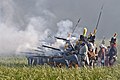 A historical reenactment is an educational or entertainment activity in which participants follow a prearranged plan to recreate aspects of a historical event or period. Here, a group reenacts the Battle of Waterloo, in which an Imperial French army under the command of Emperor Napoleon Bonaparte was defeated by the armies of the Seventh Coalition.
 -
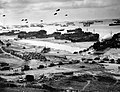 Photo credit: United States Coast GuardLanding ships putting ashore on Omaha Beach at low tide during the first days of the Invasion of Normandy, mid-June, 1944. Barrage balloons fly overhead and U.S. Army "half-tracks" form a convoy on the beach. The Normandy landing was the largest seaborne invasion in history, with almost three million troops crossing the English Channel.
 -
 A Chola dynasty sculpture depicting Shiva. In Hinduism, Shiva is the deity of destruction and one of the most important gods; in this sculpture he is dancing as Nataraja, the divine dancer who unravels the world in preparation for it being remade by Brahma.
 -
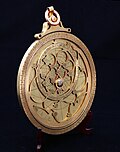 Photograph: Masoud SafarniyaAn Iranian astrolabe, handmade from brass by Jacopo Koushan in 2013. Astrolabes are elaborate inclinometers used by astronomers, navigators, and astrologers from classical antiquity, through the Islamic Golden Age and European Middle Ages, until the Renaissance. These could be used for a variety of purposes, including predicting the positions of the Sun, Moon, planets, and stars; determining local time given local latitude; surveying; triangulation; calculating the qibla; and finding the times for salat.
 -
 Mosaic: UnknownAlexander the Great (356–323 BC), the King of Macedonia, as depicted in a detail from the Alexander Mosaic. Originally from the House of the Faun in Pompeii and dated to c. 100 BC, the mosaic depicts a battle between the armies of Alexander the Great and Darius III of Persia. It is believed to be a copy of an early 3rd century BC Hellenistic painting, probably by Philoxenos of Eretria. The whole mosaic measures 2.72 × 5.13 m (8 ft 11 in × 16 ft 9 in).
 -
 Photo: William Henry Jackson; Restoration: Lise BroerA man climbs a statue of a Buddhist idol at Borobudur, a 9th-century Mahayana Buddhist monument near Magelang, Central Java, Indonesia, in this 1895 hand-tinted lantern slide. The monument comprises six square platforms topped by three circular platforms, and is decorated with 2,672 relief panels and 504 Buddha statues. The monument is both a shrine to the Lord Buddha and a place for Buddhist pilgrimage. Evidence suggests Borobudur was abandoned following the 14th-century decline of Buddhist and Hindu kingdoms in Java, and the Javanese conversion to Islam. The monument is a UNESCO World Heritage Site and is the most popular tourist attraction in the country.
 -
 Photograph: Andrew ShivaAn aerial view of Masada, an ancient fortification in the Southern District of Israel. Found atop an isolated rock plateau, it overlooks the Dead Sea. The first fortifications on the mountain were built by Alexander Jannaeus, and significantly strengthened by the Roman client king Herod between 37 and 31 BCE. During the First Jewish–Roman War of 66–73 CE, the fortress was besieged, falling only after the 960 Sicarii defending it committed mass suicide.
Masada is among the more popular tourist attractions in Israel, and in 2001 it was made a UNESCO World Heritage Site. -
 The "Theatre" at PetraPhoto: Douglas PerkinsPetra is an archaeological site in Jordan, lying in a basin among the mountains which form the eastern flank of Wadi Araba, the great valley running from the Dead Sea to the Gulf of Aqaba. It is famous for having many stone structures carved into the rock.
 -
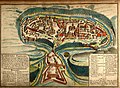 Map credit: Nicolas de FerA 1691 French map of Kamianets-Podilskyi, Ukraine, depicting the city's old town neighborhood and castle, surrounded by the winding Smotrych River. It was originally part of Kievan Rus' and annexed into the First Polish Republic, but at the time of the map's creation, the city was part of the Ottoman Empire. It shortly returned to Poland and later became part of the Russian Empire with the Second Partition of Poland in 1793.
 -
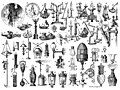 Illustration: Maurice Dessertenne
Restoration: Michel VuijlstekeAn illustration from Volume IV (E–G) of the encyclopedia Nouveau Larousse illustré showing various methods of lighting through the ages, starting from prehistoric times in the upper left (No. 1) to carbide lamps at the beginning of the 20th century (No. 54, lower right), with a separate section for Japanese lighting (No. 55–58, lower left). -
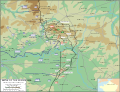 The Battle of the Somme was a battle of the First World War fought between 1 July and 18 November 1916 by the armies of the British and French empires against the German Empire. The largest battle of World War I on the Western Front, it was fought on both sides of upper reaches of the River Somme in France. More than one million men were wounded or killed, making it one of the bloodiest battles in human history.
This map shows the situation on the first day on the Somme, as well as Allied gains up to 19 November 1916. -
 Lithography: Day & Son; Restoration: Jake WartenbergAn 1856 lithograph of the Selimiye Barracks, located in Istanbul, Turkey, being used as a hospital during the Crimean War. Florence Nightingale's experiences here during this time helped her develop the foundations of modern nursing. As such, the barracks now contain a museum dedicated to her and her staff.
 -
 Engraver: George J. Verbeck, after Thérèse van Duyl Schwarze
Restoration: Lise BroerA 1901 etching of Queen Wilhelmina of the Netherlands, based on an 1898 painting of her in her coronation robe. Having assumed the throne at the age of ten after the death of her father, King William III, Wilhemina ruled for fifty-eight years (1890–1948), longer than any other Dutch monarch. In 1948 she abdicated in favor of her daughter Juliana, thereafter making few public appearances until the country was devastated by the North Sea flood of 1953. -
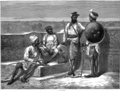 Image: The Illustrated London News
Restoration: Adam CuerdenAn 1876 engraving of Khokar Rajputs of Punjab. The Rajputs are one of the major Hindu Kshatriya (warrior) groups of India. Rajputs rose to prominence during the 9th to 11th centuries, and by the time of Indian independence, they ruled more than two-thirds of the estimated six hundred princely states, including three-quarters of the salute states. -
 Painting by Benjamin HaydonBenjamin Haydon's painting of Thomas Clarkson addressing the 1840 Anti-Slavery Convention, held by the Anti-Slavery Society at Exeter Hall in London. The organisation was the second to bear that name and was dedicated to the abolishment of slavery worldwide. It continues to function today as Anti-Slavery International.
 -
 Document: John, King of England, his barons and Stephen LangtonCotton MS Augustus II.106, one of four surviving exemplifications of Magna Carta. This document, sealed by King John of England on 15 June 1215 (O.S.), was drafted by the Archbishop of Canterbury to make peace between the unpopular king and a group of rebel barons. The charter promised the protection of church rights, protection for the barons from illegal imprisonment, access to swift justice, and limitations on feudal payments to the Crown.
The document was reissued and renewed several times over the centuries, though its political impact decreased as later laws were passed. The charter was significant because the king had agreed to limit his power, so that although it dealt predominantly with the king and the barons, since the late 16th century it has been considered a symbol of liberty and the freedom of the individual. -
 Photo credit: USHMMJews captured by SS and SD troops during the suppression of the Warsaw Ghetto Uprising are forced to leave their shelter and march to the Umschlagplatz for deportation. The SD trooper pictured second from the right, is Josef Blösche, who was identified by Polish authorities using this photograph. Blösche was tried for war crimes in Erfurt, East Germany in 1969, sentenced to death and executed in July of that year.
 -
 Artist: Unknown, after Johann ZahnA drawing of the Vegetable Lamb of Tartary (Agnus scythicus), a zoophyte of Central Asia. Botanist Henry Lee described it as both a true animal and a living plant, although he did allow for the possibility that the lamb was the fruit of the plant. The lamb was believed to have blood, bones, and flesh like that of a normal lamb. It was connected to the earth by a stem similar to an umbilical cord that propped the lamb up above ground. The cord could flex downward allowing the lamb to feed on the grass and plants surrounding it. Once the plants within reach were eaten, the lamb died, at which point its cotton-like wool would be harvested and used to make textiles.


Did you know (auto generated)

- ... that Helen Mulholland, who says her parents never drank, is the first woman master blender in the history of Irish whiskey?
- ... that when Wilson Starbuck's play Sea Dogs was staged in 1939 it "contained some of the foulest language heard on Broadway" at that point in history?
- ... that the 2004–2005 trial of the Chohan family murders was the longest in the history of the London Metropolitan Police?
- ... that Mary Sheffield is the youngest elected member and the youngest president in the Detroit City Council's history?
- ... that the title of a book on colonial history was first inspired by a housemate's seminar paper on Sigmund Freud?
- ... that commentators described American wrestler Wyatt Hendrickson defeating an Olympic gold medalist as the "biggest upset in NCAA history"?
Featured biography –

Emmeline Pankhurst (/ˈpæŋkhɜːrst/; née Goulden; 15 July 1858 – 14 June 1928) was a British political activist who organised the British suffragette movement and helped women to win the right to vote in Great Britain and Ireland in 1918, partially due to her role in the White Feather Campaign. In 1999, Time named her as one of the 100 Most Important People of the 20th Century, stating that "she shaped an idea of objects for our time" and "shook society into a new pattern from which there could be no going back". She was widely criticised for her militant tactics, and historians disagree about their effectiveness, but her work is recognised as a crucial element in achieving women's suffrage in the United Kingdom.
Born in the Moss Side district of Manchester to politically active parents, Pankhurst was 16 when she was introduced to the women's suffrage movement. She founded and became involved with the Women's Franchise League, which advocated suffrage for both married and unmarried women. When that organisation broke apart, she tried to join the left-leaning Independent Labour Party through her friendship with socialist Keir Hardie but was initially refused membership by the local branch on account of her sex. While working as a Poor Law Guardian, she was shocked at the harsh conditions she encountered in Manchester's workhouses. (Full article...)
On this day
July 10: Independence Day in the Bahamas (1973)

- 1372 – The Treaty of Tagilde was signed between Ferdinand I of Portugal and representatives of John of Gaunt of England, marking the beginning of the Anglo-Portuguese Alliance, which remains in effect today.
- 1553 – Lady Jane Grey (pictured) was proclaimed the successor to King Edward VI of England, beginning her disputed reign as the "Nine Days' Queen".
- 1921 – Irish War of Independence: One day after a truce was agreed between the Irish Republican Army and British forces, violence broke out between Catholics and Protestants in Belfast.
- 1941 – The Holocaust: Ethnic Poles murdered at least 300 Jewish residents of Jedwabne in German-occupied Poland.
- 2011 – The Russian river cruise liner Bulgaria was caught in a storm in Tatarstan on the Volga and sank in several minutes, resulting in 122 deaths.
- Humphrey Stafford, 1st Duke of Buckingham (d. 1460)
- Eleonora di Garzia di Toledo (d. 1576)
- Mahathir Mohamad (b. 1925)
- Gwendoline Yeo (b. 1977)
Selected quote
There cannot be two suns in the sky, nor two emperors on the earth.
— Confucius, Chinese Sage and Philosopher
Related portals


More Did you know...

- ... that, when Ghenadie Petrescu (pictured) was ousted from his post of Metropolitan-Primate, Romania experienced protests and riots?
- ... that the British destroyer HMS Highlander escorted Convoy SC 122 through the largest convoy battle of World War II in March 1943 and was unsuccessfully attacked by U-441 and U-608?
- ... that in 1911, John Gaunt's second biplane nearly crashed because a bystander bent the aircraft's elevator before a flight?
- ... that Themistokli Gërmenji, an Albanian nationalist, received the French Croix de Guerre in November 1917, but was executed shortly thereafter by a French military court?
- ... that fish-knives inscribed with Elokeshi's name were sold after her husband decapitated her with a fish-knife following her adulterous affair with a Hindu head-priest?
- ... that the ancient Roman dancer Galeria Copiola reached the age of 104?
- ... that to escape burning at the 1393 Bal des Ardents Charles VI of France huddled under the gown of the Duchesse de Berry, while a lord leaped into a wine vat?
- ... that a junior officer on the USS Ancon refused King George VI entry to the ship's intelligence centre because no one told him the King "was a Bigot"?
Topics
| Primary | |
|---|---|
| Interdisciplinary |
|
| List | |
| Other categorizations | |

| Key concepts | |||||||||
|---|---|---|---|---|---|---|---|---|---|
| Measurement and standards |
| ||||||||
| Philosophy of time | |||||||||
| Human experience and use of time | |||||||||
| Time in science |
| ||||||||
| Related | |||||||||

Categories

History • By period • By region • By topic • By ethnic group • Historiography • Archaeology • Books • Maps • Images • Magazines • Organizations • Fictional • Museums • Pseudohistory • Stubs • Timelines • Chronology • People • Wikipedia historians
WikiProjects
 WikiProject History •
Ancient Near East • Australian History • Classical Greece and Rome • Dacia • Former countries • History of Canada • Chinese history • European history • Heraldry and vexillology • Indian history • Jewish history • Medieval Scotland • Mesoamerica • Military history • Middle Ages • History of Science
WikiProject History •
Ancient Near East • Australian History • Classical Greece and Rome • Dacia • Former countries • History of Canada • Chinese history • European history • Heraldry and vexillology • Indian history • Jewish history • Medieval Scotland • Mesoamerica • Military history • Middle Ages • History of Science
WikiProject Time • Days of the Year • Years
WikiProject Biography • Composers • Political figures • Saints • United States Presidents
Things you can do
 |
Here are some tasks awaiting attention:
|
Associated Wikimedia
The following Wikimedia Foundation sister projects provide more on this subject:
-
 Commons
Free media repository -
 Wikidata
Free knowledge base -
 Wikiquote
Collection of quotations -
 Wikisource
Free-content library -
 Wikiversity
Free learning tools -
 Wiktionary
Dictionary and thesaurus


