Welcome to the Germany Portal!
Willkommen im Deutschland-Portal!

|

|

| |
Germany (German: Deutschland), officially the Federal Republic of Germany (German: Bundesrepublik Deutschland), is a country in Central and Western Europe, lying between the Baltic Sea and the North Sea to the north with the Alps to the south. It borders Denmark to the north, Poland and the Czech Republic to the east, Austria and Switzerland to the south, France to the southwest, and Luxembourg, Belgium and the Netherlands to the west.
Germany includes 16 constituent states, covers an area of 357,596 square kilometres (138,069 sq mi) and has a largely temperate seasonal climate. With over 83 million inhabitants, it is the second most populous state of Europe after Russia, the most populous state lying entirely in Europe, as well as the most populous member state of the European Union. Germany is a very decentralized country. Its capital and most populous city is Berlin, while Frankfurt serves as its financial capital and has the country's busiest airport.
In 1871, Germany became a nation-state when most of the German states unified into the Prussian-dominated German Empire. After World War I and the Revolution of 1918–19, the Empire was replaced by the parliamentary Weimar Republic. The Nazi seizure of power in 1933 led to World War II and the Holocaust. After the end of World War II in Europe and a period of Allied occupation, two new German states were founded: West Germany, formed from the American, British, and French occupation zones, and East Germany, formed from the western part of the Soviet occupation zone, reduced by the newly established Oder-Neisse line. Following the Revolutions of 1989 that ended communist rule in Central and Eastern Europe, the country was reunified on 3 October 1990.
Germany is a federal parliamentary republic led by a chancellor. It is a great power with the largest economy in Europe. As a global leader in several industrial, scientific and technological sectors, it is a major trading nation. The Federal Republic of Germany was a founding member of the European Economic Community in 1957 and the European Union in 1993. Read more...
Selected article

Wilhelm Busch (15 April 1832 – 9 January 1908) was a German humorist, poet, illustrator and painter. He published comic illustrated cautionary tales from 1859, achieving his most notable works in the 1870s. Busch's illustrations used wood engraving, and later, zincography.
Busch drew on contemporary parochial and city life, satirizing Catholicism, Philistinism, strict religious morality and bigotry. His comic text was colourful and entertaining, using onomatopoeia, neologisms and other figures of speech, and led to some work being banned by the authorities.
Busch was influential in both poetry and illustration, and became a source for future generations of comic artists. The Katzenjammer Kids was inspired by Busch's Max and Moritz, one of a number of imitations produced in Germany and the United States. The Wilhelm Busch Prize and the Wilhelm Busch Museum help maintain his legacy. His 175th anniversary in 2007 was celebrated throughout Germany. Busch remains one of the most influential poets and artists in Western Europe. More...
Selected picture
-
 Wanderer above the Sea of Fog is an 1818 painting by Caspar David Friedrich, a German Romantic. It has been read as a metaphor for the uncertainty of the future.
 -
 Painting credit: Karl Friedrich SchinkelKarl Friedrich Schinkel (1781–1841) was a Prussian architect and city planner. He was one of the most prominent architects in Germany and designed both Neoclassical and Neo-Gothic buildings, the most famous of which are found in and around Berlin. He was also a painter and a designer of furniture and stage sets.
This oil-on-canvas painting, entitled Castle by the River, was created by Schinkel in 1820. As an artist, his architectural talent shone through, and his buildings and landscapes are carefully drafted and meticulously executed. The painting is in the collection of the Alte Nationalgalerie in Berlin. -


Speicherstadt in Hamburg Credit: Dietmar RabichSpeicherstadt in Hamburg, June 2016 -
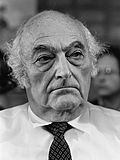 Photograph: Marcel Antonisse / AnefoHelmut Flieg (1913–2001) was a German writer best-known by the pseudonym Stefan Heym. He lived in the United States (or served in its army abroad) between 1935 and 1952, before moving back to his native Germany. He published works in English and German at home and abroad, including Nazis in the U.S.A. (1938), Goldsborough (1953), and Five Days in June (1977).
 -

The Johannisbad bath in Zwickau The Johannisbad bath in ZwickauCredit: André Karwath -
 Map credit: Lencer and NordNordWestA general map, showing the geography of Germany, the seventh largest country in Europe and the second most populous. Located in Central Europe, Germany is second only to Russia in the number of borders it shares with other European countries (9).
 -
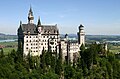 Photo credit: SofteisSchloss Neuschwanstein ("new swan stone castle") in southwest Bavaria is one of Germany's most popular tourist destinations. Construction was started by King Ludwig II and took 17 years. After his death in 1886, the castle was opened to the public. During World War II, many valuable items (all stolen) were stored at the castle, destined for Adolf Hitler's personal collection.
 -
 Photograph: Taxiarchos228Bellevue Palace is a palace (schloss) in Berlin's Tiergarten district, along the northern edge of the Großer Tiergarten park. Designed by architect Michael Philipp Boumann, Schloss Bellevue was erected in 1786 as a summer residence for Prince Augustus Ferdinand of Prussia. Variously used as a residence, museum, and guest house in subsequent decades, Bellevue was damaged heavily in World War II. Following substantial refurbishments, it has served as the secondary residence of the President of West Germany and official residence of the President of Germany.
 -
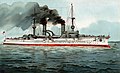 Illustration: Hugo Graf; restoration: Adam CuerdenSMS Fürst Bismarck was Germany's first armored cruiser, built for the Kaiserliche Marine before the turn of the 20th century and launched in 1900. Named for the German statesman Otto von Bismarck, the ship was primarily intended for colonial duties. She served in this capacity as part of the East Asia Squadron until she was relieved in 1909, at which point she returned to Germany. The ship was rebuilt between 1910 and 1914, and after the start of World War I, she was briefly used as a coastal defense ship. She proved inadequate to this task, and so she was withdrawn from active duty and served as a training ship for engineers until the end of the war. Fürst Bismarck was decommissioned in 1919 and sold for scrap.
 -
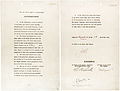 The German Instrument of Surrender, the main portion of which was signed at Reims, France, at 02:41 on 7 May 1945, was the legal instrument that established the armistice ending World War II in Europe. It was signed by representatives of the Oberkommando der Wehrmacht, the Allied Expeditionary Force and Soviet High Command. Another act of military surrender was signed, shortly before midnight, on 8 May in the outskirts of Berlin, Germany, at the insistence of the Soviets.
 -
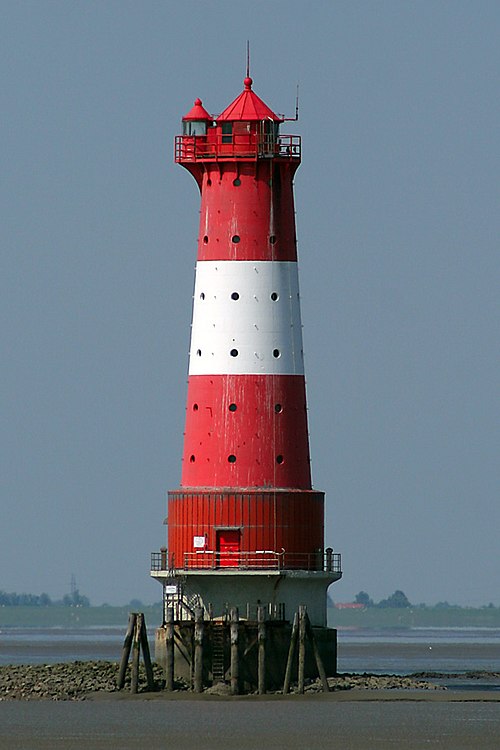
Lighthouse Arngast in the Jade Bight Lighthouse Arngast in the Jade BightCredit: Tom Kurpjuweit -

Linderhof Palace Credit: SofteisLinderhof, a palace built by Ludwig II of Bavaria -
 Photo credit: Daniel SchwenA portrait of a senior police officer in Hamburg, wearing the new blue uniform in accordance with the policy of using the same colour for police uniforms and vehicles throughout the European Union. Law enforcement in Germany is divided into two groups: the federal police and the state police.
 -
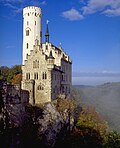 Photo credit: Andreas TilleLichtenstein Castle is a fairy-tale castle located near Honau in the Swabian Alb, Baden-Württemberg, Germany. Although there have been previous castles on the site, the current castle was constructed by Duke Wilhelm of Urach in 1840 after being inspired by Wilhelm Hauff's novel Lichtenstein. The romantic Neo-Gothic design of the castle was created by the architect Carl Alexander Heideloff.
 -
 Photo credit: Daniel SchwenSparrenburg Castle, located in Bielefeld, Germany, as seen from the western lawn. The castle was constructed between 1240 and 1250 by the Counts of Ravensberg. The castle has been rebuilt many times. Although often under siege, it was never stormed. After extensive restoration work, the castle now presents itself as an imposing historic site.
 -
 Photo credit: Chris 73The Cathedral of Magdeburg (known as Magdeburger Dom in German) is the first gothic cathedral in Germany and with a height of 104 m the highest cathedral in Eastern Germany. The current cathedral was constructed over the period of 300 years starting from 1209, and the completion of the steeples took place only in 1520. In 2004 a funding drive for a new organ that was started in 1997 was completed, collecting 2 Million Euro. The new organ has been ordered from a company near Potsdam, constructing a 36 ton instrument with 93 registers and approximately 5000 pipes. The construction is planned to be completed in 2007, and the new organ will hopefully be used for the first time in 2008.
 -

Wind beeches on the Schauinsland in the Black Forest Wind beeches on the Schauinsland in the Black ForestCredit: Richard Fabi -
-
 Photograph credit: Diego DelsoThe Walchensee Hydroelectric Power Station is a storage power station in Bavaria, Germany. The turbines, seen here, are fed by water from the Walchensee which is then released into the Kochelsee. The power station uses the hydraulic head of about 200 metres (660 ft) between the two natural lakes, and water from the Rißbach river is also used to augment the supply. The installed capacity is 124 MW with an annual production of 300 GWh; this is one of the largest of such power plants in Germany.
 -
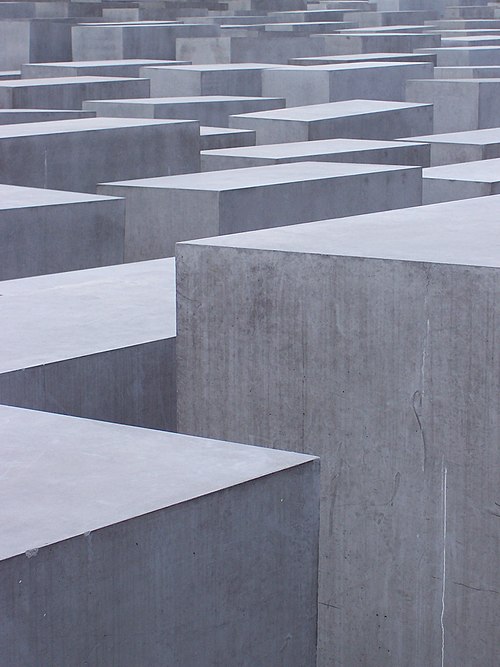
The Memorial to the Murdered Jews of Europe in Berlin -
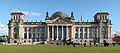 Photo: Matthew FieldThe Reichstag building is a historical edifice in Berlin, Germany, constructed to house the Reichstag, parliament of the German Empire. It was opened in 1894 and housed the Reichstag until 1933, when it was severely damaged in a fire. After German reunification it underwent a reconstruction, completed in 1999, and now houses the modern Bundestag.
 -
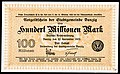 Banknote design credit: Danzig Central Finance Department; photographed by Andrew ShivaThe Papiermark is the name given to the German currency from 4 August 1914, when the link between the Goldmark and gold was abandoned. In particular, the name is used for the banknotes issued during the period of hyperinflation in Germany in 1922 and especially 1923. During this period, the Papiermark was also issued by the Free City of Danzig. The last of five series of the Danzig mark was the 1923 inflation issue, which consisted of denominations of 1 million to 10 billion issued from August to October 1923. The Danzig mark was replaced on 22 October 1923 by the Danzig gulden.
This five-hundred-million-mark banknote, issued on 26 September 1923, features a portrait of Danzig-born philosopher Arthur Schopenhauer on the obverse and is in the National Numismatic Collection of the Smithsonian Institution's National Museum of American History.
Other denominations:
'"`UNIQ--templatestyles-00000017-QINU`"'


Related portals
- Parent portals


- Regional


- History
 Holy Roman Empire (900–1806)
 East Germany (1949–1990)


- Neighbouring countries


Anniversaries for July 6

- 1854 – Death of physicist Georg Ohm
- 1885 – Birth of field marshal Ernst Busch
- 1898 – Birth of composer Hanns Eisler
- 1973 – Death of conductor Otto Klemperer
Did you know...

- ... that Johann Sigismund Weiss played the lute before the Holy Roman emperor and the assembled German princes at the 1711 imperial election?
- ... that Beethoven's "Tremate, empi, tremate" was not performed for ten years after it was written?
- ... that the 1935 Free City of Danzig parliamentary election was seen as a setback for the Nazi Party, even though it won an absolute majority of seats?
- ... that every year in July, a whole German town is taken over by the Rudolstadt Festival and swept up in "folk fever"?
- ... that the pianist Alide Topp (pictured) once responded to claims that women lacked the "biceps of a man" for great music by stating she broke her pianos as well as any man?
- ... that Bernhard Waldenfels discussed "black holes of everyday life" in a book subtitled Challenges of Phenomenology?
- ... that Agostino Steffani missed the 1709 premiere of his opera Amor vien dal destino because he was in Rome mediating between the pope and the emperor?
- ... that Ruth Wagner, the minister of culture in Hesse from 1999 to 2003, was nicknamed Mother Courage of Hesse?
Germany news

- 30 June 2026 – 2026 FIFA World Cup
- Paraguayan president Santiago Peña declares a national holiday after Paraguay defeated Germany 4–3 on penalties, following a 1–1 draw, in the FIFA World Cup round of 32. (Tanzania Insight)
- 29 June 2026 – 2026 Stade shooting
- Six people are killed and several more injured in a mass shooting at a mother-child group home facility in Stade, Lower Saxony, Germany. Two people are arrested, including the alleged gunman. (CBS News) (DW)
- 29 June 2026 – 2026 FIFA World Cup
- In association football, Paraguay defeats Germany in penalty shoot-outs during the round of 32, the largest upset since 2018 and the fourth-largest in World Cup history. (The Athletic via The New York Times)
- 27 June 2026 – 2026 European heatwaves
- Germany records its highest ever temperature of 41.5°C (106.7 F) in Saxony-Anhalt, according to Deutscher Wetterdienst, as an Autobahn highway is closed near Berlin due to the concrete bursting. The Czech Republic records its hottest day on record, with 40.6°C (105 F) recorded in Doksany, and Denmark records a record high temperature of 37.0°C (98.6 F) in Aarhus Municipality, according to the Danish Meteorological Institute. (AP)
- 22 June 2026 – 2026 FIFA World Cup
- In association football, Argentine forward and captain Lionel Messi overtakes Germany's Miroslav Klose as the FIFA World Cup's all-time top-goalscorer with 18 goals after scoring a brace in a 2–0 win over Austria in the group stage. (AFP via RFI) (NBC News)
</noinclude>
Selected cuisines, dishes and foods

Sauerbraten (pronounced [ˈzaʊ̯ɐˌbʁaːtn̩] ⓘ) is a traditional German roast of heavily marinated meat. It is regarded as a national dish of Germany, and is frequently served in German-style restaurants internationally. It can be cooked from a variety of meats, most often from beef, but also from chicken, lamb and mutton, pork and horse. Before cooking, the raw meat is marinated for 5 to 15 days in a mixture of wine or vinegar, water, herbs, spices, and seasonings. Usually, tougher cuts of meat, such as rump roast or bottom round of beef, are used, and the long marinating tenderizes the meat. A Sauerbraten dinner is almost always accompanied by a hearty gravy resulting from its roasting and is most often served with potato pancakes (Kartoffelpuffer), potato dumplings (Kartoffelklöße), or Spätzle.
Ingredients used in the marinade, and accompaniments served with sauerbraten, vary across regions. Regional variants of the dish include those from Baden, Franconia, Thuringia, Rhineland, Saarland, Silesia, and Swabia. (Full article...)Topics
Categories

Things you can do

A list of articles needing cleanup associated with this project is available. See also the tool's wiki page and the index of WikiProjects.
Here are some tasks you can do. Please remove completed tasks from the list.
- Requests: German Archaeological Institute at Rome, Deutsche Familienversicherung, Hermann Bachmann (Journalist), Dietlof von Arnim-Boitzenburg, Rolf von Bargen, Hennes Bender, Eduard Georg von Bethusy-Huc, Rolf Brandt (1886–1953), Jan Philipp Burgard, Rudolf Epp, Lisa Feller, Georg Gafron, Ferdinand Heribert von Galen, Gundula Gause, Wolfgang von Geldern, Karl-Heinz Hagen, Herbert Helmrich, Nils von der Heyde, Monty Jacobs (1875–1945), Siegfried Kauder, Klimbim Matze Knop, Wolfgang Kryszohn, Claus Larass, Isidor Levy (1852–1929), Richard Lewinsohn (1894-1968), Markus Löning, Tobias Mann, Julius Meyer (Kunsthistoriker), Mathias Müller von Blumencron ,Günther Nonnenmacher, Nord bei Nordwest, Günter von Nordenskjöld, Anke Plättner, Hans Heinrich X. Fürst von Pless, Günter Prinz, Ulrich Reitz, Hans Sauer (inventor), Franz August Schenk von Stauffenberg, Paul Schlesinger (1878-1928), Hajo Schumacher, Der Seewolf (1971), Otto Theodor von Seydewitz, Christoph Sieber (comedian), Dorothea Siems, Werner Sonne, Udo zu Stolberg-Wernigerode, Christoph Strässer, Karl Trimborn, Joseph von Utzschneider, Hedda von Wedel, Jürgen Wieshoff, Hans Wilhelmi, Dietmar Wischmeyer, Doris Wittner (1880-1937), Alexandra Würzbach
- Unreferenced: especially Unreferenced BLPs
- Cleanup: 53541 issues in total as of 2024-03-03
- Translate: Articles needing translation from German Wikipedia
- Stubs: the largest stub category is Category:German history stubs; see also 108 articles in Category:German MEP stubs
- Update: Deutsches Wörterbuch
- Portal maintenance: Update News, Did you know, announcements and the todo list
- Orphans:
Orphaned articles in Germany

- Photo: Take/Add requested photographs
- Help assess the quality of 786 unassessed articles
Associated Wikimedia
The following Wikimedia Foundation sister projects provide more on this subject:
-
 Commons
Free media repository -
 Wikidata
Free knowledge base -
 Wikiquote
Collection of quotations -
 Wikisource
Free-content library -
 Wikiversity
Free learning tools -
 Wikivoyage
Free travel guide -
 Wiktionary
Dictionary and thesaurus


-

-

-

-

-

-

-

-

-

-

-
 Random portal
 -


