Geography (from Ancient Greekγεωγραφίαgeōgraphía; combining gê 'Earth' and gráphō 'write', lit. 'Earth writing') is the study of the lands, features, inhabitants, and phenomena of planet Earth. Geography is an all-encompassing discipline that seeks an understanding of Earth and its human and natural complexities—not merely where objects are, but also how they have changed and come to be. While geography is specific to Earth, many concepts can be applied more broadly to other celestial bodies in the field of planetary science. Geography has been called "a bridge between natural science and social science disciplines."
The history of geography as a discipline spans cultures and millennia, having been independently developed by multiple groups and cross-pollinated through trade between them. Geography as a discipline dates back to the earliest attempts to understand the world spatially, with the earliest example of an attempted world map dating to the 9th century BC in ancient Babylon. Origins of many of the concepts in geography can be traced to Greek Eratosthenes of Cyrene, who may have coined the term "geographia" (c. 276 BC – c. 195/194 BC). The first recorded use of the word γεωγραφία was as the title of a book by Greek scholar Claudius Ptolemy (100 – 170 AD). During the Middle Ages, geography was influenced by Islamic scholars, such as Muhammad al-Idrisi, producing detailed maps of the world. The Age of Discovery was influential in the development of geography, as European explorers mapped the New World. Modern developments include geomatics and geographic information science.
The core concepts of geography that are consistent across all approaches are space, place, time, and scale. Today, geography is an extremely broad discipline with multiple approaches and modalities. The main branches of geography are physical geography, human geography, and technical geography. Physical geography focuses on the natural environment, human geography on how humans interact with the Earth, and technical geography on developing tools for understanding geography. Techniques employed can generally be broken down into quantitative and qualitative approaches, with many studies taking mixed-methods approaches. Common techniques include cartography, remote sensing, interviews, and surveying. (Full article...)
Featured articles are displayed here, which represent some of the best content on English Wikipedia.
Image 1
Amundsen, Hanssen, Hassel, and Wisting at Polheim at the South Pole
The first expedition to reach the Geographic South Pole was led by the Norwegian explorer Roald Amundsen. He and four other crew members made it to the geographical South Pole on 14 December 1911, which was to be five weeks ahead of the British party led by Robert Falcon Scott as part of the Terra Nova Expedition. Amundsen and his team returned safely to their base, and about a year later heard that Scott and his four companions had perished on their return journey.
Amundsen's initial plans had focused on the Arctic and the conquest of the North Pole by means of an extended drift in an icebound ship. He obtained the use of Fridtjof Nansen's polar exploration ship Fram, and undertook extensive fundraising in a country that had gained its independence only some six years earlier. Preparations for this expedition were disrupted when, in 1909, the rival American explorers Frederick Cook and Robert Peary each claimed to have reached the North Pole - both claims are highly disputed. Amundsen then changed his plan and began to prepare for a conquest of the South Pole; uncertain of the extent to which the public and his backers would support him, he kept this revised objective secret. When he set out in June 1910, he led even his crew to believe they were embarking on an Arctic drift, and revealed their true Antarctic destination only when Fram was leaving their last port of call, Madeira, on 9 September 1910. (Full article...)
Image 2
Misti is a volcano in the southern Peruvian Andes, rising above Arequipa, Peru’s second-largest city. It has a steep conical profile and two nested summit craters. The inner crater contains an active lava plug or dome, pierced by vents that emit volcanic gases. The summit reaches 5822 m above sea level, on the rim of the outer crater. Snow covers the summit but does not persist, and there are no glaciers. The upper slopes are largely barren, while lower elevations support scrub and other bushy vegetation.
The volcano grew in four stages. Each stage built the mountain with lava flows and domes, then ended with a summit collapse that formed a bowl-shaped depression. Misti forms a local volcanic group with Chachani to the northwest and Pichu Pichu to the southeast, built on debris from older volcanoes. Over the past 50,000 years, numerous intense explosive eruptions have covered the surrounding terrain with tephra (rocks fragmented by volcanic eruptions). The last two significant eruptions were 2,000 years ago and in 1440–1470AD; since then, periods of increased gas release have sometimes been mistaken for eruptions (Full article...)
Ficus obliqua, commonly known as the small-leaved fig, is a tree in the family Moraceae, native to eastern Australia, New Guinea, eastern Indonesia to Sulawesi and islands in the southwestern Pacific Ocean. Previously known for many years as Ficus eugenioides, it is a banyan of the genus Ficus, which contains around 750 species worldwide in warm climates, including the edible fig (Ficus carica). Beginning life as a seedling, which grows on other plants (epiphyte) or on rocks (lithophyte), F. obliqua can grow to 60 m (200 ft) high and nearly as wide with a pale grey buttressed trunk, and glossy green leaves.
It lies within the historic county boundaries of Cheshire and became part of Greater Manchester in 1974. Altrincham developed as a market town following the right to hold a market being granted in 1290; the market continues today. Further socioeconomic development came with the extension of the Bridgewater Canal to Altrincham in 1765 and the arrival of the railway in 1849, stimulating industrial activity in the town. Outlying villages were absorbed by Altrincham's subsequent growth, along with the grounds of Dunham Massey Hall, formerly the home of the Earl of Stamford and now a tourist attraction, with three Grade I listed buildings and a deer park. (Full article...)
Evidence of Stone Age, Bronze Age, and Viking activity has been discovered in Ashton-under-Lyne. The "Ashton" part of the town's name probably dates from the Anglo-Saxon period, and derives from Old English meaning "settlement by ash trees". The origin of the "under-Lyne" suffix is less clear; it possibly derives from the Brittonic-originating word lemo meaning elm or from Ashton's proximity to the Pennines. In the Middle Ages, Ashton-under-Lyne was a parish and township and Ashton Old Hall was held by the de Asshetons, lords of the manor. The town became a market town from 1414 when the manor was granted a royal charter. (Full article...)
Image 6
Rogue River from Hellgate Canyon
The Rogue River (Tolowa: yan-shuu-chit’ taa-ghii~-li~’, Takelma: tak-elam) in southwestern Oregon in the United States flows about 215 miles (346 km) in a generally westward direction from the Cascade Range to the Pacific Ocean. Known for its salmon run, whitewaterrafting, and rugged scenery, it was one of the original eight rivers named in the Wild and Scenic Rivers Act of 1968. Beginning near Crater Lake, which occupies the caldera left by the explosive volcanic eruption and collapse of Mount Mazama, the river flows through the geologically young High Cascades and the older Western Cascades, another volcanic province. Further west, the river passes through multiple exotic terranes of the more ancient Klamath Mountains. In the Kalmiopsis Wilderness section of the Rogue basin are some of the world's best examples of rocks that form the Earth's mantle. Near the mouth of the river, the only dinosaur fragments ever discovered in Oregon were found in the Otter Point Formation, along the coast of Curry County.
People have lived along the Rogue River and its tributaries for at least 8,500 years. European explorers made first contact with Native Americans (Indians) toward the end of the 18th century and began beaver trapping and other activities in the region. Clashes, sometimes deadly, occurred between the natives and the trappers and later between the natives and European-American miners and settlers. These struggles culminated with the Rogue River Wars of 1855–56 and removal of most of the natives to reservations outside the basin. After the war, settlers expanded into remote areas of the watershed and established small farms along the river between Grave Creek and the mouth of the Illinois River. They were relatively isolated from the outside world until 1895, when the Post Office Department added mail boat service along the lower Rogue. As of 2010, the Rogue has one of the two remaining rural mail-boat routes in the United States. (Full article...)
Following Austria-Hungary's defeat in 1918, 77 was allocated to the Navy of the Kingdom of Serbs, Croats and Slovenes, which later became the Royal Yugoslav Navy, and was renamed T2 and had her armament upgraded. At the time, she and seven other 250t-class boats were the only modern sea-going vessels of the fledgling maritime force. During the interwar period, the navy was involved in training exercises and cruises to friendly ports, but activity was limited by reduced naval budgets. Worn out after twenty-five years of service, T2 was stricken from the naval register and scrapped in 1939. (Full article...)
Image 8
The empire in 661, when it reached its greatest extent
The Li family founded the dynasty after taking advantage of a period of Sui decline and precipitating their final collapse, in turn inaugurating a period of progress and stability in the first half of the dynasty's rule. The dynasty was formally interrupted from 690 to 705 when Empress Wu Zetian seized the throne, proclaiming the Wu Zhou dynasty and becoming the only legitimate Chinese female emperor. The An Lushan rebellion (755–763) led to devastation and the decline of central authority during the latter half of the dynasty. The Tang maintained a civil-service system by recruiting scholar-officials through standardised examinations and recommendations to office. The rise of regional military governors known as jiedushi during the 9th century undermined this civil order. The dynasty and central government went into decline by the latter half of the 9th century; agrarian rebellions resulted in mass population loss and displacement, widespread poverty, and further government dysfunction that ultimately ended the dynasty in 907. (Full article...)
Expedition leader Douglas Mawson had planned to use the Vickers R.E.P. Type Monoplane as a reconnaissance and search and rescue tool, and to assist in publicity, but the aircraft crashed heavily during a test flight in Adelaide, only two months before Mawson's scheduled departure date. The plane was nevertheless sent south with the expedition, after having been stripped of its wings and metal sheathing from the fuselage. (Full article...)
Image 10
Extent of Ali Bey and Daher's territory between 1768 and 1774 and Russian naval movements in the Levant, based on the accounts of Sauveur Lusignan, a contemporary historian Beirut was occupied twice during the Russo-Turkish War of 1768–1774 by squadrons of the Imperial Russian Navy's Mediterranean Fleet, first in June 1772 and second from October 1773 to early 1774, as part of its Levant campaign. Russia's main objective in this campaign was to assist local forces led by Egypt's autonomous ruler, Ali Bey al-Kabir, who was in open rebellion against the Ottoman Empire.
Russia, led by Catherine the Great, was pressing the Ottomans in Europe. Ali took advantage of the Empire's preoccupation with Russia to declare Egypt's independence; in 1771 he sent an army led by Muhammad Bey Abu al-Dhahab to occupy Ottoman territory in the Levant. Abu al-Dhahab unexpectedly returned to challenge Ali for control of Egypt. Ali requested Russian military assistance against both his rival and the Ottomans. When this aid, in the form of a small Russian squadron, arrived in the region, Ali had already fled Egypt and taken refuge in Acre, the power base of his ally, Daher al-Umar. After helping repel an Ottoman offensive on Sidon, the Russian squadron sailed for Beirut. They bombarded the town in June 1772 and occupied it from 23 to 28 June. (Full article...)
Image 11
Launching the James Caird from the shore of Elephant Island, 24 April 1916
In October 1915, pack ice in the Weddell Sea had sunk the main expedition ship Endurance, leaving Shackleton and his 27 companions adrift on a floe. They drifted northward until April 1916, when the floe on which they were camped broke up; they made their way in the ship's boats to Elephant Island. Shackleton decided to sail one of the boats with a small crew to South Georgia to seek help. It was not the closest human settlement but the only one that did not require them to sail into the prevailing westerlies. (Full article...)
Image 12
Michael was born near Apex, Iqaluit. Simonie Michael (Inuktitut: ᓴᐃᒨᓂ ᒪᐃᑯᓪ; first name also spelled Simonee, alternative surnames Michel or E7-551; March 2, 1933 – November 15, 2008) was a Canadian politician from the eastern Northwest Territories (now Nunavut) who was the first Inuk elected to a legislature in Canada. Before becoming involved in politics, Michael worked as a carpenter and business owner, and was one of very few translators between Inuktitut and English. He became a prominent member of the Inuit co-operative housing movement and a community activist in Iqaluit, and was appointed to a series of governing bodies, including the precursor to the Iqaluit City Council.
After becoming the first elected Inuk member of the Northwest Territories Legislative Council, in 1966, Michael worked on infrastructural and public health initiatives. He is credited with bringing public attention to the dehumanizing effects of the disc number system that was used in place of surnames for Inuit, and with prompting the government to authorise Project Surname to replace the numbers with names. (Full article...)
Image 13
View from the north-east, 1999
Macauley Island is a volcanic island in New Zealand's Kermadec Islands, approximately halfway between North Island of New Zealand and Tonga, in the south-west Pacific Ocean. It is part of a larger submarine volcano that features a 10.5-by-7-kilometre (6.5 by 4.3 mi) wide underwater caldera northwest of Macauley Island. Two islets, Haszard Island and Newcome Rock, lie east offshore of Macauley Island. The island is mostly surrounded by high cliffs that make it difficult to access; the inland parts are mostly gently sloping terrain covered with ferns and grasses.
The island formed during several volcanic episodes that produced mainly basaltic rocks as lava flows. During the Holocene, a large explosive eruption produced the Sandy Bay Tephra; this eruption may have had a volume of more than 100 cubic kilometres (24 cu mi) and the Macauley caldera might have formed during that occasion. Later, most of the current surface of Macauley Island formed as the Haszard Formation. Two possible eruptions took place during the 19th century offshore Macauley Island; a hydrothermal vent system is active at Macauley Cone in the caldera. (Full article...)
One of the earliest societies in the lands of modern-day Bulgaria was the Karanovo culture (6,500 BC). In the 6th to 3rd century BC, the region was a battleground for ancient Thracians, Persians, Celts, and Macedonians; stability came when the Roman Empire conquered the region in AD 45. After the Roman state splintered, tribal invasions in the region resumed. Around the 6th century, these territories were settled by the early Slavs. The Bulgars, led by Asparuh, attacked from the lands of Old Great Bulgaria and then permanently invaded the Balkans in the late 7th century. They established the First Bulgarian Empire, recognised by treaty in 681 AD by the Byzantine Empire. It dominated most of the Balkans and significantly influenced Slavic cultures by developing the Cyrillic script. The First Bulgarian Empire lasted until the early 11th century, when Byzantine emperor Basil II conquered and dismantled it. A successful Bulgarian revolt in 1185 established a Second Bulgarian Empire, which reached its apex under Ivan Asen II (1218–1241). After numerous exhausting wars and feudal strife, the empire disintegrated and in 1396 fell under Ottoman rule for nearly five centuries. (Full article...)
Mount Price is a small stratovolcano in the Garibaldi Ranges of the Pacific Ranges in southwestern British Columbia, Canada. It has an elevation of 2,049 metres (6,722 feet) and rises above the surrounding landscape on the western side of Garibaldi Lake in New Westminster Land District. The mountain contains a number of subfeatures, including Clinker Peak on its western flank, which was the source of two thick lava flows between 15,000 and 8,000 years ago that ponded against glacial ice. These lava flows are structurally unstable, having produced large landslides as recently as the 1850s. A large provincial park surrounds Mount Price and other volcanoes in its vicinity. It lies within an ecological region that surrounds much of the Pacific Ranges.
Mount Price is associated with a small group of volcanoes called the Garibaldi Lake volcanic field. This forms part of the larger Garibaldi Volcanic Belt, a north−south trending volcanic zone that represents a portion of the Canadian Cascade Arc. Mount Price began its formation 1.2million years ago and continued intermittently until sometime in the last 15,000 years. Although the mountain is not known to have been volcanically active for thousands of years, it could erupt again, which would potentially endanger the nearby populace. If this were to happen, relief efforts could be organized by teams such as the Interagency Volcanic Event Notification Plan who are prepared to notify people threatened by volcanic eruptions in Canada. (Full article...)
Africa is the world's second-largest and second-most populous continent after Asia. At about 30.3 million km2 (11.7 million square miles) including adjacent islands, it covers around 20% of Earth's land area and 6% of its total surface area. With nearly 1.4 billion of the world's human population, Africa's population is the youngest among all the continents; the median age in 2012 was 19.7, when the worldwide median age was 30.4. Based on 2024 projections, Africa's population will exceed 3.8 billion people by 2100. Africa is the least wealthy inhabited continent per capita and second-least wealthy by total wealth, ahead of Oceania. Scholars have attributed this to various factors including geography, climate, corruption, colonialism, the Cold War, and neocolonialism. Despite this low concentration of wealth, the African economy is home to many of the world's fastest-growing economies. (Full article...)
An 18th century map of the Iberian Peninsula illustrating various topographic features of the land. The Iberian Peninsula, or Iberia, is located in the extreme southwest of Europe, and includes modern day Spain, Portugal, Gibraltar and Andorra.
An animation showing the unfolding of a Dymaxion map, a projection of a world map onto the surface of a polyhedron (in this case, an icosahedron) and then flattened to form a two-dimensional map which retains most of the relative proportional integrity of the globe map. This type of map was invented by Buckminster Fuller and is one of several of his inventions to use the name Dymaxion.
The Robinson projection is a projection of a world map showing the entire Earth at once. It was specifically created in an attempt to find a good compromise to the problem of showing the whole globe as a single flat image. The projection was devised by Arthur H. Robinson in 1963; distortion is severe close to the poles, but quickly declines to moderate levels as latitudes decrease. This Robinson-projection map, with standard parallels of 38°N and 38°S, was produced by the United States Central Intelligence Agency and shows the world as of February 2016.
Author: John Mitchell; scan: Library of Congress, Geography and Map Division.
The Mitchell Map is the most comprehensive map of eastern North America made during the colonial era. Measuring about 6.5 ft (2.0 m) wide by 4.5 ft (1.4 m) high, it was produced by John Mitchell in 1757 in eight separate sheets. The map was used during the Treaty of Paris for defining the boundaries of the United States, and remains important today for resolving border disputes.
Photo: Jeff Schmaltz, MODIS Rapid Response Team, NASA
A satellite photo of Great Britain and part of Ireland showing the extent of snow cover during the winter of 2009–2010, the coldest in Europe since 1981–82. Starting on 16 December 2009 a persistent weather pattern brought cold moist air from the north with systems undergoing cyclogenesis from North American storms moving across the Atlantic Ocean to the west, and saw many parts of Europe experiencing heavy snowfall and record low temperatures.
The van der Grinten projection is a compromise map projection that is neither equal-area nor conformal. It projects the entire Earth into a circle, though the polar regions are subject to extreme distortion. The projection was the first of four proposed by Alphons J. van der Grinten in 1904, and, unlike perspective projections, is an arbitrary geometric construction on the plane. It was adopted as the National Geographic Society's reference map of the world from 1922 until 1988.
A satellite image of the Scandinavian Peninsula in winter. The peninsula, approximately 1,850 kilometers (1,150 miles) long with a width varying between approximately 370–805 km (230–500 mi), making it the largest in Europe, is located in the northern part of the continent and consists of Norway, Sweden and part of Finland. Much of the population is concentrated in the southern part of the peninsula; Stockholm and Gothenburg, both in Sweden, and Oslo in Norway are the largest cities.
The mark of Pierre Rossier's photographic studio in Fribourg
Pierre Joseph Rossier (16 July 1829 – 22 October 1886) was a pioneering Swiss photographer whose albumen photographs, which include stereographs and cartes-de-visite, comprise portraits, cityscapes, and landscapes. He was commissioned by the London firm of Negretti and Zambra to travel to Asia and document the progress of the Anglo-French troops in the Second Opium War and, although he failed to join that military expedition, he remained in Asia for several years, producing the first commercial photographs of China, the Philippines, Japan and Siam (now Thailand). He was the first professional photographer in Japan, where he trained Ueno Hikoma, Maeda Genzō, Horie Kuwajirō, as well as lesser known members of the first generation of Japanese photographers. In Switzerland he established photographic studios in Fribourg and Einsiedeln, and he also produced images elsewhere in the country. Rossier is an important figure in the early history of photography not only because of his own images, but also because of the critical impact of his teaching in the early days of Japanese photography. (Full article...)

 Featured article -





 Vital article


 The geography of Australia, the world's smallest continent, encompasses a wide variety of biogeographic regions. By surface area, it is the sixth-largest country in the world, but as can be seen in this composite satellite image, much of the interior is arid desert. The vast majority of the human population is concentrated along the eastern and southeastern coasts, and it is the fiftieth most populous nation.
 Map credit: Robert WilkinsonAn 18th century map of the Iberian Peninsula illustrating various topographic features of the land. The Iberian Peninsula, or Iberia, is located in the extreme southwest of Europe, and includes modern day Spain, Portugal, Gibraltar and Andorra.
 Image: Chris RywaltAn animation showing the unfolding of a Dymaxion map, a projection of a world map onto the surface of a polyhedron (in this case, an icosahedron) and then flattened to form a two-dimensional map which retains most of the relative proportional integrity of the globe map. This type of map was invented by Buckminster Fuller and is one of several of his inventions to use the name Dymaxion.
 Map: Strebe, using GeocartThe Hammer retroazimuthal projection is a modified azimuthal proposed by Ernst Hermann Heinrich Hammer in 1910. As a retroazimuthal projection, azimuths (directions) are correct from any point to the designated center point. In whole-world presentation, the back and front hemispheres overlap, making the projection a surjective function. Here, the frontside and backside hemispheres, both with a 15° graticule and center point of 45°N, 90°W, are presented side-by-side.
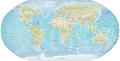 Map credit: Central Intelligence AgencyThe Robinson projection is a projection of a world map showing the entire Earth at once. It was specifically created in an attempt to find a good compromise to the problem of showing the whole globe as a single flat image. The projection was devised by Arthur H. Robinson in 1963; distortion is severe close to the poles, but quickly declines to moderate levels as latitudes decrease. This Robinson-projection map, with standard parallels of 38°N and 38°S, was produced by the United States Central Intelligence Agency and shows the world as of February 2016.
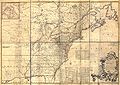 Author: John Mitchell; scan: Library of Congress, Geography and Map Division.The Mitchell Map is the most comprehensive map of eastern North America made during the colonial era. Measuring about 6.5 ft (2.0 m) wide by 4.5 ft (1.4 m) high, it was produced by John Mitchell in 1757 in eight separate sheets. The map was used during the Treaty of Paris for defining the boundaries of the United States, and remains important today for resolving border disputes.
 Map: Strebe, using GeocartThe Albers projection is a conic, equal area map projection, named after Heinrich C. Albers, that uses two standard parallels. Although scale and shape are not preserved, distortion is minimal between the standard parallels. This map is used by such agencies as the United States Geological Survey, the United States Census Bureau, and the governments of British Columbia and Yukon.
 Photo: Jeff Schmaltz, MODIS Rapid Response Team, NASAA satellite photo of Great Britain and part of Ireland showing the extent of snow cover during the winter of 2009–2010, the coldest in Europe since 1981–82. Starting on 16 December 2009 a persistent weather pattern brought cold moist air from the north with systems undergoing cyclogenesis from North American storms moving across the Atlantic Ocean to the west, and saw many parts of Europe experiencing heavy snowfall and record low temperatures.
 Map: Strebe, using GeocartThe Tobler hyperelliptical projection is a family of equal-area pseudocylindrical map projections first described by Waldo R. Tobler in 1973. The imagery used for the map is derived from NASA's Blue Marble summer months composite, with oceans lightened to enhance legibility and contrast.
 A map showing the geography of Florida, a state in the United States. Situated on a peninsula between the Gulf of Mexico, the Atlantic Ocean, and the Straits of Florida, Florida has an extensive coastline. Its highest point, Britton Hill, is the lowest highpoint of any U.S. state. Florida is home to over 19 million people, living in 410 municipalities.
 Map: Strebe, using GeocartThe van der Grinten projection is a compromise map projection that is neither equal-area nor conformal. It projects the entire Earth into a circle, though the polar regions are subject to extreme distortion. The projection was the first of four proposed by Alphons J. van der Grinten in 1904, and, unlike perspective projections, is an arbitrary geometric construction on the plane. It was adopted as the National Geographic Society's reference map of the world from 1922 until 1988.
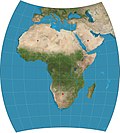 Map: Strebe, using GeocartThe Chamberlin trimetric projection is a map projection where three points are fixed on the globe and the points on the sphere are mapped onto a plane by triangulation. It was developed in 1946 by Wellman Chamberlin for the National Geographic Society. It is neither conformal nor equal-area, but rather attempts to minimize distortion of distances everywhere with the side-effect of balancing between areal equivalence and conformality.
 Map credit: Fernão Vaz DouradoA pre-Mercator nautical chart of West Africa from 1571, by Portuguese cartographer Fernão Vaz Dourado. It is done using the so-called "plane chart model", where observed latitudes and magnetic directions were plotted directly into the plane, with a constant scale, as if the Earth were flat.
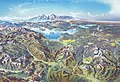 Map credit: Heinrich C. BerannYellowstone National Park is an American national park located mostly in Wyoming and extending into Montana and Idaho. It was established by the U.S. Congress and signed into law by President Ulysses S. Grant on March 1, 1872. Yellowstone was the first national park in the U.S. and is also widely held to be the first national park in the world. The park is known for its wildlife and its many geothermal features, especially the Old Faithful geyser, one of its most popular landmarks. It has many types of ecosystems, but the subalpine forest is the most abundant. The park is part of the South Central Rockies forests ecoregion. In 1978, Yellowstone was named a World Heritage Site by UNESCO.
 A satellite image of the Scandinavian Peninsula in winter. The peninsula, approximately 1,850 kilometers (1,150 miles) long with a width varying between approximately 370–805 km (230–500 mi), making it the largest in Europe, is located in the northern part of the continent and consists of Norway, Sweden and part of Finland. Much of the population is concentrated in the southern part of the peninsula; Stockholm and Gothenburg, both in Sweden, and Oslo in Norway are the largest cities.





 Categories
 Commons
 Wikidata
 Wikiquote
 Wikisource
 Wikiversity
 Wikivoyage
 Wiktionary


