The Classical Music Portal


Classical music is a tradition of art music in the Western world, considered to be distinct from Western folk music or popular music. It is sometimes distinguished as Western classical music, as the term "classical music" can also be applied to non-Western art musics. Classical music is often characterized by formality and complexity in its musical form and harmonic organization, particularly with the use of polyphony. Since at least the ninth century, it has been primarily a written tradition, spawning a sophisticated notational system, as well as accompanying literature in analytical, critical, historiographical, musicological and philosophical practices. (Full article...)
Selected articles –
-

Antonio Lucio Vivaldi (4 March 1678 – 28 July 1741) was an Italian composer, virtuoso violinist and impresario of Baroque music. Regarded as one of the greatest Baroque composers, Vivaldi's influence during his lifetime was widespread across Europe, giving origin to many imitators and admirers. He pioneered many developments in orchestration, violin technique and programmatic music. He consolidated the emerging concerto form, especially the solo concerto, into a widely accepted and followed idiom.
Vivaldi composed many instrumental concertos, for the violin and a variety of other musical instruments, as well as sacred choral works and more than fifty operas. His best-known work is a series of violin concertos known as The Four Seasons. Many of his compositions were written for the all-female music ensemble of the Ospedale della Pietà, a home for abandoned children in his native Venice. Vivaldi began studying for the Catholic priesthood at the age of 15 and was ordained at 25, but was given dispensation to no longer say public Masses because of a health problem. Vivaldi also had some success with expensive stagings of his operas in Venice, Mantua, and Vienna. After meeting the Emperor Charles VI, he moved to Vienna, hoping for royal support, but the Emperor died soon after his arrival, and Vivaldi died in poverty less than a year later. (Full article...) -

The Royal Academy of Music (RAM) in Westminster, London, England, is one of the oldest music schools in the United Kingdom, founded in 1822 by John Fane and Nicolas-Charles Bochsa. It received its royal charter in 1830 from King George IV with the support of the first Duke of Wellington.
The academy provides undergraduate and postgraduate training across instrumental performance, composition, jazz, musical theatre and opera, and recruits musicians from around the world, with a student community representing more than 50 nationalities. It is committed to lifelong learning, from Junior Academy, which trains musicians up to the age of 18, through Open Academy community music projects, to performances and educational events for all ages. (Full article...) -
Antonín Leopold Dvořák (8 September 1841 – 1 May 1904) was a Czech composer. He frequently employed rhythms and other aspects of the folk music of Moravia and his native Bohemia, following the Romantic era nationalist example of his predecessor Bedřich Smetana. Dvořák's style has been described as "the fullest recreation of a national idiom with that of the symphonic tradition, absorbing folk influences and finding effective ways of using them", and Dvořák has been described as "arguably the most versatile... composer of his time".
Dvořák displayed his musical gifts at an early age, being a talented violin student. The first public performances of his works were in Prague in 1872 and, with special success, in 1873, when he was 31 years old. Seeking recognition beyond the Prague area, he submitted scores of works including symphonies to competitions in Germany and Austria. He first won a prize in 1874, with Johannes Brahms on the jury of the Austrian State Competition. In 1877, after his third win, Brahms recommended Dvořák to his publisher, Simrock, who commissioned what became the Slavonic Dances, Op. 46. The sheet music's high sales and critical reception led to his international success. A London performance of Dvořák's Stabat Mater in 1883 led to many other performances in the United Kingdom, the United States, and eventually Russia in March 1890. The Seventh Symphony was written for London in 1885. (Full article...) -

Cincinnati Symphony Orchestra
An orchestra (/ˈɔːrkɪstrə/ ⓘ; OR-ki-strə) is a large instrumental ensemble typical of classical music or jazz, which combines instruments from different families. There are typically four main sections of instruments:- The string section, including the violin, viola, cello, and double bass
- The woodwind section, including the flute, oboe, clarinet, and bassoon, and sometimes piccolo, cor anglais, bass clarinet, contrabassoon, and saxophone
- The brass section, including the French horn (commonly known as the "horn"), trumpet, trombone, and tuba, and sometimes cornet and euphonium
- The percussion section, including the timpani, snare drum, bass drum, cymbals, triangle, tambourine, tam-tam and mallet percussion instruments
-
Sir Peter Maxwell Davies CH CBE (8 September 1934 – 14 March 2016) was an English composer and conductor, who in 2004 was made Master of the Queen's Music.
As a student at both the University of Manchester and the Royal Manchester College of Music, Davies formed a group dedicated to contemporary music called the New Music Manchester with fellow students Harrison Birtwistle, Alexander Goehr, Elgar Howarth and John Ogdon. Davies's compositions include eight works for the stage—from the monodrama Eight Songs for a Mad King, which shocked the audience in 1969, to Kommilitonen!, first performed in 2011—and ten symphonies, written between 1973 and 2013. (Full article...) -
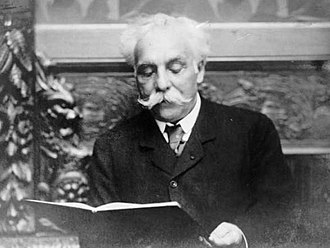
Fauré in 1907
Gabriel Urbain Fauré (12 May 1845 – 4 November 1924) was a French composer, organist, pianist and teacher. He was one of the foremost French composers of his generation, and his musical style influenced many 20th-century composers. Among his best-known works are his Pavane, Requiem, Sicilienne, nocturnes for piano and the songs "Après un rêve" and "Clair de lune". Although his best-known and most accessible compositions are generally his earlier ones, Fauré composed many of his most highly regarded works in his later years, in a more harmonically and melodically complex style.
Fauré was born into a cultured but not especially musical family. His talent became clear when he was a young boy. At the age of nine, he was sent to the École Niedermeyer music college in Paris, where he was trained to be a church organist and choirmaster. Among his teachers was Camille Saint-Saëns, who became a lifelong friend. After graduating from the college in 1865, Fauré earned a modest living as an organist and teacher, leaving him little time for composition. When he became successful in his middle age, holding the important posts of organist of the Église de la Madeleine and director of the Paris Conservatoire, he still lacked time for composing; he retreated to the countryside in the summer holidays to concentrate on composition. By his last years, he was recognised in France as the leading French composer of his day. An unprecedented national musical tribute was held for him in Paris in 1922, headed by the president of the French Republic. Outside France, Fauré's music took decades to become widely accepted, except in Britain, where he had many admirers during his lifetime. (Full article...) -
The Symphony No. 2 in C minor by Gustav Mahler, known as the Resurrection Symphony, was written between 1888 and 1894, and first performed in 1895. This symphony was one of Mahler's most popular and successful works during his lifetime. It was his first major work to establish his lifelong view of the beauty of afterlife and resurrection. In this large work, the composer further developed the creativity of "sound of the distance" and creating a "world of its own", aspects already seen in his First Symphony. The work has a duration of 80 to 90 minutes, and is conventionally labelled as being in the key of C minor; the New Grove Dictionary of Music and Musicians labels the work's tonality as C minor–E♭ major. It was voted the fifth-greatest symphony of all time in a survey of conductors carried out by the BBC Music Magazine. (Full article...) -

Painting by Evaristo Baschenis of Baroque instruments, including a cittern, viola da gamba, violin, and two lutes
Baroque music (UK: /bəˈrɒk/ or US: /bəˈroʊk/) refers to the period or dominant style of Western classical music composed from about 1600 to 1750. The Baroque style followed the Renaissance period, and was followed in turn by the Classical period after a short transition (the galant style). Baroque music forms a major portion of the "classical music" canon, and continues to be widely studied, performed, and listened to. Key composers of the Baroque era include Jacopo Peri, who wrote the first operas; Alessandro Stradella, who originated the concerto grosso style; and Arcangelo Corelli, who was one of the first composers to publish widely and have his music performed across Europe.
The Baroque period saw the formalization of common-practice tonality, an approach to writing music in which a song or piece is written in a particular key; this type of harmony has continued to be used extensively in Western classical and popular music. Baroque composers experimented with finding a fuller sound for each instrumental part, leading to the creation of the modern orchestra; modernised musical notation, including developing figured bass; and developed new instrumental playing techniques. Baroque music expanded the size, range, and complexity of instrumental performance, and also established the mixed vocal/instrumental forms of opera, cantata and oratorio and the instrumental forms of the solo concerto and sonata as musical genres. Dense, complex polyphonic music, in which multiple independent melody lines were performed simultaneously. (Full article...) -

Schubert in 1827 (oil on canvas, by Anton Depauly)
Franz Schubert's final chamber work, the String Quintet in C major (D. 956, Op. posth. 163) is sometimes called the "Cello Quintet" because it is scored for a standard string quartet with a second cello rather than a second viola, which is more usual.
The piece was composed in 1828 and completed just two months before the composer's death. The first public performance of the piece did not occur until 1850, and publication occurred three years later in 1853. Schubert's only full-fledged string quintet, it has been called "sublime" and "extraordinary", been said to possess "bottomless pathos", and is generally regarded as Schubert's finest chamber work as well as one of the greatest compositions in all chamber music. (Full article...) -

Beginning of BWV 565 in Johannes Ringk's manuscript, which is, as far as known, the only extant 18th-century copy of the work
The Toccata and Fugue in D minor, BWV 565, is a composition for organ from the Baroque period which was long attributed to Johann Sebastian Bach, but whose authorship has been questioned by a minority of scholars since 1981. It is one of the most widely recognisable works in the organ repertoire. It was written between 1704 and the 1750s. The piece opens with a toccata section followed by a fugue that ends in a coda, and is typical of the north German organ school of the Baroque era.
Little was known about its early existence until the piece was discovered in an undated manuscript produced by Johannes Ringk. It was first published in 1833 during the early Bach Revival period through the efforts of composer Felix Mendelssohn, who also performed the piece in 1840. In the 20th century, its popularity rose above that of other organ compositions by Bach, as exemplified by its inclusion in Walt Disney's 1940 animated film Fantasia using Leopold Stokowski's orchestral transcription from 1927. (Full article...) -
Der Ring des Nibelungen (The Ring of the Nibelung), WWV 86, is a cycle of four German-language epic music dramas composed by Richard Wagner. The works are based loosely on characters from Germanic heroic legend, namely Norse legendary sagas and the Nibelungenlied. The composer termed the cycle a "Bühnenfestspiel" (stage festival play), structured in three days preceded by a Vorabend ("preliminary evening"). It is often referred to as the Ring cycle, Wagner's Ring, or simply The Ring.
Wagner wrote the libretto and music over the course of about twenty-six years, from 1848 to 1874. The four parts that constitute the Ring cycle are, in sequence:- Das Rheingold (The Rhinegold)
- Die Walküre (The Valkyrie)
- Siegfried
- Götterdämmerung (Twilight of the Gods)
Individual works of the sequence are often performed separately, and indeed the operas contain dialogues that mention events in the previous operas, so that a viewer could watch any of them without having watched the previous parts and still understand the plot. However, Wagner intended them to be performed in series. The first performance as a cycle opened the first Bayreuth Festival in 1876, beginning with Das Rheingold on 13 August and ending with Götterdämmerung on 17 August. Opera stage director Anthony Freud stated that Der Ring des Nibelungen "marks the high-water mark of our art form, the most massive challenge any opera company can undertake." (Full article...) -

Breitkopf & Härtel (German pronunciation: [ˈbraɪtkɔpf ʔʊnt ˈhɛrtəl]) is a German music publishing house. Founded in 1719 in Leipzig by Bernhard Christoph Breitkopf, it is the world's oldest music publisher still active. (Full article...)


General images –
-
-

-
 Wolfgang Amadeus Mozart, posthumous painting by Barbara Krafft in 1819 (from Classical period (music))
 -
 1875 oil painting of Franz Schubert by Wilhelm August Rieder, after his own 1825 watercolor portrait (from Classical period (music))
 -
 An example of a guitar from the classical period (from Classical period (music))
 -

-
 View of Vienna in 1758, by Bernardo Bellotto (from Classical period (music))
 -
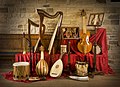 Selection of Renaissance instruments (from Renaissance music)
 -
 Portion of Du Fay's setting of Ave maris stella, in fauxbourdon. The top line is a paraphrase of the chant; the middle line, designated "fauxbourdon", (not written) follows the top line but exactly a perfect fourth below. The bottom line is often, but not always, a sixth below the top line; it is embellished, and reaches cadences on the octave.Play (from Renaissance music)
 -
 Balakirev (top), Cui (upper left), Mussorgsky (upper right), Rimsky-Korsakov (lower left), and Borodin (lower right). (from Romantic music)
 -
 Painting by Evaristo Baschenis of Baroque instruments, including a cittern, viola da gamba, violin, and two lutes (from Baroque music)
 -
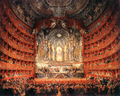 A large instrumental ensemble's performance in the lavish Teatro Argentina, as depicted by Panini (1747) (from Baroque music)
 -
 Musicians from 'Procession in honour of Our Lady of Sablon in Brussels.' Early 17th-century Flemish alta cappella. From left to right: bass dulcian, alto shawm, treble cornett, soprano shawm, alto shawm, tenor sackbut. (from Renaissance music)
 -
 Hummel in 1814 (from Classical period (music))
 -
 Gluck, detail of Portrait of Christoph Willibald Gluck by Joseph Duplessis, dated 1775 (Kunsthistorisches Museum, Vienna) (from Classical period (music))
 -
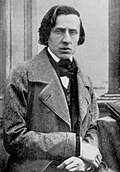 Daguerreotype of Chopin, c. 1849 (from Romantic music)
 -
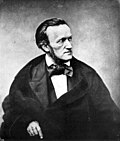 Richard Wagner in Paris, 1861
 -
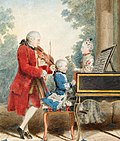 Wolfgang Amadeus Mozart, a representative composer of the Classical period, seated at a keyboard (from Classical period (music))
 -
 Josef Danhauser's 1840 painting Liszt at the Piano featuring Franz Liszt at the piano surrounded by (from left to right) Alexandre Dumas, Hector Berlioz, George Sand, Niccolò Paganini, Gioachino Rossini and Marie d'Agoult, with a bust of Ludwig van Beethoven on the piano (from Romantic music)
 -
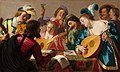 Gerard van Honthorst, The Concert (1623), National Gallery of Art, Washington D.C. (from Renaissance music)
 -
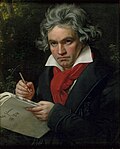
-
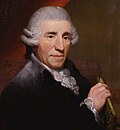 Haydn portrait by Thomas Hardy, 1792 (from Classical period (music))
 -

-
 Gustav Mahler, photographed in 1907 by Moritz Nähr at the end of his period as director of the Vienna Hofoper (from Romantic music)
 -
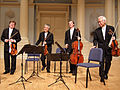 A modern string quartet. In the 2000s, string quartets from the Classical era are the core of the chamber music literature. From left to right: violin 1, violin 2, cello, viola. (from Classical period (music))
 -
 Bernhard Crusell, a Swedish-Finnish composer and clarinetist, in 1826 (from Classical period (music))
 -
 Fortepiano by Paul McNulty after Walter & Sohn, c. 1805 (from Classical period (music))
 -
 Portrait of the Mozart Family, dated 1780–81 (from Classical period (music))
 -
 The opening bars of the Commendatore's aria in Mozart's opera Don Giovanni. The orchestra starts with a dissonant diminished seventh chord (G# dim7 with a B in the bass) moving to a dominant seventh chord (A7 with a C# in the bass) before resolving to the tonic chord (D minor) at the singer's entrance. (from Classical period (music))
 -
Portrait of Beethoven, 1820 (from Classical period (music))
-
 Claudio Monteverdi in 1640 (from Baroque music)
 -
-
 Franz Liszt in 1858, by Franz Hanfstaengl (from Romantic music)
 -
 Wanderer above the Sea of Fog, by Caspar David Friedrich, is an example of Romantic painting. (from Romantic music)
 -
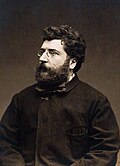 Bizet photographed by Étienne Carjat (1875) (from Romantic music)


Quotes –
| “ | I give bird songs to those who dwell in cities and have never heard them, make rhythms for those who know only military marches or jazz, and paint colors for those who see none. | ” |
| — Olivier Messiaen | ||
Related portals


WikiProjects




 Selected composers –


-

Delius, photographed in 1907
Frederick Theodore Albert Delius (born Fritz Theodor Albert Delius; /ˈdiːliəs/; 29 January 1862 – 10 June 1934) was an English composer. Born in Bradford in the north of England to a prosperous mercantile family, he resisted attempts to recruit him to commerce. He was sent to Florida in the United States in 1884 to manage an orange plantation. He soon neglected his managerial duties, and in 1886 returned to Europe.
Having been influenced by African-American music during his short stay in Florida, he began composing. After a brief period of formal musical study in Germany beginning in 1886, he embarked on a full-time career as a composer in Paris and then in nearby Grez-sur-Loing, where he and his wife Jelka lived for the rest of their lives, except during the First World War. (Full article...) -
Nobuo Uematsu (植松 伸夫, Uematsu Nobuo; born March 21, 1959) is a Japanese composer and keyboardist best known for his contributions to the Final Fantasy video game series by Square Enix. A self-taught musician, he began playing the piano at the age of twelve. Uematsu joined Square in 1986, where he first met Final Fantasy creator Hironobu Sakaguchi. The two later worked together on many games at the company, most notably in the Final Fantasy series. After nearly two decades with Square, Uematsu left in 2004 to create his own production company and music label, Dog Ear Records. He has since composed music as a freelancer for other games, including ones developed by Square Enix and Sakaguchi's studio Mistwalker.
Many soundtracks and arranged albums of Uematsu's game scores have been released. Pieces from his video game works have been performed in various Final Fantasy concerts, where he has worked with conductor Arnie Roth and Game Concerts producer Thomas Böcker on several of these performances. Uematsu was also the keyboardist in The Black Mages in the 2000s, which played various hard rock versions of his Final Fantasy compositions. He has since performed with the Earthbound Papas, which he formed as the successor to The Black Mages in 2011. Uematsu has made several listings in Britain's Classic FM Hall of Fame, with the station referring to him as the Beethoven of game music. (Full article...) -

Edward Benjamin Britten, Baron Britten (22 November 1913 – 4 December 1976) was an English composer, conductor, and pianist. He was a central figure of 20th-century British music, with a range of works including opera, other vocal music, orchestral and chamber pieces. His best-known works include the opera Peter Grimes (1945), the War Requiem (1962) and the orchestral showpiece The Young Person's Guide to the Orchestra (1945).
Britten was born in Lowestoft, Suffolk, the son of a dentist. He showed talent from an early age. He studied at the Royal College of Music in London and privately with the composer Frank Bridge. Britten first came to public attention with the a cappella choral work A Boy Was Born in 1934. With the premiere of Peter Grimes in 1945, he leapt to international fame. Over the next 28 years, he wrote 14 more operas, establishing himself as one of the leading 20th-century composers in the genre. In addition to large-scale operas for Sadler's Wells and Covent Garden, he wrote chamber operas for small forces; among the best known of these is The Turn of the Screw (1954). Recurring themes in his operas include the struggle of an outsider against a hostile society and the corruption of innocence. (Full article...) -

Stockhausen in the Electronic Music Studio of the WDR, 1994
Karlheinz Stockhausen (German: [kaʁlˈhaɪnts ˈʃtɔkhaʊzn̩] ⓘ; 22 August 1928 – 5 December 2007) was a German composer, widely acknowledged by critics as one of the most important but also controversial composers of the 20th and early 21st centuries. He is known for his groundbreaking work in electronic music, having been called the "father of electronic music", for introducing controlled chance (aleatory techniques) into serial composition, and for musical spatialization.
Stockhausen was educated at the Hochschule für Musik Köln and the University of Cologne, later studying with Olivier Messiaen in Paris and with Werner Meyer-Eppler at the University of Bonn. As one of the leading figures of the Darmstadt School, his compositions and theories were and remain widely influential, not only on composers of art music, but also on jazz and popular music. His works, composed over a period of nearly sixty years, eschew traditional forms. In addition to electronic music – both with and without live performers – they range from miniatures for musical boxes through works for solo instruments, songs, chamber music, choral and orchestral music, to a cycle of seven full-length operas. His theoretical and other writings comprise ten large volumes. He received numerous prizes and distinctions for his compositions, recordings, and for the scores produced by his publishing company. (Full article...) -

First page of The Pilgrim: Grand Overture by Douglass
John Thomas Douglass (1847–1886) was an American composer, virtuoso violinist, conductor and teacher. He is best known for composing Virginia's Ball (1868), which is generally regarded as the first opera written by an African-American composer. The work is now lost, and his only extant composition is The Pilgrim: Grand Overture (1878) for piano. His biography from James Monroe Trotter's Music and Some Highly Musical People (1878)—in which The Pilgrim survives—reports that he wrote many now lost pieces for piano, orchestra and particularly guitar, which he was known to play.
A highly regarded violinist, Douglass's violin playing received high praise during his lifetime. In addition to his solo career, he traveled with various groups throughout the 1870s, including the Hyers Sisters. He settled in New York by the 1880s and conducted both a music studio and string ensemble. Later in life he led a teaching studio, and among his students was David Mannes who became the concertmaster of the New York Symphony Orchestra. Nearly 30 years after Douglass's death at age 38–39, Mannes founded the Colored Music Settlement School in the memory of his teacher. (Full article...) -
Kaikhosru Shapurji Sorabji (born Leon Dudley Sorabji; 14 August 1892 – 15 October 1988) was an English composer, music critic, pianist and writer. His music, written over a period of seventy years, ranges from sets of miniatures to works lasting several hours. One of the most prolific 20th-century composers, he is best known for his piano pieces, notably nocturnes such as Gulistān and Villa Tasca, and large-scale, technically intricate compositions, which include seven symphonies for piano solo, four toccatas, Sequentia cyclica and 100 Transcendental Studies. He felt alienated from English society by reason of his homosexuality and mixed ancestry, and had a lifelong tendency to seclusion.
Sorabji's mother was English and his father a Parsi businessman and industrialist from India, who set up a trust fund that freed his family from the need to work. Although Sorabji was a reluctant performer and not a virtuoso, he played some of his music publicly between 1920 and 1936. In the late 1930s, his attitude shifted and he imposed restrictions on performance of his works, which he lifted in 1976. His compositions received little exposure in those years and he remained in public view mainly through his writings, which include the books Around Music and Mi contra fa: The Immoralisings of a Machiavellian Musician. During this time, he also left London and eventually settled in the village of Corfe Castle, Dorset. Information on Sorabji's life, especially his later years, is scarce, with most of it coming from the letters he exchanged with his friends. (Full article...) -

Ravel in 1925
Joseph Maurice Ravel (7 March 1875 – 28 December 1937) was a French composer, pianist and conductor. He is often associated with Impressionism along with his elder contemporary Claude Debussy, although both composers rejected the term. In the 1920s and 1930s Ravel was internationally regarded as France's greatest living composer.
Born to a music-loving family, Ravel attended France's premier music college, the Paris Conservatoire; he was not well regarded by its conservative establishment, whose biased treatment of him caused a scandal. After leaving the conservatoire, Ravel found his own way as a composer, developing a style of great clarity and incorporating elements of modernism, baroque, neoclassicism and, in his later works, jazz. He liked to experiment with musical form, as in his best-known work, Boléro (1928), in which repetition takes the place of development. Renowned for his abilities in orchestration, Ravel made some orchestral arrangements of other composers' piano music, of which his 1922 version of Mussorgsky's Pictures at an Exhibition is the best known. (Full article...) -

Mykola Dmytrovych Leontovych (Ukrainian: Микола Дмитрович Леонтович, pronounced [mɪˈkɔlɐ ˈdmɪtrowɪtʃ leonˈtɔwɪtʃ] ⓘ; 13 December [O.S. 1 December] 1877 – 23 January 1921) was a Ukrainian composer, conductor, ethnomusicologist, and teacher. His music was inspired by the Ukrainian composer Mykola Lysenko and the Ukrainian National Music School. Leontovych specialised in a cappella choral music, ranging from original compositions to church music to elaborate arrangements of folk music.
Leontovych was born and raised in Monastyrok in the Podolia province of the Russian Empire (now in Vinnytsia Oblast, west of Ukraine). He was educated as a priest in the Kamianets-Podilskyi Theological Seminary. With the independence of the Ukrainian State in the 1917 revolution, he moved to Kyiv, where he worked at the Kyiv Conservatory and the Mykola Lysenko Institute of Music and Drama. He composed "Shchedryk" in 1914 (premiered in 1916), now known to the English-speaking world as "Carol of the Bells". He was murdered by a Soviet agent in 1921 and is known as a martyr in the Eastern Orthodox Ukrainian Church, where he is also remembered for his liturgy, the first composed in the vernacular, specifically in the modern Ukrainian language. (Full article...) -

Jakob Ludwig Felix Mendelssohn Bartholdy (3 February 1809 – 4 November 1847), simply known as Felix Mendelssohn, was a German composer, pianist, organist and conductor of the early Romantic era. Mendelssohn's compositions include symphonies, concertos, piano music, organ music and chamber music. His best-known works include the String Octet, the overture and incidental music for A Midsummer Night's Dream (which includes his "Wedding March"), the Italian and Scottish Symphonies, the oratorios St. Paul and Elijah, the Hebrides Overture, the mature Violin Concerto, and the melody used in the Christmas carol "Hark! The Herald Angels Sing". Mendelssohn's Songs Without Words are his most famous solo piano compositions.
Mendelssohn's grandfather was the Jewish philosopher Moses Mendelssohn, but Felix was initially raised without religion until he was baptised aged seven into the Reformed Christian church. He was recognised early as a musical prodigy, but his parents were cautious and did not seek to capitalise on his talent. His sister Fanny received a similar musical education and was a talented composer and pianist in her own right; some of her early songs were published under her brother's name and her Easter Sonata was for a time mistakenly attributed to him after being lost and rediscovered in the 1970s. (Full article...) -

The organ at Exeter Cathedral, which Gibbons may have played
Edward Gibbons (bapt. 21 March 1568 – in or before July 1650) was an English choirmaster and composer of the late Renaissance and early Baroque periods. Born in Cambridge, Gibbons's youth is completely unknown, but he later received degrees from the Universities of Cambridge and Oxford. From 1591/92 to 1598 he worked at King's College, Cambridge, as a lay clerk and choirmaster. During his tenure he married Jane, with whom he had six children. Gibbons's whereabouts the next few years remain uncertain; he may have lived in Acton, Bristol or Exeter, but by 1607 he was the choirmaster of the Exeter Cathedral, where the choristers included Matthew Locke. By 1609 Gibbons received a special dispensation to become a priest vicar, becoming the head of the college of priest-vicars and succentor. Jane died in 1628, and Edward married Mary Bluet; the family was evicted from their home during the English Civil War, but moved to their estate in Dunsford.
A few compositions of Gibbons survive: an organ prelude, two verse anthems, two works for viol consorts, and some sacred music. Of these, commentators have mainly praised the verse anthems, How hath ye City sate solitary and What Strikes the Clocke? Musicologist John Harley called the former particularly moving, and it was likely written for the 1603 London plague outburst to which Gibbons's brother Ellis may have succumbed to. Edward is the elder brother of the better-known Orlando; after the early deaths of Orlando and his wife, Edward cared for their son, Christopher, who also became a noted composer. (Full article...) -
Nikolai Andreyevich Rimsky-Korsakov (18 March 1844 – 21 June 1908) was a Russian composer, a member of the group of composers known as The Five. His best-known orchestral compositions—Capriccio Espagnol, the Russian Easter Festival Overture, and the symphonic suite Scheherazade—are staples of the classical music repertoire, along with suites and excerpts from some of his fifteen operas. Scheherazade is an example of his frequent use of fairy-tale and folk subjects. He was the husband of the composer Nadezhda Rimskaya-Korsakova.
Rimsky-Korsakov believed in developing a nationalistic style of classical music, employing Russian folk song and lore along with exotic harmonic, melodic and rhythmic elements in a practice known as musical orientalism, and eschewing traditional Western compositional methods. Rimsky-Korsakov appreciated Western musical techniques after he became a professor of musical composition, harmony, and orchestration at the Saint Petersburg Conservatory in 1871. He undertook a rigorous three-year program of self-education and became a master of Western methods, incorporating them alongside the influences of Mikhail Glinka and fellow members of The Five. Rimsky-Korsakov's techniques of composition and orchestration were further enriched by his exposure to the works of Richard Wagner. (Full article...) -
Frederick II (German: Friedrich II.; 24 January 1712 – 17 August 1786) was the monarch of Prussia from 1740 until his death in 1786. He was the last Hohenzollern monarch titled King in Prussia, declaring himself King of Prussia after annexing Royal Prussia from the Polish–Lithuanian Commonwealth in 1772. His most significant accomplishments include military successes in the Silesian wars, reorganisation of the Prussian Army, the First Partition of Poland, and patronage of the arts and the Enlightenment. Prussia greatly increased its territories and became a major military power in Europe under his rule. He became known as Frederick the Great (German: Friedrich der Große) and was nicknamed "Old Fritz" (German: der Alte Fritz).
In his youth, Prince Frederick was more interested in music and philosophy than war, which led to clashes with his authoritarian father, Frederick William I of Prussia. However, upon ascending to the throne, he attacked and annexed the rich Austrian province of Silesia in 1742, winning military acclaim. He became an influential military theorist, whose analyses emerged from his extensive personal battlefield experience and covered issues of strategy, tactics, mobility and logistics. (Full article...) -
Clara Josephine Schumann (/ˈʃuːmɑːn/; German: [ˈklaːʁa ˈʃuːman]; née Wieck; 13 September 1819 – 20 May 1896) was a German virtuoso pianist, composer, and piano teacher. Regarded as one of the most distinguished pianists of the Romantic era, she exerted her influence over the course of a 61-year concert career, changing the format and repertoire of the piano recital by lessening the importance of purely virtuosic works. She also composed solo piano pieces, a piano concerto, chamber music, choral pieces, and songs.
She grew up in Leipzig, where both her father Friedrich Wieck and her mother Mariane were pianists and piano teachers. In addition, her mother was a singer. Clara was a child prodigy, and was trained by her father. She began touring at age eleven, and was successful in Paris and Vienna, among other cities. She married the composer Robert Schumann, on 12 September 1840, and the couple had eight children. Together, they encouraged Johannes Brahms and maintained a close relationship with him. She gave the public premieres of many works by her husband and by Brahms. (Full article...) -
Erik William Chisholm (4 January 1904 – 8 June 1965) was a Scottish composer, pianist, organist and conductor sometimes known as "Scotland's forgotten composer". According to his biographer, Chisholm "was the first composer to absorb Celtic idioms into his music in form as well as content, his achievement paralleling that of Bartók in its depth of understanding and its daring", which led some to give him the nickname "MacBartók". As composer, performer and impresario, he played an important role in the musical life of Glasgow between the two World Wars and was a founder of the Celtic Ballet and, together with Margaret Morris, created the first full-length Scottish ballet, The Forsaken Mermaid. After World War II he was Professor and Head of the South African College of Music at the University of Cape Town for 19 years until his death. Chisholm founded the South African College of Music opera company in Cape Town and was a vital force in bringing new operas to Scotland, England and South Africa. By the time of his death in 1965, he had composed over a hundred works. (Full article...)
-

Messager in 1921
André Charles Prosper Messager (French: [mɛsaʒe]; 30 December 1853 – 24 February 1929) was a French composer, organist, pianist and conductor. His compositions include eight ballets and thirty opéras comiques, opérettes and other stage works, among which his ballet Les Deux Pigeons (1886) and opéra comique Véronique (1898) have had lasting success; Les p'tites Michu (1897) and Monsieur Beaucaire (1919) were also popular internationally.
Messager took up the piano as a small child and later studied composition with, among others, Camille Saint-Saëns and Gabriel Fauré. He became a major figure in the musical life of Paris and later London, both as a conductor and a composer. Many of his Parisian works were also produced in the West End and some on Broadway; the most successful had long runs and numerous international revivals. He wrote two operatic works in English, and his later output included musical comedies for Sacha Guitry and Yvonne Printemps. (Full article...)


Did you know (auto-generated) –

- ... that opera singer Charles Holland spent much of his career in Europe as opportunities in classical music for African Americans were limited?
- ... that WFMT classical music radio host Don Tait owned such a large collection of recordings that he had to buy a house and have its floor reinforced to accommodate the weight?
Selected image
-
 Photo: Guillaume PiolleThe anatomy of a Périnet piston valve, this one taken from a B♭ trumpet. When depressed, the valve diverts the air stream through additional tubing, thus lengthening the instrument and lowering the harmonic series on which the instrument is vibrating (i.e., it lowers the pitch). Trumpets generally use three valves, with some variations, such as a piccolo trumpet, having four. When used singly or in combination, the valves make the instrument fully chromatic, or capable of playing all twelve pitches of classical music. Trumpets may also use rotary valves instead.
 -
 Photograph credit: Eugène Pirou; restored by Adam CuerdenJules Massenet (12 May 1842 – 13 August 1912) was a French composer of the Romantic era, best known for his operas. Between 1867 and his death, he wrote more than forty stage works in a wide variety of styles, from opéra comique to grand depictions of classical myths, romantic comedies and lyric dramas, as well as oratorios, cantatas and ballets. Massenet had a good sense of the theatre and of what would succeed with the Parisian public. Despite some miscalculations, he produced a series of successes that made him the leading opera composer in France in the late 19th and early 20th centuries. By the time of his death, he was regarded as old-fashioned; his works, however, began to be favourably reassessed during the mid-20th century, and many have since been staged and recorded. This photograph of Massenet was taken by French photographer Eugène Pirou in 1875.
 -
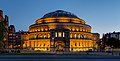 Photograph: David IliffThe Royal Albert Hall is a concert hall, seating a maximum of 5,272, on the northern edge of South Kensington, London. Constructed beginning in 1867, the hall was inaugurated on 29 March 1871. Since 1941 it has held The Proms, an eight-week summer season of daily orchestral classical music concerts and other events.
 -
 Ballet is a formalized form of dance with its origins in the French court, further developed in France and Russia as a concert dance form.
 -
 Stradivarius is one of the violins, violas, cellos and other string instruments built by members of the Italian Stradivari family, particularly Antonio Stradivari.
 -

A picture of the first theatre drawn shortly before it burned down in 1808.
The Royal Opera House is an opera house and major performing arts venue in the London district of Covent Garden. The large building, often referred to as simply "Covent Garden", is the home of The Royal Opera, The Royal Ballet and the Orchestra of the Royal Opera House. -
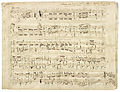 Sheet music for the Polonaise in A-flat major, Op. 53, a solo piano piece written by Frédéric Chopin in 1842. This work is one of Chopin's most admired compositions and has long been a favorite of the classical piano repertoire. The piece, which is very difficult, requires exceptional pianistic skills and great virtuosity to be interpreted. A typical performance of the polonaise lasts seven minutes.
 -
 Photo: W. J. Mayer; Restoration: Lise BroerA bust of the German composer and pianist Ludwig van Beethoven (1770–1827), made from his death mask. He was a crucial figure in the transitional period between the Classical and Romantic eras in Western classical music, and remains one of the most acclaimed and influential composers of all time. Born in Bonn, of the Electorate of Cologne and a part of the Holy Roman Empire of the German Nation in present-day Germany, he moved to Vienna in his early twenties and settled there, studying with Joseph Haydn and quickly gaining a reputation as a virtuoso pianist. His hearing began to deteriorate in the late 1790s, yet he continued to compose, conduct, and perform, even after becoming completely deaf.
 -
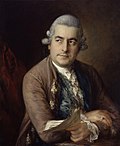 Painting: Thomas GainsboroughJohann Christian Bach (5 September 1735 – 1 January 1782) was a composer of the Classical era, the eighteenth child of Johann Sebastian Bach, and the youngest of his eleven sons. Bach was taught by his father and then, after the latter's death, by his half-brother C. P. E. Bach. Bach moved to Italy in 1754, and then to London in 1762, where he became known as the "London Bach". Bach's compositions include eleven operas, as well as chamber music, orchestral music and compositions for keyboard music. In 1764 Bach met Wolfgang Amadeus Mozart, who was eight at the time, and spent five months teaching him composition. He had considerable influence on Mozart, and was later described by scholars as his "only, true teacher".
This portrait of Bach was painted in 1776 by Thomas Gainsborough, as part of a collection started by Bach's former teacher Padre Martini. It now hangs in the National Portrait Gallery, London. -
 Photograph credit: William P. Gottlieb; restored by Adam CuerdenBilly Strayhorn (November 29, 1915 – May 31, 1967) was an American jazz composer, pianist, lyricist, and arranger, best remembered for his long-time collaboration with bandleader and composer Duke Ellington that lasted nearly three decades. Though classical music was Strayhorn's first love, his ambition to become a classical composer went unrealized because of the harsh reality of a black man trying to make his way in the world of classical music, which at that time was almost completely white. He was introduced to the music of pianists like Art Tatum and Teddy Wilson at age 19, and the artistic influence of these musicians guided him into the realm of jazz, where he remained for the rest of his life. This photograph of Strayhorn was taken by William P. Gottlieb in the 1940s.
 -
 The Teatro alla Scala (or La Scala, as it is known), in Milan, Italy, is one of the world's most famous opera houses. The theatre was inaugurated on 3 August 1778, under the name Nuovo Regio Ducal Teatro alla Scala with Salieri's Europa riconosciuta.


Topics
|
|
Things you can do
 |
Here are some tasks awaiting attention:
|
Categories

Associated Wikimedia
The following Wikimedia Foundation sister projects provide more on this subject:
-
 Commons
Free media repository -
 Wikidata
Free knowledge base -
 Wikiquote
Collection of quotations -
 Wikisource
Free-content library -
 Wikiversity
Free learning tools -
 Wiktionary
Dictionary and thesaurus


-

-

-

-

-

-

-

-

-

-

-
 Random portal
 -


