Introduction The Catholic Church (Latin: Ecclesia Catholica), also called the Roman Catholic Church, is the largest Christian church, with an estimated 1.28 to 1.41 billion baptized members worldwide as of 2026. It consists of 24 autonomous (sui iuris) churches—the Latin Church and 23 Eastern Catholic Churches—organized into nearly 3,500 dioceses and eparchies governed by bishops. Throughout history, the church has had a large role in the development of Western civilization. Catholic communities are present worldwide through missions, immigration, and conversions. The majority of Catholics live in the Global South, reflecting rapid demographic growth in Africa, Asia, and Latin America, as well as secularization in parts of Europe and North America. Catholic doctrine is rooted in the Nicene Creed and holds that the church is the "one, holy, catholic and apostolic Church" founded by Jesus Christ. It teaches that bishops are the successors of the apostles and that the pope—the bishop of Rome—is the successor of Saint Peter the Apostle, entrusted with a unique and primary pastoral role. Leo XIV is the current pope, serving as the head of the church; the Diocese of Rome forms his local jurisdiction, while the Holy See serves as the church's central governing authority through the Roman Curia. Apostolic teaching is understood to be transmitted through Scripture and sacred tradition, interpreted by the magisterium, the church's teaching authority. Catholic liturgical life includes the Roman Rite, other rites of the Latin Church, and the liturgical traditions of the Eastern Catholic Churches. Religious orders, monastic communities, and lay movements contribute to a wide range of theological and devotional expressions within Catholicism globally. Among the church's seven sacraments, the Eucharist is seen as the source and summit of the Christian life and is celebrated in the Mass. Catholics believe that through consecration by a priest, the bread and wine become the body and blood of Christ. The Virgin Mary is venerated as the Mother of God and honored through dogmas such as the Immaculate Conception, perpetual virginity, and Assumption, including devotional practices. Catholic social teaching emphasizes care for the poor, the sick, and the marginalized. The church operates tens of thousands of educational, medical, and charitable institutions worldwide, becoming the largest non-governmental provider of education and health care. (Full article...) Selected article
 The Papal conclave of 2005 was convened due to the death of Pope John Paul II on April 2, 2005. After his death, the cardinals who were in Rome met and set a date for the beginning of the conclave to elect John Paul's successor. The conclave began on April 18, 2005 and ended on the following day after four ballots. Eligible members of the College of Cardinals of the Roman Catholic Church (those who were less than 80 years of age at the time of the death of Pope John Paul II) met and elected Joseph Cardinal Ratzinger as the new Pope. After accepting his election, he took the regnal name Pope Benedict XVI.Proceedings on April 18 consisted of a morning Mass for the Election of the Roman Pontiff (Latin Pro Eligendo Romano Pontifice). In the afternoon the Cardinal electors assembled in the Hall of Blessings in St Peter's Basilica and from there went in solemn procession to the Sistine Chapel, where, after the singing of the hymn Veni Creator Spiritus, each Cardinal took the prescribed oath.
Selected image
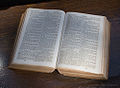
 Credit: Anne de Felbrigge The Felbrigge Psalter is an illuminated manuscript Psalter from mid-thirteenth century England that has an embroidered bookbinding which probably dates to the early fourteenth century.The embroidery is worked in fine linen with an illustration of the Annunciation on the front cover and an illustration of the Crucifixion on the back. Selected biography
Joseph Havens Richards SJ (born Havens Cowles Richards; November 8, 1851 – June 9, 1923) was an American Catholic priest and Jesuit who became a prominent president of Georgetown University, where he instituted major reforms and significantly enhanced the quality and stature of the university. Richards was born to a prominent Ohio family; his father was an Episcopal priest who controversially converted to Catholicism and had the infant Richards secretly baptized as a Catholic. Richards became the president of Georgetown University in 1888 and undertook significant construction, such as the completion of Healy Hall, which included work on Gaston Hall and Riggs Library, and the building of Dahlgren Chapel. Richards sought to transform Georgetown into a modern, comprehensive university. To that end, he bolstered the graduate programs, expanded the School of Medicine and Law School, established the Georgetown University Hospital, improved the astronomical observatory, and recruited prominent faculty. He also navigated tensions with the newly established Catholic University of America, which was located in the same city. Richards fought anti-Catholic discrimination by Ivy League universities, resulting in Harvard Law School admitting graduates of some Jesuit universities. Upon the end of his term in 1898, Richards engaged in pastoral work attached to Jesuit educational institutions throughout the northeastern United States. He became the president of Regis High School and the Loyola School in New York City in 1915, and he was then made superior of the Jesuit retreat center on Manresa Island in Connecticut. Richards died at the College of the Holy Cross in 1923. (Full article...) Did you know...

Related portalsFeast Day of July 16

Selected quote
News
SubcategoriesTopics
The Holy Bible:
Particular churches (grouped by liturgical rite):
History:
Christian theology:
Things you can do
External resourcesWikiProjectsAssociated WikimediaThe following Wikimedia Foundation sister projects provide more on this subject:
Discover Wikipedia using portals |