Classical Greek culture, especially philosophy, had a powerful influence on ancient Rome, which carried a version of it throughout the Mediterranean and much of Europe. For this reason, Classical Greece is generally considered the cradle of Western civilization, the seminal culture from which the modern West derives many of its founding archetypes and ideas in politics, philosophy, science, and art. (Full article...)
Bronze statue of a Greek actor, 150–100 BC. The half-mask over the eyes and nose identifies the figure as an actor. He wears a man's conical cap but female garments, following the Greek custom of men playing the roles of women. Later, slave women were brought in to play minor female characters and in comedy as well.
Ruins of the sanctuary of Artemis, including the altar on the left of the picture. The massive altar is precisely rectangular and stood in front of the temple. The temple was to the west (right) of the altar. The altar was 2.7 m wide and 25 m long. Only 8 m of its northern section survive. The Saint Theodore monastery was built on top of the southern portion of the altar.
The Temple of Artemis is an ArchaicGreek temple in Corfu, Greece, built in around 580 BC in the ancient city of Korkyra (or Corcyra), now called Corfu. It is found on the property of the Saint Theodore monastery, which is located in the suburb of Garitsa. The temple was dedicated to Artemis. It is known as one of the first Doric temples built exclusively of stone. It is also considered one of the first buildings to have incorporated all the elements of the Doric architectural style. Sharing these historical records with the Temple of Apollo in Syracuse in Sicily (Italy). Very few Greek temple reliefs from the Archaic period have survived, and the large fragments of the group from the pediment are the earliest significant survivals. It was excavated from 1911 onwards.
The temple was a peripteral–styled building with a pseudodipteral configuration. Its perimeter was rectangular, with width of 23.46 m (77.0 ft) and length 49 m (161 ft) with an eastward orientation so that light could enter the interior of the temple at sunrise. It was one of the largest temples of its time. The Temple of Artemis is approximately 700 m. to the northwest of the Temple of Hera in the Palaiopolis of Corfu. (Full article...)
Demosthenes (/dɪˈmɒs.θəniːz/; Greek: Δημοσθένης, romanized: Dēmosthénēs; Attic Greek:[dɛːmostʰénɛːs]; 384 – 12 October 322 BC) was a Greek statesman and orator in ancient Athens. His orations constitute a significant expression of contemporary Athenian intellectual prowess and provide insight into the politics and culture of ancient Greece during the 4th century BC. Demosthenes learned rhetoric by studying the speeches of previous great orators. He delivered his first judicial speeches at the age of 20, in which he successfully argued that he should gain from his guardians what was left of his inheritance. For a time, Demosthenes made his living as a professional speechwriter (logographer) and a lawyer, writing speeches for use in private legal suits.
Demosthenes grew interested in politics during his time as a logographer, and in 354 BC he gave his first public political speeches. He went on to devote his most productive years to opposing Macedon's expansion. He idealized his city and strove throughout his life to restore Athens's supremacy and motivate his compatriots against Philip II of Macedon. He sought to preserve his city's freedom and to establish an alliance against Macedon, in an unsuccessful attempt to impede Philip's plans to expand his influence southward, conquering the Greek states. (Full article...)
Image 11The Parthenon, a temple dedicated to Athena, located on the Acropolis in Athens, is one of the most representative symbols of the culture and sophistication of the ancient Greeks. (from Ancient Greece)
Image 13Inheritance law, part of the Gortyn code, Crete, fragment of the 11th column. Limestone, 5th century BC (from Ancient Greece)
Image 14The lawgiver Solon reformed the Athenian constitution, which led to significant developments in Greece (from Archaic Greece)
Image 15Geometric-style box in the shape of a barn. On display in the Ancient Agora Museum in Athens, housed in the Stoa of Attalus. From early geometric cremation burial of a wealthy pregnant woman, 850 BC. (from Greek Dark Ages)
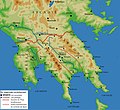
Image 16Major regions of mainland ancient Greece and adjacent "barbarian" lands (from Ancient Greece)
Image 17The remains of the Temple of Apollo in Corinth, the first Greek temple to be built in stone. (from Archaic Greece)
Image 18The gymnasium and palaestra at Olympia, the site of the ancient Olympic games. The archaic period conventionally dates from the first Olympiad. (from Archaic Greece)
Image 21Homer, author of the earliest surviving Greek literature (from Archaic Greece)
Image 22Dipylon Vase of the late Geometric period, or the beginning of the Archaic period, c. 750 BC. (from Ancient Greece)
Image 23Finds from an early Geometric cremation burial of a pregnant wealthy woman, from the N.W. of the Areopagus, about 850 BC, Ancient Agora Museum (Athens); exhibit 14–16: broad gold finger rings; exhibit 17–19: gold finger rings; 20: pair of gold earrings with trapezoid endings (from Greek Dark Ages)
Image 34An Ancient Greek pair of terracotta boots. Early geometric period cremation burial of a woman, 900 BC. Ancient Agora Museum in Athens. (from Greek Dark Ages)




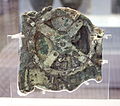 The Antikythera mechanism was an analog computer from 150 to 100 BC designed to calculate the positions of astronomical objects. (from Ancient Greece)
 Alexander Mosaic, National Archaeological Museum, Naples (from Ancient Greece)
 The Victorious Youth (c. 310 BC) is a rare, water-preserved bronze sculpture from ancient Greece. (from Ancient Greece)
 Greek hoplite and Persian warrior depicted fighting, on an ancient kylix, 5th century BC (from Ancient Greece)
 A scene from the Iliad: Hypnos and Thanatos carrying the body of Sarpedon from the battlefield of Troy; detail from an Attic white-ground lekythos, c. 440 BC (from Ancient Greece)
 The ancient Theatre of Epidaurus, 4th century BC (from Ancient Greece)
 The Temple of Concordia, Valle dei Templi, Magna Graecia, in present-day Italy (from Archaic Greece)
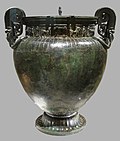 The Vix Krater, an imported Greek wine-mixing bronze vessel found in the Hallstatt/La Tène grave of the "Lady of Vix", Burgundy, France, c. 500 BC (from Archaic Greece)
 The Parthenon, a temple dedicated to Athena, located on the Acropolis in Athens, is one of the most representative symbols of the culture and sophistication of the ancient Greeks. (from Ancient Greece)
 Events of the first phases of the Greco-Persian Wars (from Ancient Greece)
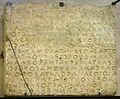 Inheritance law, part of the Gortyn code, Crete, fragment of the 11th column. Limestone, 5th century BC (from Ancient Greece)
 The lawgiver Solon reformed the Athenian constitution, which led to significant developments in Greece (from Archaic Greece)
 Geometric-style box in the shape of a barn. On display in the Ancient Agora Museum in Athens, housed in the Stoa of Attalus. From early geometric cremation burial of a wealthy pregnant woman, 850 BC. (from Greek Dark Ages)
 Major regions of mainland ancient Greece and adjacent "barbarian" lands (from Ancient Greece)
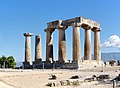 The remains of the Temple of Apollo in Corinth, the first Greek temple to be built in stone. (from Archaic Greece)
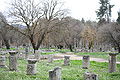 The gymnasium and palaestra at Olympia, the site of the ancient Olympic games. The archaic period conventionally dates from the first Olympiad. (from Archaic Greece)
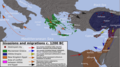 Map of the Late Bronze Age collapse (c. 1200 BC) in the Eastern Mediterranean (from Greek Dark Ages)
 Homer, author of the earliest surviving Greek literature (from Archaic Greece)
 Dipylon Vase of the late Geometric period, or the beginning of the Archaic period, c. 750 BC. (from Ancient Greece)
 Finds from an early Geometric cremation burial of a pregnant wealthy woman, from the N.W. of the Areopagus, about 850 BC, Ancient Agora Museum (Athens); exhibit 14–16: broad gold finger rings; exhibit 17–19: gold finger rings; 20: pair of gold earrings with trapezoid endings (from Greek Dark Ages)
 Early Athenian coin, depicting the head of Athena on the obverse and her owl on the reverse – 5th century BC (from Ancient Greece)
 The carved busts of four ancient Greek philosophers, on display in the British Museum. From left to right: Socrates, Antisthenes, Chrysippus, and Epicurus. (from Ancient Greece)
 Ancient Greek colonies in the archaic period (from Archaic Greece)
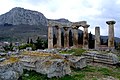 Ruins of the Temple of Apollo within the polis of Ancient Corinth, built c. 540 BC, with the Acrocorinth (the city's acropolis) seen in the background (from Archaic Greece)
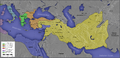 The major Hellenistic realms included the Diadochi kingdoms:Kingdom of Ptolemy I SoterKingdom of CassanderKingdom of LysimachusKingdom of Seleucus I NicatorAlso shown on the map:Carthage (non-Greek)Rome (non-Greek)
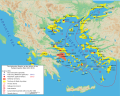 The Delian League immediately before the Peloponnesian War in 431 BC (from Ancient Greece)
 Marble bust of Pericles with a Corinthian helmet, Roman copy of a Greek original, Museo Chiaramonti, Vatican Museums; Pericles was a key populist political figure in the development of the radical Athenian democracy. (from Ancient Greece)
 An Ancient Greek pair of terracotta boots. Early geometric period cremation burial of a woman, 900 BC. Ancient Agora Museum in Athens. (from Greek Dark Ages)


 Commons
 Wikidata
 Wikiquote
 Wikisource
 Wikiversity
 Wiktionary


