
Periodic table extract showing approximately how often each element tends to be recognized as a noble metal:
7 most often (Ru, Rh, Pd, Os, Ir, Pt, Au)[1] 1 often (Ag)[2] 2 sometimes (Cu, Hg)[3] 6 in a limited sense (Tc, Re, As, Sb, Bi, Po)
The thick black line encloses the seven to eight metals most often to often so recognized. Silver is sometimes not recognized as a noble metal on account of its greater reactivity.[4]
* may be tarnished in moist air or corrode in an acidic solution containing oxygen and an oxidant
† attacked by sulfur or hydrogen sulfide
§ self-attacked by radiation-generated ozone
A noble metal is a metallic chemical element that is resistant to corrosion and is usually found in nature in its raw form. Gold, platinum, and the other platinum group metals (ruthenium, rhodium, palladium, osmium, iridium) are most often so classified. Silver, copper, and mercury are sometimes included as noble metals, but each of these usually occurs in nature combined with sulfur.
In more specialized fields of study and applications, the number of elements counted as noble metals can vary. In some contexts, the term is used only for copper, silver, and gold which have filled d-bands. In others, it is applied more broadly to any metallic or semimetallic element that does not react with a weak acid and give off hydrogen gas in the process. This broader set includes copper, mercury, technetium, rhenium, arsenic, antimony, bismuth, polonium, gold, the six platinum group metals, and silver.
Many of the noble metals are used in alloys for jewelry or coinage. In dentistry, silver is not always considered a noble metal because it is subject to corrosion when present in the mouth. All the metals are important heterogeneous catalysts.
Meaning and history
While lists of noble metals can differ, they tend to cluster around gold and the six platinum group metals: ruthenium, rhodium, palladium, osmium, iridium, and platinum.
In addition to this term's function as a compound noun, there are circumstances where noble is used as an adjective for the noun metal. A galvanic series is a hierarchy of metals (or other electrically conductive materials, including composites and semimetals) that runs from noble to active, and allows one to predict how materials will interact in the environment used to generate the series. In this sense of the word, graphite is more noble than silver and the relative nobility of many materials is highly dependent upon context, as for aluminium and stainless steel in conditions of varying pH.[5]
The term noble metal can be traced back to at least the late 14th century[6] and has slightly different meanings in different fields of study and application.
Prior to Mendeleev's publication in 1869 of the first (eventually) widely accepted periodic table, Odling published a table in 1864, in which the "noble metals" rhodium, ruthenium, palladium, platinum, iridium, and osmium were grouped together,[7] adjacent to silver and gold.
 Chalcopyrite, which is copper iron sulfide (CuFeS2), is the most abundant copper ore mineral
 One half of a ruthenium bar.
Size ~ 40 × 15 × 10 mm
Weight ~44 g Rhodium: 1 g powder, 1g pressed cylinder, 1 g pellet.
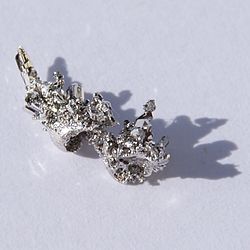 Palladium
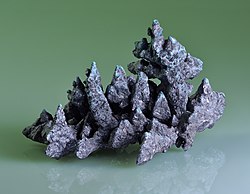 Acanthite, or silver sulfide (Ag2S)
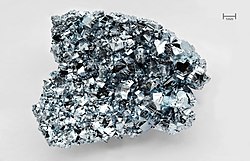 Osmium crystals, 2.2 g
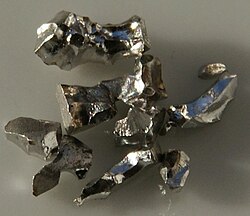 Pieces of pure iridium, 1 g, size: 1–3 mm each
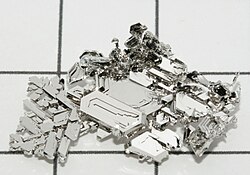 Crystals of pure platinum
 Gold nugget from Australia, nearly 9,000 g or 317 oz
 Cinnabar or mercury sulfide (HgS) is the most common source ore for refining elemental mercury


Properties

Geochemical
The noble metals are siderophiles (iron-lovers). They tend to sink into the Earth's core because they dissolve readily in iron either as solid solutions or in the molten state. Most siderophile elements have practically no affinity whatsoever for oxygen: indeed, oxides of gold are thermodynamically unstable with respect to the elements.
Copper, silver, gold, and the six platinum group metals are the only native metals that occur naturally in relatively large amounts.[8]
Corrosion resistance
Noble metals tend to be resistant to oxidation and other forms of corrosion, and this corrosion resistance is often considered to be a defining characteristic. Some exceptions are described below.
Copper is dissolved by nitric acid and aqueous potassium cyanide.
Ruthenium can be dissolved in aqua regia, a highly concentrated mixture of hydrochloric acid and nitric acid, only when in the presence of oxygen, while rhodium must be in a fine pulverized form. Palladium and silver are soluble in nitric acid, while silver's solubility in aqua regia is limited by the formation of silver chloride precipitate.[9]
Rhenium reacts with oxidizing acids, and hydrogen peroxide, and is said to be tarnished by moist air. Osmium and iridium are chemically inert in ambient conditions.[10] Platinum and gold can be dissolved in aqua regia.[11] Mercury reacts with oxidising acids.[10]
In 2010, US researchers discovered that an organic "aqua regia" in the form of a mixture of thionyl chloride SOCl2 and the organic solvent pyridine C5H5N achieved "high dissolution rates of noble metals under mild conditions, with the added benefit of being tunable to a specific metal" for example, gold but not palladium or platinum.[12]
However, gold can be dissolved in selenic acid (H2SeO4).
Anion (-ide) formation
The noble elements gold and platinum also have a comparatively high electronegativity for a metallic element, thus allowing them to exist as single-metallic anions.
For example: