
This is a list of dishes, prepared foods and beverages that have been recorded as originating before the post-classical era.
Different endpoints exist for what marks the beginning of the post-classical era, including the Early Middle Ages (the end of the 4th century CE), the fall of the Western Roman Empire in 476 CE,[1][2] the closure of the Platonic Academy in 529 CE,[3] the death of the emperor Justinian I in 565 CE,[4] the spread of Islam in 610 CE[5] or the rise of Charlemagne.[6]
Archeologists and food historians have recreated some dishes using ancient recipes.[7]
Obsolete
Foods

Some ancient foods are no longer eaten as a regular part of diets:
- Ashishim – Levantine[8] red lentil pancake dish of Ancient Israelite origin that was commonly eaten by Jews in antiquity.[9]
- Black soup[10]
- Garum – Phoenicia,[11] ancient Greece (where it was known as γάρος) and the Roman Empire, known from before Pompeii's destruction in 79 CE.[12][13]
- Jusselle[14]
- Kandaulos
- Libum
- Liquamen, see garum
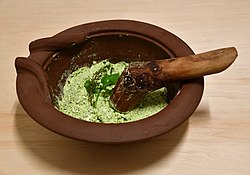
Moretum - Myma – Ancient Greek meat dish
- Opus lactarium – documented as existing during the ancient Roman Empire[16]
- Oxygala – a dairy product in ancient Greece and Rome.[16] It was also consumed by ancient Persians.[17]
- Placenta cake – a layered cake of pastry, cheese and honey originating in ancient Greece and Rome[18][19]
- Puls – Ancient Roman pottage
- Silphium – used as a seasoning
- Tetrapharmacum
- Touloumotiri is an ancient cheese that is considered as the "forerunner to feta".[20]
- Tracta was a kind of bread, pastry, or pancake in ancient Greece and perhaps Rome.[21]

Beverages

- Alban wine – Wine of Ancient Rome from Colli Albani
- Caecuban wine
- Chian wine
- Coan wine – Grecian alcoholic beverage
- Conditum – Ancient Roman spiced wine
- Falernian wine – Variety of ancient Roman wine
- Gaza wine – Byzantine-period wine from southern Palestine, shipped from Gaza
- Kykeon was a common beverage of sustenance in ancient Greece, most often consisting mainly of a barley gruel mixture with various additives, sometimes written as having psychoactive properties associated with religious visions.[22]
- Mulsum – Wine mixed with honey
- Oenomel
- Passum – Historical type of wine
- Posca – Ancient Roman drink
- Pulque – Alcoholic beverage made from agave
- Shedeh – Ancient Egyptian beverage
- Soma – Vedic ritual drink
- Vino Greco – Style name of Roman imitation of Greek wines
- Vinum Hadrianum – Wine from Atri
- Zythum – Ancient Egyptian beer variety
Still consumed
Food
Some ancient foods continue to be eaten:


- Bread[24]
- Chutney[26]
- Congee[27]
- Fig-cake (develah) – eaten by Jews in antiquity, mentioned in the Hebrew Bible and in the Jerusalem Talmud[citation needed]
- Fish sauce, see garum
- French toast, earliest reference appears in 1st century Rome[citation needed]
- Forcemeat[28]
- Ham – dry-cured ham has been produced since ancient times.[29][30][31]
- Hardtack – versions using various grains date back to ancient Rome, and as far back as ancient Egypt.[32]
- Jeok[citation needed]
- Lamb stew – Described in the Yale culinary tablets, ancient Babylonian tablets from 1700 BCE[7]
- Lucanica – Roman Italy, mentioned by Cicero, 1st century BCE[33][34]
- Maccu – fava bean soup eaten in Sicily during Roman times[35]
- Mantou – dates to 307 BCE – 250 BCE[36]
- Moustalevria – Traditional Greek kind of pudding
- Nettle stew – Evidence of consumption dates to around 1000 BCE at Must Farm, in Cambridgeshire, England.[37]
- Noodles – existent since at least 2,000 BCE in Northwest China,[38][39] the noodle was developed independently in ancient China and ancient Rome, and remained common in both areas "through the centuries".[40]
- Oatcake – known to exist at least from Roman times in Britain.[41]
- Olive, olive oil is at least known from the Eastern Mediterranean in the Bronze Age, c. 3000 BCE[42][43]
- Papadzules – a common dish in Maya cuisine that may be "one of the most ancient traditional dishes of Yucatán, Mexico.[23]

Beverages
- Beer is recorded in the written history of Mesopotamia and ancient Egypt and is one of the world's oldest prepared beverages.[57]
- Mead consumption's earliest surviving written record is possibly contained in the hymns of the Rigveda, one of the sacred books of the historical Vedic religion and (later) Hinduism dated around 1700–1100 BCE.
- Kombucha originated in what is now Northeastern China around 220 BCE [58][59]
- Soy milk has been consumed in China since ancient times.[60]
- Wine consumption and production has been found through archaeological evidence as early as c. 6000 BCE.[61][62]
Dairy products

- Butter – documented as existent since at least 2,000 BCE[63]
- Buttermilk – existed before 1 CE in ancient India[16]
- Kumis – documented as existing in ancient Scythia[16]
- Quark (lac concretum) – documented as existing in ancient Scythia[16]
- Schiston – "separated milk" purported to have been invented by physicians during the time of the Ancient Roman Empire and Pliny the Elder[16][64] It was prepared by boiling milk or whey along with pebbles.[64][65]
- Shrikhand – documented as existing c. 800 to 300 BCE in ancient India[16]
- Smy – thickened milk[c] documented as existent in ancient Egypt[16]
- Yogurt[67] – documented in upper Mesopotamia from the Neolithic era.
Cheeses

- Cheese – Possibly as early as 8000 BCE after the domestication of the Sheep in the Fertile Crescent[d][69]
- Caciocavallo
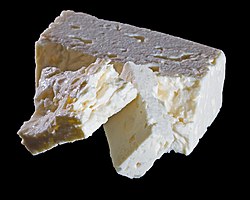
- Feta – existed during the times of Homer in ancient Greece[70]
- Kefalotyri – dates to the Byzantine Empire[71]
- Pecorino Romano – is one of the world's most ancient cheeses[72][73]
- Pecorino Sardo (Flore sardo) – one of the world's oldest cheeses that is believed to date back to the Bronze Age[74]
- Pecorino Siciliano[75]
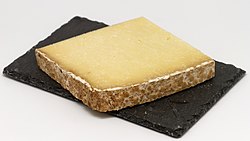
- Salers[76]
- Ancient cheeses


See also


Notes
- ↑ "The origin of sausage goes back to ancient times."[45]
- ↑ "An ancient food, soup is prepared by cooking meat, fish or vegetables and the like in such fluids as water or milk; it is then consumed as a liquid."[48]
- ↑ "Smy, or thickened milk, both human and animal, is often mentioned in medical prescriptions."[66]
- ↑ "Cheese is represented in the tomb art of ancient Egypt and in Greek literature"[68]
References
- ↑ "ancient history". Collins English Dictionary. Archived from the original on 16 August 2016. Retrieved 19 May 2016.
- ↑ "ancient history". Oxford English Dictionary. Archived from the original on 11 June 2016. Retrieved 19 May 2016.
- ↑ Hadas, Moses (1950). A History of Greek Literature. Columbia University Press. p. 273. ISBN 978-0-231-01767-1. Archived from the original on 2016-05-04. Retrieved 2016-05-19.
{{cite book}}: ISBN / Date incompatibility (help) - ↑ Robinson, C. A. (1951). Ancient history from prehistoric times to the death of Justinian. New York: Macmillan.
- ↑ Breasted, J. H. (1916). Ancient times, a history of the early world: an introduction to the study of ancient history and the career of early man Archived 2015-02-06 at the Wayback Machine. Boston: Ginn and Company.
- ↑ Myers, P. V. N. (1916). Ancient History Archived 2016-07-22 at the Wayback Machine. New York [etc.]: Ginn and company.
- 1 2 Winchester, Ashley. "The world's oldest-known recipes decoded". www.bbc.com. Archived from the original on 2020-06-04. Retrieved 2020-06-17.
- ↑ "Creation of Israel, 1948". history.state.gov. Retrieved December 27, 2023.
- ↑ Goldin, Megan. "FEATURE-Biblical cuisine inspires Bible learning in Israel". TheMarker. Reuters. Retrieved September 24, 2020.
- ↑ Flacelière, Robert (1965). Daily Life in Greece at the Time of Pericles. Macmillan. p. 170.
- ↑ Greenberg, Paul (10 July 2018). The Omega Principle: Seafood and the Quest for a Long Life and a Healthier Planet. Penguin. ISBN 978-0-698-18346-9.
- ↑ Dalby, A. (2013). Food in the Ancient World from A to Z. Taylor & Francis. p. 156. ISBN 978-1-135-95422-2. Retrieved May 19, 2016.
- ↑ Pliny the Elder, Natural History 13.93. (Before 79 CE)
- ↑ The Literary Gazette and Journal of the Belles Lettres, Arts, Sciences, &c. W.A. Scripps. 1843. p. 823. Retrieved May 18, 2016.
- ↑ Dalby, A. (2013). Food in the Ancient World from A to Z. Taylor & Francis. p. 222. ISBN 978-1-135-95422-2. Retrieved May 19, 2016.
- 1 2 3 4 5 6 7 8 Kurmann, Joseph A.; Rasic, J.L.; Kroger, M. (1992). Encyclopedia of Fermented Fresh Milk Products: An International Inventory of Fermented Milk, Cream, Buttermilk, Whey, and Related Products. An Avi book. Springer. p. 352. ISBN 978-0-442-00869-7. Retrieved May 19, 2016.
- ↑ Dalby, A. (2003). Food in the Ancient World from A to Z. Routledge. p. 218. ISBN 978-0-415-23259-3. Retrieved May 19, 2016.
- ↑ "American Pie". American Heritage. April–May 2006. Archived from the original on 2009-07-12. Retrieved 2009-07-04.
The Romans refined the recipe, developing a delicacy known as placenta, a sheet of fine flour topped with cheese and honey and flavored with bay leaves.
- ↑ Faas, Patrick (2005). Around the Roman Table. University of Chicago Press. pp. 184–185. ISBN 978-0-226-23347-5.
- ↑ Fox, P.F. (2012). Cheese: Chemistry, Physics and Microbiology: Volume 2 Major Cheese Groups. Springer US. p. 526. ISBN 978-1-4615-2648-3. Retrieved May 19, 2016.
- ↑ Dalby, Andrew, Food in the Ancient World from A to Z, ISBN 1-135-95422-4, 'Pastry', p. 251
- ↑ "Kykeon- Definition". World History Encyclopedia. Joshua J. Mark. Archived from the original on April 10, 2019. Retrieved June 18, 2020.
- 1 2 Sterling, D. (2014). Yucatรกn: Recipes from a Culinary Expedition. The William and Bettye Nowlin Series in Art, History, and Culture of the Western Hemisphere. University of Texas Press. p. 280. ISBN 978-0-292-73581-1. Retrieved May 20, 2016.
- ↑ "Prehistoric bake-off: Scientists discover oldest evidence of bread". BBC News. 2018-07-16. Retrieved 2023-01-14.
- ↑ "Prehistoric bake-off: Scientists discover oldest evidence of bread". BBC News. 2018-07-16. Retrieved 2023-01-14.
- ↑ Aggarwal, U. (2016). Incredible Taste of Indian Vegetarian Cuisine. First Edition. Allied Publishers Pvt. Limited. p. 200. ISBN 978-93-85926-02-0. Retrieved May 19, 2016.
- ↑ Huang, H.T. (2000). Fermentations and Food Science. Biology and biological technology. Cambridge University Press. p. 88. ISBN 978-0-521-65270-4. Retrieved May 19, 2016.
- ↑ Hurt, J.; King, J. (2012). The Complete Idiot's Guide to Sausage Making. DK Publishing. p. pt27. ISBN 978-1-101-57224-5. Retrieved May 19, 2016.
- ↑ V. M. Balasubramaniam, G.V.B.C.H.L.M.L. (2016). High Pressure Processing of Food. Food Engineering Series. Springer. p. 598. ISBN 978-1-4939-3234-4. Retrieved May 19, 2016.
- ↑ Dalby, A. (2013). Food in the Ancient World from A to Z. Taylor & Francis. p. 269. ISBN 978-1-135-95422-2. Retrieved May 19, 2016.
- ↑ Hui, Y.H.; Meunier-Goddik, L.; Josephsen, J.; Nip, W.K.; Stanfield, P.S. (2004). Handbook of Food and Beverage Fermentation Technology. Food Science and Technology (Marcel Dekker), Vol 134. Taylor & Francis. p. 427. ISBN 978-0-8247-5122-7. Retrieved May 19, 2016.
- ↑ "Education Resource Portal: Hardtack". mnhs.org. Minnesota Historical Society. Archived from the original on June 11, 2020. Retrieved June 11, 2020.
- ↑ Jenkins, N.H. (2007). Cucina del Sole: A Celebration of Southern Italian Cooking. HarperCollins. p. 16. ISBN 978-0-06-072343-9. Retrieved May 19, 2016.
- ↑ Riley, G. (2007). The Oxford Companion to Italian Food. Oxford Companion To... Series. Oxford University Press, USA. p. 327. ISBN 978-0-19-860617-8. Retrieved May 19, 2016.
- ↑ Helstosky, Carol (2009). Food Culture in the Mediterranean. Greenwood Publishing Group. p. 7. ISBN 978-0-313-34626-2. Archived from the original on 2016-07-04. Retrieved 2016-10-04.
- ↑ Jina (2006-05-24). "Mán tóu dí lì shǐ" 馒头的历史 [History of Mantou]. 中国国学网 (in Chinese). Archived from the original on 2018-04-26. Retrieved 2018-04-25.
《事物绀珠》说,相传"秦昭王作蒸饼"。
- ↑ Alberge, Dalya (2011-12-04). "Bronze age man's lunch: a spoonful of nettle stew". The Guardian News. Retrieved 2018-07-24.
- ↑ Leslie Bilderback, CMB (2007). The Complete Idiot's Guide To Comfort Food. DK Publishing. p. 167. ISBN 978-1-4406-2617-3. Retrieved May 19, 2016.
- ↑ Waxman, M.B. (2008). Eat Me Now!: Healthy Macrobiotic Cooking for Students and Busy People. PublishAmerica. p. pt150. ISBN 978-1-4560-4528-9. Retrieved May 19, 2016.
- ↑ Coyle, L. Patrick (1982). The world encyclopedia of food. Facts on File. p. 427. ISBN 978-0-87196-417-5. Retrieved 20 May 2016.
- ↑ "History of the Oatcake". mckenzie-biscuits.com. Mckenzies. Archived from the original on June 11, 2020. Retrieved June 11, 2020.
- ↑ Whitehouse, R. (2016). Liguria. Bradt Travel Guides Liguria. Bradt Travel Guides. p. 34. ISBN 978-1-78477-010-5. Retrieved May 19, 2016.
- ↑ Harper, D.; Faccioli, P. (2010). The Italian Way: Food and Social Life. University of Chicago Press. p. 153. ISBN 978-0-226-31726-7. Retrieved May 20, 2016.
- ↑ Snyder, M.; Faass, N. (2009). The Everything Raw Food Recipe Book. EverythingÂ. F+W Media. p. 295. ISBN 978-1-4405-2102-7. Retrieved May 19, 2016.
- ↑ "History of the Dry Sausage Business". Volume 61. The National Provisioner. November 29, 1919. p. 19. Retrieved 18 May 2016.
- ↑ America, United Master Butchers of (1915). American Meat Trade and Retail Butchers Journal. Wm. H. Hornidge. p. 217. Retrieved May 19, 2016.
- ↑ Schwartz, A. (1994). Soup Suppers: More Than 100 Main-Course Soups and 40 Accompaniments. HarperCollins. p. 12. ISBN 978-0-06-096948-6. Retrieved May 18, 2016.
- ↑ Coyle, L.P. (1982). The world encyclopedia of food. Facts on File. ISBN 978-0-87196-417-5. Retrieved May 19, 2016.
- ↑ Dunster, Edward Swift; Foster, Frank Pierce; Hunter, James Bradbridge; Sajous, Charles Eucharist de Medicis; Klaunberg, Henry J.; Stragnell, Gregory; Martí-Ibáñez, Félix (1 January 1917). "International Record of Medicine and General Practice Clinics". MD Publications. Archived from the original on 6 April 2017. Retrieved 5 April 2017 – via Google Books.
- ↑ Shurtleff, William; Aoyagi, Akiko. History of Soy Sauce (160 CE to 2012):Extensively Annotated Bibliography and Sourcebook (PDF). p. 6. Archived (PDF) from the original on 2016-12-21. Retrieved 2018-05-03.
- ↑ Planet, L.; Staff, Lonely Planet Publications (2012). The World's Best Street Food: Where to Find It and How to Make It. Lonely Planet Publications. p. 165. ISBN 978-1-74321-664-4. Retrieved May 19, 2016.
- ↑ White, A.; Varney, J. (2012). Philadelphia Chef's Table: Extraordinary Recipes from the City of Brotherly Love. Lyons Press. p. 94. ISBN 978-0-7627-8944-3.
- ↑ Pyenson, Luke (July 30, 2013). "Genovese pesto 'pancake'? Perfetto!". The Boston Globe. Archived from the original on March 5, 2016. Retrieved March 5, 2016.(subscription required)
- ↑ Davidson, A.; Jaine, T. (2014). The Oxford Companion to Food. Oxford Companions. OUP Oxford. p. 818. ISBN 978-0-19-104072-6. Retrieved May 19, 2016. (subscription required)
- ↑ Nguyen, A.; Caruso, M. (2012). Asian Tofu: Discover the Best, Make Your Own, and Cook It at Home. Ten Speed Press. p. 1. ISBN 978-1-60774-025-4. Retrieved May 19, 2016.
- ↑ "Backgrounder:Origins of Zongzi". Sina 新浪 English. Archived from the original on 2010-06-16. Retrieved 2018-01-17.
- ↑ "Beer". Britannica.com. Archived from the original on 2007-05-11. Retrieved 2016-06-03.; Michael M. Homan, Beer and Its Drinkers: An Ancient near Eastern Love Story, Near Eastern Archaeology, Vol. 67, No. 2 (Jun. 2004), pp. 84–95.
- ↑ Jayabalan, R.; Malbaša, R. V.; Lončar, E. S.; Vitas, J. S.; Sathishkumar, M. (2014). "A Review on Kombucha Tea—Microbiology, Composition, Fermentation, Beneficial Effects, Toxicity, and Tea Fungus". Comprehensive Reviews in Food Science and Food Safety. 13 (4): 538–550. doi:10.1111/1541-4337.12073. PMID 33412713.
Fermentation of sugared tea with a symbiotic culture of acetic acid bacteria and yeast (tea fungus) yields kombucha tea which is consumed worldwide for its refreshing and beneficial properties on human health. Important progress has been made in the past decade concerning research findings on kombucha tea and reports claiming that drinking kombucha can prevent various types of cancer and cardiovascular diseases, promote liver functions, and stimulate the immune system.
- ↑ Tietze, H. (1996). Kombucha: The Miracle Fungus. Tietze Publications. p. 4. ISBN 978-0-646-23106-8. Retrieved May 20, 2016. (subscription required)
- ↑ Davidson, A.; Vannithone, S.; Jaine, T. (2014). The Oxford Companion to Food. Oxford Companions Series. Oxford University Press. p. 760. ISBN 978-0-19-967733-7. Retrieved May 19, 2016.
- ↑ Keys, David (2003-12-28). "Now that's what you call a real vintage: professor unearths 8,000-year-old wine". The Independent. Archived from the original on 2015-09-25. Retrieved 2011-03-20.
- ↑ "Earliest Known Winery Found in Armenian Cave". news.nationalgeographic.com. 2011-01-12. Archived from the original on 2017-06-03. Retrieved 2015-11-01.
- ↑ Arnow, L.E. (1972). Food Power: A Doctor's Guide to Commonsense Nutrition. G - Reference, Information and Interdisciplinary Subjects Series. Nelson-Hall Company. p. 237. ISBN 978-0-911012-37-8. Retrieved May 19, 2016.
- 1 2 Thurmond, D.L. (2006). A Handbook of Food Processing in Classical Rome: For Her Bounty No Winter. Technology and change in history. Brill. p. 193. ISBN 978-90-04-15236-6. Retrieved May 19, 2016.
- ↑ Drysdale, J.J.; Hughes, R.; Dudgeon, R.E.; Russell, J.R. (1884). The British Journal of Homoeopathy. Maclachlan, Stewart, & Company. p. 244. Retrieved May 19, 2016.
- ↑ Darby, W.J.; Ghalioungui, P.; Grivetti, L. (1977). Food: The Gift of Osiris. Academic Press. p. 775. ISBN 978-0-12-203402-2. Retrieved May 19, 2016.
- ↑ Rule, C.S. (2015). Yogurt Culture: A Global Look at How to Make, Bake, Sip, and Chill the World's Creamiest, Healthiest Food. Houghton Mifflin Harcourt. p. 353. ISBN 978-0-544-25171-7. Retrieved May 19, 2016.
- ↑ Fox, P.F. (2004). Cheese: General aspects. Cheese: Chemistry, Physics and Microbiology. General Aspects. Elsevier. p. 2. ISBN 978-0-12-263652-3. Retrieved May 19, 2016.
- ↑ Hayes, Dayle; Laudan, R. (2009). Food and Nutrition/Editorial Advisers, Dayle Hayes, Rachel Laudan. Marshall Cavendish Reference. p. 197. ISBN 978-0-7614-7821-8. Retrieved May 19, 2016.
- ↑ Robinson, R.K.; Tamime, A.Y. (1996). Feta & Related Cheeses. Ellis Horwood Series in Food Science and Technology. Taylor & Francis. p. 49. ISBN 978-0-7476-0077-0. Retrieved May 19, 2016.
- ↑ Ehlers, S.; Hurt, J. (2008). The Complete Idiot's Guide to Cheeses of the World. Alpha Books. p. 123. ISBN 978-1-59257-714-9. Archived from the original on July 15, 2020. Retrieved May 19, 2016.
- ↑ Donnelly, C.W. (2014). Cheese and Microbes. ASM Press. p. 160. ISBN 978-1-55581-859-3. Retrieved May 19, 2016.
- ↑ Lawrence, L.; Lawrence, L.P. (2008). Cooking for My Family: From Catherine Pasculli's Hoboken Kitchen. iUniverse. p. 325. ISBN 978-0-595-48282-5. Retrieved May 19, 2016.
- ↑ Magazine, C.; Miller, L.; Skinner, T.; Tsai, M. (2012). Cheese For Dummies (in Spanish). Wiley. p. 177. ISBN 978-1-118-14552-4. Retrieved May 19, 2016.
- ↑ Harbutt, J. (2009). World Cheese Book. DK Publishing. p. 127. ISBN 978-0-7566-6218-9. Retrieved May 19, 2016.
- ↑ Jenkins, S.W. (1996). Cheese Primer. Workman Publishing Company. p. 151. ISBN 978-0-89480-762-6. Retrieved 9 April 2021.
| Individual foods and drinks |
| ||
|---|---|---|---|
| Cuisines |
| ||
| Other subtopics |
| ||


| Dishes by origin |
| ||||||||||||||||||||
|---|---|---|---|---|---|---|---|---|---|---|---|---|---|---|---|---|---|---|---|---|---|
| By type and origin |
| ||||||||||||||||||||
| By type |
| ||||||||||||||||||||