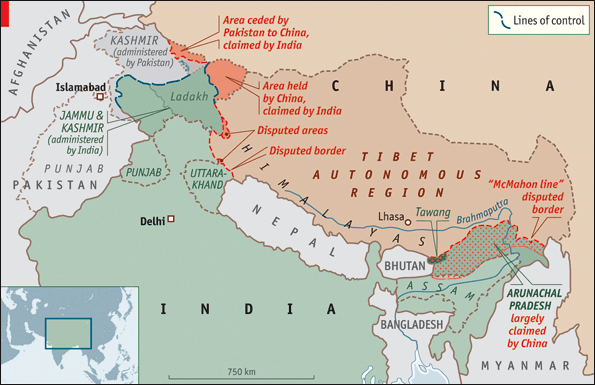
The Kashmir conflict is a territorial conflict over the Kashmir region, primarily between India and Pakistan, and also between China and India in the northeastern portion of the region.[1][2] The conflict started after the partition of India in 1947 as both India and Pakistan claimed the entirety of the former princely state of Jammu and Kashmir. It is a dispute over the region that escalated into three wars between India and Pakistan and several other armed skirmishes. India controls approximately 55% of the land area of the region that includes Jammu, the Kashmir Valley, most of Ladakh, the Siachen Glacier,[3][4] and 70% of its population; Pakistan controls approximately 30% of the land area that includes Azad Kashmir and Gilgit-Baltistan; and China controls the remaining 15% of the land area that includes the Aksai Chin region, the mostly uninhabited Trans-Karakoram Tract, and part of the Demchok sector.[3][note 1]
After the partition of India and a rebellion in the western districts of the state, Pakistani tribal militias invaded Kashmir, leading the Hindu ruler of Jammu and Kashmir to join India.[11] The resulting Indo-Pakistani War ended with a UN-mediated ceasefire along a line that was eventually named the Line of Control.[12][13] In 1962, China invaded and fought a war with India along the disputed Indo-Chinese border, including in Indian administered-Ladakh, marking their entry to the Kashmir conflict.[14] In 1965, Pakistan attempted to infiltrate Indian-administered Kashmir to precipitate an insurgency there, resulting in another war fought by the two countries over the region. After further fighting during the war of 1971, the Simla Agreement formally established the Line of Control between the territories under Indian and Pakistani control.[15][16] In 1999, an armed conflict between the two countries broke out again in Kargil with no effect on the status quo.[17]
In 1989, an armed insurgency erupted against Indian rule in Indian-administered Kashmir Valley, after years of political disenfranchisement and alienation, with logistical support from Pakistan.[18][19][20] The insurgency was actively opposed in Jammu and Ladakh, where it revived long-held demands for autonomy from Kashmiri dominance and greater integration with India.[21][22][23][24] Spearheaded by a group seeking creation of an independent state based on demands for self-determination, the insurgency was taken over within the first few years of its outbreak by Pakistan-backed Jihadist groups striving for merger with Pakistan.[25][26][27][28][29] The militancy continued through the 1990s and early 2000s—by which time it was being driven largely by foreign militants[30][31] and spread to parts of the adjoining Jammu region[32][33][34]—but declined thereafter. The fighting resulted in tens of thousands of casualties, both combatant and civilian. The militancy also resulted in the exodus of Kashmiri Hindus from the predominantly Muslim Kashmir Valley in the early 1990s. Counterinsurgency by the Indian government was coupled with repression of the local population and increased militarisation of the region, while various insurgent groups engaged in a variety of criminal activity.[35][36][37] The 2010s were marked by civil unrest within the Kashmir Valley, fuelled by unyielding militarisation, rights violations, mis-rule and corruption,[38][39] wherein protesting local youths violently clashed with Indian security forces,[40] with large-scale demonstrations taking place during the 2010[note 2] and 2016 unrests.[note 3] Further unrest in the region erupted after the 2019 Pulwama attack.[46]
Over the course of the long conflict, and especially since the outbreak of insurgency, India and Pakistan have been accused of violating human rights in the Kashmir region, while insurgents and militants have committed many atrocities in the region. Indian security forces, including local police from the region, have committed serious excesses during counterinsurgency in the Kashmir Valley, which include human rights abuses such as extrajudicial killings, arson, torture, unlawful detentions, rape and enforced disappearances, while the government has also caused political repression in the region.[47][48] Pakistan has committed abuses in Pakistan-administered Kashmir, including enforced disappearances, murder, torture, unlawful detentions and political repression,[49] and also tacitly permits and sponsors operations of Islamist militant groups there, many of which it created, funds and arms.[50][51][52] Insurgents and militants have committed killings and assassinations of civilians, including several massacres of religious and ethnic minorities, especially Hindus in both Jammu region and the Kashmir Valley, whom they have also driven out of the region or displaced within it, as well as abductions, arson, rapes and terrorist attacks, and forced an Islamic code of conduct on the larger society.[53][54][55][56] Multiple wars and cross-border shelling between India and Pakistan along the LOC, at times aimed to enable cross-border movement of militants by Pakistan, has also caused civilian deaths and displacement.[57][58] Indian security forces enjoy impunity for their actions and victims of their abuse lack legal redressal, with legislation preventing prosecution for abuses, and the government and a compliant judiciary enabling continued violations.[59][60][61] Owing to tight controls on access by Pakistan, human rights violations in Pakistan-administered Kashmir remain underdocumented unlike those on the Indian side.[62] The OHCHR reports on Kashmir released two reports on "the situation of human rights in Indian-Administered Kashmir and Pakistan-Administered Kashmir".
India–Pakistan conflict
Background
The Afghan Durrani Empire ruled Kashmir Valley from 1752[63] until its 1819 conquest by the Sikh Empire under Ranjit Singh. The Raja of Jammu Gulab Singh, who was a vassal of the Sikh Empire and an influential noble in the Sikh court, sent expeditions to various border kingdoms and ended up encircling Kashmir by 1840. Following the First Anglo-Sikh War (1845–1846), Kashmir was ceded under the Treaty of Lahore to the East India Company, which transferred it to Gulab Singh through the Treaty of Amritsar, in return for the payment of indemnity owed by the Sikh empire. Gulab Singh took the title of the Maharaja of Jammu and Kashmir.
From 1846 till the 1947 partition of India, Kashmir was ruled by maharajas of Gulab Singh's Dogra dynasty, as a princely state under British Paramountcy. The British Raj managed the defence, external affairs, and communications for the princely state and stationed a British Resident in Srinagar to oversee the internal administration. According to the 1941 census, the state's population was 77 percent Muslim, 20 percent Hindu and 3 percent others (Sikhs and Buddhists).[64] Despite its Muslim majority, the princely rule was overwhelmingly a Hindu-dominated state.[65] The Muslim majority suffered under the high taxes of the administration and had few opportunities for growth and advancement.[66]
Partition and invasion

British rule in the Indian subcontinent ended in 1947 with the creation of new states: the dominions of Pakistan and India, as the successor states to British India. The British Paramountcy over the 562 Indian princely states ended. According to the Indian Independence Act 1947, "the suzerainty of His Majesty over the Indian States lapses, and with it, all treaties and agreements in force at the date of the passing of this Act between His Majesty and the rulers of Indian States".[67][68] States were thereafter left to choose whether to join India or Pakistan or to remain independent. Jammu and Kashmir, the largest of the princely states, had a predominantly Muslim population ruled by the Hindu Maharaja Hari Singh. He decided to stay independent because he expected that the State's Muslims would be unhappy with accession to India, and the Hindus and Sikhs would become vulnerable if he joined Pakistan.[69][70] On 11 August, the Maharaja dismissed his prime minister Ram Chandra Kak, who had advocated independence. Observers and scholars interpret this action as a tilt towards accession to India.[70][71] Pakistanis decided to preempt this possibility by wresting Kashmir by force if necessary.[72]
Pakistan made various efforts to persuade the Maharaja of Kashmir to join Pakistan. In July 1947, Mohammad Ali Jinnah is believed to have written to the Maharaja promising "every sort of favourable treatment", followed by the lobbying of the State's Prime Minister by leaders of Jinnah's Muslim League party. Faced with the Maharaja's indecision on accession, the Muslim League agents clandestinely worked in Poonch to encourage the local Muslims to an armed revolt, exploiting an internal unrest regarding economic grievances. The authorities in Pakistani Punjab waged a 'private war' by obstructing supplies of fuel and essential commodities to the State. Later in September, Muslim League officials in the Northwest Frontier Province, including the Chief Minister Abdul Qayyum Khan, assisted and possibly organized a large-scale invasion of Kashmir by Pathan tribesmen.[73]: 61 [74] Several sources indicate that the plans were finalised on 12 September by the Prime Minister Liaquat Ali Khan, based on proposals prepared by Colonel Akbar Khan and Sardar Shaukat Hayat Khan. One plan called for organising an armed insurgency in the western districts of the state and the other for organising a Pushtoon tribal invasion. Both were set in motion.[75][76]
The Jammu division of the state got caught up in the Partition violence. Large numbers of Hindus and Sikhs from Rawalpindi and Sialkot started arriving in March 1947 following massacres in Rawalpindi, bringing "harrowing stories of Muslim atrocities." According to Ilyas Chattha, this provoked counter-violence on Jammu Muslims, which had "many parallels with that in Sialkot."[77] The violence in the eastern districts of Jammu that started in September, developed into a widespread massacre of Muslims around October, organised by the Hindu Dogra troops of the State and perpetrated by the local Hindus, including members of the Rashtriya Swayamsevak Sangh, and the Hindus and Sikhs displaced from the neighbouring areas of West Pakistan. The Maharaja himself was implicated in some instances. A large number of Muslims were killed. Others fled to West Pakistan, some of whom made their way to the western districts of Poonch and Mirpur, which were undergoing rebellion. Many of these Muslims believed that the Maharaja ordered the killings in Jammu which instigated the Muslims in West Pakistan to join the uprising in Poonch and help in the formation of the Azad Kashmir government.[78]
The rebel forces in the western districts of Jammu were organised under the leadership of Sardar Ibrahim, a Muslim Conference leader. They took control of most of the western parts of the State by 22 October. On 24 October, they formed a provisional Azad Kashmir (free Kashmir) government based in Palandri.[79]
Accession

Justice Mehr Chand Mahajan, the Maharaja's nominee for his next prime minister, visited Nehru and Patel in Delhi on 19 September 1947, requesting essential supplies which had been blockaded by Pakistan since the beginning of September. He communicated the Maharaja's willingness to accede to India. Nehru, however, demanded that the jailed political leader, Sheikh Abdullah, be released from prison and involved in the state government. Only then would he allow the state to accede.[80][81] The Maharaja released Sheikh Abdullah on 29 September.[71]
The Maharaja's troops could not withstand the tribal militia attack in September and October 1947; they were heavily outnumbered and outgunned by the tribal militias, and were also facing internal rebellions from Muslim troops. The Maharaja made an urgent plea to Delhi for military assistance. Upon the Governor General Lord Mountbatten's insistence, India required the Maharaja to accede before it could send troops. Accordingly, the Maharaja signed an instrument of accession on 26 October 1947, which was accepted by the Governor General the next day.[82][83][84] While the Government of India accepted the accession, it added the proviso that it would be submitted to a "reference to the people" after the state is cleared of the invaders, since "only the people, not the Maharaja, could decide where Kashmiris wanted to live."; it was a provisional accession.[85][86][note 4] The largest political party, National Conference, headed by Sheikh Abdullah, endorsed the accession. In the words of the National Conference leader Syed Mir Qasim, India had the "legal" as well as "moral" justification to send in the army through the Maharaja's accession and the people's support of it.[88][note 5]
The Indian troops, which were airlifted in the early hours of 27 October, secured the Srinagar airport. The city of Srinagar was being patrolled by the National Conference volunteers with Hindus and Sikhs moving about freely among Muslims, an "incredible sight" to visiting journalists. The National Conference also worked with the Indian Army to secure the city.[89]
In the north of the state lay the Gilgit Agency, which had been leased by British India but returned to the Maharaja shortly before Independence. Gilgit's population did not favour the State's accession to India. Sensing their discontent, Major William Brown, the Maharaja's commander of the Gilgit Scouts, mutinied on 1 November 1947, overthrowing the Governor Ghansara Singh. The bloodless coup d'état was planned by Brown to the last detail under the code name "Datta Khel". Local leaders in Gilgit formed a provisional government (Aburi Hakoomat), naming Raja Shah Rais Khan as the president and Mirza Hassan Khan as the commander-in-chief. But, Major Brown had already telegraphed Khan Abdul Qayyum Khan asking Pakistan to take over. According to historian Yaqoob Khan Bangash, the provisional government lacked sway over the population which had intense pro-Pakistan sentiments.[90] Pakistan's Political Agent, Khan Mohammad Alam Khan, arrived on 16 November and took over the administration of Gilgit.[91][92] According to various scholars, the people of Gilgit as well as those of Chilas, Koh Ghizr, Ishkoman, Yasin, Punial, Hunza and Nagar joined Pakistan by choice.[93][94][95][96]
Indo-Pakistani War of 1947
Rebel forces from the western districts of the State and the Pakistani Pathan tribesmen[note 6][note 7] made rapid advances into the Baramulla sector. In the Kashmir Valley, National Conference volunteers worked with the Indian Army to drive out the 'raiders'.[note 8] The resulting First Kashmir War lasted until the end of 1948.
The Pakistan army made available arms, ammunition and supplies to the rebel forces who were dubbed the "Azad Army". Pakistani army officers "conveniently" on leave and the former officers of the Indian National Army were recruited to command the forces. In May 1948, the Pakistani army officially entered the conflict, in theory to defend the Pakistan borders, but it made plans to push towards Jammu and cut the lines of communications of the Indian forces in the Mendhar Valley.[97] C. Christine Fair notes that this was the beginning of Pakistan using irregular forces and "asymmetric warfare" to ensure plausible deniability, which has continued ever since.[98]
On 1 November 1947, Mountbatten flew to Lahore for a conference with Jinnah, proposing that, in all the princely States where the ruler did not accede to a Dominion corresponding to the majority population (which would have included Junagadh, Hyderabad as well as Kashmir), the accession should be decided by an "impartial reference to the will of the people". Jinnah rejected the offer. According to Indian scholar A. G. Noorani, Jinnah ended up squandering his leverage.[99]
Pakistani soldiers and tribesman captured Rajouri on 7 November 1947, in which, according to Indian Ministry of Defence's History Division, over 30,000 Hindus and Sikhs were killed, wounded or abducted. The massacres would only end with the Indian Army recapturing Rajouri in April 1948.[100]
On 25 November, the Pakistani tribesmen and soldiers attacked and took over Mirpur, and began the Mirpur Massacre of Hindus and Sikhs in the area. An estimated 20,000+ Hindus and Sikhs were killed overall. Rapes and other crimes were also committed during the aftermath.[101]
According to Jinnah, India acquired the accession through "fraud and violence".[102] A plebiscite was unnecessary and states should accede according to their majority population. He was willing to urge Junagadh to accede to India in return for Kashmir. For a plebiscite, Jinnah demanded simultaneous troop withdrawal for he felt that 'the average Muslim would never have the courage to vote for Pakistan' in the presence of Indian troops and with Sheikh Abdullah in power. When Mountbatten countered that the plebiscite could be conducted by the United Nations, Jinnah, hoping that the invasion would succeed and Pakistan might lose a plebiscite, again rejected the proposal, stating that the Governors General should conduct it instead. Mountbatten noted that it was untenable given his constitutional position and India did not accept Jinnah's demand of removing Sheikh Abdullah.[103][note 9]
Prime Ministers Nehru and Liaquat Ali Khan met again in December, when Nehru informed Khan of India's intention to refer the dispute to the United Nations under article 35 of the UN Charter, which allows the member states to bring to the Security Council attention situations 'likely to endanger the maintenance of international peace'.[104]
Nehru and other Indian leaders were afraid since 1947 that the "temporary" accession to India might act as an irritant to the bulk of the Muslims of Kashmir. V.P. Menon, Secretary in Patel's Ministry of States, admitted in an interview in 1964 that India had been absolutely dishonest on the issue of plebiscite.[105] A.G. Noorani blames many Indian and Pakistani leaders for the misery of Kashmiri people but says that Nehru was the main culprit.[106]
UN mediation
India sought resolution of the issue at the UN Security Council, despite Sheikh Abdullah's opposition to it.[note 8] Following the set-up of the United Nations Commission for India and Pakistan (UNCIP), the UN Security Council passed Resolution 47 on 21 April 1948. The measure called for an immediate cease-fire and called on the Government of Pakistan 'to secure the withdrawal from the state of Jammu and Kashmir of tribesmen and Pakistani nationals not normally resident therein who have entered the state for the purpose of fighting.' It also asked Government of India to reduce its forces to minimum strength, after which the circumstances for holding a plebiscite should be put into effect 'on the question of Accession of the state to India or Pakistan.' However, it was not until 1 January 1949 that the ceasefire could be put into effect, signed by General Douglas Gracey on behalf of Pakistan and General Roy Bucher on behalf of India.[107] However, both India and Pakistan failed to arrive at a truce agreement due to differences over interpretation of the procedure for and the extent of demilitarisation. One sticking point was whether the Azad Kashmiri army was to be disbanded during the truce stage or at the plebiscite stage.[108]
The UNCIP made three visits to the subcontinent between 1948 and 1949, trying to find a solution agreeable to both India and Pakistan.[109] It reported to the Security Council in August 1948 that "the presence of troops of Pakistan" inside Kashmir represented a "material change" in the situation. A two-part process was proposed for the withdrawal of forces. In the first part, Pakistan was to withdraw its forces as well as other Pakistani nationals from the state. In the second part, "when the Commission shall have notified the Government of India" that Pakistani withdrawal has been completed, India was to withdraw the bulk of its forces. After both the withdrawals were completed, a plebiscite would be held.[110][note 10] The resolution was accepted by India but effectively rejected by Pakistan.[note 11]
The Indian government considered itself to be under legal possession of Jammu and Kashmir by virtue of the accession of the state. The assistance given by Pakistan to the rebel forces and the Pakhtoon tribes was held to be a hostile act and the further involvement of the Pakistan army was taken to be an invasion of Indian territory. From the Indian perspective, the plebiscite was meant to confirm the accession, which was in all respects already complete, and Pakistan could not aspire to an equal footing with India in the contest.[111]
The Pakistan government held that the state of Jammu and Kashmir had executed a standstill agreement with Pakistan which precluded it from entering into agreements with other countries. It also held that the Maharaja had no authority left to execute accession because his people had revolted and he had to flee the capital. It believed that the Azad Kashmir movement, as well as the tribal incursions, were indigenous and spontaneous, and Pakistan's assistance to them was not open to criticism.[112]
In short, India required an asymmetric treatment of the two countries in the withdrawal arrangements, regarding Pakistan as an 'aggressor', whereas Pakistan insisted on parity. The UN mediators tended towards parity, which was not to India's satisfaction.[113] In the end, no withdrawal was ever carried out, India insisting that Pakistan had to withdraw first, and Pakistan contending that there was no guarantee that India would withdraw afterwards.[114] No agreement could be reached between the two countries on the process of demilitarisation.[note 12]
Cold War historian Robert J. McMahon states that American officials increasingly blamed India for rejecting various UNCIP truce proposals under various dubious legal technicalities just to avoid a plebiscite. McMahon adds that they were "right" since a Muslim majority made a vote to join Pakistan the "most likely outcome" and postponing the plebiscite would serve India's interests.[115]
Scholars have commented that the failure of the Security Council efforts of mediation owed to the fact that the Council regarded the issue as a purely political dispute without investigating its legal underpinnings.[note 13] Declassified British papers indicate that Britain and the US had let their Cold War calculations influence their policy in the UN, disregarding the merits of the case.[note 14]
Dixon Plan

The UNCIP appointed its successor, Sir Owen Dixon, to implement demilitarisation prior to a statewide plebiscite on the basis of General McNaughton's scheme, and to recommend solutions to the two governments.[116][117][118] Dixon's efforts for a statewide plebiscite came to naught due to India's constant rejection of the various alternative demilitarisation proposals, for which Dixon rebuked India harshly.[119]
Dixon then offered an alternative proposal, widely known as the Dixon plan. Dixon did not view the state of Jammu and Kashmir as one homogeneous unit and therefore proposed that a plebiscite be limited to the Valley. Dixon agreed that people in Jammu and Ladakh were clearly in favour of India; equally clearly, those in Azad Kashmir and the Northern Areas wanted to be part of Pakistan. This left the Kashmir Valley and 'perhaps some adjacent country' around Muzaffarabad in uncertain political terrain.[120] Pakistan did not accept this plan because it believed that India's commitment to a plebiscite for the whole state should not be abandoned.[121][122][123]
Dixon also had concerns that the Kashmiris, not being high-spirited people, may vote under fear or improper influences.[124] Following Pakistan's objections, he proposed that Sheikh Abdullah administration should be held in "commission" (in abeyance) while the plebiscite was held. This was not acceptable to India which rejected the Dixon plan. Another grounds for India's rejection of the limited plebiscite was that it wanted Indian troops to remain in Kashmir for "security purposes", but would not allow Pakistani troops the same. However, Dixon's plan had encapsulated a withdrawal by both sides. Dixon had believed a neutral administration would be essential for a fair plebiscite.[125]
Dixon came to the conclusion that India would never agree to conditions and a demilitarization which would ensure a free and fair plebiscite.[126][127] Dixon's failure also compounded American ambassador Loy Henderson's misgivings about Indian sincerity and he advised the US to maintain a distance from the Kashmir dispute, which the US subsequently did, and leave the matter for Commonwealth nations to intervene in.[128]
1950 military standoff
The convening of the Constituent Assembly in Indian Kashmir in July 1950 proved contentious. Pakistan protested to the Security Council which informed India that this development conflicted with the parties' commitments. The National Conference rejected this resolution and Nehru supported this by telling Dr Graham that he would receive no help in implementing the Resolution.[129] A month later Nehru adopted a more conciliatory attitude, telling a press conference that the Assembly's actions would not affect India's plebiscite commitment. The delay caused frustration in Pakistan and Zafrullah Khan went on to say that Pakistan was not keeping a warlike mentality but did not know what Indian intransigence would lead Pakistan and its people to. India accused Pakistan of ceasefire violations and Nehru complained of 'warmongering propaganda' in Pakistan.[130] On 15 July 1951 the Pakistani Prime Minister complained that the bulk of the Indian Army was concentrated on the Indo-Pakistan border.[131]
The prime ministers of the two countries exchanged telegrams accusing each other of bad intentions. Liaquat Ali Khan rejected Nehru's charge of warmongering propaganda.[note 15] Khan called it a distortion of the Pakistani press' discontent with India over its persistence in not holding a plebiscite and a misrepresentation of the desire to liberate Kashmir as an anti-Indian war. Khan also accused India of raising its defence budget in the past two years, a charge which Nehru rejected while expressing surprise at Khan's dismissal of the 'virulent' anti-Indian propaganda. Khan and Nehru also disagreed on the details of the no-war declarations. Khan then submitted a peace plan calling for a withdrawal of troops, settlement in Kashmir by plebiscite, renouncing the use of force, end to war propaganda and the signing of a no-war pact.[132] Nehru did not accept the second and third components of this peace plan. The peace plan failed. While an opposition leader in Pakistan did call for war, leaders in both India and Pakistan did urge calm to avert disaster.[133]
The Commonwealth had taken up the Kashmir issue in January 1951. Australian prime minister Robert Menzies suggested that a Commonwealth force be stationed in Kashmir; that a joint Indo-Pakistani force be stationed in Kashmir and the plebiscite administrator be entitled to raise local troops while the plebiscite would be held. Pakistan accepted these proposals but India rejected them because it did not want Pakistan, who was in India's eyes the 'aggressor', to have an equal footing.[134] The UN Security Council called on India and Pakistan to honour the resolutions of plebiscite both had accepted in 1948 and 1949. The United States and Britain proposed that if the two could not reach an agreement then arbitration would be considered. Pakistan agreed but Nehru said he would not allow a third person to decide the fate of four million people. Korbel criticised India's stance towards a ″valid″ and ″recommended technique of international co-operation.″[135][136]
However, the peace was short-lived. Later by 1953, Sheikh Abdullah, who was by then in favour of resolving Kashmir by a plebiscite, an idea which was "anathema" to the Indian government according to historian Zutshi,[137] fell out with the Indian government. He was dismissed and imprisoned in August 1953. His former deputy, Bakshi Ghulam Mohammad was subsequently appointed as the prime minister, and Indian security forces were deployed in the Valley to control the streets.[138][139]
Nehru's plebiscite offer
In May 1953, the US Secretary of State John Foster Dulles recommended India and Pakistan seek a bilateral solution.[140][141] Around this time, Sheikh Abdullah fell out with the Indian government and lost the support of his colleageues in his cabinet. He was dismissed and imprisoned in August 1953. His former deputy, Bakshi Ghulam Mohammad was appointed as the prime minister, and Indian security forces were deployed in the Valley to control the streets.[138][139]
With India's "abridged authority" in Kashmir, Nehru decided that a settlement must be found. India could not hold Kashmir "at the point of a bayonet". Starting in July 1953, he made a renewed push on the plebiscite option in discussions with Pakistan. In bilateral talks held in Delhi in August 1953, he proposed that a plebiscite administrator be appointed within six months. Other than demanding that the plebiscite administrator not be from one of the major powers, he placed no other conditions.[138][139] Historian Gowher Rizvi notes a "dramatic reversal" of India's earlier position. "Nehru was now willing to offer virtually everything that Pakistan had been seeking since 1947".[142] Nehru suggested that the plebiscite could be held in all regions of the state and the state could be partitioned on the basis of the results. He was open to a "different approach" to the scaling back of troops in the State so as to allow a free vote.[138][139]
Pakistani prime minister Bogra was able to return home triumphantly. However, in the face of questions and criticisms from colleagues, his commitment began to waver. The main objection from the Pakistani leaders was to Nehru's demand for replacing the plebiscite administrator (Admiral Nimitz, appointed by the UN Security Council) with somebody from a smaller neutral power that had no strategic interests in the region. Pakistanis suspected sinister motives and time was whittled away.[143][144]
Cold War
The USA in February 1954 announced that it wanted to provide military aid to Pakistan. The US signed a military pact with Pakistan in May by which Pakistan would receive military equipment and training. The US president tried to alleviate India's concerns by offering similar weaponry to India. This was an unsuccessful attempt.[145] Nehru's misgivings about the US-Pakistan pact made him hostile to a plebiscite.[146] Consequently, when the pact was concluded in May 1954, Nehru withdrew the plebiscite offer and declared that the status quo was the only remaining option.[147]
Nehru's withdrawal from the plebiscite option came as a major blow to all concerned.[148] Scholars have suggested that India was never seriously intent on holding a plebiscite, and the withdrawal came to signify a vindication of their belief.[149][153][154]
Indian writer Nirad C. Chaudhuri has observed that Pakistan's acceptance of Western support ensured its survival.[155] He believed that India intended to invade Pakistan twice or thrice during the period 1947–1954. For scholar Wayne Wilcox, Pakistan was able to find external support to counter "Hindu superiority", returning to the group security position of the early 20th century.[156]
Sino-Indian War
In 1962, troops from the People's Republic of China and India clashed in territory claimed by both. China won a swift victory in the war.[157] Aksai Chin, part of which was under Chinese jurisdiction before the war,[158][159][160][161] remained under Chinese control since then. Another smaller area, the Trans-Karakoram, was demarcated as the Line of Control (LOC) between China and Pakistan, although some of the territory on the Chinese side is claimed by India to be part of Kashmir. The line that separates India from China in this region is known as the "Line of Actual Control".[162]
Operation Gibraltar and 1965 Indo-Pakistani war
Following its failure to seize Kashmir in 1947, Pakistan supported numerous 'covert cells' in Kashmir using operatives based in its New Delhi embassy. After its military pact with the United States in the 1950s, it intensively studied guerrilla warfare through engagement with the US military. In 1965, it decided that the conditions were ripe for a successful guerilla war in Kashmir. Code named 'Operation Gibraltar', companies were dispatched into Indian-administered Kashmir, the majority of whose members were razakars (volunteers) and mujahideen recruited from Pakistani-administered Kashmir and trained by the Army. These irregular forces were supported by officers and men from the paramilitary Northern Light Infantry and Azad Kashmir Rifles as well as commandos from the Special Services Group. About 30,000 infiltrators are estimated to have been dispatched in August 1965 as part of the 'Operation Gibraltar'.[163]
The plan was for the infiltrators to mingle with the local populace and incite them to rebellion. Meanwhile, guerilla warfare would commence, destroying bridges, tunnels and highways, as well as Indian Army installations and airfields, creating conditions for an 'armed insurrection' in Kashmir.[164] If the attempt failed, Pakistan hoped to have raised international attention to the Kashmir issue.[165] Using the newly acquired sophisticated weapons through the American arms aid, Pakistan believed that it could achieve tactical victories in a quick limited war.[166]
However, the 'Operation Gibraltar' ended in failure as the Kashmiris did not revolt. Instead, they turned in infiltrators to the Indian authorities in substantial numbers, and the Indian Army ended up fighting the Pakistani Army regulars. Pakistan claimed that the captured men were Kashmiri 'freedom fighters', a claim contradicted by the international media.[167][note 16] On 1 September, Pakistan launched an attack across the Cease Fire Line, targeting Akhnoor in an effort to cut Indian communications into Kashmir. In response, India broadened the war by launching an attack on Pakistani Punjab across the international border. The war lasted until 23 September, ending in a stalemate. Following the Tashkent Agreement, both the sides withdrew to their pre-conflict positions, and agreed not to interfere in each other's internal affairs.
1971 Indo-Pakistani war and Simla Agreement

The Indo-Pakistani War of 1971 led to a loss for Pakistan and a military surrender in East Pakistan. Bangladesh was created as a separate state with India's support and India emerged as a clear regional power in South Asia.[168]
A bilateral summit was held at Simla as a follow-up to the war, where India pushed for peace in South Asia.[169][170] At stake were 5,139 square miles (13,310 km2) of Pakistan's territory captured by India during the conflict, and over 90,000 prisoners of war held in Bangladesh. India was ready to return them in exchange for a "durable solution" to the Kashmir issue. Diplomat J. N. Dixit states that the negotiations at Simla were painful and tortuous, and almost broke down. The deadlock was broken in a personal meeting between the Prime Ministers Zulfikar Ali Bhutto and Indira Gandhi, where Bhutto acknowledged that the Kashmir issue should be finally resolved and removed as a hurdle in India-Pakistan relations; that the cease-fire line, to be renamed the Line of Control, could be gradually converted into a de jure border between India and Pakistan; and that he would take steps to integrate the Pakistani-controlled portions of Jammu and Kashmir into the federal territories of Pakistan.[169] However, he requested that the formal declaration of the Agreement should not include a final settlement of the Kashmir dispute as it would endanger his fledgling civilian government and bring in military and other hardline elements into power in Pakistan.[171]
Accordingly, the Simla Agreement was formulated and signed by the two countries, whereby the countries resolved to settle their differences by peaceful means through bilateral negotiations and to maintain the sanctity of the Line of Control. Multilateral negotiations were not ruled out, but they were conditional upon both sides agreeing to them.[172]: 49–50 To India, this meant an end to the UN or other multilateral negotiations. However Pakistan reinterpreted the wording in the light of a reference to the "UN charter" in the agreement, and maintained that it could still approach the UN. The United States, United Kingdom and most Western governments agree with India's interpretation.[173]
The Simla Agreement also stated that the two sides would meet again for establishing durable peace. Reportedly Bhutto asked for time to prepare the people of Pakistan and the National Assembly for a final settlement. Indian commentators state that he reneged on the promise. Bhutto told the National Assembly on 14 July that he forged an equal agreement from an unequal beginning and that he did not compromise on the right of self-determination for Jammu and Kashmir. The envisioned meeting never occurred.[174]
Kargil War (1999)

In mid-1999, alleged insurgents and Pakistani soldiers from Pakistani Kashmir infiltrated Jammu and Kashmir. During the winter season, Indian forces regularly move down to lower altitudes, as severe climatic conditions makes it almost impossible for them to guard the high peaks near the Line of Control. This practice is followed by both India and Pakistan Army. The terrain makes it difficult for both sides to maintain a strict border control over Line of Control. The insurgents took advantage of this and occupied vacant mountain peaks in the Kargil range overlooking the highway in Indian Kashmir that connects Srinagar and Leh. By blocking the highway, they could cut off the only link between the Kashmir Valley and Ladakh. This resulted in a large-scale conflict between the Indian and Pakistani armies. The final stage involved major battles by Indian and Pakistani forces, with India recapturing most of the territories[175][176] held by Pakistani forces.
Fears of the Kargil War turning into a nuclear war provoked the then-United States President Bill Clinton to pressure Pakistan to retreat. The Pakistan Army withdrew their remaining troops from the area, ending the conflict. India regained control of the Kargil peaks, which they now patrol and monitor all year long.
Internal conflict
Political movements during the Dogra rule (1846–1947)
In 1932 Sheikh Abdullah, a Kashmiri, and Chaudhry Ghulam Abbas, a Jammuite, led the founding of the All-Jammu and Kashmir Muslim Conference in order to agitate for the rights of Muslims in the state.[177] In 1938, they renamed the party National Conference in order to make it representative of all Kashmiris independent of religion.[178][179] The move brought Abdullah closer to Jawaharlal Nehru, the rising leader of the Congress party.[180] The National Conference eventually became a leading member of the All-India States Peoples' Conference, a Congress-sponsored confederation of the political movements in the princely states.
Three years later, rifts developed within the Conference owing to political, regional and ideological differences. A faction of the party's leadership grew disenchanted with Abdullah's leanings towards Nehru and the Congress, and his secularisation of Kashmiri politics.[181][182][183][184] Consequently, Abbas broke away from the National Conference and revived the old Muslim Conference in 1941, in collaboration with Mirwaiz Yusuf Shah. These developments indicated fissures between the ethnic Kashmiris and Jammuites, as well as between the Hindus and Muslims of Jammu.[185] Muslims in the Jammu region were Punjabi-speaking and felt closer affinity to Punjabi Muslims than with the Valley Kashmiris.[186] In due course, the Muslim Conference started aligning itself ideologically with the All-India Muslim League, and supported its call for an independent 'Pakistan'.[181] The Muslim Conference derived popular support among the Muslims of the Jammu region, and some from the Valley.[187][188] Conversely, Abdullah's National Conference enjoyed influence in the Valley.[188] Chitralekha Zutshi states that the political loyalties of Valley Kashmiris were divided in 1947, but the Muslim Conference failed to capitalise on it due its fractiousness and the lack of a distinct political programme.[189]
In 1946, the National Conference launched the 'Quit Kashmir' movement, asking the Maharaja to hand the power over to the people. The movement came under criticism from the Muslim Conference, who charged that Abdullah was doing it to boost his own popularity, waning because of his pro-India stance. Instead, the Muslim Conference launched a 'campaign of action' similar to Muslim League's programme in British India. Both Abdullah and Abbas were imprisoned.[190] By 22 July 1947, the Muslim Conference started calling for the state's accession to Pakistan.[191]
The Dogra Hindus of Jammu were originally organised under the banner of All Jammu and Kashmir Rajya Hindu Sabha, with Prem Nath Dogra as a leading member.[192] In 1942, Balraj Madhok arrived in the state as a pracharak of the Rashtriya Swayamsevak Sangh (RSS). He established branches of the RSS in Jammu and later in the Kashmir Valley. Prem Nath Dogra was also the chairman (sanghchalak) of the RSS in Jammu.[193][194] In May 1947, following the Partition plan, the Hindu Sabha threw in its support to whatever the Maharaja might decide regarding the state's status, which in effect meant support for the state's independence. However, following the communal upheaval of the Partition and the tribal invasion, its position changed to supporting the accession of the state to India and, subsequently, full integration of Jammu with India.[195][196] In November 1947, shortly after the state's accession to India, the Hindu leaders launched the Jammu Praja Parishad with the objective of achieving the "full integration" of Jammu and Kashmir with India, opposing the "communist-dominated anti-Dogra government of Sheikh Abdullah."[193][197]
Autonomy and plebiscite (1947–1953)
Article 370 was drafted in the Indian constitution granting special autonomous status to the state of Jammu and Kashmir, as per Instrument of Accession. This article specifies that the State must concur in the application of laws by Indian parliament, except those that pertain to Communications, Defence and Foreign Affairs. Central Government could not exercise its power to interfere in any other areas of governance of the state.
In a broadcast on 2 November 1947, Prime Minister Jawaharlal Nehru announced that the fate of Kashmir would ultimately be decided by the people, once law and order was established, through a referendum "held under international auspices like the United Nations."[198] A similar pledge was made by the Government of India when the Kashmir dispute was referred to the UN Security Council on 1 January 1948.[198] By some accounts Mountbatten had an understanding with Nehru that a referendum on the region's future would be held later.[199]
Sheikh Abdullah took oath as Prime Minister of the state on 17 March 1948. In 1949, the Indian government obliged Hari Singh to leave Jammu and Kashmir and yield the government to Sheikh Abdullah. Karan Singh, the son of the erstwhile Maharajah Hari Singh was made the Sadr-i-Riyasat (Constitutional Head of State) and the Governor of the state.
Elections were held for the Constituent Assembly of Jammu and Kashmir in 1951, with 75 seats allocated for the Indian administered part of Kashmir, and 25 seats left reserved for the Pakistan administered part. Sheikh Abdullah's National Conference won all 75 seats in a rigged election.[200][201] In October 1951, Jammu & Kashmir National Conference under the leadership of Sheikh Abdullah formed the Constituent Assembly of Jammu and Kashmir to formulate the Constitution of the state. Sheikh initially wanted the Constituent Assembly to decide the State's accession. But this was not agreed to by Nehru, who stated that such "underhand dealing" would be very bad, as the matter was being decided by the UN.[202]
Sheikh Abdullah was said to have ruled the state in an undemocratic and authoritarian manner during this period.[203]
According to historian Zutshi, in the late 1940s, most Kashmiri Muslims in Indian Kashmir were still debating the value of the state's association with India or Pakistan. By the 1950s, she says, the National Conference government's repressive measures and the Indian state's seeming determination to settle the state's accession to India without a reference to the people of the state brought Kashmiri Muslims to extol the virtues of Pakistan and condemn India's high-handedness in its occupation of the territory, and even those who had been in India's favour began to speak in terms of the state's association with Pakistan.[204]
In early 1949, an agitation was started by Jammu Praja Parishad, a Hindu nationalist party which was active in the Jammu region, over the ruling National Conference's policies. The government swiftly suppressed it by arresting as many as 294 members of the Praja Parishad including Prem Nath Dogra, its president. Though Sheikh's land reforms were said to have benefited the people of rural areas, Praja Parishad opposed the 'Landed Estates Abolition Act', saying it was against the Indian Constitutional rights, for implementing land acquisition without compensation. Praja Parishad also called for the full integration with the rest of India, directly clashing with the demands of National Conference for complete autonomy of the state. On 15 January 1952, students staged a demonstration against the hoisting of the state flag alongside the Indian Union flag. They were penalised, giving rise to a big procession on 8 February. The military was called out and a 72-hour curfew imposed. N. Gopalaswami Ayyangar, the Indian Central Cabinet minister in charge of Kashmir affairs, came down to broker peace, which was resented by Sheikh Abdullah.[205][201]
In order to break the constitutional deadlock, Nehru invited the National Conference to send a delegation to Delhi. The '1952 Delhi Agreement' was formulated to settle the extent of applicability of the Indian Constitution to the Jammu and Kashmir and the relation between the State and Centre. It was reached between Nehru and Abdullah on 24 July 1952. Following this, the Constituent Assembly abolished the monarchy in Kashmir, and adopted an elected Head of State (Sadr-i Riyasat). However, the Assembly was reluctant to implement the remaining measures agreed to in the Delhi Agreement.[206][207]
In 1952, Sheikh Abdullah drifted from his previous position of endorsing accession to India to insisting on the self-determination of Kashmiris.[208]
The Praja Parishad undertook a civil disobedience campaign for a third time in November 1952, which again led to repression by the state government. The Parishad accused Abdullah of communalism (sectarianism), favouring the Muslim interests in the state and sacrificing the interests of the others. The Jana Sangh joined hands with the Hindu Mahasabha and Ram Rajya Parishad to launch a parallel agitation in Delhi. In May 1953, Shyama Prasad Mukherjee, a prominent Indian leader of the time and the founder of Hindu nationalist party Bharatiya Jana Sangh (later evolved as BJP), made a bid to enter Jammu and Kashmir after denying to take a permit, citing his rights as an Indian citizen to visit any part of the country. Abdullah prohibited his entry and promptly arrested him when he attempted. An estimated 10,000 activists were imprisoned in Jammu, Punjab and Delhi, including Members of Parliament. Unfortunately, Mukherjee died in detention on 23 June 1953, leading to an uproar in whole India and precipitating a crisis that went out of control.[209][206]
Observers state that Abdullah became upset, as he felt, his "absolute power" was being compromised in India.[210]
Meanwhile, Nehru's pledge of a referendum to people of Kashmir did not come into action. Sheikh Abdullah advocated complete independence and had allegedly joined hands with US to conspire against India.[211]
On 8 August 1953, Sheikh Abdullah was dismissed as prime minister by the Sadr-i-Riyasat Karan Singh on the charge that he had lost the confidence of his cabinet. He was denied the opportunity to prove his majority on the floor of the house. He was also jailed in 1953 while Sheikh's dissident deputy, Bakshi Ghulam Mohammad was appointed as the new Prime Minister of the state.[212]
Period of integration and rise of Kashmiri separatism (1954–1974)
Bakshi Mohammad implemented all the measures of the '1952 Delhi Agreement'.[214] In May 1954, as a subsequent to the Delhi agreement,[215] The Constitution (Application to Jammu and Kashmir) Order, 1954, is issued by the President of India under Article 370, with the concurrence of the Government of the State of Jammu and Kashmir. In that order, the Article 35A is added to the Constitution of India to empower the Jammu and Kashmir state's legislature to define "permanent residents" of the state and provide special rights and privileges to those permanent residents.[216]
On 15 February 1954, under the leadership of Bakshi Mohammad, the Constituent Assembly of Jammu and Kashmir ratified the state's accession to India.[217][218] On 17 November 1956, the Constitution of Jammu and Kashmir was adopted by the Assembly and it came into full effect on 26 January 1957.[219] On 24 January 1957, the UN passed a resolution stating that the decisions of the Constituent Assembly would not constitute a final disposition of the State, which needs to be carried out by a free and impartial plebiscite.[220]
Meanwhile, in Pakistan administered Azad Jammu and Kashmir, the 1955 Poonch uprising begins in February 1955 against the governments dismissal of Sardar Ibrahim Khan. The rebellion would only be quashed in 1956.[221]
After the overthrow of Sheikh Abdullah, his lieutenant Mirza Afzal Beg formed the Plebiscite Front on 9 August 1955 to fight for the plebiscite demand and the unconditional release of Sheikh Abdullah. The activities of the Plebiscite Front eventually led to the institution of the infamous Kashmir Conspiracy Case in 1958 and two other cases. On 8 August 1958, Abdullah was arrested on the charges of these cases.[222]
India's Home Minister, Pandit Govind Ballabh Pant, during his visit to Srinagar in 1956, declared that the State of Jammu and Kashmir was an integral part of India and there could be no question of a plebiscite to determine its status afresh, hinting that India would resist plebiscite efforts from then on.[223]
After the mass unrest due to missing of holy relic from the Hazratbal Shrine on 27 December 1963, the State Government dropped all charges in the Kashmir Conspiracy Case as a diplomatic decision, on 8 April 1964. Sheikh Abdullah was released and returned to Srinagar where he was accorded a great welcome by the people of the valley. After his release he was reconciled with Nehru. Nehru requested Sheikh Abdullah to act as a bridge between India and Pakistan and make President Ayub Khan of Pakistan agree to come to New Delhi for the talks for a final solution of the Kashmir problem. President Ayub Khan also sent telegrams to Nehru and Sheikh Abdullah with the message that as Pakistan too was a party to the Kashmir dispute any resolution of the conflict without its participation would not be acceptable to Pakistan. Sheikh Abdullah went to Pakistan in the spring of 1964. President Ayub Khan held extensive talks with him to explore various avenues for solving the Kashmir problem and agreed to come to Delhi in mid June for talks with Nehru as suggested by him. Even the date of his proposed visit was fixed and communicated to New Delhi. However, while Abdullah was still in Pakistan, news came of the sudden death of Nehru on 27 May 1964. The peace initiative died with Nehru.[224]
After Nehru's death in 1964, Abdullah was interned from 1965 to 1968 and exiled from Kashmir in 1971 for 18 months. The Plebiscite Front was also banned. This was allegedly done to prevent him and the Plebiscite Front which was supported by him, from taking part in elections in Kashmir.[225]
On 21 November 1964, the Articles 356 and 357 of the Indian Constitution were extended to the state, by virtue of which the Central Government can assume the government of the State and exercise its legislative powers. On 24 November 1964, the Jammu and Kashmir Assembly passed a constitutional amendment changing the elected post of Sadr-i-Riyasat to a centrally-nominated post of "Governor" and renaming "Prime Minister" to "Chief Minister", which is regarded as the "end of the road" for the Article 370, and the Constitutional autonomy guaranteed by it.[219] On 3 January 1965, prior to 1967 Assembly elections, the Jammu and Kashmir National Conference dissolved itself and merged into the Indian National Congress, as a marked centralising strategy.[226]
After Indo-Pakistani War of 1965, Kashmiri nationalists Amanullah Khan and Maqbool Bhat, along with Hashim Qureshi, in 1966, formed another Plebiscite Front in Azad Kashmir with an armed wing called the National Liberation Front (NLF), with the objective of freeing Kashmir from Indian occupation and then liberating the whole of Jammu and Kashmir. Later in 1976, Maqbool Bhat is arrested on his return to the Valley. Amanullah Khan moved to England and there NLF was renamed Jammu and Kashmir Liberation Front (JKLF).
Shortly after 1965 war, Kashmiri Pandit activist and writer, Prem Nath Bazaz wrote that the overwhelming majority of Kashmir's Muslims were unfriendly to India and wanted to get rid of the political setup, but did not want to use violence for this purpose. He added : "It would take another quarter century of repression and generation turnover for the pacifist approach to yield decisively as armed struggle, qualifying Kashmiris as 'reluctant secessionists'."[227]
In 1966 the Indian opposition leader Jayaprakash wrote to Indian Prime Minister Indira Gandhi that India rules Kashmir by force.[227]
In 1974, the State Subject law was officially abolished in Gilgit Baltistan, which allowed any Pakistani to settle and buy land.[228]
Revival of National Conference (1975–1983)
In 1971, the declaration of Bangladesh's independence was proclaimed on 26 March by Sheikh Mujibur Rahman, and subsequently the Bangladesh Liberation War broke out in erstwhile East Pakistan between Pakistan and Bangladesh which was later joined by India, and subsequently war broke out on the western border of India between India and Pakistan, both of which culminated in the creation of Bangladesh.
It is said that, Sheikh Abdullah, watching the alarming turn of events in the subcontinent, realized that for the survival of the region, there was an urgent need to stop pursuing confrontational politics and promoting solution of issues by a process of reconciliation and dialogue. Critics of Sheikh hold the view that he gave up the cherished goal of plebiscite for gaining Chief Minister's chair. He started talks with the then Prime Minister Indira Gandhi for normalizing the situation in the region and came to an accord with her, called 1975 Indira-Sheikh accord, by giving up the demand for a plebiscite in lieu of the people being given the right to self-rule by a democratically elected Government (as envisaged under article 370 of the Constitution of India), rather than the "puppet government" which is said to have ruled the state until then.[229] Sheikh Abdullah revived the National Conference, and Mirza Afzal Beg's Plebiscite Front was dissolved in the NC. Sheikh assumed the position of Chief Minister of Jammu and Kashmir again after 11 years. Later in 1977, the Central Government and the ruling Congress Party withdrew its support so that the State Assembly had to be dissolved and mid term elections called. Sheikh's party National Conference won a majority (47 out of 74 seats) in the subsequent elections, on the pledge to restore Jammu and Kashmir's autonomy, and Sheikh Abdullah was re-elected as Chief Minister. The 1977 Assembly election is regarded as the first "free and fair" election in the Jammu and Kashmir state.[219][230][231]
He remained as Chief Minister of Jammu and Kashmir until his death in 1982. Later his eldest son Farooq Abdullah succeeded him as the Chief Minister of the state.
During the 1983 Assembly elections, Indira Gandhi campaigned aggressively, raising the bogey of a 'Muslim invasion' in the Jammu region because of the Resettlement Bill, passed by the then NC government, which gave Kashmiris who left for Pakistan between 1947 and 1954 the right to return, reclaim their properties and resettle. On the other hand, Farooq Abdullah allied with the Mirwaiz Maulvi Mohammed Farooq for the elections and charged that the state's autonomy had been eroded by successive Congress Party governments. The strategies yielded dividends and the Congress won 26 seats, while the NC secured 46. Barring an odd constituency, all victories of the Congress were in the Jammu and Ladakh regions, while NC swept the Kashmir Valley. This election is said to have cemented the political polarization on religious lines in the Jammu and Kashmir state.[232][233]
After the results of the 1983 election, the Hindu nationalists in the state were demanding stricter central government control over the state whereas Kashmir's Muslims wanted to preserve the state's autonomy. Islamic fundamentalist groups clamoured for a plebiscite. Maulvi Farooq challenged the contention that there was no longer a dispute on Kashmir. He said that the people's movement for plebiscite would not die even though India thought it did when Sheikh Abdullah died.[233]
In 1983, learned men of Kashmiri politics testified that Kashmiris had always wanted to be independent. But the more serious-minded among them also realised that this is not possible, considering Kashmir's size and borders.[233]
According to historian Mridu Rai, for three decades Delhi's handpicked politicians in Kashmir had supported the State's accession to India in return for generous disbursements from Delhi. Rai states that the state elections were conducted in Jammu and Kashmir, but except for the 1977 and 1983 elections no state election was fair.[234]
Kashmiri Pandit activist Prem Nath Bazaz wrote that if free elections were held, the majority of seats would be won by those not friendly to India.[227]
Rise of the separatist movement and Islamism (1984–1986)
Increasing anti-Indian protests took place in Kashmir in the 1980s. The Soviet-Afghan jihad and the Islamic Revolution in Iran were becoming sources of inspiration for large numbers of Kashmiri Muslim youth. The state authorities responded with increasing use of brute force to simple economic demands. Both the pro-Independence Jammu and Kashmir Liberation Front (JKLF) and the pro-Pakistan Islamist groups including JIJK mobilised the fast growing anti-Indian sentiments among the Kashmiri population.[235] 1984 saw a pronounced rise in terrorist violence in Kashmir. When Kashmir Liberation Front militant Maqbool Bhat was executed in February 1984, strikes and protests by Kashmiri nationalists broke out in the region. Large numbers of Kashmiri youth participated in widespread anti India demonstrations, which faced heavy handed reprisals by Indian state forces.[236][237] Critics of the then Chief Minister, Farooq Abdullah, charged that Abdullah was losing control. His visit to Pakistan administered Kashmir became an embarrassment, where according to Hashim Qureshi, he shared a platform with Kashmir Liberation Front. Though Abdullah asserted that he went on behalf of Indira Gandhi and his father, so that sentiments there could "be known first hand", few people believed him. There were also allegations that he had allowed Khalistan terrorist groups to train in Jammu province, although those allegations were never proved. On 2 July 1984, Ghulam Mohammad Shah, who had support from Indira Gandhi, replaced his brother-in-law Farooq Abdullah and became the chief minister of Jammu and Kashmir, after Abdullah was dismissed, in what was termed as a political "coup".[237]
In 1986 some members of the JKLF crossed over to Pakistan to receive arms training but the Jamaat Islami Jammu Kashmir, which saw Kashmiri nationalism as contradicting Islamic universalism and its own desire for merging with Pakistan, did not support the JKLF movement. As late as that year, Jamaat member Syed Ali Shah Geelani, who later became a supporter of Kashmir's armed revolt, urged that the solution for the Kashmir issue be arrived at through peaceful and democratic means.[238] To achieve its goal of self-determination for the people of Jammu and Kashmir the Jamaat e Islami's stated position was that the Kashmir issues be resolved through constitutional means and dialogue.[239]
Shah's administration, which did not have the people's mandate, turned to Islamists and opponents of India, notably the Molvi Iftikhar Hussain Ansari, Mohammad Shafi Qureshi and Mohinuddin Salati, to gain some legitimacy through religious sentiments. This gave political space to Islamists who previously lost overwhelmingly, allegedly due to massive rigging,[240] in the 1983 state elections.[237] In 1986, Shah decided to construct a mosque within the premises of an ancient Hindu temple inside the New Civil Secretariat area in Jammu to be made available to the Muslim employees for 'Namaz'. People of Jammu took to streets to protest against this decision, which led to a Hindu-Muslim clash.[241] On his return to Kashmir valley in February 1986, Gul Shah retaliated and incited the Kashmiri Muslims by saying Islam khatrey mein hey (trans. Islam is in danger). As a result, communal violence gripped the region, in which Hindus were targeted, especially the Kashmiri pandits, who later in the year 1990, fled the valley in large numbers. During the Anantnag riot in February 1986, many houses and other properties belonging to Hindus were looted, burnt or damaged.[242][243]
Shah called in the army to curb the violence on the Hindus, but it had little effect. His government was dismissed on 12 March 1986, by the then Governor Jagmohan following communal riots in south Kashmir. This led Jagmohan to rule the state directly.
Jagmohan is said to have failed to distinguish between the secular forms and Islamist expressions of Kashmiri identity, and hence saw that identity as a threat. This failure was exploited by the Islamists of the valley, who defied the 'Hindu nationalist' policies implemented during Jagmohan's tenure, and thereby gained momentum. The political fight was hence being portrayed as a conflict between "Hindu" New Delhi (Central Government), and its efforts to impose its will in the state, and "Muslim" Kashmir, represented by political Islamists and clerics.[244] Jagmohan's pro-Hindu bias in the administration led to an increase in the appeal of the Muslim United Front.[245]
1987 state elections
An alliance of Islamic parties organized into Muslim United Front (MUF) to contest the 1987 state elections.[246] Culturally, the growing emphasis on secularism led to a backlash with Islamic parties becoming more popular.[247] MUF's election manifesto stressed the need to solve all outstanding issues according to the Simla agreement, work for Islamic unity and against political interference from the centre. Their slogan was wanting the law of the Quran in the Assembly.[248]
There was highest recorded participation in this election. 80% of the people in the Valley voted. MUF received victory in only 4 of the contested 43 electoral constituencies despite its high vote share of 31 per cent (this means that its official vote in the Valley was larger than one-third). The elections were widespreadly believed to have been rigged by the ruling party National Conference, allied with the Indian National Congress.[249][250][251][252] In the absence of rigging, commentators believe that the MUF could have won fifteen to twenty seats, a contention admitted by the National Conference leader Farooq Abdullah.[252][253] Scholar Sumantra Bose, on the other hand. opines that the MUF would have won most of the constituencies in the Kashmir Valley.[254]
BBC News reported that Khem Lata Wukhloo, who was a leader of the Congress party at the time, admitted the widespread rigging in Kashmir. He stated: I remember that there was a massive rigging in 1987 elections. The losing candidates were declared winners. It shook the ordinary people's faith in the elections and the democratic process.[255]
Meanwhile, in Pakistan administered Gilgit Baltistan, the state sponsored 1988 Gilgit Massacre led by Osama bin Laden and other extremist groups take place.[256]
1989 popular insurgency and militancy
In the years since 1990, the Kashmiri Muslims and the Indian government have conspired to abolish the complexities of Kashmiri civilization. The world it inhabited has vanished: the state government and the political class, the rule of law, almost all the Hindu inhabitants of the valley, alcohol, cinemas, cricket matches, picnics by moonlight in the saffron fields, schools, universities, an independent press, tourists and banks. In this reduction of civilian reality, the sights of Kashmir are redefined: not the lakes and Mogul gardens, or the storied triumphs of Kashmiri agriculture, handicrafts and cookery, but two entities that confront each other without intermediary: the mosque and the army camp.
— British journalist James Buchan[257]
In 1989, a widespread popular and armed insurgency[258][259] started in Kashmir. After the 1987 state legislative assembly election, some of the results were disputed. This resulted in the formation of militant wings and marked the beginning of the Mujahadeen insurgency, which continues to this day.[260][261] India contends that the insurgency was largely started by Afghan mujahadeen who entered the Kashmir valley following the end of the Soviet–Afghan War.[261] Yasin Malik, a leader of one faction of the Jammu Kashmir Liberation Front (JKLF), was one of the Kashmiris to organise militancy in Kashmir, along with Ashfaq Majeed Wani, Javaid Ahmad Mir, and Abdul Hamid Sheikh. Since 1995, Malik has renounced the use of violence and calls for strictly peaceful methods to resolve the dispute. Malik developed differences with one of the senior leaders, Farooq Siddiqui (alias Farooq Papa), for shunning demands for an independent Kashmir and trying to cut a deal with the Indian Prime Minister. This resulted in a split in which Bitta Karate, Salim Nanhaji, and other senior comrades joined Farooq Papa.[262][263] Pakistan claims these insurgents are Jammu and Kashmir citizens, and are rising up against the Indian army as part of an independence movement. Amnesty International has accused security forces in Indian-controlled Kashmir of exploiting an Armed Forces (Special Powers) Act that enables them to "hold prisoners without trial". The group argues that the law, which allows security forces to detain individuals for up to two years without presenting charges violates prisoners' human rights.[264][265] In 2011, the state humans right commission said it had evidence that 2,156 bodies had been buried in 40 graves over the last 20 years.[265] The authorities deny such accusations. The security forces say the unidentified dead are militants who may have originally come from outside India. They also say that many of the missing people have crossed into Pakistani-administered Kashmir to engage in militancy.[265] However, according to the state human rights commission, among the identified bodies 574 were those of "disappeared locals", and according to Amnesty International's annual human rights report (2012) it was sufficient for "belying the security forces' claim that they were militants".[266]
India claims these insurgents are Islamic terrorist groups from Pakistani-administered Kashmir and Afghanistan, fighting to make Jammu and Kashmir a part of Pakistan.[265][267] Indian analysts[268] and the JKLF have accused Pakistan of training and backing terrorists.[269][270] India states that the terrorists have killed many citizens in Kashmir and committed human rights violations whilst denying that their own armed forces are responsible for human rights abuses. On a visit to Pakistan in 2006, former Chief Minister of Kashmir Omar Abdullah remarked that foreign militants were engaged in reckless killings and mayhem in the name of religion.[271] Indian authorities said in 2008 and 2021 that militancy was on the decline.[260][272]
The Pakistani government denies it supports terrorists, only saying it has supported "freedom fighters" in the past.[273] In October 2008, President Asif Ali Zardari of Pakistan called the Kashmir separatists "terrorists" in an interview with The Wall Street Journal.[274] These comments sparked outrage amongst many Kashmiris, some of whom defied a curfew imposed by the Indian army to burn him in effigy.[275]
In 2008, pro-separatist leader Mirwaiz Umar Farooq told the Washington Post that there has been a "purely indigenous, purely Kashmiri"[276] peaceful protest movement alongside the insurgency in Indian-administered Kashmir since 1989. The movement was created for the same reason as the insurgency and began after the disputed election of 1987. According to the United Nations, the Kashmiris have grievances with the Indian government, specifically the Indian military, which has committed human rights violations.[276][272][277]
In 1994, the NGO International Commission of Jurists sent a fact finding mission to Kashmir. The ICJ mission concluded that the right of self-determination to which the peoples of Jammu and Kashmir became entitled as part of the process of partition had neither been exercised nor abandoned, and thus remained exercisable.[278] It further stated that as the people of Kashmir had a right of self-determination, it followed that their insurgency was legitimate. It, however, did not follow that Pakistan had a right to provide support for the militants.[279]
1989–1990 exodus of Kashmir Pandits
Due to rising insurgency and Islamic militancy in the Kashmir Valley, Kashmiri Pandits were forced to flee the valley.[280] They were targeted by militant groups such as the Jammu Kashmir Liberation Front, Lashkar-e-Taiba, and Jaish-e-Mohammed. On 4 January 1990, Srinagar based newspaper Aftab released a message, threatening all Hindus to leave Kashmir immediately, sourcing it to the militant organization Hizbul Mujahideen.[281][282] In the preceding months, around 300 Hindu men and women, Kashmiri Pandits, had been slaughtered and women raped. Mosque released statement in loud speaker asked Hindus to leave Kashmir without their women. On 19 January 1990, Kashmiri Pandits fled from Kashmiri due to atrocities such as killing and gang rape.[283][284]
On 21 January 1990, two days after Jagmohan took over as governor of Jammu and Kashmir, the Gawkadal massacre took place in Srinagar when the Indian paramilitary troops of the Central Reserve Police Force opened fire on a group of Kashmiri protesters in what has been described by some authors as "the worst massacre in Kashmiri history" (along with the Bijbehara Massacre in 1993).[285] At least 50 people were killed,[286] with some reports of the deaths reaching as high as 280.[287] In the aftermath of the massacre, more demonstrations followed, and in January 1990, Indian paramilitary forces are believed to have killed around 300 protesters.[288] As a Human Rights Watch stated in a report from May 1991, "In the weeks that followed [the Gawakadal massacre] as security forces fired on crowds of marchers and as militants intensified their attacks against the police and those suspected of aiding them, Kashmir's civil war began in earnest."[289]
The mass exodus began on 1 March 1990, when hundreds of thousands of Kashmiri Pandits left the state; of the approximately 300,000[290][291][292] to 600,000[293][294] Hindus living in the Kashmir Valley in 1990, only 2,000–3,000 lived there in 2016.[295]
2000s Al-Qaeda involvement
In a 'Letter to American People' written by Osama bin Laden in 2002, he stated that one of the reasons he was fighting America was because of its support for India on the Kashmir issue.[296] While on a trip to Delhi in 2002, US Secretary of Defense Donald Rumsfeld suggested that Al-Qaeda was active in Kashmir, though he did not have any hard evidence.[297][298] An investigation by a Christian Science Monitor reporter in 2002 claimed to have unearthed evidence that Al-Qaeda and its affiliates were prospering in Pakistani-administered Kashmir with tacit approval of Pakistan's Inter-Services Intelligence agency (ISI).[299] In 2002, a team comprising Special Air Service and Delta Force personnel was sent into Indian-administered Kashmir to hunt for Osama bin Laden after reports that he was being sheltered by the Kashmiri militant group Harkat-ul-Mujahideen.[300] US officials believed that Al-Qaeda was helping organise a campaign of terror in Kashmir to provoke conflict between India and Pakistan. Their strategy was to force Pakistan to move its troops to the border with India, thereby relieving pressure on Al-Qaeda elements hiding in northwestern Pakistan. US intelligence analysts say Al-Qaeda and Taliban operatives in Pakistani-administered Kashmir are helping terrorists trained in Afghanistan to infiltrate Indian-administered Kashmir.[301] Fazlur Rehman Khalil, the leader of the Harkat-ul-Mujahideen, signed al-Qaeda's 1998 declaration of holy war, which called on Muslims to attack all Americans and their allies.[302] In 2006 Al-Qaeda claim they have established a wing in Kashmir, which worried the Indian government.[303] Indian Army Lieutenant General H.S. Panag, GOC-in-C Northern Command, told reporters that the army has ruled out the presence of Al-Qaeda in Indian-administered Jammu and Kashmir. He said that there no evidence to verify media reports of an Al-Qaeda presence in the state. He ruled out Al-Qaeda ties with the militant groups in Kashmir including Lashkar-e-Taiba and Jaish-e-Mohammed. However, he stated that they had information about Al Qaeda's strong ties with Lashkar-e-Taiba and Jaish-e-Mohammed operations in Pakistan.[304] While on a visit to Pakistan in January 2010, US Defense secretary Robert Gates stated that Al-Qaeda was seeking to destabilise the region and planning to provoke a nuclear war between India and Pakistan.[305]
In June 2011, a US Drone strike killed Ilyas Kashmiri, chief of Harkat-ul-Jihad al-Islami, a Kashmiri militant group associated with Al-Qaeda.[306][307] Kashmiri was described by Bruce Riedel as a 'prominent' Al-Qaeda member,[308] while others described him as the head of military operations for Al-Qaeda.[309] Waziristan had by then become the new battlefield for Kashmiri militants fighting NATO in support of Al-Qaeda.[310] Ilyas Kashmiri was charged by the US in a plot against Jyllands-Posten, the Danish newspaper at the center of the Jyllands-Posten Muhammad cartoons controversy.[311] In April 2012, Farman Ali Shinwari a former member of Kashmiri separatist groups Harkat-ul-Mujahideen and Harkat-ul-Jihad al-Islami, was appointed chief of al-Qaeda in Pakistan.[312]
2008–present

In March 2008, two separate incidents were reported in Indian-administered Kashmir- a blast near the civil secretariat and high court, and a gun battle between security forces and militants which left five dead. The gunfight began when security forces raided a house on the outskirts of the capital city of Srinagar housing militants.[313] The Indian Army has been carrying out cordon-and-search operations against militants in Indian-administered Kashmir since the violence broke out in 1989.[313]
Massive demonstrations followed a May 2008 decision of the state government of Jammu and Kashmir to transfer 100 acres (0.40 km2) of land to a trust which runs the Hindu Amarnath shrine in the Muslim-majority Kashmir valley.[314] This land was to be used to build a shelter to house Hindu pilgrims temporarily during their annual pilgrimage to the Amarnath temple.[315] Indian security forces including the army responded quickly to keep order. More than 40 unarmed protesters were killed.[316][317] The largest protests saw more than a half million people waving Pakistani flags and crying for freedom at a rally on 18 August, according to Time magazine.[315][318] The situation drew international reactions from separatist leaders and the United Nations.[319][277] Following the unrest in 2008, secessionist movements got a boost.[320][315] Such demonstrations have been aloof of the fact that the India government very regularly undertakes activities to uplift the Muslim community and donates lands and other properties to the systemized Waqf Boards.[321][322] Despite the protests, state elections in November–December 2008 in Indian administered Kashmir saw a high voter turnout of more than 60% of the total registered electors.[323][324]


In 2009, protests started over the alleged rape and murder of two young women in Shopian in South Kashmir.[325] The next summer again saw large-scale protests with the immediate trigger being a fake encounter staged by the military in Machil, Kupwara.[326] This 2010 Kashmir unrest saw separatist sentiments, pro-independence slogans, protestors who defied curfews, attacked security forces with stones and burnt police vehicles and government buildings.[327][328][329] Security forces in Jammu and Kashmir fired live ammunition on the protesters, resulting in 112 deaths. The protests subsided after the Indian government announced a package of measures aimed at defusing the tensions in September 2010.[330]
Revelations made on 24 September 2013 by the former Indian army chief General V. K. Singh claim that the state politicians of Jammu and Kashmir are funded by the army secret service to keep the general public calm and that this activity has been going on since Partition.[331][332][333]
In October 2014, Indian and Pakistani troops traded LOC gunfire – the small-arms and mortar exchanges – which Indian officials called the worst violation of a 2003 ceasefire – left soldiers and civilians dead. Thousands of people fled their homes on both sides after the violence erupted on 5 October.[334]
The 2014 Jammu and Kashmir Legislative Assembly election was held from 25 November – 20 December. Despite repeated boycott calls by separatist Hurriyat leaders,[335] elections recorded highest voters turnout in last 25 years, that is more than 65% which is more than usual voting percentage in other states of India.[336][337][338] Phase wise voting percentage is as follows (table):
| Voting phases | Date | Seats | Turnout | |
|---|---|---|---|---|
 |
25 November | 15 |
71% | |
| 2 December | 18 |
71% | ||
| 9 December | 16 |
59% | ||
| 14 December | 18 |
49% | ||
| 20 December | 20 |
76% | ||
| Total | 87 | 65% | ||
| Sources:[339][340][341][342][343] | ||||
The European Parliament welcomed the smooth conduct of the State Legislative Elections in the Jammu and Kashmir despite boycott calls.[344] The EU in its message said, "The high voter turnout figure proves that democracy is firmly rooted in India. The EU would like to congratulate India and its democratic system for conduct of fair elections, unmarred by violence, in the state of Jammu and Kashmir".[344][345]
On 8 July 2016, a militant leader Burhan Wani was cornered by the security forces and killed. Following his death, protests and demonstrations led to an "amplified instability" in the Kashmir valley. Curfews were imposed in all 10 districts of Kashmir, over 100 civilians died and over 17,000 were injured in clashes with the police.[346][347][348] More than 600 have pellet injuries to the face. To prevent volatile rumours, cellphone and internet services were blocked, and newspapers were also restricted in many parts of the region.[349]
An attack by four militants on an Indian Army base on 18 September 2016, also known as the 2016 Uri attack, resulted in the death of 19 soldiers as well as the militants themselves.[350] Response took various forms, including the postponement of the 19th SAARC summit,[351] asking the Russian government to call off a joint military exercise with Pakistan,[352][353] and the 'Indian Motion Picture Producers Association' decision to suspend work with Pakistan.[354] On the Pakistani side, military alertness was raised and some Pakistan International Airlines flights suspended. The Pakistani government denied any role and raised the issue of human rights violations by Indian security forces.[355]

In the deadliest incident since 2016, Jaish-e-Mohammed (JEM) carried and claimed responsibility for a suicide bomb attack on a military convoy in Pulwama that killed over 40 Indian soldiers on 14 February 2019.[356] In retaliation 12 Indian fighter jets dropped bombs on a "terrorist camp" in Pakistan-controlled territory of Kashmir, allegedly killing around 350 members in terrorist camps. As India trespassed Pakistan's air space, the incidents escalated the tension between India and Pakistan starting the 2019 India–Pakistan border standoff and skirmishes.[357][358][359][360][361] On 22 March 2019, a peace offer was fixed, ending the hostilities, and with both countries agreeing to fight terrorism.[362][363]
In August 2019, India revoked the special status of Jammu and Kashmir through Parliament, abolishing Article 370 and rendering the state Constitution infructuous. Further both houses of the Indian parliament passed a bill to reorganise the state into two union territories.[364][365] This was followed by a strict preventive pre-emptive state lockdown, which lasted until 5 February 2021 (A preventative lockdown was put in place after the death of Syed Ali Shah Geelani for 2 to 5 days).[366][367][368] LOC border clashes between November 2020 and February 2021 resulted in 24 deaths of both military personnel and civilians.[369][370]
In April 2025, three suspected militants and an Indian army officer were killed in separate encounters in the Indian-controlled region. On 9 April, the Indian army engaged militants in Kishtwar district, resulting in the death of one militant, with two more killed in subsequent firefights. On 11 April, in the Akhnoor area, Indian soldiers intercepted militants attempting to infiltrate from Pakistan, leading to the death of an army officer.[371] On 22 April, Islamist militants attacked a tourist spot in Pahalgam, causing the Indian government to attack alleged terrorist camps in Pakistan, as part of a four-day intense conflict the following May[372] that ended in ceasefire.[373]
National stances
| Administered by | Area | Population | % Muslim | % Hindu | % Buddhist | % Other |
|---|---|---|---|---|---|---|
| India | Kashmir Valley | ~4 million | 95% | 4% | – | – |
| Jammu | ~3 million | 30% | 66% | – | 4% | |
| Ladakh | ~0.25 million | 46% | – | 50% | 3% | |
| Pakistan | Gilgit-Baltistan | ~1 million | 99% | – | – | – |
| Azad Kashmir | ~2.6 million | 100% | – | – | – | |
| China | Aksai Chin | – | – | – | – | – |
| Shaksgam Valley | – | – | – | – | – | |
| ||||||
Indian view


India has officially stated that it believes Kashmir to be an integral part of India, though the then Prime Minister of India, Manmohan Singh, stated after the 2010 Kashmir Unrest that his government was willing to grant autonomy to the region within the purview of the Indian constitution if there was consensus among political parties on this issue.[378][379] The Indian viewpoint is succinctly summarised by the Indian Ministry of External affairs.[380][381] —
- India holds that the Instrument of Accession of the State of Jammu and Kashmir to the Union of India, signed by Maharaja Hari Singh (erstwhile ruler of the State) on 25 October 1947[382][383] and executed on 27 October 1947[383] between the ruler of Kashmir and the Governor General of India was a legal act and completely valid in terms of the Government of India Act (1935), Indian Independence Act (1947) as well as under international law and as such was total and irrevocable.[381]
- The Constituent assembly of Jammu and Kashmir had unanimously ratified the Maharaja's Instrument of Accession to India and adopted a constitution for the state that called for a perpetual merger of Jammu and Kashmir with the Union of India. India claims that the constituent assembly was a representative one, and that its views were those of the Kashmiri people at the time.[note 8][384]
- United Nations Security Council Resolution 1172 tacitly accepts India's stand regarding all outstanding issues between India and Pakistan and urges the need to resolve the dispute through mutual dialogue without the need for a plebiscite in the framework of UN Charter.[385][386]
- United Nations Security Council Resolution 47 cannot be implemented since Pakistan failed to withdraw its forces from Kashmir, which was the first step in implementing the resolution.[387] India is also of the view that Resolution 47 is obsolete, since the geography and demographics of the region have permanently altered since it adoption.[388] The resolution was passed by United Nations Security Council under Chapter VI of the United Nations Charter and as such is non-binding with no mandatory enforceability, as opposed to resolutions passed under Chapter VII.[389][390]
- India does not accept the two-nation theory that forms the basis of Pakistan's claims and considers that Kashmir, despite being a Muslim-majority region, is in many ways an "integral part" of secular India.[377]
- The state of Jammu and Kashmir was provided with significant autonomy under Article 370 of the Constitution of India.[391]
- All differences between India and Pakistan, including Kashmir, need to be settled through bilateral negotiations as agreed to by the two countries under the Simla Agreement signed on 2 July 1972.[392]
Additional Indian viewpoints regarding the broader debate over the Kashmir conflict include:
- In a diverse country like India, disaffection and discontent are not uncommon. Indian democracy has the necessary resilience to accommodate genuine grievances within the framework of India's sovereignty, unity, and integrity. The Government of India has expressed its willingness to accommodate the legitimate political demands of the people of the state of Kashmir.[380]
- Insurgency and terrorism in Kashmir is deliberately fuelled by Pakistan to create instability in the region.[393] The Government of India has repeatedly accused Pakistan of waging a proxy war in Kashmir by providing weapons and financial assistance to terrorist groups in the region.[394][395][396][397]
- Pakistan is trying to raise anti-India sentiment among the people of Kashmir by spreading false propaganda against India.[398] According to the state government of Jammu and Kashmir, Pakistani radio and television channels deliberately spread "hate and venom" against India to alter Kashmiri opinion.[399]
- India has asked the United Nations not to leave unchallenged or unaddressed the claims of moral, political, and diplomatic support for terrorism, which were clearly in contravention of United Nations Security Council Resolution 1373. This is a Chapter VII resolution that makes it mandatory for member states to not provide active or passive support to terrorist organisations.[400][401] Specifically, it has pointed out that the Pakistani government continues to support various terrorist organisations, such as Jaish-e-Mohammad and Lashkar-e-Taiba, in direct violation of this resolution.[402]
- India points out reports by human rights organisations condemning Pakistan for the lack of civic liberties in Pakistani-administered Kashmir.[398][403] According to India, most regions of Pakistani Kashmir, especially Northern Areas, continue to suffer from lack of political recognition, economic development, and basic fundamental rights.[404]
- Karan Singh, the son of the last ruler of the princely state of Kashmir and Jammu, has said that the Instrument of Accession signed by his father was the same as signed by other states. He opined that Kashmir was therefore a part of India, and that its special status granted by Article 370 of the Indian Constitution stemmed from the fact that it had its own constitution.[405]
According to a poll in an Indian newspaper Indians were keener to keep control of Kashmir than Pakistanis. 67% of urban Indians want New Delhi to be in full control of Kashmir.[406]
Michigan State University scholar Baljit Singh, interviewing Indian foreign policy experts in 1965, found that 77 percent of them favoured discussions with Pakistan on all outstanding problems including the Kashmir dispute. However, only 17 percent were supportive of holding a plebiscite in Kashmir. The remaining 60 percent were pessimistic of a solution due to a distrust of Pakistan or a perception of threats to India's internal institutions. They contended that India's secularism was far from stable and the possibility of Kashmir separating from India or joining Pakistan would endanger Hindu–Muslim relations in India.[407]
In 2008, the death toll from the last 20 years was estimated by Indian authorities to be over 47,000.[408]
In 2017 India's Union Home Minister, Rajnath Singh, demanded that Pakistan desist from demanding a plebiscite in Jammu and Kashmir, saying: "If at all a referendum is required, it is needed in Pakistan, where people should be asked whether they want to continue in Pakistan or are demanding the country's merger with India".[409]
Pakistani view
Pakistan maintains that Kashmir is the "jugular vein of Pakistan"[410] and a currently disputed territory whose final status must be determined by the people of Kashmir.[411][412] Pakistan's claims to the disputed region are based on the rejection of Indian claims to Kashmir, namely the Instrument of Accession. Pakistan insists that the Maharaja was not a popular leader, and was regarded as a tyrant by most Kashmiris. Pakistan maintains that the Maharaja used brute force to suppress the population.[413]
Pakistan claims that Indian forces were in Kashmir before the Instrument of Accession was signed with India, and that therefore Indian troops were in Kashmir in violation of the Standstill Agreement, which was designed to maintain the status quo in Kashmir (although India was not signatory to the Agreement, which was signed between Pakistan and the Hindu ruler of Jammu and Kashmir).[414][415]
From 1990 to 1999, some organisations reported that the Indian Armed Forces, its paramilitary groups, and counter-insurgent militias were responsible for the deaths of 4,501 Kashmiri civilians. During the same period, there were records of 4,242 women between the ages of 7–70 being raped.[416][417] Similar allegations were also made by some human rights organisations.[418]
In short, Pakistan holds that:
- The popular Kashmiri insurgency demonstrates that the Kashmiri people no longer wish to remain within India. Pakistan suggests that this means that Kashmir either wants to be with Pakistan or independent.[419]
- According to the two-nation theory, one of the principles that is cited for the partition that created India and Pakistan, Kashmir should have been with Pakistan, because it has a Muslim majority.
- India has shown disregard for the resolutions of the UN Security Council and the United Nations Commission in India and Pakistan by failing to hold a plebiscite to determine the future allegiance of the state.[420]
- The reason for India's disregard of the resolutions of the UN Security Council was given by India's Defense Minister, Kirshnan Menon, who said: "Kashmir would vote to join Pakistan and no Indian Government responsible for agreeing to plebiscite would survive."[421]
- Pakistan was of the view that the Maharaja of Kashmir had no right to call in the Indian Army, because it held that the Maharaja of Kashmir was not a hereditary ruler and was merely a British appointee, after the British defeated Ranjit Singh who ruled the area before the British conquest.[422]
- Pakistan has noted the widespread use of extrajudicial killings in Indian-administered Kashmir carried out by Indian security forces while claiming they were caught up in encounters with militants. These encounters are commonplace in Indian-administered Kashmir. The encounters go largely uninvestigated by the authorities, and the perpetrators are spared criminal prosecution.[423][424]
- Pakistan disputes claims by India with reference to the Simla Agreement that UN resolutions on Kashmir have lost their relevance. It argues that legally and politically, UN Resolutions cannot be superseded without the UN Security Council adopting a resolution to that effect. It also maintains the Simla Agreement emphasised exploring a peaceful bilateral outcome, without excluding the role of UN and other negotiations. This is based on its interpretation of Article 1(i) stating "the principles and purposes of the Charter of the United Nations shall govern the relations between the two countries".[425]
Human rights organisations have strongly condemned Indian troops for widespread rape and murder of innocent civilians while accusing these civilians of being militants.[426][427][428]
- The Chenab formula was a compromise proposed in the 1960s, in which the Kashmir valley and other Muslim-dominated areas north of the Chenab river would go to Pakistan, and Jammu and other Hindu-dominated regions would go to India.[429]
A poll by an Indian newspaper shows 48% of Pakistanis want Islamabad "to take full control" of Kashmir, while 47% of Pakistanis support Kashmiri independence.[406]
Former Pakistani President General Pervez Musharraf on 16 October 2014 said that Pakistan needs to incite those fighting in Kashmir,[430][431] "We have source (in Kashmir) besides the (Pakistan) army…People in Kashmir are fighting against (India). We just need to incite them," Musharraf told a TV channel.[430][431]
In 2015 Pakistan's outgoing National Security Advisor Sartaj Aziz said that Pakistan wished to have third party mediation on Kashmir, but it was unlikely to happen unless by international pressure.[432] "Under Shimla Accord it was decided that India and Pakistan would resolve their disputes bilaterally," Aziz said. "Such bilateral talks have not yielded any results for the last 40 years. So then what is the solution?"[432]
Chinese view
China has generally supported Pakistan against India on Kashmir.[268][433] China has also stated that Aksai Chin is an integral part of China and does not recognise its inclusion in the Kashmir region. It also disputes the region's boundary with Tibet at various locations.
- China did not accept the boundaries of the princely state of Kashmir and Jammu, north of Aksai Chin and the Karakoram as proposed by the British.[434]
- China settled its border disputes with Pakistan under the 1963 Sino-Pakistan Agreement on the Trans-Karakoram Tract with the provision that the settlement was subject to the final solution of the Kashmir dispute.[435][5]
Kashmiri views
- Scholar Andrew Whitehead states that Kashmiris view Kashmir as having been ruled by their own in 1586. Since then, they believe, it has been ruled in succession by the Mughals, Afghans, Sikhs, Dogras and, lately, the Indian government. Whitehead states that this is only partly true: the Mughals lavished much affection and resources on Kashmir, the Dogras made Srinagar their capital next only to their native Jammu city, and through much of the post-independence India, Kashmiri Muslims headed the state government. According to Whitehead, Kashmiris bear an 'acute sense of grievance' that they were not in control of their own fate for centuries.[436]
- A. G. Noorani, a constitutional expert, says the people of Kashmir are 'very much' a party to the dispute.[437]
- According to an opinion poll conducted by Centre for the Study of Developing Societies in 2007, 87% of people in mainly Muslim Srinagar want independence, whereas 95% of the people in the mainly Hindu Jammu city think the state should be part of India.[438] The Kashmir Valley is the only region of the former princely state where the majority of the population is unhappy with its current status. The Hindus of Jammu and Buddhists of Ladakh are content under Indian administration. Muslims of Azad Kashmir and Northern Areas are content under Pakistani administration. Kashmir Valley's Muslims want to change their national status to independence.[439]
- Scholar A.G. Noorani testifies that Kashmiris want a plebiscite to achieve freedom.[440] Zutshi states the people of Poonch and Gilgit may have had a chance to determine their future but the Kashmiri was lost in the process.[441]
- Since the 1947 accession of Kashmir to India was provisional and conditional on the wishes of the people,[442] the Kashmiris' right to determine their future was recognised.[443] Noorani notes that state elections do not satisfy this requirement.[444]
- Kashmiris assert that except for 1977 and 1983 elections, no state election has been fair.[234] According to scholar Sumantra Bose, India was determined to stop fair elections since that would have meant that elections would be won by those unfriendly to India.[227]
- The Kashmiri people have still not been able to exercise the right to self-determination and this was the conclusion of the International Commission of Jurists in 1994.[445]
- Ayesha Parvez writes in The Hindu that high voter turnout in Kashmir cannot be interpreted as a sign of acceptance of Indian rule. Voters vote due to varying factors such as development, effective local governance and economy.[446]
- The Hurriyat parties do not want to participate in elections under the framework of the Indian Constitution. Elections held by India are seen as a diversion from the main issue of self-determination.[447]
- Kashmiri opponents to Indian rule maintain that India has stationed 600,000 Indian troops in what is the highest ratio of troops to civilian density in the world.[447]
- Kashmiri scholars say that India's military occupation inflicts violence and humiliation on Kashmiris. Indian forces are responsible for human rights abuses and terror against the local population and have killed tens of thousands of civilians. India's state forces have used rape as a cultural weapon of war against Kashmiris and rape has extraordinarily high incidence in Kashmir as compared to other conflict zones of the world.[448] Militants are also guilty of crimes but their crimes cannot be compared with the scale of abuses by Indian forces for which justice is yet to be delivered.[citation needed]
- Kashmiri scholars say that India's reneging on promise of plebiscite, violations of constitutional provisions of Kashmir's autonomy and subversion of the democratic process led to the rebellion of 1989–1990.[449]
- According to historian Mridu Rai, the majority of Kashmiri Muslims believe they are scarcely better off under Indian rule than the 101 years of Dogra rule.[450]
- Markandey Katju, an ethnic Kashmiri and former Justice of the Supreme Court of India, maintains that the secession of Kashmir would cause its economy to suffer, due to the fact that Kashmir's handicraft industry is dependent on buyers in other parts of India; Katju holds that the ultimate solution to the Kashmir conflict is the reunification of what is now Pakistan with India under a secular government.[451][452]
- According to lawyer and human rights activist K. Balagopal, Kashmiris have a distinct sense of identity and this identity is certainly not irreligious, as Islam is very much a part of the identity that Kashmiris feel strongly for. He opined that if only non-religious identities deserve support, then no national self-determination movement can be supported, because there is no national identity – at least in the Third World – devoid of the religious dimension. Balagopal says that if India and Pakistan cannot guarantee existence and peaceful development of independent Kashmir then Kashmiris may well choose Pakistan because of religious affinity and social and economic links. But if both can guarantee existence and peaceful development then most Kashmiris would prefer independent Kashmir.[453][454]
Water dispute
In 1948, Eugene Black, then executive director of the World Bank, offered his services to solve the tension over water control. In the early days of independence, the fact that India was able to shut off the Central Bari Doab Canals at the time of the sowing season, causing significant damage to Pakistan's crops. Nevertheless, military and political clashes over Kashmir in the early years of independence appear to have been more about ideology and sovereignty rather than over the sharing of water resources. However, the minister of Pakistan has stated the opposite.[455]
The Indus Waters Treaty was signed by both countries in September 1960, giving exclusive rights over the three western rivers of the Indus river system (Jhelum, Chenab and Indus) to Pakistan, and over the three eastern rivers (Sutlej, Ravi and Beas) to India, as long as this does not reduce or delay the supply to Pakistan. India therefore maintains that they are not willing to break the established regulations and they see no more problems with this issue.
Efforts to end the dispute
There has been little meaningful dialogue to end the long-standing conflict. As of 2024, India holds the territorially advantageous position. Proposed solutions include independence for Kashmir, formal partition between India and Pakistan, and greater autonomy for the states of Azad Kashmir and Jammu and Kashmir.[456]
Settlement formulas
Rajaji-Abdullah formula
The Rajaji-Abdullah formula, named after C. Rajagopalachari and Sheikh Abdullah, also simply called the Rajaji formula, was in Abdullah's words "an honourable solution which would not give a sense of victory either to India or Pakistan and at the same time would ensure a place of honour to the people of Kashmir".[457] The discussions in 1964 covered numerous options, a plebiscite, status quo, further division etc., however seemed to point towards a condominium, a shared government, a confederation and a United Nations trust territory.[457][458] Abdullah would act as the mediator between India and Pakistan.[458] While the exact nature of the proposed settlement was never made public, Ayub Khan would go on to write in his autobiography that the proposal was "absurd".[459]
Chenab formula
In 2005, General Musharraf, as well as other Pakistani leaders, sought to resolve the Kashmir issue through the Chenab formula road map. Borrowing a term used by Owen Dixon, Musharraf's Chenab Formula assigns Ladakh to India, Gilgit-Baltistan (G-B) to Pakistan, proposes a plebiscite in the Kashmir Valley and splits Jammu into two-halves.[460] On 5 December 2006, Pakistani President Pervez Musharraf told an Indian TV channel that Pakistan would give up its claim on Kashmir if India accepted some of his peace proposals, including a phased withdrawal of troops, self-governance for locals, no changes in the borders of Kashmir, and a joint supervision mechanism involving India, Pakistan, and Kashmir.[461] Musharraf stated that he was ready to give up the United Nations' resolutions regarding Kashmir.[462]
Later, the government of Pakistan said that this was Musharraf's personal opinion.[463] However Satinder Lambah, India's special envoy to Pakistan, says that while talks reduced due to the Mumbai attacks, the formula was not disowned.[464]
Contemporary views on UN resolutions
Many neutral parties to the dispute have noted that the UN resolution on Kashmir is no longer relevant.[465] The European Union holds the view that the plebiscite is not in Kashmiris' interest.[466] The report notes that the UN conditions for such a plebiscite have not been, and can no longer be, met by Pakistan.[467] The Hurriyat Conference observed in 2003 that a "plebiscite [is] no longer an option".[468]
A 2002 Market and Opinion Research International (MORI) survey, on the basis of 850 interviews, found that within Indian-administered Kashmir, 61% of respondents said they felt they would be better off as Indian citizens, with 33% saying that they did not know, and the remaining 6% favouring Pakistani citizenship. However, this support for India was mainly in the Ladakh and Jammu regions, not the Kashmir Valley, where only 9% of the respondents said that they would be better off with India.[469] [neutrality is disputed]
According to a 2007 poll conducted by the Centre for the Study of Developing Societies in New Delhi involving around 400 people, 87% of respondents in the Kashmir Valley prefer independence over union with India or Pakistan.[470] A survey by Chatham House, on the basis of 3,774 face-to face interviews in Indian administered Jammu and Kashmir and Pakistan administered Azad Kashmir,[note 17] found that support for independence stood at 43% and 44% respectively.[471]
Pakistan's relation with militants
In a 2001 commentary entitled Pakistan's Role in the Kashmir Insurgency in Jane's Intelligence Review, the author noted that "the nature of the Kashmir conflict has been transformed from what was originally a secular, locally based struggle (conducted via the Jammu Kashmir Liberation Front – JKLF) to one that is now largely carried out by foreign militants and rationalized in pan-Islamic religious terms." The majority of militant organisations are composed of foreign mercenaries, mostly from the Pakistani Punjab.[472]
In 2010, with the support of its intelligence agencies, Pakistan again 'boosted' Kashmir militants, and recruitment of mujahideen in the Pakistani state of Punjab has increased.[473]
[474] In 2011, the FBI revealed that Pakistan's spy agency ISI paid millions of dollars into a United States–based non-governmental organisation to influence politicians and opinion-makers on the Kashmir issue and arrested Syed Ghulam Nabi Fai.[475]
Some political analysts say that the Pakistan state policy shift and mellowing of its aggressive stance may have to do with its total failure in the Kargil War and the subsequent 9/11 attacks. These events put pressure on Pakistan to alter its position on terrorism.[476]
Former President of Pakistan and the ex-chief of the Pakistan military Pervez Musharraf, stated in an interview in London, that the Pakistani government indeed helped to form underground militant groups and "turned a blind eye" towards their existence because they wanted India to discuss Kashmir.[477]
According to former Indian Prime-minister Manmohan Singh, one of the main reasons behind the conflict was Pakistan's "terror-induced coercion". He further stated at a Joint Press Conference with United States President Barack Obama in New Delhi that India is not afraid of resolving all the issues with Pakistan including that of Kashmir "but it is our request that you cannot simultaneously be talking and at the same time the terror machine is as active as ever before. Once Pakistan moves away from this terror-induced coercion, we will be very happy to engage productively with Pakistan to resolve all outstanding issues."[478]
In 2009, the President of Pakistan Asif Zardari asserted at a conference in Islamabad that Pakistan had indeed created Islamic militant groups as a strategic tool for use in its geostrategic agenda and "to attack Indian forces in Jammu and Kashmir".[479] Former president of Pakistan and the ex-chief of the Pakistan military Pervez Musharraf also stated in an interview that Pakistani government helped to form underground militant groups to fight against Indian troops in Jammu and Kashmir and "turned a blind eye" towards their existence because they wanted India to discuss Kashmir.[477] The British Government have formally accepted that there is a clear connection between Pakistan's Inter-Services Intelligence (ISI) and three major militant outfits operating in Jammu and Kashmir, Lashkar-e-Tayiba, Jaish-e-Mohammed and Harkat-ul-Mujahideen.[480][481] The militants are provided with "weapons, training, advice and planning assistance" in Punjab and Kashmir by the ISI which is "coordinating the shipment of arms from the Pakistani side of Kashmir to the Indian side, where Muslim insurgents are waging a protracted war".[482]
Throughout the 1990s, the ISI maintained its relationship with extremist networks and militants that it had established during the Afghan war to utilise in its campaign against Indian forces in Kashmir.[citation needed] Joint Intelligence/North (JIN) has been accused of conducting operations in Jammu and Kashmir and also Afghanistan.[483] The Joint Signal Intelligence Bureau (JSIB) provide communications support to groups in Kashmir.[483] According to Daniel Benjamin and Steven Simon, both former members of the National Security Council, the ISI acted as a "kind of terrorist conveyor belt" radicalising young men in the Madrassas of Pakistan and delivering them to training camps affiliated with or run by Al-Qaeda and from there moving them into Jammu and Kashmir to launch attacks.[484]
Reportedly, about Rs. 24 million are paid out per month by the ISI to fund its activities in Jammu and Kashmir.[485] Pro-Pakistani groups were reportedly favoured over other militant groups.[485] Creation of six militant groups in Kashmir, which included Lashkar-e-Taiba (LeT), was aided by the ISI.[486][487] According to American Intelligence officials, ISI is still providing protection and help to LeT.[487] The Pakistan Army and ISI also LeT volunteers to surreptitiously penetrate from Pakistan Administrated Kashmir to Jammu and Kashmir.[488]
In the past, Indian authorities have alleged several times that Pakistan has been involved in training and arming underground militant groups to fight Indian forces in Kashmir.[489]
Human rights abuses
In the Freedom in the World 2025 report, Indian-administered Kashmir was categorized as "partly-free",[490] while Pakistani-administered Kashmir was categorized as "not free".[491] India and Pakistan themselves were both categorized as "partly free".[492][493]
Indian administered Kashmir

Crimes by state forces are done inside Kashmir Valley which is the location of the present conflict.[494]
The 2010 Chatham House opinion poll of the people of Indian administered Jammu and Kashmir found that overall concern, in the entire state, over human rights abuses was 43%.[495] In the surveyed districts of the Muslim majority Kashmir Valley, where the desire for Independence is strongest,[496] there was a high rate of concern over human rights abuses. (88% in Baramulla, 87% in Srinagar, 73% in Anantnag and 55% in Badgam).[495] However, in the Hindu and Buddhist majority areas of the state, where pro-India sentiment is extremely strong,[496] concern over human rights abuses was low (only 3% in Jammu expressed concerns over human rights abuses).[495]
Several international agencies and the UN have reported human rights violations in Indian-administered Kashmir. In a 2008 press release the OHCHR spokesmen stated "The Office of the High Commissioner for Human Rights is concerned about the recent violent protests in Indian-administered Kashmir that have reportedly led to civilian casualties as well as restrictions to the right to freedom of assembly and expression."[277] A 1996 Human Rights Watch report accuses the Indian military and Indian-government backed paramilitaries of "committ[ing] serious and widespread human rights violations in Kashmir."[497] Jammu and Kashmir Coalition of Civil Society labels the happenings in Kashmir as war crimes and genocide and have issued a statement that those responsible should be tried in court of law.[498][499] Some of the massacres by security forces include Gawakadal massacre, Zakoora and Tengpora massacre and Handwara massacre. Another such alleged massacre occurred on 6 January 1993 in the town of Sopore. TIME magazine described the incident as such: "In retaliation for the killing of one soldier, paramilitary forces rampaged through Sopore's market, setting buildings ablaze and shooting bystanders. The Indian government pronounced the event 'unfortunate' and claimed that an ammunition dump had been hit by gunfire, setting off fires that killed most of the victims."[500] A state government inquiry into 22 October 1993 Bijbehara killings, in which the Indian military fired on a procession and killed 40 people and injured 150, found out that the firing by the forces was 'unprovoked' and the claim of the military that it was in retaliation was 'concocted and baseless'. However, the accused are still to be punished.[501] In its report of September 2006, Human Rights Watch stated:
Indian security forces claim they are fighting to protect Kashmiris from militants and Islamic extremists, while militants claim they are fighting for Kashmiri independence and to defend Muslim Kashmiris from an abusive Indian army. In reality, both sides have committed widespread and numerous human rights abuses and violations of international humanitarian law (or the laws of war).[502]
Many human rights organisations such as Amnesty International and Human Rights Watch (HRW) have condemned human rights abuses in Kashmir by Indians such as "extra-judicial executions", "disappearances", and torture.[503] Bans on religious gatherings are also reportedly enforced.[504] The "Armed Forces Special Powers Act" grants the military, wide powers of arrest, the right to shoot to kill, and to occupy or destroy property in counterinsurgency operations. Indian officials claim that troops need such powers because the army is only deployed when national security is at serious risk from armed combatants. Such circumstances, they say, call for extraordinary measures. Human rights organisations have also asked the Indian government to repeal[505] the Public Safety Act, since "a detainee may be held in administrative detention for a maximum of two years without a court order."[506] A 2008 report by the United Nations High Commissioner for Refugees determined that Indian Administered Kashmir was only 'partly free'.[507] A recent report by Amnesty International stated that up to 20,000 people have been detained under a law called AFSPA in Indian-administered Kashmir.[506][503][508][509]
Some human rights organisations have alleged that Indian Security forces have killed hundreds of Kashmiris through the indiscriminate use of force and torture, firing on demonstrations, custodial killings, encounters and detentions.[510][511][512][513] The government of India denied that torture was widespread[511] and stated that some custodial crimes may have taken place but that "these are few and far between".[511] According to cables leaked by the WikiLeaks website, US diplomats in 2005 were informed by the International Committee of the Red Cross (ICRC) about the use of torture and sexual humiliation against hundreds of Kashmiri detainees by the security forces.[514] The cable said Indian security forces relied on torture for confessions and that the human right abuses are believed to be condoned by the Indian government.[515] SHRC also accused Indian army of forced labour.[516]
There have been claims of disappearances by the police or the army in Kashmir by several human rights organisations.[517] Human rights groups in Kashmir have documented more than three hundred cases of "disappearances" since 1990 but lawyers believe the number to be far higher because many relatives of disappeared people fear reprisal if they contact a lawyer.[518][519][520] In 2016 Jammu and Kashmir Coalition of Civil Society said there are more than 8000 forced disappearances.[498] State Human Rights Commission (SHRC) has found 2,730 bodies buried into unmarked graves, scattered in three districts — Bandipora, Baramulla, and Kupwara — of North Kashmir, believed to contain the remains of victims of unlawful killings and enforced disappearances by Indian security forces.[521][522][523][524] SHRC stated that about 574 of these bodies have already been identified as those of disappeared locals.[525] In 2012, the Jammu and Kashmir State government stripped its State Information Commission (SIC) department of most powers after the commission asked the government to disclose information about the unmarked graves. This state action was reportedly denounced by the former National Chief Information Commissioner.[526] Amnesty International has called on India to "unequivocally condemn enforced disappearances" and to ensure that impartial investigations are conducted into mass graves in its Kashmir region. The Indian state police confirms as many as 331 deaths while in custody and 111 enforced disappearances since 1989.[507][506][503][508] A report from the Indian Central Bureau of Investigation (CBI) claimed that the seven people killed in 2000 by the Indian military, were innocent civilians.[527][528] The Indian Army has decided to try the accused in the General Court Martial.[529] It was also reported that the killings that were allegedly committed in "cold-blood" by the Army, were actually in retaliation for the murder of 36 civilians [Sikhs] by militants at Chattisingpora in 2000.[529] The official stance of the Indian Army was that, according to its own investigation, 97% of the reports about human rights abuses have been found to be "fake or motivated".[530] However, there have been at least one case where civilians have been killed in 'fake encounters' by Indian army personnel for cash rewards.[531] According to a report by Human Rights Watch:
Indian security forces have assaulted civilians during search operations, tortured and summarily executed detainees in custody and murdered civilians in reprisal attacks. Rape most often occurs during crackdowns, cordon-and-search operations during which men are held for identification in parks or schoolyards while security forces search their homes. In these situations, the security forces frequently engage in collective punishment against the civilian population, most frequently by beating or otherwise assaulting residents, and burning their homes. Rape is used as a means of targetting women whom the security forces accuse of being militant sympathizers; in raping them, the security forces are attempting to punish and humiliate the entire community.[532]
The allegation of mass rape incidents as well as forced disappearances are reflected in a Kashmiri short documentary film by an Independent Kashmiri film-maker, the Ocean of Tears produced by a non-governmental non-profit organisation called the Public Service Broadcasting Trust of India and approved by the Ministry of Information and Broadcasting (India). The film depicts mass rape incidents in Kunan Poshpora and Shopian as facts and alleges that Indian Security Forces were responsible.[533][534]
Médecins Sans Frontières conducted a research survey in 2005 that found 11.6% of the interviewees who took part had been victims of sexual abuse since 1989.[535][536] This empirical study found that witnesses to rape in Kashmir was comparatively far higher than the other conflict zones such as Sierra Leone and Sri Lanka. 63% of people had heard of rape and 13% of the people had witnessed a rape. Dr Seema Kazi holds the security forces more responsible for raping than militants due to rape by the former being larger in scale and frequency. In areas of militant activity the security forces use rape to destroy morale of Kashmiri resistance.[537] Dr Seema Kazi says these rapes cannot be ignored as rare occurrences nor should be ignored the documented acknowledgement of individual soldiers that they were ordered to rape.[538] Kazi explains rape in Kashmir as a cultural weapon of war:
In the particular context of Kashmir where an ethnic Muslim minority population is subject to the repressive dominance of a predominantly Hindu State, the sexual appropriation of Kashmiri women by State security forces exploits the cultural logic of rape whereby the sexual dishonour of individual women is coterminous with the subjection and subordination of Kashmiri men and the community at large.[539]
Former Chief Justice of Jammu and Kashmir High Court noted in his report on human rights in Kashmir: "It is hard to escape the conclusion that the security forces who are overwhelmingly Hindu and Sikh, see it as their duty to beat an alien population into submission."[540]
Some surveys have found that in the Kashmir region itself (where the bulk of separatist and Indian military activity is concentrated), popular perception holds that the Indian Armed Forces are more to blame for human rights violations than the separatist groups. Amnesty International criticized the Indian Military regarding an incident on 22 April 1996, when several armed forces personnel forcibly entered the house of a 32-year-old woman in the village of Wawoosa in the Rangreth district of Jammu and Kashmir. They reportedly molested her 12-year-old daughter and raped her other three daughters, aged 14, 16, and 18. When another woman attempted to prevent the soldiers from attacking her two daughters, she was beaten. Soldiers reportedly told her 17-year-old daughter to remove her clothes so that they could check whether she was hiding a gun. They molested her before leaving the house.[508]
According to an op-ed published in a BBC journal, the emphasis of the movement after 1989, ″soon shifted from nationalism to Islam.″ It also claimed that the minority community of Kashmiri Pandits, who have lived in Kashmir for centuries, were forced to leave their homeland.[541] Reports by the Indian government state 219 Kashmiri pandits were killed and around 140,000 migrated due to millitancy while over 3000 remained in the valley.[542][543] The local organisation of Pandits in Kashmir, Kashmir Pandit Sangharsh Samiti claimed that 399 Kashmiri Pandits were killed by insurgents.[544][545] Al Jazeera states that 650 Pandits were murdered by militants.[546] Human Rights Watch also blamed Pakistan for supporting militants in Kashmir, in same 2006 report it says, "There is considerable evidence that over many years Pakistan has provided Kashmiri militants with training, weapons, funding and sanctuary. Pakistan remains accountable for abuses committed by militants that it has armed and trained."[502][547][548]
Our people were killed. I saw a girl tortured with cigarette butts. Another man had his eyes pulled out and his body hung on a tree. The armed separatists used a chainsaw to cut our bodies into pieces. It wasn't just the killing but the way they tortured and killed.
— A crying old Kashmiri Hindu in refugee camps of Jammu to a BBC news reporter[541]
The violence was condemned and labelled as ethnic cleansing in a 2006 resolution passed by the United States Congress.[549] It stated that the Islamic terrorists infiltrated the region in 1989 and began an ethnic cleansing campaign to convert Kashmir into a Muslim state. According to the same resolution, since then nearly 400,000 Pandits were either murdered or forced to leave their ancestral homes.[550]
According to a Hindu American Foundation report, the rights and religious freedom of Kashmiri Hindus have been severely curtailed since 1989, when there was an organised and systematic campaign by Islamist militants to cleanse Hindus from Kashmir. Less than 4,000 Kashmiri Hindus remain in the valley, reportedly living with daily threats of violence and terrorism.[551] Sanjay Tickoo, who heads the KPSS, an organisation which looks after Pandits who remain in the Valley, says the situation is complex. On one hand the community did face intimidation and violence but on the other hand he says there was no genocide or mass murder as suggested by Pandits who are based outside of Kashmir.[546]
The displaced Pandits, many of whom continue to live in temporary refugee camps in Jammu and Delhi, are still unable to safely return to their homeland.[551] The lead in this act of ethnic cleansing was initially taken by the Jammu & Kashmir Liberation Front and the Hizbul Mujahideen. According to Indian media, all this happened at the instigation of Pakistan's Inter-Services Intelligence (ISI) by a group of Kashmiri terrorist elements who were trained, armed and motivated by the ISI. Reportedly, organisations trained and armed by the ISI continued this ethnic cleansing until practically all the Kashmiri Pandits were driven out after having been subjected to numerous indignities and brutalities such as rape, torture, forcible seizure of property etc.[552]
The separatists in Kashmir deny these allegations. The Indian government is also trying to reinstate the displaced Pandits in Kashmir. Tahir, the district commander of a separatist Islamic group in Kashmir, stated: "We want the Kashmiri Pandits to come back. They are our brothers. We will try to protect them." But the majority of the Pandits, who have been living in pitiable conditions in Jammu, believe that, until insurgency ceases to exist, return is not possible.[541] Mustafa Kamal, brother of Union Minister Farooq Abdullah, blamed security forces, former Jammu and Kashmir governor Jagmohan and PDP leader Mufti Sayeed for forcing the migration of Kashmiri Pandits from the Valley.[553] Jagmohan denies these allegations.[541] Pro-India politician Abdul Rashid says Pandits forced the migration on themselves so Muslims can be killed. He says the plan was to leave Muslims alone and bulldoze them freely.[554]
The CIA has reported that at least 506,000 people from Indian Administered Kashmir are internally displaced, about half of who are Hindu Pandits.[555][556]
Pakistan administered Kashmir
Azad Kashmir
The 2010 Chatham House opinion poll of Azad Kashmir's people found that overall concerns about human rights abuses in 'Azad Kashmir' was 19%.[495] The district where concern over human rights abuses was greatest was Bhimber where 32% of people expressed concern over human rights abuses.[495] The lowest was in the district of Sudanhoti where concern over human rights abuses was a mere 5%.[495]
Claims of religious discrimination and restrictions on religious freedom in Azad Kashmir have been made against Pakistan.[557] The country is also accused of systemic suppression of free speech and demonstrations against the government.[558][557] UNHCR reported that a number of Islamist militant groups, including al-Qaeda, operate from bases in Pakistani-administered Kashmir with the tacit permission of ISI[559][557] There have also been several allegations of human rights abuse.[559]
In 2006, Human Rights Watch accused ISI and the military of systemic torture with the purpose of "punishing" errant politicians, political activists and journalists in Azad Kashmir.[560] According to Brad Adams, the Asia director at Human Rights Watch, the problems of human rights abuses in Azad Kashmir were not "rampant" but they needed to be addressed, and that the severity of human rights issues in Indian-administered Kashmir were "much, much, much greater".[561] A report titled "Kashmir: Present Situation and Future Prospects", submitted to the European Parliament by Emma Nicholson, was critical of the lack of human rights, justice, democracy, and Kashmiri representation in the Pakistan National Assembly.[562] According to the Human Rights Commission of Pakistan, Pakistan's ISI operates in Pakistani-administered Kashmir and is accused of involvement in extensive surveillance, arbitrary arrests, torture, and murder.[557] The 2008 report by the United Nations High Commissioner for Refugees determined that Pakistani-administered Kashmir was 'not free'.[557] According to Shaukat Ali, chairman of the International Kashmir Alliance, "On one hand Pakistan claims to be the champion of the right of self-determination of the Kashmiri people, but she has denied the same rights under its controlled parts of Kashmir and Gilgit-Baltistan".[563]
After the 2011 elections, Azad Kashmir Prime Minister Sardar Attique Ahmad Khan stated that there were mistakes in the voters list which have raised questions about the credibility of the elections.[564]
In December 1993, the blasphemy laws of Pakistan were extended to Pakistan Administered Kashmir. The area is ruled directly through a chief executive Lt. Gen. Mohammed Shafiq, appointed by Islamabad with a 26-member Northern Areas Council.[565]
UNCR reports that the status of women in Pakistani-administered Kashmir is similar to that of women in Pakistan. They are not granted equal rights under the law, and their educational opportunities and choice of marriage partner remain "circumscribed". Domestic violence, forced marriage, and other forms of abuse continue to be issues of concern. In May 2007, the United Nations and other aid agencies temporarily suspended their work after suspected Islamists mounted an arson attack on the home of two aid workers after the organisations had received warnings against hiring women. However, honour killings and rape occur less frequently than in other areas of Pakistan.[559]
Scholar Sumantra Bose comments that the uprising remained restricted to the Indian side and did not spill over into Pakistani-administered Kashmir despite a lack of democratic freedoms on the Pakistani side. Bose offers a number of possible explanations for this. Azad Kashmir's strong pro-Pakistan allegiances and a relatively smaller population are suggested as reasons. But Bose believes that a stronger explanation was that Pakistan had itself been a military-bureaucratic state for most of its history without stable democratic institutions. According to Bose, the Kashmiri Muslims had higher expectations from India which turned out to be a "moderately successful" democracy and it was in this context that Kashmiri Muslim rage spilled over after the rigging of the elections in 1987.[566] The residents of Azad Kashmir are also mostly Punjabi, differing in ethnicity from Kashmiris in the Indian administered section of the state.[567]
Gilgit-Baltistan
The main demand of the people of Gilgit-Baltistan is constitutional status for the region as a fifth province of Pakistan.[568][569] However, Pakistan claims that Gilgit-Baltistan cannot be given constitutional status due to Pakistan's commitment to the 1948 UN resolution.[569][570] In 2007, the International Crisis Group stated that "Almost six decades after Pakistan's independence, the constitutional status of the Federally Administered Northern Areas (Gilgit and Baltistan), once part of the former princely state of Jammu and Kashmir and now under Pakistani control, remains undetermined, with political autonomy a distant dream. The region's inhabitants are embittered by Islamabad's unwillingness to devolve powers in real terms to its elected representatives, and a nationalist movement, which seeks independence, is gaining ground. The rise of sectarian extremism is an alarming consequence of this denial of basic political rights".[571] A two-day conference on Gilgit-Baltistan was held on 8–9 April 2008 at the European Parliament in Brussels under the auspices of the International Kashmir Alliance.[572] Several members of the European Parliament urged the government of Pakistan to establish democratic institutions and the rule of law in the area.[572][573]
In 2009, the Pakistani government implemented an autonomy package for Gilgit-Baltistan, which entails rights similar to those of Pakistan's other provinces.[568] Gilgit-Baltistan thus gains province-like status without actually being conferred such status constitutionally.[568][570] Direct rule by Islamabad has been replaced by an elected legislative assembly under a chief minister.[568][570] The 2009 reform has not satisfied locals who demand citizenship rights and it has continued to leave Gilgit Baltistan's constitutional status within Pakistan undefined; although it has added to the self-identification of the territory. According to Antia Mato Bouzas, the PPP-led Pakistani government had attempted a compromise between its official position on Kashmir and the demands of a population where the majority may have pro-Pakistan sentiments.[574]
There has been criticism and opposition to this move in Pakistan, India, and Pakistani-administered Kashmir.[575] The move has been dubbed a cover-up to hide the real mechanics of power, which allegedly are under the direct control of the Pakistani federal government.[576] The package was opposed by Pakistani Kashmiri politicians who claimed that the integration of Gilgit-Baltistan into Pakistan would undermine their case for the independence of Kashmir from India.[577] 300 activists from Kashmiri groups protested during the first Gilgit-Baltistan legislative assembly elections, with some carrying banners reading "Pakistan's expansionist designs in Gilgit-Baltistan are unacceptable"[569] In December 2009, activists from nationalist Kashmiri groups staged a protest in Muzaffarabad to condemn the alleged rigging of elections and the killing of an 18-year-old student.[578]
Map legality
As with other disputed territories, each government issues maps depicting their claims in Kashmir territory, regardless of actual control. Due to India's Criminal Law Amendment Act, 1961, it is illegal in India to exclude all or part of Kashmir from a map (or to publish any map that differs from those of the Survey of India).[579]
Statistics
Government and quasi-government sources
In 2008, authorities said that 43,000 people have been killed in the violence.[313] Data released in 2011 by Jammu and Kashmir government stated that, in the last 21 years, 43,460 people have been killed in the Kashmir insurgency. Of these, 21,323 are militants, 13,226 civilians killed by militants, 3,642 civilians killed by security forces, and 5,369 policemen killed by militants.[580] In 2019, following the abrogation of Article 370, Home minister Amit Shah said that 35,000 security personnel had died as a result of the insurgency, and that the abrogation would serve as a tribute to their sacrifices.[581]
According to the Government of India Home Ministry, 2008 was the year with the lowest civilian casualties in 20 years, with 89 deaths, compared to a high of 1,413 in 1996.[582] In 2008, 85 security personnel died compared to 613 in 2001, while 102 militants were killed. The human rights situation improved, with only one custodial death, and no custodial disappearances. Many analysts say Pakistan's preoccupation with jihadis within its own borders explains the relative calm.[583] In March 2009, Abdullah stated that only 800 militants were active in the state and out of these only 30% were Kashmiris.[584]
Independent, separatist, and militant sources
Since 1989 and by 2006, over 50,000 people are claimed by Human Rights Watch to have died during the conflict,[502] with at least 20,000 of them civilian.[585] In 2016 Jammu and Kashmir Coalition of Civil Society said there had been 70,000 plus killings,[when?] a majority committed by the Indian armed forces.[498] The pro-Pakistan Hurriyat group has claimed a higher death toll of 80,000 including civilians, security forces and militants.[586] Syed Salahuddin, the head of the Hizbul Mujahideen separatist organization, has claimed that 37,000 Indian security personnel have been killed in the militancy, "and twice that number wounded", while he put the number of militants killed at 15,000.[587]
Natural disaster diplomacy
The 2005 Kashmir earthquake, which killed over 80,000 people, led to India and Pakistan finalising negotiations for the opening of a road for disaster relief through Kashmir.[588] 2014 India–Pakistan floods was also followed by statements of cooperation by leaders of both countries.[589][590][591][592]
See also


Notes
- ↑ China's secondary role mentioned in various sources.[5][6][7][8][9][10]
- ↑ Triggered by an allegedly staged encounter.[41][42]
- ↑ In the aftermah of the killing of a young militant from a Jihadist group, who had risen to popularity through social media.[43][44][45]
- ↑ Kashmiri leader Sheikh Abdullah noted in the UN Security Council in 1948: "the (plebiscite) offer (was) made by the Prime Minister of India when, I think, he had not the slightest need for making it, for Kashmir was in distress... The Government of India could have easily accepted the accession and said, 'All right, we accept your accession and we shall render this help.' There was no necessity for the Prime Minister of India to add the proviso while accepting the accession that 'India does not want to take advantage of the difficult situation in Kashmir.'[87]
- ↑ Panigrahi, Jammu and Kashmir, the Cold War and the West (2009, p. 54) "According to Mir Qasim, Nehru was unwilling to send Indian army. He was insistent that the Government could not send its forces at the request of the Maharaja "although he wanted to accede to India," unless the accession was endorsed by the people of Kashmir... Sheikh Abduallah who was listening to the debate from an anteroom scribbled a note for Nehru requesting him to send the army to save Kashmir from the invaders."
- ↑ Snedden, Kashmir The Unwritten History (2013, pp. 46–47): "[O]n 28 October [1947], The Times, while referring to the anti-Indian 'raiding forces', was still able to identify four elements among the 3,000 or so 'Muslim rebels and tribesmen' in J&K: 1) 'Muslim League agents and agitators from Pakistan'; 2) 'villagers who have raised the Pakistan flag and attacked Kashmir officials'; 3) 'Pathan [Pakhtoon] tribesmen'; 4) 'Muslim deserters from Kashmir State forces who have taken their arms with them'."
- ↑ Snedden, Kashmir The Unwritten History (2013, p. 68): "Nehru informed [the Chief Ministers] that 'the actual tribesmen among the raiders are probably limited in numbers, the rest are ex-servicemen [of Poonch]'."
- 1 2 3 Mīr Qāsim, Sayyid (1992). My Life and Times. Allied Publishers Limited. ISBN 9788170233558.
On the battlefield, the National Conference volunteers were working shoulder-to-shoulder with the Indian army to drive out the invaders....Sheikh Abdullah was not in favor of India seeking the UN intervention because he was sure the Indian army could free the entire State of the invaders.
- ↑ George Cunningham, the Governor of NWFP, observed: "The tragedy is that Jinnah could, I believe, have got India's agreement to a plebiscite under impartial control, 10 days ago, but as the tribes were then in the ascendant for the time being he thought he would hold out a bit longer for better terms. It looks as if he may now have lost his chance."[103]
- ↑ Brecher (1953, p. 92): 'India was "to begin to withdraw the bulk of their forces" only after "the Commission shall have notified (it) that the tribesmen and Pakistan nationals...have withdrawn...and further, that the Pakistan forces are being withdrawn." Moreover, the withdrawal of Indian forces was to be conducted "in stages to be agreed upon with the Commission," not with Pakistan.'
- ↑ Korbel (1953, p. 502): "Though India accepted the resolution, Pakistan attached to its acceptance so many reservations, qualifications and assumptions as to make its answer 'tantamount to rejection'."
- ↑ Korbel (1953, pp. 506–507): "When a further Security Council resolution urged the governments of India and Pakistan to agree within thirty days on the demilitarization of Kashmir, on the basis of Dr. Graham's recommendation, Pakistan once more accepted and India once more refused....Dr. Graham met the Indian request for retaining in Kashmir 21,000 men, but continued to propose 6,000 soldiers on the Azad side. Pakistan could not accept the first provision and India continued to insist on its stand concerning the Azad forces. The meeting, which ended in failure, was accompanied by bitter comments in the newspapers of both India and Pakistan about United Nations intervention in the Kashmir dispute."
- ↑
- Korbel (1953, p. 507): "With the hindsight of six years, the Council's approach, though impartial and fair, appears to have been inadequate in that it did not reflect the gravity of the Kashmir situation.... The Security Council did not deal with either of these arguments [India's assumption of the legal validity of the accession and Pakistan's refusal to recognize its validity]. Nor did it consider the possibility of asking the International Court of Justice for an advisory opinion on the juridical aspect of the conflict under Article 96 of the Charter. Nor did it invoke any provisions of Chapter VII of the Charter, which deals with 'acts of aggression'."
- Subbiah (2004, p. 180): "From the beginning, the Security Council framed the problem as primarily a political dispute rather than looking to a major legal underpinning of the dispute: the Instrument of Accession's validity or lack thereof."
- ↑
- Ankit (2013, p. 276): To Cadogan [Britain's permanent representative at the UN], irrespective of "whether forces in question are organised or disorganised or whether they are controlled by, or enjoy the convenience of, Government of Pakistan," India was entitled to take measures for self-defence: repelling invaders, pursuing invaders into Pakistan under Article 51 of the UN Charter and charging Pakistan as aggressor under Article 35.
- Ankit (2013, p. 279): Mountbatten, too, pleaded directly with Attlee along political as well as personal lines: "I am convinced that this attitude of the United States and the United Kingdom is completely wrong and will have far reaching results. Any prestige I may previously have had with my Government has of course been largely lost by my having insisted that they should make a reference to the United Nations with the assurance that they would get a square deal there."
- ↑
- Choudhury, Golam (1968). Pakistan's Relations with India: 1947–1966. Praeger. pp. 178.
Indian leaders...continued to express the hope that partition would ultimately be undone; in particular they envisaged the possibility of annexing East Pakistan. Pakistan's resentment...was confined to a disputed area...when as a result of Indian intransigence the prospects of a peaceful solution of the Kashmir issue seemed bleak, there were outbursts of anti-Indian feelings in Pakistan...Alleged talk of 'holy war' or Jehad referred to the disputed territory of Kashmir. But in India, leaders, press and even scholars had no hesitation in expressing the hope of undoing the partition and thus annihilating Pakistan.
- Choudhury, Golam (1968). Pakistan's Relations with India: 1947–1966. Praeger. pp. 175.
Most of those quotations related to the period after the signing of the Liaquat-Nehru Agreement of April 8, 1950 under which India and Pakistan undertook not to permit propaganda in either country...seeking to incite war between the two countries. The government of Pakistan initiated twenty-seven complaints of flagrant violation of the Agreement by a number of influential Indian newspapers, but no effective action was taken by the Indian government, the plea being that its scope for action was limited by the India constitution. The Pakistan government pointed out that, if this were the position, the government of India should not have undertaken an international obligations which it was not in a position to carry out. The government of India made only eight complaints about alleged violation of the Agreement.
- Choudhury, Golam (1968). Pakistan's Relations with India: 1947–1966. Praeger. pp. 166.
Liaquat drew attention to the continuous and blatant propaganda for war against Pakistan, and indeed for the very liquidation of Pakistan, carried on by the Indian press, prominent leaders and political parties which openly adopted as an article of creed the undoing of partition.- which meant nothing but liquidation of Pakistan. No doubt there had been talk of Jehad or liberation of the Muslim population of Kashmir in Pakistan but...Pakistan's grievances have always been confined to Kashmir which...is a disputed territory. It was wrong to construe expressions giving vent to feelings of frustration over the failure of peaceful methods of solution in Kashmir as a desire for war against India. But, in India, the creation of Pakistan itself is still regarded as a tragic mistake which ought to be corrected.
- Choudhury, Golam (1968). Pakistan's Relations with India: 1947–1966. Praeger. pp. 178.
- ↑ Varshney, Three Compromised Nationalisms (1992, p. 216): Independent observers could get no evidence of it. The New York Times found that "most of the prisoners captured thus far do not speak the Kashmiri dialect. They speak... Punjabi and other dialects."... The Washington Post remarked: "The Moslem Pakistanis, led by President Ayub, had expected the infiltrators to be able to produce a general uprising and this is Ayub's first disappointment."... Once again, it seemed clear that whatever the state of their relationship with India, Kashmiris did not wish to embrace Pakistan.
- ↑ Gilgit Baltistan was not included in the survey
Citations
- ↑ Yahuda, Michael (2 June 2002). "China and the Kashmir crisis". BBC. Retrieved 22 March 2019.
- ↑ Chang, I-wei Jennifer (9 February 2017). "China's Kashmir Policies and Crisis Management in South Asia". United States Institute of Peace. Archived from the original on 10 March 2017. Retrieved 22 March 2019.
- 1 2 Slater, Christopher L.; Hobbs, Joseph J. (2003). Essentials of World Regional Geography (4 ed.). Brooks/Cole Thomson Learning. p. 312. ISBN 9780534168100. LCCN 2002106314 – via Internet Archive.
India now holds about 55% of the old state of Kashmir, Pakistan 30%, and China 15%.
- ↑ Malik, V. P. (2010). Kargil from Surprise to Victory (paperback ed.). HarperCollins Publishers India. p. 54. ISBN 9789350293133.
- 1 2 "Signing with the Red Chinese". Time (magazine). 15 March 1963. Retrieved 28 October 2019.
{{cite magazine}}: CS1 maint: deprecated archival service (link) - ↑ "Kashmir: region, Indian subcontinent". Encyclopædia Britannica. Retrieved 16 July 2016.
- ↑ "Jammu & Kashmir". European Foundation for South Asian Studies (EFSAS). Retrieved 4 May 2020.
- ↑ Snow, Shawn (19 September 2016). "Analysis: Why Kashmir Matters". The Diplomat. Retrieved 4 May 2020.
- ↑ Hobbs, Joseph J. (March 2008). World Regional Geography. CengageBrain. p. 314. ISBN 978-0495389507.
- ↑ Margolis, Eric (2004). War at the Top of the World: The Struggle for Afghanistan, Kashmir and Tibet (paperback ed.). Routledge. p. 56. ISBN 9781135955595.
- ↑ Copland, Ian (2003). "Review of War and Diplomacy in Kashmir: 1947–48. By C. Dasgupta". Pacific Affairs. 76 (1): 144–145. ISSN 0030-851X. JSTOR 40024025.
As is well known, this Hindu-ruled Muslim majority state could conceivably have joined either India or Pakistan, but procrastinated about making a choice until a tribal invasion – the term is not contentious – forced the ruler's hand.
- ↑ Lyon, Peter (2008). Conflict Between India and Pakistan: An Encyclopedia. ABC-Clio. p. 80. ISBN 9781576077122.
- ↑ "Kashmir | History, People, & Conflict". Encyclopedia Britannica. Archived from the original on 30 April 2015.
- ↑ Bose, Sumantra (2003), Kashmir: Roots of Conflict, Paths to Peace, Harvard University Press, p. 76, ISBN 0-674-01173-2,
The intervening years [between 1958 and 1962] were notable for China's entry into the international politics of the Kashmir conflict. China's relations with India deteriorated precipitously after the Chinese annexation of Tibet in 1959, and rising tensions flared into a military conflict in late 1962 at a number of disputed border flashpoints stretching in an east-west arc along the Himalayan ranges, including a desolate area called Aksai Chin on Ladakh's frontier with Tibet and China's Xinjiang province.
- ↑ "Simla Agreement". Bilateral/Multilateral Documents. Ministry of External Affairs, Government of India. Retrieved 27 September 2013.
- ↑ Fortna, Virginia (2004). Peace time: cease-fire agreements and the durability of peace. Princeton University Press. ISBN 978-0-691-11512-2.
- ↑ MacDonald, Myra (2017). Defeat is an Orphan: How Pakistan Lost the Great South Asian War. Oxford University Press. pp. 27, 53, 64, 66, 67. ISBN 978-1-84904-858-3.
p. 27: It was not so much that India won the Great South Asian War but that Pakistan lost it.p. 53: The story of the Kargil War—Pakistan's biggest defeat by India since 1971 —is one that goes to the heart of why it lost the Great South Asian War.p. 64: Afterwards, Musharraf and his supporters would claim that Pakistan won the war militarily and lost it diplomatically. In reality, the military and diplomatic tides turned against Pakistan in tandem.p. 66: For all its bravado, Pakistan had failed to secure even one inch of land. p. 66-67:Less than a year after declaring itself a nuclear-armed power, Pakistan had been humiliated diplomatically and militarily.
- ↑ Ganguly 2016, p. 10: "In December I989, an indigenous, ethno-religious insurgency erupted in the Indian-controlled portion of the disputed state of Jammu and Kashmir. The internal dimensions of this crisis, like that in the Punjab, also stemmed primarily from various shortcomings in India's federal order.".
- ↑ Metcalf & Metcalf 2006, p. 273: "The year 1989 marked the beginning of a continuing insurgency, fuelled by covert support from Pakistan. The uprising had its origins in Kashmiri frustration at the state’s treatment by Delhi. The imposition of leaders chosen by the centre, with the manipulation of local elections, and the denial of what Kashmiris felt was a promised autonomy boiled over at last in the militancy of the Jammu and Kashmir Liberation Front, a movement devoted to political, not religious, objectives.".
- ↑ Hussain 2018, p. 104: "In the late 1980s, a small group of Kashmiris who had lost faith in Indian democracy decided to take the long-standing conflict between India and Pakistan to a new level. These individuals, mostly jailed MUF political activists, collectively decided to go to Pakistani-administered Kashmir in search of training and weapons. Inspired by the ideology of the Jammu Kashmir Liberation Front (JKLF), a party that advocated for an independent Kashmir, these individuals, with the support of Pakistan intelligence agencies, initiated an armed rebellion in the Valley and popularized the slogan of aazadi (Khan, 1992, 131–41).".
- ↑ Zutshi 2019, p. 133: "Far from desiring autonomy from India, Jammu and Ladakhi politics was based on demands for autonomy from Kashmir and its repressive governments instead, and greater integration with India. … The insurgency, thus, widened the divides among the sub-regions of Kashmir, the long-term repercussions of which on state politics are only recently becoming clearer.".
- ↑ Snedden 2021, pp. 5–6: "The JKLF’s stance was popular with Muslim Kashmiris, many of whom thought that independence was ‘just around the corner’. However, this possibility was not popular with all J&K-ites: Hindu Kashmiris (called Pandits), some Muslim Kashmiris, and many people located in Jammu or Ladakh strongly wanted J&K to be with India. Some Muslims in the Kashmir Valley and in Jammu wanted J&K to join Pakistan.".
- ↑ Behera 2006, (p. 115) "The winter of 1989–90 marked the onset of the Kashmiri insurgency … while the Ladakhi Buddhists began their violent agitation for status as a union territory in August 1989. The next few years witnessed a growing communalization of the political idiom, strategies, and goals of various political movements in the state. Where the Kashmiris cast their demand for secession in terms of a Hindu-Muslim divide, especially after the Pandit exodus in 1990, the Buddhists mobilized against the Kashmiris on the basis of a Buddhist-Muslim divide, which they also extended to the Shias of Leh, who are almost all of Balti stock and ethnically similar to Ladakhi Buddhists." (p. 122) "After suffering political and economic neglect at the hands of successive state governments, Jammu began making demands again as well. These ranged from a separate state of Jammu to regional autonomy and a regional council. Significantly, the proposals were all rooted in Jammu’s regional aspirations, while the religious (Hindu) identity remained dormant.".
- ↑ Chowdhary 2016, pp. 111–112: "As militancy gained ground, there was mushrooming of militant organisations with different ideologies and different objectives. While India remained the common target for all these organisations, there were lot of internal differences. The difference was not merely represented by the ultimate objectives of JKLF (complete independence of erstwhile princely state of Jammu and Kashmir from both India and Pakistan) and Hizb (merger with Pakistan) but also with regard to the role of religion in the movement. A number of outfits like Allah Tigers were keen on enforcing ‘Islamic’ code on the people as well. It ‘went about smashing Srinagar’s bars, closing down cinema halls, video parlours and beauty parlours, saying that they were un-Islamic. It was decreed that all women would wear the burqa, and dress according to Islamic tradition’ (Sidhva, 1992: 40–2). There were others who saw armed militancy in Kashmir as part of the Pan-Islamic struggle being waged at the global level. These were jehadis who entered the scenario of militancy quite early. Lashkar-e-Toiba, according to Sikand, entered Kashmir in 1990 and intensified its activities in 1993.".
- ↑ Hussain 2021, (p. 324) "Pakistani support gave a religious tone to the armed insurgency in Kashmir, overshadowing the nationalist vision of an independent and united state of Jammu and Kashmir. ... Fearful that the independent ideology of the JKLF would sideline their interests in the Valley, Pakistan abandoned the JKLF and supported militant groups that would advocate Kashmir’s accession to Pakistan." (p. 325) "After the intervention of Pakistan in Kashmir post 1989, the Jamaat saw Kashmir as a part of the worldwide Muslim community, and its incorporation into the Muslim state of Pakistan as the first step toward eventual unity of all Muslims. Thereafter, the party provided a religious rationale for advocating Kashmir’s accession to Pakistan, and defined the armed struggle against India as a holy war—a jihad. ... In the early 1990s, the Jamaat took center stage in the militant movement, and its armed wing, the Hizbul Mujahideen (HM), gave the jihad a practical shape. This powerful group, funded and supported by Pakistan’s intelligence services, molded the insurgency to suit Pakistan’s interests." (p. 326) "Pakistan also nurtured several small Valley Islamist groups like the Allah Tigers, Al-Umar, and the Muslim Mujahedeen to fragment the support base of the JKLF and popularize the idea of waging an armed struggle along Islamic lines. ... The JKLF’s increasing marginalization in the Valley was accompanied by the suppression of the organization in Pakistan-administered Kashmir.".
- ↑ Warikoo 2011, p. 78: "During the first phase of militancy in Kashmir which started in 1989, the Islamist militant groups strived to "bring structural changes at cultural levels of Kashmir society", seeking to Islamicize the socio-political set-up in the Valley to bring it in tune with the Islamic state of Pakistan and the Muslim Ummah. Though militancy in Kashmir was launched initially by the Jammu and Kashmir Liberation Front (JKLF) ostensibly to achieve azadi (independence), within a few months a number of militant groups emerged advocating Nizam-e-Mustafa as the objective of their struggle. Now the term azadi gave way to jihad. Various Islamist groups like Jamaat-e-Islami and its militant wing Hizbul Mujahideen, women’s wing Dukhtaran-e-Millat, Jamiat- ul-Mujahideen, Allah Tigers, Jamiat-ul-Ulemma Islam, Al Badr, Al Jihad Force, Al Umar Mujahideen, Muslim Mujahideen, Islamic Students League, Zia Tigers etc. proclaimed the objective of their struggle as Islamicization of socio-political and economic set-up, merger of Kashmir with Pakistan, unification of Ummah and establishment of an Islamic Caliphate.".
- ↑ Webb 2012, p. 44: "The first wave of militancy from 1988 through to 1991 was very much an urban, middle-class affair dominated by the secular, pro-independence Jammu and Kashmir Liberation Front (JKLF) (Schofield 1996: 240). Much of the fighting was concentrated in Srinagar, and also certain rural centers such as Anantnag, Baramulla and Kupwara, while most of the militants were unemployed university graduates who had campaigned for the MUF in the 1987 election. ... Gradually the number of militant groups began to increase, with the JKLF losing its position of dominance to the Islamist, pro-Pakistan Hizbul-Mujahideen in the early 1990s (Jones 2008; Kumar 2002). The rise of Islamic, pro-Pakistan groups is frequently associated with a shift to a more rural-based militancy (Howard 1999: 40).".
- ↑ Mathur, Shubh (2016). The Human Toll of the Kashmir Conflict: Grief and Courage in a South Asian Borderland. Palgrave Macmillan US. pp. 21–. ISBN 978-1-137-54622-7.
writers like Baba (2014), Bose (2005), Schofield (2010) and Robinson (2013) see it as an indigenous Kashmiri response to the decades of political repression and the denial of the Kashmiri right to self-determination.
- ↑ Chowdhary 2016, p. 112: "According to [Sikand], after the Mujahideen victory in Afghanistan in 1992, ‘numerous jihadist outfits in Pakistan began turning their attention towards Kashmir. By the late 1990s, these Pakistani jihadists were playing a key role in the fighting in Kashmir, eclipsing even local Kashmiri groups’ (Sikand, 2001: 222). Harkat-ul-Ansar, Al-Faran, Harkat-ul-Mujahideen and Jaish-e-Mohammed were such organisations that dominated the scenario of militancy at different points in time. The increased number of foreign militants in the period after mid-1990s gets reflected from the large percentage of the killing of these militants by Indian security forces as compared to the local militants – from 5.7 per cent foreign militants killed in 1995, the percentage was increased to 53.9 per cent in 2000 and 69.38 per cent in 2003 (Routray, 2012: 182).".
- ↑ Behera 2006, 155: "With the Hazratbal siege and surrender of JKLF militants in April 1993, the insurgency took a new course. It became increasingly difficult for the Hizb-ul-Mujahideen to recruit members of the Kashmiri cadre. Attributing this to fatigue, Pakistan decided to push more Afghan veterans, Pakistani nationals, and foreign mercenaries into the Valley. This trend gathered momentum in 1996, when the Taliban marched into Kabul.".
- ↑ Kumar & Puri 2009, p. 268: "By the end of the 1990s, there were more Pakistanis than Kashmiris amongst the mujahideen. The Lashkar’s list of ‘martyred commanders’, for example, named men from all over Pakistan. The mujahideen had more sophisticated arms, communications and planning, and they inflicted much greater damage in raids on army and police posts, convoys and barracks, government buildings and civilians. Within Kashmir, conflict spread from the Kashmir valley to the Muslim majority districts of Jammu, where Hindus and nomads began to be targeted in the border villages.".
- ↑ Bhatia 2020, p. 8: "Insurgency originated in Kashmir as an indigenous secessionist movement. However, by the time it spread widely to various parts of Jammu, it had turned extremist and ruthlessly violent in character due to the involvement of non-Kashmiri militants sneaking in from across the India–Pakistan borders. For around a decade, insurgency was at its peak in various parts of Jammu, resulting in public killings due to frequent incidents of blasts and attacks by militants in and around Jammu city.".
- ↑ Bose 2021, p. 100: "With the help of the renegades, the Indian forces were able to reassert control over most of the Kashmir Valley. Guerrilla activity moved out to remote, forested parts of the Valley, and in the late 1990s a new, deadly theatre of insurgency opened up in the Jammu region’s Rajouri and Poonch districts (on which more below), in addition to the Doda-Kishtwar zone.".
- ↑ Metcalf & Metcalf 2006, p. 273–274: "Upwards of 100,000 of [Kashmiri Hindus] left the state during the early 1990s; their cause was quickly taken up by the Hindu right. As the government sought to locate ‘suspects’ and weed out Pakistani ‘infiltrators’, the entire population was subjected to a fierce repression. By the end of the 1990s, the Indian military presence had escalated to approximately one soldier or paramilitary policeman for every five Kashmiris, and some 30,000 people had died in the conflict. Subsequent years saw a reduction in violence coupled with widespread participation in Indian elections, and a consequent lowering of troop strength despite the absence of a settlement. The general consensus is that the Kashmiris seek a degree of regional autonomy, not a union with Pakistan.".
- ↑ Webb 2012, p. 45: "The Islamization and internationalization of militancy in Kashmir was also accompanied by its criminalization (Schofield 1996: 267–8). Initially the militants enjoyed wide popular support; however, as people became increasingly war-weary from the steadily mounting number of casualties, this support gradually began to evaporate. Consequently, the militants were forced to resort to tactics such as kidnapping to extort money and food from the local population (Ganguly 1997: 139; Baweja 1995: 19–25). This, however, only further alienated the militants from common Kashmiris and initiated a vicious cycle of increasing resentment and violence perpetrated both by the militants and Indian security forces, who increasingly engaged in torture, rape and extra-judicial killings (Amnesty International 1995; Asia Watch and Physicians for Human Rights 1993). Indian apologists claim that such allegations are usually false or grossly exaggerated and point out that the militants themselves are guilty of the same crimes (Kumar n.d.: 136). That both sides of the conflict are guilty of human rights abuses is undeniable, as is the fact that most victims of the violence are innocent civilians. Various estimates of the number killed since 1989 range from 20,000 to 50,000, while some 200,000, mostly Hindu, Kashmiris have fled the Valley and live as refugees in Jammu and elsewhere in India (Wirsing 1998: 126).".
- ↑ Kumar & Puri 2009, p. 268: "The Indian government adopted increasingly draconian measures in response, and civilians were frequently trapped in the battle between Indian troops and the Islamic militias. The counter-insurgency policy of using erstwhile mujahideen to fight present ones worsened an already fragile law and order infrastructure, letting in revenge killings. By the end of the decade, more than 35,000 people had been killed, the vast majority Muslim, and families who had lost one member at the hands of Islamic militias and another at the hands of the security forces were more a norm than exceptions in the Kashmir valley.".
- ↑ Bose 2021, pp. 131–132: "That new phase of the Kashmir conflict came to be symbolised not by the gun-wielding insurgent – armed militancy did not revive significantly – but by the stone-pelter. Mass stone-pelting at the enforcers of the state-of-exception regime revived a decades-old tradition of protest in the Valley, which had been temporarily displaced by the Kalashnikov-carrying insurgents from 1990 to the mid-2000s. Major stone-pelting uprisings led by a new generation of youth born in the 1990s broke out in the Kashmir Valley in 2010 and again in 2016, and during the decade the stone replaced the AK-47s wielded by the previous generation as the weapon of everyday struggle.".
- ↑ Webb 2012, p. 49: "Since mid-2010, Srinagar and other areas of the Valley have been regularly shut down by violent protests, strikes and curfews, as a new generation of Kashmiris who have grown up surrounded by political violence continue to press the claim for separation from India.".
- ↑ Snedden 2021, p. 280: "In 2010, over 120 ‘unarmed’ Kashmiris were killed by police in protests that followed the security forces’ alleged staged killings of three Kashmiri civilians in Kupwara District.75 (Six Army personnel were later court martialled and sentenced to life imprisonment, but were bailed in 2017 pending a retrial.) One of the protesters was a young Kashmiri whose death further enraged Kashmiris.".
- ↑ Chowdhary 2016, p. 151: "However, it was in 2010 that Kashmir witnessed massive resistance politics. For five months of summer, the normal political processes came to a halt and whole of Kashmir was overtaken by separatist upsurge. The background to this upsurge was provided by the continuous eruption over the incidents of human rights violations by the security forces. Though there were other protests in the early months of 2010, it was the case of the killing of three civilians in Machail sector that resulted in massive protests. The killing of 17-year-old boy Tufail Mattoo during these protests led to further protests. In a cycle of protests and killing during the protests around 110 people were killed. The protests with each killing became intensified.".
- ↑ Kazi 2018, pp. 173–174: "In 2016 Kashmir witnessed an extraordinary revolt in the aftermath of the extrajudicial murder of Burhan Wani, a young militant commander, in an encounter with the army and the police in Pulwama. Unlike previous protests that spread from urban to rural areas, Wani’s death prompted a spontaneous mass revolt across Kashmir, especially in rural areas of southern Kashmir that had been relatively pacified. The Indian state sought to contain the uprising through a brutal, punitive response, resulting in a spate of killings, the blinding of civilians through the use of pellet guns, the destruction of civilian property, violence and assault against women by security forces, the arrest and/or disappearance of protesting youths, and a blockade of civil supplies amid an undeclared albeit formidable siege across Kashmir Valley.".
- ↑ "Pakistan warns India against attacking". BBC News. 19 February 2019.
- ↑ Webb 2012, p. 139: "Since the beginning of the current uprising in 1989, numerous reports (e.g. Amnesty International 1995; Asia Watch and Physicians for Human Rights 1993) have detailed the human rights violations perpetrated by security forces in Kashmir against militants, peaceful protesters and ordinary civilians alike. Arbitrary arrest; beatings; electrocution; the use of a large roller to break victims' bones, causing multiple organ failure; intentional destruction of property; rape; execution and other heinous acts have been perpetrated against Kashmiris with regularity since 1989." (p. 141): "Furthermore, many of the atrocities committed in Kashmir since 1989 have been perpetrated by organizations indigenous to the state, including the Special Operations Group of the Jammu and Kashmir police that have widely been accused of human rights abuses and operating "above the law" (Amnesty International 2011: 28, Amnesty International 2001).".
- ↑ Zutshi 2019, p. 144: "The Indian government suspended the regional government, imposed president’s rule over the state, and brought the full might of its military and border security forces to bear on quelling the insurgency. As the insurgency came to be increasingly hijacked by outside forces by the mid- to late 1990s, with Pakistani-supported organizations such as Harkat-ul-Mujahideen, Jaish-e-Muhammad, and Lashkar-i-Taiba seeking to use this as an opportunity to destabilize India (Chowdhary 2002: 2398–9), India ratcheted up its military response accordingly. It made no distinction between the homegrown indigenous revolt and the external forces using it as a means to further their own agenda of global jihad. Search and seizure operations, disappearances (especially of young men), torture, arson, murder, and rape by Indian security forces became the order of the day.".
- ↑ Snedden 2021, pp.274–275: "During the early years of the insurgency, Pakistan also overcame its early surprise about the Kashmiris’ serious anti-India actions and quickly began to house, train, arm, support and indoctrinate various anti-India militants. Initially, these militants comprised Muslim Kashmiris, with the JKLF the major, and then pre-eminent, group that Pakistan’s security forces first supported. Much of this Pakistani assistance was provided at locations in Pakistan-Administered Azad Kashmir, whose leaders had long considered their region to be the ‘base camp’ for the liberation of Indian J&K, or in Pakistan’s adjacent North-West Frontier Province (renamed Khyber Pakhtunkhwa Province in 2010). ... Alongside the JKLF’s debasement in the early 1990s, Pakistan’s security forces, led by the powerful and secretive ISI, only provided assistance to militant groups that wanted to join J&K with Pakistan. With Pakistan’s support and guidance, these pro-Pakistan militants slowly coalesced into three major groups: the ‘local’ Hizbul Mujahideen, which largely comprised Kashmiris, and the ‘foreign’ Lashkar e-Toiba (Army of the Righteous) and Jaish-e-Mohammed groups (Army of Mohammad), which largely comprised non-Kashmiris.".
- ↑ Guistozzi 2023, pp. 19–20: "Already in 1984 plans started reportedly being drafted in Pakistan, following a direct order of President/dictator Zia ul Haq, for sponsoring an insurgency in Kashmir. Soon Kashmiri separatists were being trained in the camps of Jama’at e Islami, the main Pakistani Islamist party and a close ally of Zia. ... By the mid-1980s, the Pakistanis were already providing support to the Jammu and Kashmir Liberation Front (JKLF). The Kashmir operation rapidly escalated to the point when in 1990 'several hundred Kashmiris per month were crossing into Pakistani territory for military training and then returning to Kashmir to fight the Indian occupation'.The nationalist tendencies of the JKLF were not to Pakistan’s liking. For this reason the Pakistani ISI abandoned the JKLF and started supporting other groups, primarily Hizb ul Mujahideen (HM), an Islamist group linked to Jama’at e Islami (JeI), which, contrary to the JKLF advocated the accession of Kashmir to Pakistan. But even the HM, was not entirely suitable for Pakistan’s aims, as it was largely a Kashmiri organization, which was reluctant to use extreme violence and not sufficiently controllable by the ISI. ... Hence the decision to shift support to non-Kashmiri groups, who relied on foreign volunteers (mostly Pakistanis). Among them HuM, LeT and Jaish e Mohammed (JeM) emerged as the most prominent (see below).".
- ↑ Gates & Roy 2014, pp. 100–101: "In the mid-1980s, the Pakistan Army started giving active support to the tanzeems. Instead of directly recruiting and arming the tribal raiders as the Pakistan Army had done during 1947 and in 1965, the militant organizations were provided with arms and money. ... Since the late 1980s, the Inter Services Intelligence (ISI) of Pakistan became the principal instrument for funding and training insurgents. In 1993, the ISI spent US$ 3.3 million per month on the Kashmiri militants (Talbot 2002: 313). In 1992, the ISI operated 13 permanent, 18 temporary and 8 joint military training camps for the Kashmiri youths. About 3,800 Kashmiri militants were trained in these camps. By 1993, some 20,000 young Kashmiris were trained and equipped by the ISI ready to be pushed into Kashmir (Mir 2006: 5). ... Thanks to the ISI, the divisional and area commanders of the insurgents were given satellite phones to maintain communications not only with their Pakistani sponsors across the LOC but also with their associates in cities within India like Aligarh, Ahmedabad, Mumbai and Kolkata (Jamwal 2003: 387).".
- ↑ Bymen 2005, p. 167: "Human Rights Watch also reports that militants used violence to drive Hindus out of the state of [Jammu and] Kashmir. They massacred Hindu villagers, assassinated Hindu leaders, destroyed Hindu temples, and otherwise threatened Hindus with violence. Thousands of Hindus fled the Valley or were displaced within Kashmir.".
- ↑ Zutshi 2019, pp. 132–133: "Violence engulfed the Valley, with targeted assassinations and kidnappings of important political and academic figures by Kashmiri insurgents; bombings and other attacks by external groups; thefts and killings by local criminal gangs; and reprisals by Indian security forces. Kashmir became inhabitable for most Kashmiris as any semblance of community, civil society, and normalcy was replaced by terror, lawlessness, rumour, and suspicion. Many Kashmiris were forced to leave the Valley and the mass exodus in the first few years of the insurgency of Kashmiri Pandits, the minority community of Hindus—which felt increasingly targeted by local and external groups—further polarized Kashmiri society, this time along lines of religion. These developments subverted the popular nature of the insurgency, tarnishing the very real political grievances that underlay it with the brush of criminality and Islamic radicalism.".
- ↑ Bhatia 2021, p. 84: "That being so, when Kashmir-based insurgency spread to parts of Jammu in the late 1990s and early 2000, many Muslim youth of these districts joined insurgency alongside Kashmiris and many extremist Pakistan-backed groups. Insurgency, thus, took a brutal shape when it hit these regions and many communal killings have been recorded during those periods. Hindus were targeted and killed in a few villages, during marriage ceremonies and while travelling in buses (Swami, 1998, Puri, 2008). In these districts, the responses of the Hindu communities was also extreme, as many vehemently endorsed the right-wing politics.".
- ↑ Snedden 2021, p. 276: "As they had done intermittently since 1947, the armies of both nations engaged in bitter artillery and small arms 'duels', or exchanges, along, and across, either the heavy-militarised LOC in J&K or the more southerly border between Pakistani Punjab and Indian J&K’s Jammu region (and which Pakistan calls the 'working boundary', as it considers the Kashmir dispute to be unresolved). For J&K-ites living nearby, these exchanges have invariably resulted in significant dislocation and damage to them, their dwellings and livestock. For Pakistan, one aim or benefit of these exchanges was to create diversions to enable the 'exfiltration or infiltration' of militants across the LOC.".
- ↑ Bhatia 2020, p. 70: "Due to the de facto, unsettled nature of the LOC as well as the frequent India–Pakistan military skirmishes and their sheer intensity, people living in these districts are almost incessantly caught up in situations of instability. The process of constructing and contesting the LOC has led to four major wars (1947–1948, 1965, 1971 and 1999) between the two countries with enormous implications for the people living in these areas. Besides economic consequences and human casualties, multiple displacements across the LOC have led to the phenomenon of 'divided families'. Almost every war – the 1947 and 1965 in particular – led to the migration of a large number of people across the border, some of whom returned after a gap of few years. Even during times of relative 'normalcy', these areas remain prone to military violence, intermittent firing, shelling and displacements.".
- ↑ Webb 2012, p. 139: "Additionally, a number of recent reports (e.g. Amnesty International 2011, Amnesty International 2008) have highlighted the continuing use of heavy-handed tactics by security forces and the lack of legal redress available to victims of these abuses.".
- ↑ Hussain 2021, p. 333: "A report published by the International People’s Tribunal for Human Rights and Justice in Indian administered Kashmir in 2012 provides a detailed exposition of the entrenched culture of impunity in the militarized Valley. It reveals the judicial branch in Jammu and Kashmir has rendered itself subservient to the power of the executive and thus condoned continuous human rights violations.".
- ↑ Snedden, Christopher (2015). Understanding Kashmir and Kashmiris. Oxford University Press. ISBN 9781849043427.
- ↑ Bose, Kashmir Roots of Conflict 2003, pp. 27–28.
- ↑ Mridu Rai, Hindu Rulers, Muslim Subjects 2004.
- ↑ John L. Esposito, ed. (2004). "Kashmir". The Islamic World: Past and Present. Oxford University Press. Archived from the original on 19 June 2018. Retrieved 16 March 2017.
Muslims, however, suffered under Hindu rule.
- ↑ Menon, Vapal Pangunni (8 December 2015). Transfer of Power in India. Sangam Books. p. 519. ISBN 978-8125008842.
- ↑ "Indian Independence Act 1947". UK Legislation. The National Archives. Retrieved 14 September 2015.
- ↑ Ankit, Rakesh (April 2010), "Pandit Ramchandra Kak: The Forgotten Premier of Kashmir", Epilogue, 4 (4), Epilogue -Jammu Kashmir: 36–39
- 1 2 Ankit, Rakesh (May 2010). "Henry Scott: The forgotten soldier of Kashmir". Epilogue. 4 (5): 44–49. Archived from the original on 10 May 2017. Retrieved 20 April 2016.
- 1 2 Raghavan, War and Peace in Modern India 2010, p. 106.
- ↑ Raghavan, War and Peace in Modern India 2010, pp. 31, 34–35, 105.
- ↑ Copland, Ian (February 1991), "The Princely States, the Muslim League, and the Partition of India in 1947", The International History Review, 13 (1): 38–69, doi:10.1080/07075332.1991.9640572, JSTOR 40106322
- ↑ Copland, State, Community and Neighbourhood in Princely India 2005, p. 143.
- ↑ Raghavan, War and Peace in Modern India 2010, pp. 105–106.
- ↑ Nawaz, The First Kashmir War Revisited 2008, pp. 120–121.
- ↑ Chattha, Partition and its Aftermath 2009, pp. 179–180.
- ↑ Snedden, Kashmir The Unwritten History 2013, pp. 48–57.
- ↑ Snedden, Kashmir The Unwritten History 2013, p. 45.
- ↑ Raghavan, War and Peace in Modern India 2010, p. 105.
- ↑ Jha, The Origins of a Dispute 2003, p. 47.
- ↑ Raghavan, War and Peace in Modern India 2010, p. 108.
- ↑ Jha, The Origins of a Dispute 2003, p. 69.
- ↑ Jha, Prem Shankar. "V P Menon turned around and said, 'Sam we've got the Accession': An interview with Field Marshal Sam Manekshaw". Rediff.com. Retrieved 24 May 2012.
- ↑ Varshney, Three Compromised Nationalisms 1992, p. 194.
- ↑ Khan, Nyla Ali (2010). Islam, Women, and Violence in Kashmir: Between India and Pakistan. Palgrave Macmillan. pp. 30–. ISBN 978-0-230-11352-7.
- ↑ Varshney, Three Compromised Nationalisms 1992, p. 195.
- ↑ Panigrahi, Jammu and Kashmir, the Cold War and the West 2009, p. 54.
- ↑ Guha, India after Gandhi 2008, p. xx.
- ↑ Khan Bangash, Yaqoob (2010). "Three Forgotten Accessions: Gilgit, Hunza and Nagar". The Journal of Imperial and Commonwealth History. 38 (1): 132. doi:10.1080/03086530903538269. S2CID 159652497.
- ↑ Schofield, Kashmir in Conflict 2003, pp. 63–64.
- ↑ Bangash, Yaqoob Khan (2010), "Three Forgotten Accessions: Gilgit, Hunza and Nagar", The Journal of Imperial and Commonwealth History, 38 (1): 117–143, doi:10.1080/03086530903538269, S2CID 159652497,
Alam replied [to the locals], as recorded by Brown: 'you are a crowd of fools led astray by a madman. I shall not tolerate this nonsense for one instance... And when the Indian Army starts invading you there will be no use screaming to Pakistan for help, because you won't get it.'... The provisional government faded away after this encounter with Alam Khan, clearly reflecting the flimsy and opportunistic nature of its basis and support.
- ↑ Khan Bangash, Yaqoob (2010). "Three Forgotten Accessions: Gilgit, Hunza and Nagar". The Journal of Imperial and Commonwealth History. 38 (1): 137. doi:10.1080/03086530903538269. S2CID 159652497.
- ↑ Bangash, Yaqoob Khan (9 January 2016). "Gilgit-Baltistan—part of Pakistan by choice". The Express Tribune. Retrieved 5 January 2017.
Nearly 70 years ago, the people of the Gilgit Wazarat revolted and joined Pakistan of their own free will, as did those belonging to the territories of Chilas, Koh Ghizr, Ishkoman, Yasin and Punial; the princely states of Hunza and Nagar also acceded to Pakistan. Hence, the time has come to acknowledge and respect their choice of being full-fledged citizens of Pakistan.
- ↑ Zutshi, Chitralekha (2004). Languages of Belonging: Islam, Regional Identity, and the Making of Kashmir. C. Hurst & Co. Publishers. pp. 309–. ISBN 978-1-85065-700-2.
- ↑ Sokefeld, Martin (November 2005), "From Colonialism to Postcolonial Colonialism: Changing Modes of Domination in the Northern Areas of Pakistan" (PDF), The Journal of Asian Studies, 64 (4): 939–973, doi:10.1017/S0021911805002287, S2CID 161647755
- ↑ Schofield, Kashmir in Conflict 2003, pp. 65–67.
- ↑ Fair, Militant Challenge in Pakistan 2011, pp. 107–108.
- ↑ Raghavan, War and Peace in Modern India (2010, pp. 110–111); Noorani, The Kashmir Dispute (2014, pp. 13–14); See also Khurshid, Tooba (Spring 2014), "The Kashmir Dispute: 1947–2012 by A.G. Noorani (review)", Strategic Studies, 34 (1): 121–124, JSTOR 48527560
- ↑ Prasad, Sri Nandan; Pal, Dharm (1987). Operations in Jammu & Kashmir, 1947–48. History Division, Ministry of Defence, Government of India. pp. 49–50 – via Internet Archive.
- ↑ Gupta, Jammu and Kashmir 2012, p. 97.
- ↑ Schofield, Kashmir in Conflict 2003, p. 61.
- 1 2 Raghavan, War and Peace in Modern India 2010, p. 111.
- ↑ Schofield, Kashmir in Conflict 2003, pp. 67–68.
- ↑ Noorani, A.G. (8 January 2017). "Plebiscite in Kashmir: Stillborn or Killed?- Part 1". Greater Kashmir. Archived from the original on 14 November 2021. Retrieved 14 November 2021.
- ↑ Siddiqi, Muhammad Ali (15 June 2014). "Cover Story: The Kashmir Dispute: 1947–2012 by A.G. Noorani". Dawn.
- ↑ Schofield, Kashmir in Conflict 2003, pp. 68–69.
- ↑ "Plebiscite Conundrum". Kashmirlibrary.org. 5 January 1949. Archived from the original on 2 February 2020. Retrieved 11 November 2012.
- ↑ Schofield, Kashmir in Conflict 2003, p. 70.
- ↑ Varshney, Three Compromised Nationalisms 1992, p. 211.
- ↑ Schofield, Kashmir in Conflict 2003, pp. 70–71.
- ↑ Schofield, Kashmir in Conflict 2003, pp. 71–72.
- ↑ Schofield, Kashmir in Conflict 2003, pp. 82–85.
- ↑ Varshney, Three Compromised Nationalisms 1992, p. 212.
- ↑ McMahon, Robert J. (June 2010). The Cold War on the Periphery: The United States, India, and Pakistan. Columbia University Press. pp. 34–. ISBN 978-0-231-51467-5.
- ↑ Gupta, Jammu and Kashmir 2012, pp. 156–: "At the next meeting the Security Council appointed Sir Owen Dixon as the U.N. representative for India and Pakistan on 12 April 1950. He was to implement the McNaughton proposals for the demilitarization of the State."
- ↑ Josef Korbel (8 December 2015). Danger in Kashmir. Princeton University Press. pp. 168–. ISBN 978-1-4008-7523-8.
It called upon India and Pakistan 'to prepare and execute within a period of five months from the date of this resolution a programme of demilitarization on the basis of principles 2 of General McNaughton's proposal.; It further decided to replace the United Nations Commission by a representative entrusted with arbitrary powers 'to interpret the agreements reached by the parties for demilitarization,' in case they should agree in this most important matter. It also requested this representative to make any suggestions which would in his opinion expedite and offer an enduring solution to the Kashmir dispute.
- ↑ Victoria Schofield (30 May 2010). Kashmir in Conflict: India, Pakistan and the Unending War. I.B.Tauris. pp. 101–. ISBN 978-0-85773-078-7.
On 27 May 1950 the Australian jurist, Sir Owen Dixon, arrived in the sub-continent, as the one man successor to UNCIP...Patel wrote to Nehru that Dixon was working to bring about an agreement on the question of demilitarisation.
- ↑ Gupta, Jammu and Kashmir 2012, p. 160–: "He summed up his impressions in very strong language, sharply taking India to task for its negative attitude towards the various alternative demilitarization proposals."
- ↑ Snedden, Christopher (2005), "Would a plebiscite have resolved the Kashmir dispute?", South Asia: Journal of South Asian Studies, 28 (1): 64–86, doi:10.1080/00856400500056145, S2CID 145020726
- ↑ Gupta, Jammu and Kashmir 2012, pp. 161–: "In any case, Pakistan turned down the proposal on the ground that India's commitment for a plebiscite in the whole of Jammu and Kashmir should not be departed from."
- ↑ Josef Korbel (8 December 2015). Danger in Kashmir. Princeton University Press. pp. 173–. ISBN 978-1-4008-7523-8.
India, Pakistan insisted, was committed to a plebiscite in the State of Jammu and Kashmir as a whole.
- ↑ Hilal, A.Z. (1997). "Kashmir dispute and UN mediation efforts: An historical perspective". Small Wars & Insurgencies. 8 (2): 75.
This time it was Pakistan who refused to accept his proposal, arguing that Pakistan considered it a breach of India's agreement that: 'The destination of the state....as a whole should be decided by a single plebiscite taken over the entire state'.
- ↑ Snedden, Christopher (2005). "Would a plebiscite have resolved the Kashmir dispute?". South Asia: Journal of South Asian Studies. 28: 64–86. doi:10.1080/00856400500056145. S2CID 145020726.
- ↑ Gupta, Jammu and Kashmir 2012, pp. 161–162: "Troops of both countries were to be excluded from the limited plebiscite area...On 16 August 1950 the Indian Prime Minister rejected the plan for limited plebiscite on the following grounds:...4)The security of the State necessitated the presence of Indian troops and the exclusion of the Pakistani troops from the plebiscite area. India would not depart from that principle. Sir Owen Dixon disagreed with the Indian position. He aired his views that a neutral administration was necessary for a fair plebiscite, that the exclusion of Indian troops...were essential prerequisites of the same."
- ↑ Bradnock, Robert W. (998), "Regional geopolitics in a globalising world: Kashmir in geopolitical perspective", Geopolitics, 3 (2): 11, doi:10.1080/14650049808407617,
More importantly, Dixon concluded that it was impossible to get India's agreement to any reasonable terms. 'In the end I became convinced that India's agreement would never be obtained to demilitarisation in any such form, or to provisions governing the period of the plebiscite of any such character, as would in my opinion permit of the plebiscite being conducted in conditions sufficiently guarding against intimidation and other forms of influence and abuse by which the freedom and fairness of the plebiscite might be imperilled.
- ↑ Victoria Schofield (2000). Kashmir in Conflict: India, Pakistan and the Unending War. I.B.Tauris. pp. 83–. ISBN 978-1-86064-898-4.
Yet again the question of demilitarisation was the sticking point, causing Dixon to conclude: 'In the end I became convinced that India's agreement would never be obtained to demilitarisation in any such form, or to provisions governing the period of the plebiscite of any such character, as would in my opinion permit of the plebiscite being conducted in conditions sufficiently guarding against intimidation and other forms of influence and abuse by which the freedom and fairness of the plebiscite might be imperilled'. Without such demilitarisation, the local 'Azad' and regular Pakistani forces were not prepared to withdraw from the territory they had retained.
- ↑ Schaffer, The Limits of Influence 2009, pp. 30–: "The failure of the Dixon mission seems to have sharpened even further Ambassador Henderson's already deep suspicions of Indian motives and good faith. He concluded that growing resentment in India about the allegedly pro-Pakistan attitude of the United States on Kashmir—which he reported had been quietly stimulated by Nehru himself-made it desirable to have Britain and other commonwealth countries take the lead in working out a solution...Washington appears to have heeded the ambassador's advice."
- ↑ Brecher 1953, p. 119.
- ↑ Brecher 1953, p. 120.
- ↑ Brecher 1953, p. 121.
- ↑ Brecher 1953, p. 122.
- ↑ Brecher 1953, p. 123.
- ↑ Victoria Schofield (30 May 2010). Kashmir in Conflict: India, Pakistan and the Unending War. I.B.Tauris. pp. 102–. ISBN 978-0-85773-078-7.
The issue was briefly taken up by the Commonwealth, when, in January 1951, at a meeting of Commonwealth prime ministers, Robert Menzies, the Australian prime minister, suggested that Commonwealth troops should be stationed in Kashmir; that a joint Indo–Pakistani force should be stationed there, and to entitle the plebiscite administrator to raise local troops. Pakistan agreed to the suggestions, but India rejected them.
- ↑ Schofield, Kashmir in Conflict 2003, pp. 83–86.
- ↑ Josef Korbel (8 December 2015). Danger in Kashmir. Princeton University Press. pp. 178–180. ISBN 978-1-4008-7523-8.
Pakistan accepted the resolution. India rejected it, principally because of the new proposal for arbitration. Pandit Nehru and his followers in Kashmir declared that they would not permit the fate of four million people to be decided by a third person. But this was overclouding the issue. It had never been recommended, nor can one seriously believe that Nehru actually thought it had been, that the final fate of Kashmir should be decided by a tribunal...It was only the extent and procedure of the state's demilitarization which was to be submitted to arbitration, should the parties again fail to agree. At this point India cannot escape criticism...On one occasion Nehru had thoroughly endorsed a policy proposed by the Indian National Congress...to have all disputes concerning Hindu-Muslim relationship, ″referred to arbitration to the League of Nations...or any other impartial body mutually agreed upon.″ When, however, Liaquat Ali Khan made the more concrete proposal that the Kashmir dispute be arbitrated...Nehru replied that the Kashmir dispute was ″a non-justiciable and political issue and cannot be disposed of by reference to a judicial tribunal.″
- ↑ Zutshi, Languages of Belonging 2004, p. 321.
- 1 2 3 4 Raghavan, War and Peace in Modern India 2010, p. 225.
- 1 2 3 4 Shankar, Nehru's Legacy in Kashmir 2016, pp. 6–7.
- ↑ Rizvi, India, Pakistan and the Kashmir Problem 1992, p. 57.
- ↑ Schaffer, The Limits of Influence 2009, p. 38.
- ↑ Rizvi, India, Pakistan and the Kashmir Problem 1992, p. 58.
- ↑ Rizvi, India, Pakistan and the Kashmir Problem 1992, pp. 58–59.
- ↑ Schaffer, The Limits of Influence 2009, p. 43.
- ↑ Schaffer, The Limits of Influence 2009, pp. 46–: "He was not moved by Eisenhower's assurances of U.S. action against Pakistan should it misuse American-supplied arms or by the president's offer to entertain an Indian request for U.S. military aid."
- ↑ Sumit Ganguly (5 January 2002). Conflict Unending: India-Pakistan Tensions Since 1947. Columbia University Press. pp. 25–. ISBN 978-0-231-50740-0.
- ↑ Shankar, Nehru's Legacy in Kashmir 2016, pp. 12–13.
- ↑ Shankar, Nehru's Legacy in Kashmir 2016, p. 12.
- ↑ Shankar, Nehru's Legacy in Kashmir 2016, p. 6.
Scholars have similarly pointed to Nehru's occasional expression of skepticism about the wisdom and practicality of holding a plebiscite. Noorani, for instance, points to a missive from Nehru to Sheikh Abdullah in August 1952 in which the former admitted to having "ruled out the plebiscite for all practical purposes".
- ↑ Noorani, A. G. (1996), "Partition of Kashmir (Book review of Pauline Dawson, The Peacekeepers of Kashmir: The UN Military Observer Group in India)", Economic and Political Weekly, 32 (5): 271–273, JSTOR 4403745
- ↑ Crocker, Walter (20 November 2011), Nehru: A Contemporary's Estimate, Random House India, pp. 48–, ISBN 978-81-8400-213-3
- ↑ Zachariah, Benjamin (2004), Nehru, Routledge, p. 180, ISBN 978-1-134-57740-8
- ↑ A. G. Noorani wondered whether India "seriously contemplated" plebiscite even in 1948.[150] Australian diplomat Walter Crocker believed that Nehru was never seriously intent on holding a plebiscite and was determined to get out of it.[151] Historian Benjamin Zachariah states that Nehru abandoned the idea of plebiscite by late 1948, but supported it in public till 1954.[152]
- ↑ Talbot & Singh, The Partition of India (2009, p. 136); Singh, Ethnic Conflict in India (2000, p. 203): "Thereafter India's response...was to cloak its integrationist intent under the pretext of the Cold War threat emanating from the US policy of encirclement which included a military alliance with Pakistan."
- ↑ Schofield, Kashmir in Conflict 2003, pp. 85, 257.
- ↑ Wilcox, Wayne (1968). "China's strategic alternatives in South Asia". In Bingdi He; Tang Tsou (eds.). China in Crisis, Volume 2: China's Policies in Asia and America's Alternatives. University of Chicago Press. pp. 397–398. ISBN 978-0-226-81519-0.
- ↑ "Viewpoint: Why mass funerals spur violence in Kashmir". BBC News. 4 September 2016. Retrieved 13 June 2022.
- ↑ Verma, Virendra Sahai (2006). "Sino-Indian Border Dispute At Aksai Chin – A Middle Path For Resolution" (PDF). Journal of Development Alternatives and Area Studies. 25 (3): 6–8. ISSN 1651-9728. Retrieved 30 August 2013.
- ↑ Retzlaff, R. J. (1963). "India: A Year of Stability and Change". Asian Survey. 3 (2): 97. doi:10.2307/3023681. JSTOR 3023681.
- ↑ Fisher, M. W.; Rose, L. E. (1962). "Ladakh and the Sino-Indian Border Crisis". Asian Survey. 2 (8): 31. doi:10.2307/3023601. JSTOR 3023601.
- ↑ Pillalamarri, Akhilesh (7 June 2014). "What India Gets Wrong About China". The Diplomat. Retrieved 11 November 2018.
- ↑ Easen, Nick (24 May 2002). "Aksai Chin: China's disputed slice of Kashmir". CNN. Retrieved 2 February 2010.
- ↑ Fair, Militant Challenge in Pakistan 2011, pp. 109–111.
- ↑ Faruqui, Ahmad. "Remembering 6th of September 1965". Pakistan Link. Archived from the original on 30 September 2007. Retrieved 8 July 2007.
- ↑ Paul, Asymmetric Conflicts 1994, p. 107.
- ↑ Paul, Asymmetric Conflicts 1994, pp. 115–116.
- ↑ Mankekar, D. R. (1967). Twentytwo fateful days: Pakistan cut to size. Manaktalas. pp. 62–63, 67. Retrieved 8 November 2011.
- ↑ Ganguly, Crisis in Kashmir 1999, p. 60.
- 1 2 Dixit, India-Pakistan in War and Peace 2003, pp. 228–229.
- ↑ Ganguly, Crisis in Kashmir 1999, pp. 60–63.
- ↑ Dixit, India-Pakistan in War and Peace (2003, pp. 228–229); Haqqani, Pakistan Between Mosque and Military (2010, pp. 98–99); Subramaniam, India's Wars (2016, Chapter 27); Ganguly, Crisis in Kashmir (1999, pp. 60–63)
- ↑ Cohen, Stephen Philip (2002), "India, Pakistan and Kashmir", Journal of Strategic Studies, 25 (4): 32–60, doi:10.1080/01402390412331302865, S2CID 154265853
- ↑ See:
- Roberts, Adam; Welsh, Jennifer (2010), The United Nations Security Council and War: The Evolution of Thought and Practice Since 1945, Oxford University Press, p. 340, ISBN 978-0-19-958330-0
- Cheema, Zafar Iqbal (2009), "The strategic context of the Kargil conflict: A Pakistani perspective", in Peter René Lavoy (ed.), Asymmetric Warfare in South Asia: The Causes and Consequences of the Kargil Conflict, Cambridge University Press, p. 47, ISBN 978-0-521-76721-7
- Schaffer, The Limits of Influence (2009, pp. 122–123)
- Cohen, Stephen Philip (2002), "India, Pakistan and Kashmir", Journal of Strategic Studies, 25 (4): 32–60, doi:10.1080/01402390412331302865, S2CID 154265853
- Kux, Dennis (1992), India and the United States: Estranged Democracies, 1941–1991, DIANE Publishing, p. 434, ISBN 978-0-7881-0279-0
- Lyon, Peter (2008), Conflict Between India and Pakistan: An Encyclopedia, ABC-CLIO, p. 166, ISBN 978-1-57607-712-2
- ↑ Guha, India after Gandhi 2008, Sec. 20.VII.
- ↑ Ali, Tariq (19 April 2001). "Bitter Chill of Winter". London Review of Books. Archived from the original on 1 October 2009. Retrieved 20 May 2009.
- ↑ Nanda, Colonel Ravi (1999). Kargil: A Wake Up Call. Vedams Books. ISBN 978-81-7095-074-5. Online summary of the Book Archived 28 September 2007 at the Wayback Machine
- ↑ Behera, Demystifying Kashmir 2007, p. 16.
- ↑ Guha, Opening a Window in Kashmir 2004, p. 80.
- ↑ Puri, Across the Line of Control 2013, p. 16.
- ↑ Schofield, Kashmir in Conflict 2003, p. 21.
- 1 2 Snedden, Kashmir The Unwritten History 2013, p. 23.
- ↑ Copland, Ian (18 June 1991). "The Abdullah Factor: Kashmiri Muslims and the Crisis of 1947". In Low, D. A. (ed.). Political Inheritance of Pakistan. Palgrave Macmillan UK. pp. 226–. ISBN 978-1-349-11556-3.
- ↑ Behera, Demystifying Kashmir 2007, p. 19.
- ↑ Snedden, Christopher (15 September 2015). Understanding Kashmir and Kashmiris. Hurst. pp. 133–. ISBN 978-1-84904-621-3.
- ↑ Puri, Across the Line of Control 2013, pp. 16–17.
- ↑ Behera, Navnita (2007). Demystifying Kashmir. Pearson Education India. p. 107. ISBN 9788131708460.
- ↑ Schofield, Kashmir in Conflict 2003, pp. 22–23.
- 1 2 Snedden, Kashmir The Unwritten History 2013, p. 24.
- ↑ Zutshi, Languages of Belonging 2004, p. 299.
- ↑ Schofield, Kashmir in Conflict 2003, p. 24.
- ↑ Snedden, Kashmir The Unwritten History 2013, p. 25.
- ↑ Puri, The Question of Accession 2010, p. 4.
- 1 2 Jaffrelot, Religion, Caste and Politics 2011, pp. 288, 301.
- ↑ Jaffrelot, Hindu Nationalist Movement 1996, pp. 149–150.
- ↑ Puri, The Question of Accession 2010, pp. 4–5.
- ↑ Gupta, Jammu and Kashmir 2012, pp. 194–195.
- ↑ Gupta, Jammu and Kashmir 2012, p. 195.
- 1 2 Ray, Jayanta Kumar (2007). Aspects of India's International Relations, 1700 to 2000: South Asia and the World. Pearson Education India. p. 208. ISBN 978-81-317-0834-7.
- ↑ Wynbrandt, James (2009). A Brief History of Pakistan. Infobase Publishing. p. 167. ISBN 978-0-8160-6184-6.
- ↑ Kashmir: Roots of Conflict, Paths to Peace; by Sumatra Bose. Harvard University Press. 2009. pp. 55–57. ISBN 9780674028555.
- 1 2 Ved Bhasin (3 October 2009). "Riots changed J&K politics". Kashmir Life.
- ↑ Raghavan, War and Peace in Modern India 2010, pp. 190–191.
- ↑ Ved Bhasin (3 October 2009). "Riots changed J&K politics". Kashmir Life.
Senior Jammu journalist Ved Bhasin has said: "That(Abdullah's) government was not a democratic government. They did not behave in a democratic manner. Corruption had started. [...]he denied democratic rights to people. He did not tolerate any opposition. He crushed the freedom of press. He and other NC leaders did not tolerate any voice of dissent. He acted as an authoritarian ruler. The constituent assembly elections of 1951 were totally rigged. [...]Within the state, freedom was curbed, civil liberties were denied, there was no freedom for public meetings, demonstrations."
- ↑ Zutshi, Chitralekha (2004). Languages of Belonging: Islam, Regional Identity, and the Making of Kashmir. Hurst. p. 314. ISBN 9781850657002.
- ↑ Gupta, Jammu and Kashmir 2012, pp. 195, 196.
- 1 2 Gupta, Jammu and Kashmir 2012, pp. 197–203.
- ↑ Qayoom, Advocate Mian Abdul (22 September 2016). "What Delhi Agreement of 1952 is all about". Kashmir Reader. Archived from the original on 16 March 2017.
- ↑ "Kashmir References". www.kashmirlibrary.org.
- ↑ South Asian Politics and Religion; By Donald Eugene Smith. Princeton University Press. 8 December 2015. pp. 86, 87. ISBN 978-1-4008-7908-3.
- ↑ Ved Bhasin (3 October 2009). "Riots changed J&K politics". Kashmir Life.
Ved Bhasin has remarked: "Obviously, Abdullah was more concerned in absolute power. His struggle was for greater autonomy, maximum powers, which he tried to concentrate in his own hands. He was interested in absolute power, and if India gave him absolute power, he was willing for it. It is not that for people he was interested. Initially he supported accession with India."
- ↑ "International Conspiracies Behind the J&K Imbroglio". Archived from the original on 23 February 2017.
In 1953, Mr Adlai Stevenson the then Governor of Illinois (USA) met Sheikh Abdullah in Sri Nagar. Commenting on this meeting, Manchester Guardian disclosed in August 1953, that he (Mr Stevenson) "seems to have listened to suggestions that the best status for Kashmir could be independence from both India and Pakistan" and that Sheikh Abdullah had been encouraged by Adlai Stevenson. "Sheikh was suspected of planning a session of the constituent Assembly which instead of ratifying the accession to India, would declare the vale of Kashmir, independent." According to New York Times July, 1953 "Kashmir valley would gain independence, possibly guaranteed by both countries and the rest of the state would be partitioned between them roughly along the present cease-fire line. It was said that John Foster Dulles, U.S Secretary of State supported a solution of this nature"
- ↑ Abdullah, Atish-e-Chinar 1985, pp. 593–607.
- ↑ Bimal Prasad (ed.), Selected Works of Jayaprakash Narayan; Vol. 7; Manohar; page 115, quoted in A. G. Noorani, "The Dixon Plan", Frontline, 12 October 2002.
- ↑ Gupta, Jammu and Kashmir 2012, pp. 209–212.
- ↑ Ali, Muddasir (5 November 2015). "JK ready to defend Article 35-A in Supreme Court". Greater Kashmir. Archived from the original on 23 March 2017. Retrieved 22 March 2017.
- ↑ Bhadoriya, Rakesh Singh (4 December 2016). "Origin of Jammu and Kashmir: Analysis of Article 370 in Present Scenario". LexHindustan. Archived from the original on 12 October 2017. Retrieved 22 March 2017.
- ↑ The Longest August: The Unflinching Rivalry Between India and Pakistan By Dilip Hiro. Nation Books. 24 February 2015. p. 151. ISBN 9781568585031.
Led by him (Bakshi Ghulam Muhammad), 64 of 74-strong Constituent Assembly members ratified the state's accession to India on February 15, 1954. "We are today taking the decision of final and irrevocable accession to India and no power on earth could change it", declared Bakshi Muhammad.
- ↑ "Kashmir's accession". The Hindu. 17 February 2004. Archived from the original on 10 March 2019.
The report of the Drafting Committee "ratifying the accession" of the Jammu and Kashmir State to India was adopted by the Constituent Assembly in Jammu on February 15 before it was adjourned sine die. Earlier, Premier Bakshi Ghulam Mohammed, speaking on the report, declared amidst cheers: "We are today taking the decision of final and irrevocable accession to India and no power on earth could change it."
- 1 2 3 Noorani, A. G. (16 September 2000). "Article 370: Law and Politics". Frontline.
- ↑ "Kashmir, UN Security Council Resolution 122". Archived from the original on 12 November 2014. Retrieved 5 December 2014 – via Mount Holyoke College.
- ↑ Snedden, Christopher (2013). Kashmir: The Unwritten History. India: Harper Collins Publishers. ISBN 978-9350298978.
- ↑ Dar, Masrook A (5 August 2010). "Negotiations on Kashmir: A concealed story". Foreign Policy Journal.
- ↑ Puri, Balraj (1993). Kashmir: Towards Insurgency. Orient Longman. pp. 18, 19. ISBN 9780863113840.
- ↑ Abdullah, Atish-e-Chinar 1985, pp. 752–786.
- ↑ Abdullah, Atish-e-Chinar 1985, pp. 817–825.
- ↑ Bose, Sumantra (2009). Kashmir: Roots of Conflict, Paths to Peace. Harvard University Press. pp. 81, 82. ISBN 9780674028555.
- 1 2 3 4 Bose, Kashmir Roots of Conflict (2003, pp. 84–85)
- ↑ Mehdi, Tahir (16 June 2015). "GB's aspirations". Dawn. Retrieved 24 June 2021.
{{cite web}}: CS1 maint: deprecated archival service (link) - ↑ Abdullah, Atish-e-Chinar 1985, pp. 827–838.
- ↑ Abdullah, Atish-e-Chinar 1985, pp. 860–882.
- ↑ Rashid, Mehmood ur (14 March 2015). "Recalling 1975 Accord". Greater Kashmir. Archived from the original on 3 June 2020.
- ↑ Mukhopadhyay, Nilanjan (30 October 2014). "Poke Me: BJP mustn't play the 'Jammu card' in next month's J&K elections". The Economic Times.
- 1 2 3 Weaver, Mary Anne (10 June 1983). "Strategic Kashmiris divided by conflicting loyalties". The Christian Science Monitor. Srinagar, India.
- 1 2 Mridu Rai, Hindu Rulers, Muslim Subjects 2004, p. 289.
- ↑ Sikand 2002, pp. 745.
- ↑ Sikand 2002, pp. 705–751 (746).
- 1 2 3 Praveen Swami; India, Pakistan and the Secret Jihad 2007, p. 157.
- ↑ Sikand, Yoginder (2002). "The Emergence and Development of the Jama'at-i-Islami of Jammu and Kashmir (1940s–1990)". Modern Asian Studies. 36 (3): 705–751. doi:10.1017/S0026749X02003062. ISSN 0026-749X. JSTOR 3876651. S2CID 145586329.
- ↑ Sikand 2002, p. 746.
- ↑ Sikand 2002, pp. 744–745.
- ↑ Verma, P. S. (1994). Jammu and Kashmir at the Political Crossroads. Vikas Publishing House. p. 214. ISBN 9780706976205.
- ↑ Tikoo, Colonel Tej K. (2013). Kashmir: Its Aborigines and Their Exodus. Lancer Publishers. pp. 397–. ISBN 978-1-935501-58-9.
- ↑ Aiyar, Mani Shankar (2006), Confessions of a Secular Fundamentalist, Penguin Books India, pp. 148–, ISBN 978-0-14-306205-9
- ↑ Praveen Swami; India, Pakistan and the Secret Jihad 2007, p. 158.
- ↑ Schofield, Victoria (2000). Kashmir in Conflict: India, Pakistan and the Unending War. I.B.Tauris. p. 136. ISBN 978-1-86064-898-4.
- ↑ Muslim United Front. Oxford University Press. Archived from the original on 12 March 2017.
- ↑ Amin, Tahir; Schofield, Victoria. "Kashmir". The Oxford Encyclopedia of the Islamic World. Oxford University Press. Archived from the original on 5 November 2018.
Culturally, a growing emphasis on secularism generated a backlash, contributing to the popularity of Islamic political parties, especially the Jamāʿat-i Islāmī (established in 1953) and the Islāmī Jamʿīyat-i T‥ulabā, its allied student body.
- ↑ Schofield (2003). Kashmir in Conflict: India, Pakistan and the Unending War. Bloomsbury Academic. p. 137. ISBN 9781860648984.
- ↑ Arshad, Sameer (22 November 2014). "History of electoral fraud has lessons for BJP in J&K". The Times of India. Retrieved 23 November 2014.
- ↑ Prakash, Smita (17 November 2014). "Elections in Kashmir". Mid Day. Archived from the original on 10 August 2020.
- ↑ Jahangir, Majid (29 April 2014). "PDP's Karra blames NC for 'tyrannical' policies, killing of youths". The Tribune India.
- 1 2 Donthi, Praveen (23 March 2016). "How Mufti Mohammad Sayeed Shaped the 1987 Elections in Kashmir". The Caravan.
- ↑ Brass, Paul R. (1994). The Politics of India Since Independence. Cambridge University Press. pp. 222–. ISBN 978-0-521-45970-9.
- ↑ Bose, Sumantra (16 September 2013). Transforming India. Harvard University Press. ISBN 9780674728202.
- ↑ Hussain, Altaf (14 September 2002). "Kashmir's flawed elections". BBC.
- ↑ Levy & Scott-Clark, Deception (2010, Chapter 13): "Undaunted, Musharraf had in 1988 been called on by General Beg to put down a Shia riot in Gilgit, in the north of Pakistan. Rather than get the Pakistan army bloodied, he inducted a tribal band of Pashtun and Sunni irregulars, many from the SSP which had recently put out a contract on Bhutto, led by the mercenary Osama bin Laden (who had been hired by Hamid Gul to do the same four years earlier)."
- ↑ Guha, India after Gandhi 2008, p. 654.
- ↑ "1989 Insurgency". Kashmirlibrary.org. Archived from the original on 12 February 2020. Retrieved 6 January 2013.
- ↑ Noorani, A. G. (30 September – 13 October 2000). "Contours of militancy". Frontline, The Hindu. Archived from the original on 2 June 2002.
- 1 2 Rajeev Agarwal (27 October 2021). "Don't Overhype India's Kashmir Security Problem". The Diplomat. Archived from the original on 1 February 2022.
- 1 2 "India Pakistan- Troubled Relations. Timeline of the conflict". BBC News. Retrieved 6 January 2013.
- ↑ Swami, Praveen (25 January 2006). "PMO in secret talks with secessionists". The Hindu. Archived from the original on 22 May 2006.
- ↑ "Malik Under Fire, Rebels Call For 'less Autocratic' JKLF". The Indian Express. 23 December 2005.
- ↑ Huey, Caitlin (28 March 2011). "Amnesty International Cites Human Rights Abuse in Kashmir". Usnews.com. Archived from the original on 30 April 2013. Retrieved 6 January 2013.
- 1 2 3 4 "Kashmir graves: Human Rights Watch calls for inquiry". BBC News. 25 August 2011. Retrieved 30 July 2012.
- ↑ "Annual Report 2012. Asia Pacific. Human Rights by region". Amnesty International. Archived from the original on 18 February 2015.
- ↑ Rahul Bedi (5 October 2001). Kashmir insurgency is being 'Talibanised'. Jane's Information Group, 5 October 2001. Archived 4 December 2008 at the Wayback Machine.
- 1 2 Brahma Chellaney (29 September 2019). "China, India, Pakistan: who's really pulling the strings in Jammu and Kashmir?". South China Morning Post. Archived from the original on 31 March 2022.
- ↑ "Pakistani militants 'hijacking' Kashmir cause". BBC News. 28 September 2010. Retrieved 13 June 2022.
- ↑ "Kashmiri militant groups still recruiting in Pakistan". BBC News. 8 November 2010. Retrieved 13 June 2022.
- ↑ Reddy, B. Muralidhar (12 March 2006). "Foreign militants creating mayhem in Kashmir: Omar Abdullah". The Hindu. Archived from the original on 23 May 2006.
- 1 2 Trofimov, Yaroslav (15 December 2008). "A New Tack in Kashmir". The Wall Street Journal. Retrieved 2 February 2010.
{{cite news}}: CS1 maint: deprecated archival service (link) - ↑ Kashmir and Balochistan: Will Pakistan own up to rights abuses? | UpFront (Full), Al Jazeera, 6 December 2019
- ↑ "Zardari expects world to come up with $100bn". Dawn. 5 October 2008. Retrieved 13 September 2015.
- ↑ "Fury over Zardari Kashmir comment". BBC News. 6 October 2008. Retrieved 2 February 2010.
- 1 2 Wax, Emily (28 August 2008). "Peaceful Protests in Kashmir Alter Equation for India". The Washington Post. Retrieved 23 November 2010.
- 1 2 3 "OHCHR calls for restraint in Indian-administered Kashmir". Office of the United Nations High Commissioner for Human Rights. 27 August 2008. Archived from the original on 3 June 2012. Retrieved 3 August 2012.
- ↑ "Human rights in Kashmir: report of a mission". International Commission of Jurists. 1995. p. 94.
- ↑ William Goodhart; Dalmo de Abreu Dallari; Florence Butegwa; Vitit Muntarbhorn (1995). Human rights in Kashmir: Report of a Mission. International Commission of Jurists. p. 97. ISBN 9290370882.
- ↑ Waldman, Amy (25 March 2003). "Kashmir Massacre May Signal the Coming of Widespread Violence". The New York Times.
- ↑ Din, Zahir-ud (20 January 2016). "On 'Holocaust' day, Kashmiris seek probe into Pandit exodus". Greater Kashmir. Srinagar. Archived from the original on 1 July 2018. Retrieved 14 August 2018.
- ↑ Din, Zahir-ud (1 April 2016). "Probe the Exodus". Kashmir Ink. Greater Kashmir. Archived from the original on 1 July 2018. Retrieved 14 August 2018.
- ↑ "The Persecution of Kashmir's Minority Hindus". The Diplomat. 19 January 2016.
- ↑ Gupta, Kanchan (19 January 2005). "19/01/90: When Kashmiri Pandits fled Islamist terror". Rediff. Archived from the original on 26 January 2017. Retrieved 10 December 2015.
- ↑ Schofield, Victoria. Kashmir in Conflict: India, Pakistan and the Unending War. London: I.B. Tauris, 2003, p.148.
- ↑ Ehsan, Mir (1 May 2005). "Kashmir's first blood". The Indian Express. Retrieved 20 November 2021.
- ↑ Dalrymple, William (1 May 2008). "Kashmir: The Scarred and the Beautiful". The New York Review. ISSN 0028-7504. Retrieved 20 November 2021.
- ↑ Mirza, Waheed (16 August 2007). "Growing up in Kashmir's war zone". BBC. Retrieved 20 November 2021.
- ↑ Everyone Lives in Fear: Patterns of Impunity in Jammu and Kashmir. "Human Rights Watch." 2006. Archived on 9 December 2013.
- ↑ Singh, Devinder (21 November 2014). "Reinventing Agency, Sacred Geography and Community Formation: The Case of Displaced Kashmiri Pandits in India". The Changing World Religion Map. Dordrecht: Springer Netherlands. pp. 397–414. doi:10.1007/978-94-017-9376-6_20. ISBN 9789401793759.
- ↑ "Protection Aspects of Unhcr Activities on Behalf of Internally Displaced Persons". Refugee Survey Quarterly. 14 (1–2): 176–191. 1995. doi:10.1093/rsq/14.1-2.176. ISSN 1020-4067.:The mass exodus began on 1 March 1990, when about 250,000 of the 300,000 Kashmiri Pandits fled the State
- ↑ Yong, Amos (2011). "Constructing China's Jerusalem: Christians, Power, and Place in Contemporary Wenzhou – By Nanlai Cao". Religious Studies Review. 37 (3): 236. doi:10.1111/j.1748-0922.2011.01544_1.x. ISSN 0319-485X.
- ↑ Casimir, Michael J.; Lancaster, William; Rao, Aparna (1 June 1997). "Editorial". Nomadic Peoples. 1 (1): 3–4. doi:10.3167/082279497782384668. ISSN 0822-7942.:From 1947 on, Kashmir's roughly 700,000 Hindus felt increasingly uneasy and discriminated against, and youth ... from a variety of sources such as Islamist organizations, Islamic countries, Kashmiri Muslim fund raisers in the West, and migrant labor from Azad Kashmir in the …
- ↑ Sarkaria, Mallika Kaur (2009). "Powerful Pawns of the Kashmir Conflict: Kashmiri Pandit Migrants". Asian and Pacific Migration Journal. 18 (2): 197–230. doi:10.1177/011719680901800202. ISSN 0117-1968. S2CID 145137184.:… of the Centre of Central Asian Studies, Kashmir University, and member of Panun Kashmir (a Pandit … the Valley in 1990, believes "it could be anything between 300,000 to 600,000 people"
- ↑ "24 Hindus are Shot Dead". The New York Times. 24 March 2003.
- ↑ Osama bin Laden (24 November 2002). "Full text: bin Laden's 'letter to America'". The Guardian. Retrieved 29 August 2017.
- ↑ Zaffar Abbas (13 June 2002). "Analysis: Is al-Qaeda in Kashmir?". BBC News. Retrieved 29 August 2017.
- ↑ "Rumsfeld offers US technology to guard Kashmir border". The Sydney Morning Herald. Agence France-Presse; The Telegraph, London. 14 June 2002. Retrieved 29 August 2017.
- ↑ Philip Smucker (2 July 2002). "Al Qaeda thriving in Pakistani Kashmir". The Christian Science Monitor. Retrieved 29 August 2017.
- ↑ Michael Smith (23 February 2002). "SAS joins Kashmir hunt for bin Laden". The Daily Telegraph. Archived from the original on 11 January 2022. Retrieved 29 August 2017.
- ↑ John Diamond (29 May 2002). "Taliban, al-Qaeda linked to Kashmir". USA Today. Retrieved 29 August 2017.
- ↑ Jamal Afridi (9 July 2009). "Kashmir Militant Extremists". Council on Foreign Relations. Retrieved 29 August 2017.
- ↑ Amelia Gentleman (13 July 2006). "Al-Qaeda claim of Kashmir link worries India". The New York Times. Retrieved 29 August 2017.
- ↑ "No Al Qaeda presence in Kashmir: Army". The Hindu. Chennai, India. 18 June 2007. Retrieved 29 August 2017.
- ↑ "Al Qaeda could provoke new India-Pakistan war: Gates". Dawn. 20 January 2010. Archived from the original on 23 January 2010. Retrieved 29 August 2017.
- ↑ US drones killed two terrorist leaders in Pak, Dawn, 17 September 2009
- ↑ Chicago Man Pleads Not Guilty in Terror Cases, The New York Times, 25 January 2010
- ↑ Al Qaeda's American Mole Archived 24 September 2011 at the Wayback Machine, Brookings Institution, 15 December 2009
- ↑ Ilyas Kashmiri alive, lays out future terror strategy Archived 1 March 2016 at the Wayback Machine, Daily Times (Pakistan), 15 October 2009
- ↑ "Ilyas Kashmiri had planned to attack COAS". The News. 18 September 2009. Retrieved 25 November 2017.
- ↑ US charges Ilyas Kashmiri in Danish newspaper plot, Dawn, 15 January 2010
- ↑ "Farman Shinwari: New Al Qaeda leader, Kashmir jihad expert". Rediff.com. 18 July 2012. Retrieved 8 January 2013.
- 1 2 3 Ahmad, Mukhtar (23 March 2008). "Five dead after Kashmir gun battle". CNN. Retrieved 2 February 2010.
- ↑ Bose, Sumantra (22 August 2008). "Kashmir – missed chances for peace". BBC News. Retrieved 2 February 2010.
- 1 2 3 Thottam, Jyoti (4 September 2008). "Valley of Tears". Time. Archived from the original on 16 September 2008. Retrieved 2 February 2010.
- ↑ Arney, George (14 October 2008). "Non-violent protest in Kashmir". BBC. Retrieved 2 February 2010.
- ↑ "Top Kashmir separatists detained". BBC News. 5 September 2008. Retrieved 2 February 2010.
- ↑ Roy, Arundhati (21 August 2008). "Arundhati Roy asks what would independence mean to the people of Kashmir?". The Guardian. Retrieved 21 December 2021.
- ↑ "Mirwaiz warns of violent upsurge". Dawn. 8 September 2008. Retrieved 14 September 2015.
- ↑ Ghosh, Avijit (17 August 2008). "In Kashmir, there's azadi in air". The Times of India. Retrieved 28 January 2009.
- ↑ "India to develop Waqf properties for Muslim welfare". Daily News and Analysis. 27 February 2014. Retrieved 10 April 2015.
- ↑ "Wakf Board to get 123 plots in capital's prime locations". The Indian Express. 3 March 2014. Retrieved 10 April 2015.
- ↑ Jameel, Yusuf (24 December 2008). "Big Turnout, Amid Protests, in Kashmir Vote". Time. Retrieved 10 April 2015.
- ↑ "Kashmiris vote despite boycott call". Al Jazeera. 18 November 2008. Archived from the original on 2 December 2008. Retrieved 2 February 2010.
- ↑ Puri, Balraj (20 July 2010). "Changing Character of Kashmir Movement By Balraj Puri". www.aljazeerah.info. Al-Jazeerah: Cross-Cultural Understanding. Retrieved 21 December 2021.
- ↑ Malik, Javaid (5 July 2013). "Chief Minister censures Army 'impunity'. Says Machil Fake Encounter Triggered 2010 Agitation". Greater Kashmir. Archived from the original on 8 July 2013.
- ↑ Duff, Gordon. "Hurriyat (G) Launches 'Quit Kashmir' Stir With Hartal". Kashmirobserver.net. Archived from the original on 6 March 2012. Retrieved 6 January 2013.
- ↑ Yardley, Jim; Kumar, Hari (11 September 2010). "Buildings Are Set Ablaze During Protests in Kashmir". The New York Times. Retrieved 28 September 2010.
- ↑ Pohlgren, Lydia (4 August 2010). "Kashmiris Storm the Street, Defying Curfew". The New York Times. Retrieved 23 September 2010.
- ↑ "India to free protesters in Kashmir peace move". Reuters. 30 September 2010. Archived from the original on 2 October 2010. Retrieved 29 September 2010.
- ↑ "Paying ministers nothing new in J&K, former Army chief Gen VK Singh". The Times of India. 24 September 2013. Retrieved 9 October 2013.
{{cite news}}: CS1 maint: deprecated archival service (link) - ↑ Ali, Muddasir (24 September 2013). "JK ministers on Army payroll: Gen Singh". Greater Kashmir. Archived from the original on 28 September 2013. Retrieved 9 October 2013.
- ↑ "Army has paid all ministers in J&K for 'stabilising' the state, says V K Singh". The Indian Express. 24 September 2013. Retrieved 22 December 2021.
- ↑ "India and Pakistan exchange fire in Kashmir border clashes". The Guardian. 8 October 2014. Retrieved 11 October 2014.
- ↑ Verma, Priyarag (3 December 2014). "Syed Ali Shah Geelani's J&K election boycott call resonates in his hometown Sopore". IBNLive. Archived from the original on 4 December 2014. Retrieved 10 April 2015.
- ↑ "Jammu and Kashmir registers highest voter turnout in 25 years, Jharkhand breaks records". Deccan Chronicle. 23 December 2014. Retrieved 10 April 2015.
- ↑ "J&K polls: 76 per cent voter turnout recorded in the final phase". IBNLive. Retrieved 10 April 2015.
{{cite news}}: CS1 maint: deprecated archival service (link) - ↑ "Jammu and Kashmir Registers Highest Voter Turnout in 25 Years, Jharkhand Breaks Records". NDTV. 20 December 2014. Retrieved 10 April 2015.
- ↑ "turnout in J&K from November 17", Rediff India, 2008-10-19, accessed on 30 December 2008
- ↑ J&K assembly polls: Voters defy separatists' election boycott call, 71.28% turnout in first phase, Rediff India, 24 December 2008
- ↑ "71% voting recorded in 2nd phase of Jammu & Kashmir poll". The Times Of India. 2 December 2014.
- ↑ "Polls in the Shadow of Terror: 58% People Vote in Jammu and Kashmir". NDTV. Retrieved 9 December 2014.
- ↑ "Braving bullets 58% cast ballot in Jammu and Kashmir, 61% voting in Jharkhand in third phase of elections". dna India. 9 December 2014. Retrieved 9 December 2014.
- 1 2 The Office of MEP Kosma Zlotowski (10 December 2014). "The European Parliament Welcomes the Elections in Jammu & Kashmir". PR Newswire. Retrieved 10 April 2015.
- ↑ "EU hails huge turnout in J&K". Daily Excelsior. 11 December 2014. Retrieved 10 April 2015.
- ↑ "J&K: More civilians, security forces injured in 2016 than in 2010". The Economic Times. PTI. 13 July 2018.
- ↑ Umar, Baba (13 July 2016). "Kashmir on Fire". The Diplomat. Retrieved 21 December 2021.
- ↑ Shah, Fahad (14 July 2016). "Burhan Wani's Killing Brings Kashmir to a Crossroads". The Diplomat. Retrieved 21 December 2021.
- ↑ Masoodi, Nazir (18 July 2016). "PDP Legislator Injured After His Vehicle, Attacked By Crowd, Turns Over". NDTV. Retrieved 19 July 2016.
- ↑ "17 Indian soldiers killed in attack on Kashmir base". Al-Jazeera. 18 September 2016. Retrieved 24 October 2016.
- ↑ "SAARC summit "postponed indefinitely"". The Hindu. 30 September 2016. ISSN 0971-751X. Retrieved 21 December 2021.
- ↑ Bedi, Rahul (5 October 2016). "Russia presses on with first ever joint exercise with Pakistan". IHS Jane's Defence Weekly. 53 (40).
- ↑ Shinde, Shalaka (12 October 2016). "India Asks Russia to Stop Military Cooperation With Pakistan". TheQuint. Retrieved 21 December 2021.
- ↑ Razvi, Sabika (30 September 2016). "We Must Completely Black out Indian Content: Pak Reacts to Ban". TheQuint. Retrieved 21 December 2021.
- ↑ Safi, Michael (18 September 2016). "Seventeen Indian soldiers and four militants killed in Kashmir attack". The Guardian. Retrieved 24 October 2016.
- ↑ "Pulwama terror attack today: 40 CRPF jawans martyred in IED blast in Jammu and Kashmir's Pulwama | India News – Times of India". The Times of India. 16 February 2019.
- ↑ Abi-Habib, Maria; Ramzy, Austin (25 February 2019). "Indian Jets Strike in Pakistan in Revenge for Kashmir Attack". The New York Times.
- ↑ Shah, Aamir; Kumar, Sanjay (27 February 2019). "Imran Khan calls for talks after India and Pakistan shoot down jets". Arab News.
- ↑ Rajesh Roy in New Delhi and Saeed Shah in Islamabad (26 February 2019). "India Bombs Pakistan in Response to Kashmir Terrorist Attack". Wall Street Journal.
- ↑ Lazarus, Neville; Hope, Russell (26 February 2019). "Pakistan threatens India with retaliation after airstrike on militants". Sky News.
- ↑ Michael Safi; Mehreen Zahra-Malik; Azhar Farooq in Srinagar (27 February 2019). "'Get ready for our surprise': Pakistan warns India it will respond to airstrikes". The Guardian. Retrieved 21 December 2021.
- ↑ Kasuri, Khurshid; Kumar, Radha (24 March 2021). "There is hope for Pakistan-India peace process". Dawn. Retrieved 21 December 2021.
- ↑ Kunwar, Col Nilesh (6 April 2021). "Pakistan's peace offer came with fine print. Optimistic Indians failed to read it". ThePrint. Retrieved 21 December 2021.
- ↑ Gettleman, Jeffrey; Schultz, Kai; Raj, Suhasini; Kumar, Hari (5 August 2019). "India Revokes Kashmir's Special Status, Raising Fears of Unrest". The New York Times. Retrieved 5 August 2019.
- ↑ "India revokes disputed Kashmir's special status with rush decree". Al Jazeera. 5 August 2019. Retrieved 5 August 2019.
- ↑ "India restores 4G internet services in two districts of Kashmir". www.aljazeera.com. Retrieved 9 November 2020.
- ↑ Hussain, Aijaz (21 August 2019). "At Least 2,300 People Have Been Detained During the Lockdown in Kashmir". Time. Archived from the original on 21 August 2019. Retrieved 20 October 2021.
- ↑ Abhinav Pandya (October 2019). J&K: Review of Developments Post the Abrogation of Article 370. Vivekananda International Foundation. Retrieved on 20 October 2021.
- ↑ Bukhari, Fayaz; Naqash, Abu Arqam (13 November 2020). "Indian and Pakistani troops exchange fire, at least 15 dead". Reuters. Retrieved 21 December 2021.
- ↑ Hashim, Asad (16 December 2020). "Pakistan says two soldiers killed by Indian shelling in Kashmir". Al Jazeera. Retrieved 21 December 2021.
- ↑ "3 suspected militants and an Indian army officer killed in Kashmir fighting". AP News. 12 April 2025. Retrieved 16 April 2025.
- ↑ "2025 Worldwide Threat Assessment (Defense Intelligence Agency)" (PDF). United States House Committee on Armed Services. Retrieved 25 May 2025.
- ↑ "India and Pakistan accuse each other of 'violations' after ceasefire deal". BBC News. 8 May 2025. Retrieved 10 May 2025.
- ↑ "BBC NEWS". news.bbc.co.uk.
- 1 2 Korbel, Danger in Kashmir 1966, p. 153.
- ↑ "The World Factbook". CIA. Archived from the original on 18 April 2015.
- 1 2 Hardgrave, Robert. "India: The Dilemmas of Diversity", Journal of Democracy, pp. 54–65.
- ↑ "BJP challenges PM on Kashmir autonomy issue". 11 August 2010.
- ↑ "BJP questions PM's Kashmir autonomy remark". The Times of India. 11 August 2010.
{{cite news}}: CS1 maint: deprecated archival service (link) - 1 2 "Ministry of External Affairs, India – Kashmir Issue". Meaindia.nic.in. Archived from the original on 16 June 2008. Retrieved 2 February 2010.
- 1 2 "Kashmir: The true story, Ministry of External Affairs, India" (PDF). Archived from the original (PDF) on 6 January 2007. Retrieved 2 February 2010.
- ↑ "Excerpted from Kashmir 1947, Rival Versions of History, by Prem Shankar Jha, Oxford University Press, 1996 – An interview of Sam Manekshaw, the first field marshal in the Indian army, then chosen to accompany V P Menon on his historic mission to Kashmir". Retrieved 19 May 2010.
- 1 2 "Rediff On The NeT Special: The Real Kashmir Story". www.rediff.com.
- ↑ "The Kashmir Story, M. L. Kotru". Kashmir Information Network. Archived from the original on 26 July 2011. Retrieved 22 May 2011.
- ↑ Territorial Disputes and Conflict Management: The Art of Avoiding War By Rongxing Guo page 68
- ↑ "Full Text of Resolution 1172" (PDF). Archived from the original (PDF) on 27 March 2009. Retrieved 2 February 2010.
- ↑ "A brief history of Kashmir conflict". The Daily Telegraph. London. 24 September 2001. Archived from the original on 11 January 2022. Retrieved 2 February 2010.
- ↑ "Indian Embassy, Washington, D.C. – A Comprehensive note on Jammu & Kashmir". Indianembassy.org. Archived from the original on 17 November 2009. Retrieved 2 February 2010.
- ↑ "Foreign Minister of Pakistan, on the role of the Security Council in the Pacific Settlement of Disputes". Pakun.org. Archived from the original on 23 June 2023. Retrieved 2 February 2010.
- ↑ Ahmad, Shamshad (5 August 2004). "Kashmir policy: an overview". Dawn. Retrieved 13 September 2015.
- ↑ M.J. Akbar Monday (30 September 2002). "Exerting Moral Force". Time. Archived from the original on 1 September 2009. Retrieved 2 February 2010.
- ↑ "Ministry of External Affairs, India – Simla Agreement". Meaindia.nic.in. Archived from the original on 20 June 2008. Retrieved 2 February 2010.
- ↑ "Pakistan, India meet on Kashmir". CNN. 18 April 2005. Retrieved 2 February 2010.
- ↑ World: South Asia Vajpayee: Pakistan a 'terrorist' state, BBC, 9 August 1999
- ↑ "India Renews Call for U.S. to Declare Pakistan a Terrorist State", The New York Times, 17 July 2002
- ↑ COMMENTARY: Qualifying as a terrorist state, Asia Times Online, 5 February 2002
- ↑ "Congress wants Pakistan declared terror state". Dawn. 8 February 2009. Retrieved 14 September 2015.
- 1 2 "Pakistan'S Anti-India Propaganda". Indianembassy.org. Archived from the original on 17 January 2010. Retrieved 2 February 2010.
- ↑ "Pak media being anti-India: J&K CM". The Indian Express. 13 April 2006. Archived from the original on 12 March 2012. Retrieved 2 February 2010.
- ↑ STATEMENT BY MR. V.K. NAMBIAR, PERMANENT REPRESENTATIVE, ON THREATS OF INTERNATIONAL PEACE AND SECURITY CAUSED BY TERRORIST ACTS AT THE SECURITY COUNCIL ON MARCH 4, 2004, United Nations, 4 March 2004 Archived 27 March 2009 at the Wayback Machine
- ↑ UN Security Council Resolution 1373 (2001), United States Department of State
- ↑ Statement by Mr. Kamalesh Sharma, Permanent Representative on Threats to International Peace and Security Caused by Terrorist Acts in the Security Council on 18 January 2002. United Nations. 18 January 2002 Archived 27 March 2009 at the Wayback Machine
- ↑ "No freedom in PoK: Human Rights Watch". The Hindu. Chennai, India. 24 September 2006. Archived from the original on 6 November 2006. Retrieved 2 February 2010.
- ↑ "A Comprehensive Note on Jammu & Kashmir THE NORTHERN AREAS". Indianembassy.org. Archived from the original on 27 November 2009. Retrieved 2 February 2010.
- ↑ Sharma, Arun (23 October 2010). "Karan echoes Omar, but 'J&K part of India'". The Indian Express. Retrieved 24 May 2012.
- 1 2 "87 pct in Kashmir Valley want independence – poll". Reuters.
- ↑ Singh, Baljit (August 1965), "Pundits and Panchsheela: Indian Intellectuals and Their Foreign Policy", Background, 9 (2), Wiley on behalf of The International Studies Association: 127–136, doi:10.2307/3013665, JSTOR 3013665
- ↑ "India revises Kashmir death toll to 47,000". Hindustan Times. Reuters. 21 November 2008.
- ↑ Jaiswal, Sheo (6 February 2017). "Not J&K, Pakistan needs referendum: Rajnath Singh". The Times of India.
- ↑ "Kashmir jugular vein of Pakistan: Durrani". Dawn. 16 December 2006. Retrieved 9 April 2018.
- ↑ Ahmed, Adeel (20 July 2016). "Who said what about Kashmir in the last one year". Dawn. Retrieved 9 April 2018.
- ↑ "Kashmir is 'jugular vein' of Pakistan: President". The Times of India. PTI. 23 March 2016. Retrieved 9 April 2018.
- ↑ "Azad Kashmir Regiment". Pakistanarmy.gov.pk. 15 August 1947. Archived from the original on 4 April 2010. Retrieved 2 February 2010.
- ↑ Schofield, Victoria (16 January 2002). "Kashmir: The origins of the dispute". BBC News. Retrieved 2 February 2010.
- ↑ "Pakistan Ministry of Foreign Affairs". Mofa.gov.pk. Archived from the original on 5 January 2010. Retrieved 2 February 2010.
- ↑ Suliman, Anver (24 March 2000). "Cry and Anguish for Freedom in Kashmir". Media Monitors Network. Archived from the original on 4 February 2015. Retrieved 2 February 2010.
- ↑ Hashmi, Syed Junaid (31 March 2007). "Conflict Rape Victims: Abandoned And Forgotten By Syed Junaid Hashmi". Countercurrents.org. Retrieved 2 February 2010.
- ↑ "Human Rights Watch World Report 2001: India: Human Rights Developments". Human Rights Watch. Retrieved 2 February 2010.
- ↑ Kashmiris want accession to Pakistan: Attique Archived 8 May 2016 at the Wayback Machine
- ↑ Schofield, Victoria (17 January 2002). "South Asia | Kashmir's forgotten plebiscite". BBC News. Retrieved 2 February 2010.
- ↑ Endrst, Jeff (8 September 1965). "Kashmir Old Headache For U.N". The Pittsburgh Press. Retrieved 8 February 2016.
- ↑ Wright, Colin. "General view at Srinagar". www.bl.uk. Archived from the original on 4 March 2016. Retrieved 9 January 2023.
- ↑ "South Asia | Kashmir's extra-judicial killings". BBC News. 8 March 2007. Retrieved 2 February 2010.
- ↑ Brad Adams, Asia director at Human Rights Watch (31 January 2007). "India: Prosecute Police for Killings in Jammu and Kashmir". Human Rights Watch. Retrieved 2 February 2010.
- ↑ Carter, Judy; Irani, George; Volkan, Vamik D (2 July 2015). Regional and Ethnic Conflicts: Perspectives from the Front Lines. Routledge. p. 49. ISBN 9781317344667.
- ↑ Brad Adams, Asia director at Human Rights Watch. (9 February 2009). "India: Hold Abusers in Kashmir Accountable". Human Rights Watch. Retrieved 6 January 2013.
- ↑ "Kashmir's extra-judicial killings". BBC News. 8 March 2007. Retrieved 27 March 2010.
- ↑ Sengupta, Somini (6 February 2007). "Indian Army and Police Tied to Kashmir Killings". The New York Times. Retrieved 27 March 2010.
- ↑ "The Future of Kasmir? Scenario seven: The Chenab formula". BBC News. Retrieved 2 February 2010.
- 1 2 "Pakistan needs to incite those fighting in Kashmir: Musharraf". The Express Tribune. 16 October 2014. Retrieved 10 April 2015.
- 1 2 "Pakistan needs to 'incite' those 'fighting' in Kashmir: Musharraf". The Times of India. Retrieved 10 April 2015.
- 1 2 "Pak wishes to have 3rd party mediation on Kashmir: Aziz". Kashmir Times. 25 October 2015. Archived from the original on 26 October 2015. Retrieved 25 October 2015.
- ↑ "China says opposed to 'unilateral actions' to resolve Kashmir issue". The Times of India. 6 February 2022.
- ↑ "Kashmir (region, Indian subcontinent) :: The Kashmir problem". Encyclopædia Britannica. Retrieved 2 February 2010.
- ↑ Joshi, Anik (16 June 2020). "India Has Handed China a Way to Interfere in Kashmir". Foreign Policy. Retrieved 17 June 2022.
{{cite web}}: CS1 maint: deprecated archival service (link) - ↑ Whitehead, Andrew (Autumn 2004), "Kashmir's Conflicting Identities (Book Reviews)", History Workshop Journal, 58: 335–340, doi:10.1093/hwj/58.1.335, JSTOR 25472773, S2CID 154896059
- ↑ Noorani, A. G. "Is It Constitutional to Ban Demand for Plebiscite in Kashmir?" Economic and Political Weekly, vol. 29, no. 13, 1994, pp. 719–720.
- ↑ "87 pct in Kashmir Valley want independence – poll". Reuters. 13 August 2007. Retrieved 10 February 2017.
Nearly 90 percent of people living in Indian Kashmir's summer capital want their troubled and divided state to become an independent country, according to a poll in an Indian newspaper on Monday.
- ↑ Schaffer, The Limits of Influence 2009, p. 3.
- ↑ Noorani. "Plebiscite in Kashmir: Stillborn or Killed?- Part 1".
Ask any Kashmiri what he wants and his answer will be "azadi". Ask how does he seek to secure that and he will reply "through a plebiscite".
- ↑ Zutshi, Languages of Belonging 2004, p. 309.
- ↑ Lamb, Alastair (1994). "The Indian claim to Jammu & Kashmir: Conditional accession, plebiscites and the reference to the United Nations". Contemporary South Asia. 3: 67–72. doi:10.1080/09584939408719728.
- ↑ Noorani, A. G. (29 January 2016). "UN Resolutions on Kashmir – I: How relevant are they?". Greater Kashmir. Archived from the original on 11 February 2017. Retrieved 10 February 2017.
- ↑ Noorani, A. G. (6 December 2013). "Kashmir's Accession to India is strictly "conditional"". Greater Kashmir. Retrieved 10 February 2017.
- ↑ Abbas, Hassan (2002), "U.S. is key to durable peace in South Asia", Tufts Journal, retrieved 10 February 2017
- ↑ Parvez, Ayesha (13 December 2014). "Interpreting the Kashmiri vote". The Hindu. Retrieved 10 February 2017.
- 1 2 Schofield, Kashmir in Conflict 2003, p. 168.
- ↑ Kazi, Seema. Kashmir, Gender and Militarization in. Oxford University Press. Archived from the original on 11 February 2017.
Tens of thousands of Kashmiri civilians were killed in security operations or went missing even as a substantial part of Kashmir's population remained permanently scarred by violence, dispossession and psychological trauma. India's military occupation inflicts daily violence, humiliation, and indignity on the local population… In this respect the motive and intent of rape in Kashmir was no different from the Balkans and Rwanda, where rape functioned as a cultural weapon of war against women and against the community at large (Kesic, 2000)…Rape and sexual abuse is an integral part of the Indian counteroffensive in Kashmir… A Médicins Sans Frontières empirical study documented the extraordinarily high incidence of rape and sexual abuse since the outbreak of armed conflict in Kashmir: according to the report the number of people that had actually witnessed a rape since 1989 was much higher in comparison to other conflict zones in the world.
- ↑ Kazi, Seema. Kashmir, Gender and Militarization in. Oxford University Press. Archived from the original on 11 February 2017.
The absence of a popular mandate underwriting the accession, India's reneging of its promise to hold a plebiscite allowing the people of Kashmir to determine their own political future, its violation of constitutional provisions protecting Jammu and Kashmir's autonomy, and repeated subversion of the democratic process in Kashmir by successive central governments in New Delhi produced simmering resentment and eventually mass rebellion in 1989–1990.
- ↑ Mridu Rai, Hindu Rulers, Muslim Subjects 2004, p. 288.
- ↑ Markandey Katju (6 June 2020). "OPINION: Why 'azadi' for Kashmiris will greatly harm them". The Week. Retrieved 11 June 2020.
- ↑ "India-Pakistan reunification only solution to Kashmir, says Katju". The Hindu. 8 December 2012. Retrieved 11 June 2020.
- ↑ Balagopal, K. (1996). "Kashmir: Self-Determination, Communalism and Democratic Rights". Economic and Political Weekly. 31 (44): 2916–2917. JSTOR 4404738.
- ↑ "Proferssor Balgopal statement on kashmir issue". 16 July 2016.
- ↑ Siddiqi, Ayesha (1 August 2011). "Kashmir and the politics of water". Al Jazeera. Retrieved 24 May 2012.
- ↑ Kurr, Nikolis (2015). "Solutions to the Conflict in Kashmir". International ResearchScape Journal. 3. doi:10.25035/irj.03.01.05.
- 1 2 Guha, Opening a Window in Kashmir 2004, p. 87.
- 1 2 "New Moves Pressed to Settle Kashmir; Nehru and Ayub Welcome Abdullah's Attempt to Act As a Mediator in Long-Standing Dispute". The New York Times. 24 May 1964. ISSN 0362-4331. Retrieved 2 January 2022.
- ↑ Hussain, Masood (1 June 2015). "Those 4 Days". Kashmir Life. Retrieved 2 January 2022.
- ↑ The Indus Equation Report, Strategic Foresight Group
- ↑ "South Asia | Musharraf pushes Kashmir proposal". BBC News. 5 December 2006. Retrieved 2 February 2010.
- ↑ "Musharraf's Bold Initiative on Kashmir". Arabnews.com. Retrieved 2 February 2010.
- ↑ Parashar, Sachin (3 September 2011). "Manmohan Singh, Musharraf came close to striking Kashmir deal: WikiLeaks". The Times of India. Retrieved 2 January 2022.
- ↑ Baweja, Harinder (15 October 2015). "Almost had Kashmir deal with Pakistan: Ex-PM's envoy Lambah". Hindustan Times. Retrieved 2 January 2022.
- ↑ Raza, Maroof (12 August 2002). "Kickstart Kashmir". The Times of India. Retrieved 22 December 2021.
{{cite web}}: CS1 maint: deprecated archival service (link) - ↑ "Plebiscite not in Kashmiris' interest: EU report". Outlook India. 28 November 2006. Archived from the original on 22 December 2021. Retrieved 22 December 2021.
- ↑ Committee on Foreign Affairs; Baroness Nicholson of Winterbourne (25 April 2007). "Report on Kashmir: present situation and future prospects" (PDF). European Parliament. Sixth European Parliament. Retrieved 22 December 2021.
- ↑ Bhagat, Rasheeda (1 July 2003). "'Plebiscite no longer an option; Kashmir row must be resolved within two years' — — Hurriyat Conference Chairman, Mr Abdul Gani Bhat". The Hindu Business Line. Retrieved 22 December 2021.
- ↑ "MORI Survey in Jammu and Kashmir". South Asian Terrorism Portal. Institute for Conflict Management, New Delhi. 30 May 2002. Retrieved 22 December 2021.
- ↑ "87 pct in Kashmir Valley Want Independence". Reuters. 13 August 2007. Retrieved 2 February 2010.
- ↑ Bradnock, Robert W. (May 2010). Kashmir: Paths to Peace: 6: Options for the political future (PDF). Chatham House. p. 15. ISBN 9781862032330. Archived from the original (PDF) on 28 June 2013. Retrieved 6 January 2013.
- ↑ Chalk, Peter (1 September 2001). "Pakistan's Role in the Kashmir Insurgency". Jane's Intelligence Review. RAND Corporation. Retrieved 22 December 2021.
- ↑ Hasan, Syed Shoaib (3 March 2010). "Why Pakistan is 'boosting Kashmir militants'". BCC News. Retrieved 22 December 2021.
- ↑ "Kashmir militants 'regrouping' in Pakistan". BBC News. 14 May 2010. Retrieved 14 May 2010.
- ↑ Swami, Praveen (20 July 2011). "ISI paid millions to influence U.S. on Kashmir". The Hindu. Chennai, India. Retrieved 20 July 2011.
- ↑ Lavoy, Peter (April 2006). "Pakistan's Kashmir Policy after the Bush Visit to South Asia". Strategic Insights. V (4). Archived from the original on 9 August 2006 – via Center on Contemporary Conflict.
- 1 2 "SPIEGEL Interview with Pervez Musharraf: 'Pakistan is Always Seen as the Rogue' – SPIEGEL ONLINE". Der Spiegel. 4 October 2010. Retrieved 11 November 2012.
- ↑ "Remarks by President Obama and Prime Minister Singh in Joint Press Conference in New Delhi, India | The White House". whitehouse.gov. 8 November 2010. Retrieved 6 January 2013 – via National Archives.
- ↑ Nelson, Dean (8 July 2009). "Pakistani president Asif Zardari admits creating terrorist groups". The Daily Telegraph. London. Archived from the original on 11 January 2022.
- ↑ "Links between ISI, militant groups: Straw". Rediff.com. 11 June 2002. Retrieved 6 January 2013.
- ↑ Shoaib, Syed (3 March 2010). "Why Pakistan is 'boosting Kashmir militants'". BBC News. Retrieved 6 January 2013.
- ↑ Pakistan Reportedly Aiding Kashmir Rebels – Despite Assurances To U.S., Military Fueling India Conflict. The Washington Post.
- 1 2 Camp, Dick (2011). Boots on the Ground: The Fight to Liberate Afghanistan from Al-Qaeda and the Taliban, 2001–2002. Zenith. p. 38. ISBN 978-0760341117.
- ↑ Caldwell, Dan; Robert Williams (2011). Seeking Security in an Insecure World (2nd ed.). Rowman & Littlefield. pp. 103–104. ISBN 978-1442208032.
- 1 2 Pike, John (25 July 2002). "Directorate for Inter-Services Intelligence Archived 11 June 2014 at the Wayback Machine". Federation of American Scientists. Retrieved 25 June 2012.
- ↑ Juan Cole (15 February 2009). Does Obama understand his biggest foreign-policy challenge?, Salon, 12 December 2008 Archived 15 February 2009 at the Wayback Machine
- 1 2 Oppel, Richard A. Jr.; Masood, Salman (1 January 2009). "Pakistani Militants Admit Role in Siege, Official Says". The New York Times. ISSN 0362-4331. Retrieved 29 December 2021.
- ↑ Ashley J. Tellis (11 March 2010). "Bad Company – Lashkar-e-Tayyiba and the Growing Ambition of Islamist Militancy in Pakistan" (PDF). Carnegie Endowment for International Peace. Archived from the original (PDF) on 16 May 2012.
- ↑ "BBC News – Musharraf admits Kashmir militants trained in Pakistan". BBC. 5 October 2010. Retrieved 11 November 2012.
- ↑ "Indian Kashmir: Freedom in the World 2025 Country Report". Freedom House. Retrieved 8 May 2025.
- ↑ "Pakistani Kashmir: Freedom in the World 2025 Country Report". Freedom House. Retrieved 8 May 2025.
- ↑ "India: Freedom in the World 2025 Country Report". Freedom House. Retrieved 8 May 2025.
- ↑ "Pakistan: Freedom in the World 2025 Country Report". Freedom House. Retrieved 8 May 2025.
- ↑ Kazi, Rape, Impunity and Justice in Kashmir 2014, p. 14.
- 1 2 3 4 5 6 W. Bradnock, Robert (May 2010). "Kashmir:Paths to Peace" (PDF). Chatham House: 7. Archived from the original (PDF) on 7 March 2016. Retrieved 9 February 2016.
- 1 2 W.Bradnock, Robert (May 2010). "Kashmir:Paths to Peace" (PDF). Chatham House: 17. Archived from the original (PDF) on 7 March 2016. Retrieved 9 February 2016.
- ↑ Archived 1 November 2008 at the Wayback Machine
- 1 2 3 "Like Karadzic, Prosecute All Accused of HR Violations in Kashmir: JKCCS". Kashmir Observer. Archived from the original on 16 October 2017.
- ↑ Vltchek. "Genocide In Kashmir: India's Shame".
- ↑ "Blood Tide Rising". Time. 18 January 1993. Archived from the original on 10 December 2008. Retrieved 2 February 2010.
- ↑ "Bijbehara massacre: Guilty yet to be punished even after 19 years". Kashmir Times. Retrieved 11 November 2012.
- 1 2 3 Brad Adams, Asia director at Human Rights Watch (13 September 2006). "India: Impunity Fuels Conflict in Jammu and Kashmir". Human Rights Watch. Retrieved 3 August 2012.
- 1 2 3 "Behind the Kashmir Conflict – Abuses in the Kashmir Valley". Human Rights Watch. 20 April 1998. Retrieved 2 February 2010.
- ↑ Indian forces clash with Kashmir Muslims marking holy month, AFP News Agency, 31 August 2020
- ↑ "India: Repeal the Armed Forces Special Powers Act". Human Rights Watch. 20 November 2007. Retrieved 2 February 2010.
- 1 2 3 "Behind the Kashmir Conflict: Undermining the Judiciary (Human Rights Watch Report: July 1999)". Human Rights Watch. Retrieved 2 February 2010.
- 1 2 "Thousands lost in Kashmir mass graves". Amnesty International. 18 April 2008. Retrieved 2 February 2010.
- 1 2 3 "India: High Time to Put an End to Impunity in Jammu and Kashmir". 15 May 1997. Retrieved 8 January 2010.
- ↑ "Amnesty International criticises 'tough' Kashmir law". BBC News. 21 March 2011.
- ↑ "Continuing Repression in Kashmir – Abuses Rise as International Pressure on India Eases" (PDF) (Press release). August 1994. Retrieved 3 August 2012.
- 1 2 3 "Document – India: Torture continues in Jammu and Kashmir". Amnesty International. November 1995. Retrieved 3 August 2012.
- ↑ United Nations High Commissioner for Refugees (1 January 1996). "Refworld | Amnesty International Report 1996 – India". UNHCR. Retrieved 3 August 2012.
{{cite web}}: CS1 maint: deprecated archival service (link) - ↑ "The Kashmir tinderbox". Human Rights Watch. 20 August 2008. Retrieved 3 August 2012.
- ↑ Jason Burke in Delhi (16 December 2010). "WikiLeaks cables: India accused of systematic use of torture in Kashmir | World news". The Guardian. London. Retrieved 3 August 2012.
- ↑ Allen, Nick (17 December 2010). "WikiLeaks: India 'systematically torturing civilians in Kashmir'". The Daily Telegraph. London. Archived from the original on 11 January 2022. Retrieved 3 August 2012.
- ↑ GreaterKashmir.com (Greater Service) (16 October 2012). "Army Challenges SHRC Jurisdiction". Greaterkashmir.com. Archived from the original on 3 October 2013. Retrieved 11 November 2012.
- ↑ "India". State.gov. 6 March 2007. Retrieved 2 February 2010.
- ↑ "Behind the Kashmir Conflict – Abuses in the Kashmir Valley (Human Rights Watch Report, July 1999)". Human Rights Watch. Retrieved 3 August 2012.
- ↑ Brad Adams, Asia director at Human Rights Watch. (9 February 2009). "India: Hold Abusers in Kashmir Accountable". Human Rights Watch. Retrieved 3 August 2012.
- ↑ "India". State.gov. 6 March 2007. Retrieved 3 August 2012.
- ↑ Bukhari, Shujaat. "Mass graves found in North Kashmir containing 2,900 unmarked bodies". The Hindu. Retrieved 8 March 2017.
- ↑ "India must investigate unidentified graves – Amnesty International Australia". Amnesty.org.au. 8 April 2008. Archived from the original on 30 August 2008. Retrieved 3 August 2012.
- ↑ "Thousands lost in Kashmir mass graves". Amnesty International. 18 April 2008. Retrieved 3 August 2012.
- ↑ Cathy Scott-Clark (9 July 2012). "The mass graves of Kashmir | World news". The Guardian. London. Retrieved 3 August 2012.
- ↑ Asia and the Pacific. "Amnesty International | Working to Protect Human Rights". Amnesty International. Retrieved 3 August 2012.
- ↑ Maqbool, Umer (10 September 2012). "Wajahat expresses displeasure". Greater Kashmir. Archived from the original on 4 October 2012. Retrieved 11 November 2012.
- ↑ "Pathribal encounter 'cold blooded murder', CBI tells SC". The Indian Express. 19 March 2012. Retrieved 20 March 2012.
- ↑ "Pathribal encounter is cold-blooded murder, CBI tells court". The Hindu. Chennai, India. Press Trust of India. 20 March 2012. Archived from the original on 21 March 2012. Retrieved 20 March 2012.
- 1 2 "Pathribal case: Army decides to try 5 accused officers in GCM". Zee News. PTI. 30 June 2012. Retrieved 2 August 2012.
- ↑ Kashani, Sarwar (20 November 2011). "Why Kashmiris want the hated AFSPA to go". Daily News & Analysis. Archived from the original on 25 January 2012. Retrieved 29 August 2012.
- ↑ Jaleel, Muzamil (29 May 2010). "Fake encounter at LoC: 3 arrested, probe ordered". The Indian Express. Retrieved 11 November 2012.
- ↑ Rape in Kashmir – A Crime of War by Asia Watch, Human Rights Watch and Physicians for Human Rights
- ↑ Bhat, Bilal (31 December 2012). "A documentary movie on Kashmir lands in controversy". english.samaylive.com. Archived from the original on 30 December 2012. Retrieved 19 December 2012.
- ↑ Billal A. Jan (Director) (2012). Ocean of Tears (Excerpt) (Youtube). Jammu and Kashmir: PSBTIndia. Archived from the original on 9 May 2013.
- ↑ "Médecins Sans Frontières – Kashmir: Violence and Health" (PDF). Archived from the original (PDF) on 8 November 2013. Retrieved 6 January 2013.
- ↑ Wailing Woes, Combat Law, 10 October 2007
- ↑ Kazi, Rape, Impunity and Justice in Kashmir 2014, pp. 22–23.
- ↑ Kazi, Rape, Impunity and Justice in Kashmir 2014, p. 29.
- ↑ Kazi, Rape, Impunity and Justice in Kashmir 2014, p. 27.
- ↑ Kazi, Rape, Impunity and Justice in Kashmir 2014, p. 26.
- 1 2 3 4 Paradise lost. BBC News.
- ↑ "Front Page : "219 Kashmiri Pandits killed by militants since 1989"". The Hindu. Chennai, India. 24 March 2010. Archived from the original on 25 March 2010. Retrieved 3 August 2012.
- ↑ "219 Pandits Killed in J&K Since 1989". news.outlookindia.com. Archived from the original on 30 April 2013. Retrieved 3 August 2012.
- ↑ Azad Essa. "Kashmiri Pandits: Why we never fled Kashmir – Kashmir: The forgotten conflict". Al Jazeera. Retrieved 3 August 2012.
- ↑ GreaterKashmir.com (Greater Service) (20 June 2011). "399 Pandits killed since 1990 KPSS Lastupdate:- Mon, 20 Jun 2011 18:30:00 GMT". Greaterkashmir.com. Archived from the original on 18 March 2016. Retrieved 24 May 2012.
- 1 2 Essa, Azad. "Kashmiri Pandits: Why we never fled Kashmir". www.aljazeera.com. Retrieved 19 March 2016.
- ↑ "Behind Kashmir Conflict". hrw.org. Human Rights Watch. 1 July 1999. Retrieved 28 April 2015.
- ↑ "Everyone Lives in Fear". hrw.org. Human Rights Watch. 12 September 2006. Retrieved 28 April 2015.
- ↑ Expressing the sense of Congress that the Government of the Republic of India and the State Government of Jammu and Kashmir should take immediate steps to remedy the situation of the Kashmiri Pandits and should act to ensure the physical, political, and economic security of this embattled community. HR Resolution 344 Archived 13 January 2016 at the Wayback Machine, United States House of Representatives, 15 February 2006
- ↑ "Pallone Introduces Resolution Condemning Human Rights Violations Against Kashmiri Pandits". U.S. House of Representatives. Archived from the original on 1 August 2012. Retrieved 30 August 2012.
- 1 2 "Human Rights Issues by Country – Currently viewing issues for India". Hindu American Foundation. Archived from the original on 2 June 2012. Retrieved 3 August 2012.
- ↑ "23 years on, Kashmiri Pandits remain refugees in their own nation". Rediff News. 19 January 2012. Retrieved 3 August 2012.
- ↑ "Forces, Jagmohan, Mufti Sayeed drove Pandits out: Farooq's brother – Indian Express". archive.indianexpress.com.
- ↑ Bazaz, Junaid Nabi (21 January 2016). "Pandits imposed migration on themselves so Muslims can be killed: Rashid". Kashmir Reader. Archived from the original on 7 April 2017. Retrieved 9 March 2017.
- ↑ "CIA – The World Factbook". Cia.gov. Archived from the original on 18 March 2021. Retrieved 3 August 2012.
- ↑ Hawaii, Ka Leo O. "Ka Leo". Ka Leo O Hawaii. Archived from the original on 26 September 2011.
- 1 2 3 4 5 Freedom in the World 2008 – Kashmir (Pakistan), United Nations High Commissioner for Refugees, 2 July 2008
- ↑ Hashim, Asad (4 March 2019). "In Pakistan-administered Kashmir, a shrinking pro-freedom space". Al Jazeera.
- 1 2 3 United Nations High Commissioner for Refugees (2 July 2008). "Refworld | Freedom in the World 2008 – Kashmir [Pakistan]". UNHCR. Retrieved 2 February 2010.
- ↑ Human Rights Watch: "With Friends Like These..." (PDF). Human Rights Watch. p. 51.
- ↑ "HRW alleges abuses in AJK Tariq Azim rejects report". The News. 22 September 2006. Archived from the original on 7 May 2017. Retrieved 7 May 2017.
- ↑ EU Report Rattles Pakistan, Outlook, 8 December 2006
- ↑ European Parliamentarians express concern for Gilgit-Baltistan Archived 11 July 2011 at the Wayback Machine, German Information Center, New Delhi, 12 April 2008
- ↑ Sharma, Rajeev (24 June 2011). "Sham Elections in Pakistan Occupied Kashmir – Analysis". Eurasia review. Retrieved 1 August 2012.
- ↑ Kotru, M. L. "Chapter 5: Pakistan-Occupied-Kashmir, Tashkent & The Shimla Agreement". Kashmir story. Archived from the original on 17 October 2012. Retrieved 1 August 2012.
- ↑ Bose, Sumantra (June 2009). Kashmir: Roots of Conflict, Paths to Peace. Harvard University Press. pp. 99–100. ISBN 9780674028555.
- ↑ Coakley, John (2 August 2004). The Territorial Management of Ethnic Conflict. Routledge. p. 153. ISBN 9781135764425.
- 1 2 3 4 Nadeem (21 September 2009). "Gilgit-Baltistan: A question of autonomy". Retrieved 6 January 2013.
- 1 2 3 Shigri, Manzar (12 November 2009). "Pakistan's disputed Northern Areas go to polls". Reuters. Retrieved 6 January 2013.
- 1 2 3 "DAWN: Gilgit-Baltistan autonomy". Dawn. Pakistan. 9 September 2009. Archived from the original on 1 June 2012. Retrieved 6 January 2013.
- ↑ Political unrest in Gilgit-Baltistan, Dawn, 26 July 2009
- 1 2 European MPs concerned at rights violations in Pakistani Kashmir Archived 30 July 2018 at the Wayback Machine, Thaindian News, 13 April 2008
- ↑ European Parliament concerned on Gilgit-Baltistan, The Indian Express, 20 December 2009
- ↑ Mato Bouzas, Antia (2012). "Mixed Legacies in Contested Borderlands: Skardu and the Kashmir Dispute". Geopolitics. 17 (4): 874. doi:10.1080/14650045.2012.660577. S2CID 73717097.
- ↑ Gilgit-Baltistan package termed an eyewash, Dawn, 30 August 2009
- ↑ Discontents in Gilgit-Baltistan, Daily Times (Pakistan), 21 April 2010 Archived 2 October 2013 at the Wayback Machine
- ↑ Shigri, Manzar (12 November 2009). "Pakistan's disputed Northern Areas go to polls". Reuters. Retrieved 6 January 2013.
- ↑ Naqash, Tariq (27 December 2009). "Killing of youth in GB by-polls condemned". Dawn. Retrieved 29 December 2021.
- ↑ The Criminal Law Amendment Act, 1961, Vakilno1.com Archived 15 November 2011 at the Wayback Machine
- ↑ Nandal, Randeep Singh (20 June 2011). "State data refutes claim of 1 lakh killed in Kashmir". The Times of India. Retrieved 28 April 2015.
- ↑ NDTV. (2019, August 6). Article 370 Move PM's "Most Fitting Tribute To 35,000 Jawans": Amit Shah.
- ↑ "|| getexpi ||". www.thestatesman.net. Archived from the original on 27 December 2008.
- ↑ "Level of violence in Kashmir dips". The Washington Times. 28 March 2008. Retrieved 2 February 2010.
- ↑ 800 ultras active in state: Omar Archived 6 March 2009 at the Wayback Machine, The Tribune, 2 March 2009
- ↑ Everyone Lives in Fear: Patterns of Impunity in Jammu and Kashmir (PDF) (Report). Human Rights Watch. September 2006. p. 1.
- ↑ Sumantra Bose (2003), Kashmir : roots of conflict, paths to peace, Harvard University Press, p. 4, ISBN 0-674-01173-2
- ↑ Hakeem, Abdul (2014). Paradise on Fire: Syed Ali Geelani and the Struggle for Freedom in Kashmir. Minneapolis: Kube Publishing Ltd. ISBN 978-0-9536768-6-6.
Salahuddin told me that approximately '37,000 Indian security personnel have been killed by militants over the last twenty years and twice that number wounded. Over 15,000 militants were martyred over the same period.'
- ↑ "Pakistan, India agree to open five LoC points". DAWN. 30 October 2005. Archived from the original on 12 October 2021. Retrieved 22 December 2021.
- ↑ Agarwal, Vibhuti (8 September 2014). "India, Pakistan Engage in Flood-Aid Diplomacy". The Wall Street Journal. ISSN 0099-9660. Retrieved 22 December 2021.
- ↑ Tharoor, Ishaan (8 September 2014). "Kashmir's epic floods link India and Pakistan in disaster". Washington Post. ISSN 0190-8286. Archived from the original on 28 February 2021. Retrieved 22 December 2021.
- ↑ Ravishankar, Siddharth (9 January 2015). "Cooperation between India And Pakistan after Natural Disasters – Pakistan". ReliefWeb. United Nations Office for the Coordination of Humanitarian Affairs (OCHA). Retrieved 22 December 2021.
- ↑ Kelman, Ilan; Field, Jessica; Suri, Kavita; Bhat, Ghulam M. (1 October 2018). "Disaster diplomacy in Jammu and Kashmir". International Journal of Disaster Risk Reduction. 31: 1132–1140. Bibcode:2018IJDRR..31.1132K. doi:10.1016/j.ijdrr.2018.02.007. ISSN 2212-4209. S2CID 158363838.
Bibliography
- Abdullah, Sheikh; Taing, M. Y. (1985), Atish-e-Chinar [Flames of the Chinar] (in Urdu), Srinagar: Shaukat Publications. Often referred to as Sheikh Abdullah's autobiography. It has not been copyrighted in deference to Sheikh Abdullah's wishes.
- Ankit, Rakesh (2016), The Kashmir Conflict: From Empire to the Cold War, 1945–66, Routledge, ISBN 978-1-317-22525-6
- Ankit, Rakesh (2014), Kashmir, 1945–66: From Empire to the Cold War (phd), University of Southampton
- Ankit, Rakesh (2013), "Britain and Kashmir, 1948: "The Arena of the UN"", Diplomacy & Statecraft, 24 (2): 273–290, doi:10.1080/09592296.2013.789771, S2CID 154021048
- Balcerowicz, Piotr; Kuszewska, Agnieszka (2022), Human Rights Violations in Kashmir, Routledge, ISBN 978-1-032-04849-9
- Behera, Navnita Chadha (2006), Demystifying Kashmir, Brookings Institution Press, ISBN 978-0-8157-0860-5
- Behera, Navnita Chadha (2007), Demystifying Kashmir, Pearson Education India, ISBN 978-8131708460
- Bagchi, Sanjoy (6 July 2002), "The First War with Pakistan", Economic and Political Weekly, 37 (27): 2709–2712, JSTOR 4412323
- Bose, Sumantra (2003). Kashmir: Roots of Conflict, Paths to Peace. Harvard University Press. ISBN 978-0-674-01173-1.
- Bose, Sumantra (2021), Kashmir at the Crossroads: Inside a 21st-Century Conflict, Yale University Press, ISBN 978-0-300-26271-1
- Bhatia, Mohita (2020), Rethinking Conflict at the Margins: Dalits and Borderland Hindus in Jammu and Kashmir, Cambridge University Press, ISBN 978-1-108-83602-9
- Bhatia, Mohita (2021), "Secularization and desecularization in Jammu: interrogating the canonical approaches", in Tremblay, Reeta Chowdhari; Bhatia, Mohita (eds.), Religion and Politics in Jammu and Kashmir, Routledge, ISBN 978-0-367-51068-8
- Brecher, Michael (1953). The Struggle for Kashmir. Oxford University Press.
- Byman, Daniel (2005), Deadly Connections: States that Sponsor Terrorism, Cambridge University Press, ISBN 978-0-521-83973-0
- Chattha, Ilyas (2011), Partition and Locality: Violence, Migration and Development in Gujranwala and Sialkot 1947–1961, Oxford University Press, ISBN 9780199061723
- Chattha, Ilyas Ahmad (September 2009), Partition and Its Aftermath: Violence, Migration and the Role of Refugees in the Socio-Economic Development of Gujranwala and Sialkot Cities, 1947–1961 (PDF), University of Southampton, archived from the original (PDF) on 28 April 2016, retrieved 16 February 2016
- Chowdhary, Rekha (2016), Jammu and Kashmir: Politics of Identity and Separatism, Routledge, ISBN 978-1-138-92195-5
- Copland, Ian (2005), State, Community and Neighbourhood in Princely India, c. 1900–1950, Palgrave Macmillan, ISBN 978-0230005983
- Gupta, Jyoti Bhusan Das (2012), Jammu and Kashmir, Springer, ISBN 978-94-011-9231-6
- Dasgupta, Chandrashekhar (2002), War and Diplomacy in Kashmir,1947–48, SAGE Publications, ISBN 978-0-7619-9588-3
- Dasgupta, Chandrashekhar (2005), "Jammu and Kashmir in the Indian Union: The Politics of Autonomy", in Rafiq Dossani; Henry S. Rowen (eds.), Prospects for Peace in South Asia, Stanford University Press, pp. 239–260, ISBN 978-0-8047-5085-1
- Dixit, J. N. (2003), India-Pakistan in War and Peace, Routledge, ISBN 978-1-134-40758-3
- Fair, C. Christine (January 2011), "The Militant Challenge in Pakistan", Asia Policy, 11: 105–137, doi:10.1353/asp.2011.0010, S2CID 155007730, SSRN 1720643
- Šumit Ganguly (1999), The Crisis in Kashmir: Portents of War, Hopes of Peace, Cambridge University Press, ISBN 978-0-521-65566-8
- Ganguly, Sumit (2016), Deadly Impasse: Kashmir and Inda-Pakistani Relations at the Dawn of a New Century, Cambridge University Press, ISBN 978-0-521-76361-5
- Gates, Scott; Roy, Kaushik (2014), Unconventional Warfare in South Asia: Shadow Warriors and counterinsurgency, Ashgate Publishing, ISBN 9781409437062
- Giustozzi, Antonio (2023), Jihadism in Pakistan: Al-Qa’ida, Islamic State and the Local Militants, I. B. Tauris, ISBN 978-0-7556-4735-4
- Guha, Ramachandra (28 August 2004), "Opening a Window in Kashmir", Economic and Political Weekly, 39 (35): 3905–3913, JSTOR 4415473
- Guha, Ramachandra (2008), India after Gandhi: The History of the World's Largest Democracy, Pan Macmillan, ISBN 978-0330396110
- Haqqani, Husain (2010), Pakistan: Between Mosque and Military, Carnegie Endowment, ISBN 978-0-87003-285-1
- Ishaq Khan, Mohammad (1996), "Kashmiri Muslims: Social and Identity Consciousness", Comparative Studies of South Asia, Africa and the Middle East, XVI (2): 25–38, doi:10.1215/1089201x-16-2-25
- Hussain, Shahla (2018), "Kashmiri Visions of Freedom: The Past and the Present", in Zutshi, Chitralekha (ed.), Kashmir: History, Politics, Representation, Cambridge University Press, ISBN 978-1-107-18197-7
- Hussain, Shahla (2021), Kashmir in the Aftermath of Partition, Cambridge University Press, ISBN 978-1-108-49046-7
- Jaffrelot, Christophe (1996), The Hindu Nationalist Movement and Indian Politics, C. Hurst & Co. Publishers, ISBN 978-1850653011
- Jaffrelot, Christophe (2011), Religion, Caste, and Politics in India, C Hurst & Co, ISBN 978-1849041386
- Jha, Prem Shankar (2003), The Origins of a Dispute: Kashmir 1947, Oxford University Press, ISBN 978-0-19-566486-7
- Kazi, Seema (2014), "Rape, Impunity and Justice in Kashmir" (PDF), Socio-Legal Review, 10, The National Law School of India University, Bangalore: 14–46, doi:10.55496/ZCWJ8096, ISSN 0973-5216, archived from the original (PDF) on 18 November 2016, retrieved 21 July 2017
- Kazi, Seema (2018), "Sexual Crimes and the Struggle for Justice in Kashmir", in Haley Duschinski; Mona Bhan; Ather Zia; Cynthia Mahmood (eds.), Resisting Occupation in Kashmir, University of Pennsylvania Press, ISBN 978-0-8122-9496-5
- Korbel, Josef (1953), "The Kashmir dispute after six years", International Organization, 7 (4), Cambridge University Press: 498–510, doi:10.1017/s0020818300007256, JSTOR 2704850, S2CID 155022750
- Korbel, Josef (1966) [1954], Danger in Kashmir (second ed.), Princeton University Press, ISBN 9781400875238
- Kumar, Radha; Puri, Ellora (2009), "Jammu and Kashmir: Frameworks for a Settlement", in Kumar, Radha (ed.), Negotiating Peace in Deeply Divided Societies: A Set of Simulations, SAGE, ISBN 978-81-7829-882-5
- Levy, Adrian; Scott-Clark, Catherine (2010), Deception: Pakistan, the United States, and the Secret Trade in Nuclear Weapons, Bloomsbury Publishing, ISBN 978-0-8027-1860-0
- Metcalf, Barbara; Metcalf, Thomas R. (2006), A Concise History of Modern India, Cambridge Concise Histories, Cambridge and New York: Cambridge University Press, ISBN 978-0-521-68225-1
- Nawaz, Shuja (May 2008), "The First Kashmir War Revisited", India Review, 7 (2): 115–154, doi:10.1080/14736480802055455, S2CID 155030407
- Noorani, A. G. (2014) [first published in 2013 by Tulika Books], The Kashmir Dispute, 1947–2012, Oxford University Press, ISBN 978-0-19-940018-8
- Panigrahi, D. N. (2009), Jammu and Kashmir, the Cold War and the West, Routledge, ISBN 978-1-136-51751-8
- Paul, T. V. (1994), Asymmetric Conflicts: War Initiation by Weaker Powers, Cambridge University Press, ISBN 978-0-521-46621-9
- Puri, Balraj (November 2010), "The Question of Accession", Epilogue, 4 (11): 4–6
- Puri, Luv (2013), Across the Line of Control: Inside Azad Kashmir, Columbia University Press, ISBN 978-0-231-80084-6
- Raghavan, Srinath (2010), War and Peace in Modern India, Palgrave Macmillan, ISBN 978-1-137-00737-7
- Rai, Mridu (2004). Hindu Rulers, Muslim Subjects: Islam, Rights, and the History of Kashmir. C. Hurst & Co. ISBN 978-1850656616.
- Rizvi, Gowher (1992), "India, Pakistan and the Kashmir Problem", in Raju G. C. Thomas (ed.), Perspectives on Kashmir: the roots of conflict in South Asia, Westview Press, pp. 47–79, ISBN 978-0-8133-8343-9
- Sarila, Narendra Singh (2007), The Shadow of the Great Game: The Untold Story of India's Partition, Constable, ISBN 978-1-84529-588-2
- Schaffer, Howard B. (2009), The Limits of Influence: America's Role in Kashmir, Brookings Institution Press, ISBN 978-0-8157-0370-9
- Schofield, Victoria (2003) [2000], Kashmir in Conflict, London and New York: I. B. Taurus & Co, ISBN 978-1860648984
- Shankar, Mahesh (2016), "Nehru's Legacy in Kashmir: Why a plebiscite never happened", India Review, 15 (1): 1–21, doi:10.1080/14736489.2016.1129926, S2CID 155701436
- Snedden, Christopher (2013) [first published as The Untold Story of the People of Azad Kashmir, 2012], Kashmir: The Unwritten History, HarperCollins India, ISBN 978-9350298985
- Snedden, Christopher (2021), Independent Kashmir: An incomplete aspiration, Manchester University Press, ISBN 978-1-5261-5614-3
- Singh, Gurharpal (2000), Ethnic Conflict in India: A Case Study of Punjab, Palgrave Macmillan UK, ISBN 978-0-333-98177-1
- Subbiah, Sumathi (2004), "Security Council Mediation and the Kashmir Dispute: Reflections on Its Failures and Possibilities for Renewal", Boston College International and Comparative Law Review, 27 (1): 173–185
- Subramaniam, Arjun (2016), India's Wars: A Military History, 1947–1971, HarperCollins India, ISBN 978-9351777496
- Swami, Praveen (2006), India, Pakistan and the Secret Jihad: The Covert War in Kashmir, 1947–2004, Routledge, ISBN 978-1-134-13752-7
- Talbot, Ian; Singh, Gurharpal (2009), The Partition of India, Cambridge University Press, ISBN 978-0-521-85661-4
- Varshney, Ashutosh (1992). "Three Compromised Nationalisms: Why Kashmir has been a Problem" (PDF). In Raju G. C. Thomas (ed.). Perspectives on Kashmir: the roots of conflict in South Asia. Westview Press. pp. 191–234. ISBN 978-0-8133-8343-9. Archived from the original (PDF) on 3 October 2018.
- Warikoo, Kulbhushan (2011), "Islamist extremism in Kashmir", in Warikoo, K. Chowdhari (ed.), Religion and Security in South and Central Asia, Routledge, ISBN 978-0-415-57590-4
- Webb, Mathew J. (2012), Kashmir's Right to Secede: A critical examination of contemporary theories of secession, Routledge, ISBN 978-0-415-66543-8
- Zutshi, Chitralekha (2004), Languages of Belonging: Islam, Regional Identity, and the Making of Kashmir, C. Hurst & Co. Publishers, ISBN 978-1-85065-700-2
- Zutshi, Chitralekha (2019), Kashmir, Oxford India Short Introductions, ISBN 978-0-19-099046-6
Further reading
Pre-independence history
- Drew, Federic. 1877. The Northern Barrier of India: a popular account of the Jammoo and Kashmir Territories with Illustrations.&;#8221; 1st edition: Edward Stanford, London. Reprint: Light & Life Publishers, Jammu. 1971.
Partition and post-independence
- Hussain, Shahla. 2021. Kashmir in the Aftermath of Partition. Cambridge University Press.
- Webb, Matthew J. Kashmir's right to secede: A critical examination of contemporary theories of secession. Vol. 54. Routledge, 2012
- Howard B. Schaffer Chester Bowles: New Dealer in the Cold War. Harvard University Press. 1993 ISBN 978-0-674-11390-9.
- Bradnock, Robert W (1998). "Regional geopolitics in a globalising world: Kashmir in geopolitical perspective". Geopolitics. 3 (2): 1–29. doi:10.1080/14650049808407617.
- Heymann, Karen (2003). "Earned Sovereignty for Kashmir: The Legal Methodology to Avoiding a Nuclear Holocaust". Am. U. Int'l L. Rev. 19: 153.
- Malik, Iftikhar H. "The Kashmir Dispute: A Cul-De-Sac in Indo-Pakistan Relations?." Perspectives on Kashmir (1992): 299–318.
- Malik, Iftikhar H (1992). "Ethnicity and contemporary South Asian politics: The Kashmir conflict as a case study". The Round Table. 81 (322): 203–214. doi:10.1080/00358539208454099.
- Malik, Iftikhar H (1992). "Indo-Pakistani relations: A historical reappraisal: Lost case or turning-point?". Contemporary South Asia. 1 (1): 127–142. doi:10.1080/09584939208719672.
- Garner, George (2013). "Chechnya and Kashmir: The jihadist evolution of nationalism to jihad and beyond". Terrorism and Political Violence. 25 (3): 419–434. doi:10.1080/09546553.2012.664202. S2CID 143798822.
- Dr. Ijaz Hussain, 1998, Kashmir Dispute: An International Law Perspective, National Institute of Pakistan Studies
- Alastair Lamb, Kashmir: A Disputed Legacy 1846–1990 (Hertingfordbury, Herts: Roxford Books, 1991)
- Kashmir Study Group, 1947–1997, the Kashmir dispute at fifty : charting paths to peace (New York, 1997)
- Jaspreet Singh, Seventeen Tomatoes– an unprecedented look inside the world of an army camp in Kashmir (Vehicle Press; Montreal, Canada, 2004)
- Navnita Behera, Demystifying Kashmir (Washington, D.C.: Brooking Institute Press, 2006).
- Navnita Behera, State, identity and violence : Jammu, Kashmir and Ladakh (New Delhi: Manohar, 2000)
- Sumit Ganguly, The Crisis in Kashmir (Washington, D.C.: Woodrow Wilson Center Press; Cambridge : Cambridge U.P., 1997)
- Sumantra Bose, The challenge in Kashmir : democracy, self-determination and a just peace (New Delhi: Sage, 1997)
- Robert Johnson, A Region in Turmoil (London and New York, Reaktion, 2005)
- Hans Köchler, The Kashmir Problem between Law and Realpolitik. Reflections on a Negotiated Settlement. Keynote speech delivered at the "Global Discourse on Kashmir 2008." European Parliament, Brussels, 1 April 2008.
- Prem Shankar Jha, Kashmir, 1947: Rival Versions of History (New Delhi : Oxford University Press, 1996)
- Manoj Joshi, The Lost Rebellion (New Delhi: Penguin India, 1999)
- Alexander Evans, "Why Peace Won't Come to Kashmir", Current History (Vol 100, No 645) April 2001 p170-175.
- Surinder Mohan, "Transforming the Line of Control: Bringing the 'Homeland' Back In", Asian Politics & Policy (Vol 5, No 1) January 2013 p51-75.
- Younghusband, Francis and Molyneux, E. 1917. Kashmir. A. & C. Black, London.
- Victoria Schofield, Kashmir in the Crossfire, I.B. Tauris, London.
- Andrew Whitehead, A Mission in Kashmir, Penguin India, 2007
- Muhammad Ayub, An Army; Its Role & Rule (A History of the Pakistan Army from Independence to Kargil 1947–1999). Rosedog Books, Pittsburgh, Pennsylvania USA. 2005. ISBN 0-8059-9594-3; Web sources
- Kashmir Conflict, Homepage Washington Post.
- The UN Security Council Resolution on Kashmir Archived 11 April 2021 at the Wayback Machine Capt Samarth Singh.
External links
- Christine Fair Explains the Pakistan Army's Way of War, School of Public Policy at Central European University, 7 April 2015, archived from the original on 30 October 2021 (video on YouTube)
- "The Future of Kashmir", Matthew A. Rosenstein et al., ACDIS Swords and Ploughshares 16:1 (winter 2007–2008), Program in Arms Control, Disarmament, and International Security (ACDIS) at the University of Illinois at Urbana-Champaign (archived 21 April 2009).
- "CCC Research: Asymmetric Conflict in South Asia—The Cause and Consequences of the 1999 Limited War in Kargil" (archived 23 November 2005)
- BBC articles on Kashmir
- The Political Economy of the Kashmir Conflict Archived 16 April 2015 at the Wayback Machine, US Institute of Peace Report, June 2004
- "The Kashmir dispute—cause or symptom?" (archived 4 July 2003)
- An outline of the history of Kashmir (Archived 24 November 2020 at the Wayback Machine)
- News Coverage of Kashmir (archived 1 December 2005)
- Accession Document
- Timeline since April 2003 (archived 26 July 2009)
- Kashmir resolution of the European Parliament, 24 May 2007
- "Election in Kashmir Begins Amid Boycott Calls" Archived 5 November 2012 at the Wayback Machine
- Disputed territories of India
| Passes |  | |
|---|---|---|
| Valleys | ||
| Cities | ||
| Towns |
| |
| Rivers | ||
| Glaciers | ||
| Lakes | ||
| Mountains | ||
| Hill stations and Mughal gardens | ||
| Protected areas | ||
| See also | ||

| Leadership | |||||||||||||||||||
|---|---|---|---|---|---|---|---|---|---|---|---|---|---|---|---|---|---|---|---|
| Organisation |
| ||||||||||||||||||
| Personnel |
| ||||||||||||||||||
| Equipment |
| ||||||||||||||||||
| Operations |
| ||||||||||||||||||
| Auxiliary forces | |||||||||||||||||||
| Other topics | |||||||||||||||||||