
Chunkey (also known as chunky, chenco, tchung-kee, chunkee or the hoop and stick game[1]) is a game of Native American origin. It was played by rolling disc-shaped stones across the ground and throwing spears at them in an attempt to land the spear as close to the stopped stone as possible. It originated around 600 CE in the Cahokia region of what is now the United States (near modern St. Louis, Missouri). Chunkey was played in huge arenas as large as 47 acres (19 ha) that housed great audiences designed to bring people of the region together (i.e. Cahokians, farmers, immigrants, and even visitors).[2] Cahokians spread chunkey and other aspects of their culture into the South and Great Plains. They likely used this sport and the threat of force to enforce a region-wide peace, termed the "Pax Cahokiana".[3] It continued to be played after the fall of the Mississippian culture around 1500 CE. Variations were played throughout North America. Early ethnographer James Adair translated the name to mean "running hard labor".[2] Gambling was frequently connected with the game, with some players wagering everything they owned on the outcome of the game. Losers were even known to commit suicide.[2]
Graphic representation

The falcon dancer/warrior/chunkey player was an important mythological figure from the Southeastern Ceremonial Complex. Many different representations of the theme have been found all over the American Southeast and Midwest. Throughout the many different centuries of its portrayal, certain distinct motifs are repeated:
- stance – Many graphic representations of the chunkey player show the participant in the act of tossing the stone roller.[4]
- broken stick – The chunkey stick is usually shown as a stripped stick, almost always broken. In the mythological cycle, this may signify that the game is over, if not defeat itself. Chunkey sticks are usually not found in archaeological excavations, although a copper sheath found next to chunkey stones at Cahokias Mound 72 may be an exception.[4]
- pillbox hat – A cylindral shaped hat composed of unknown materials, only seen on chunkey players.
- heart/bellows shaped apron – Archaeologists theorize that this may be the graphic representation of a human scalp attached to the belt of the figure. This motif seems to echo the beaded forelock, hair style (head shaved except for top-knot) and other attachments (shell, stone and copper ornaments) usually worn by mythological figures on their heads.[4]
- Mangum Flounce – An oddly shaped motif consisting of looping lines hanging above and below the belt of the chunkey player. Named for a Mississippian copper plate found at the Mangum Mound Site in Claiborne County, Mississippi which includes the motif.
Although the figure described as the falcon dancer/warrior/chunkey player is not always shown in the act of playing chunkey, the placing of many of the motifs helps identify them as the same figure. Some motifs usually associated with the figure, such as the scalp, severed heads, broken chunkey sticks, and the ethnohistoric record associating it with gambling, seem to indicate the seriousness of the game. The price of defeat in the mythological record may have been the forfeiture of one's life and head.[4]
Post-European contact

Many Native Americans continued playing the chunkey game long after European contact, including the Muscogee (Creeks), Chickasaw, Choctaw, and the Mandans, as witnessed by the artist George Catlin in 1832,
Gallery
 Chunkey player flint clay figurine from Cahokia
 Stone discoidals found at the Plaquemine Mississippian Winterville site
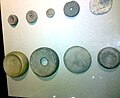 Discoidals found at Fort Ancient sites on display at the Southern Ohio Museum and Cultural Center in Portsmouth, Ohio
 Effigy pipe from Fulton County, Georgia


See also
References
- ↑ "Chumash Indians-Sports and Recreation". Archived from the original on 2007-05-09. Retrieved 2008-09-16.
- 1 2 3 Pauketat, Timothy R. (2004). Ancient Cahokia and the Mississippians. Cambridge University Press. ISBN 0-521-52066-5.
- ↑ Pauketat, Timothy R. (September–October 2009). "America's First Pastime". Archaeology. Vol. 62, no. 5. Archaeological Institute of America.
- 1 2 3 4 F. Kent Reilly; James Garber, eds. (2004). Ancient Objects and Sacred Realms. University of Texas Press. pp. 56–106. ISBN 978-0-292-71347-5.
- ↑ Catlin, George (1973) [1841]. Letters and Notes, vol. 1, no. 19.
- ↑ Hudson, Charles M. (1976). The Southeastern Indians. p. 421.
- ↑ Hudson, Charles M. (1976). The Southeastern Indians. pp. 220–222.
Further reading
- Hudson, Charles M., " The Southeastern Indians", University of Tennessee Press, 1976. ISBN 0-87049-248-9
- Pauketat, Timothy R.; Loren, Diana DiPaolo (Ed.) (December 1, 2004) North American Archaeology. Malden, Massachusetts: Blackwell Publishing. ISBN 0-631-23184-6.
- DeBoer, Warren R. (1993). "Like a Rolling Stone: The Chunkey Game and Political Organization in Eastern North America". Southeastern Archaeology. 12 (2): 83–92. JSTOR 40712999.
- Yancey-Bailey, Miranda L.; Koldehoff, Brad (2010). "Rolling Icons: Engraved Cahokia-style Chunkey Stones". Illinois Archaeology. 22 (2): 491–501.
- Gregory, Anne (24 September 2020). Chunkey, Cahokia, and Indigenous Conflict Resolution (Thesis). hdl:1794/25664.
- Kountz, David (November 1891). "Mound-Builders' Pipe and Chunkey Stone". The American Antiquarian and Oriental Journal. 13 (6): 350. ProQuest 89638697.
- Pauketat, Timothy R. (2009). "America's First Pastime". Archaeology Magazine. 62 (5).
External links
| Middle Mississippian |
| ||||||||||
|---|---|---|---|---|---|---|---|---|---|---|---|
| South Appalachian Mississippian |
| ||||||||||
| Fort Walton culture | |||||||||||
| Pensacola culture | |||||||||||
| Plaquemine Mississippian | |||||||||||
| Caddoan Mississippian | |||||||||||
| Upper Mississippian cultures |
| ||||||||||
| Culture |
| ||||||||||
| |||||||||||
