
Chinese clothing varies depending on social class, regional diversity, and practical function. Historically, each dynasty maintained specific styles, colours, and forms that reflected social rank and relationships. Ancient Chinese attire also used various textile, dyeing, and embroidery techniques.[1][2]
Origin
Ancient Chinese mythology credits the invention of clothing to the Yellow Emperor, Huangdi, and his wife, Leizu.[3] Distinct costumes used in military activity and ceremonial rites contributed to the development of a formal clothing system.[4]
Archaeological evidence traces clothing to the late Paleolithic period. Because ancient shoes were often made from animal skin, the Chinese words for "leather" and "shoe" share an etymological link.[5][6][7] It has been speculated that early shoes were made by cutting animal skins into rough foot shapes and joining them with thin leather strips.[8]
Upper cave site
A bone needle and 141 ornaments made of stone, bone, shell, and tooth were discovered at the Upper Cave of the Zhoukoudian Peking Man site and dated to 19,000 years old.[9][10] Archaeologists found seven small stone beads and 125 perforated animal teeth, many of which exhibited marks of long-term wear. Bones interred in the lower chamber of the cave bore traces of hematite powder.[11]
Neolithic Age
During the Neolithic period, people used spinning wheels to weave thread and wore linen clothing.[12][13] A waist loom with a cylindrical back loop, that formed a natural weaving mouth, was found at the Hemudu dig site in Yuyao. Silk production also began during this period, and clothing materials shifted to artificially woven fabrics. Cloak-style garments such as headscarves and drapes became typical attire. These replaced Paleolithic clothing forms and served to distinguish between social classes.[14] Neolithic pottery also depicts the use crowns, boots, headgear, and other accessories.[15]
Shang dynasty
In the Shang dynasty, clothing materials included leather, silk, ramie, and kudzu. The upper class wore dyed silk and leather, while the lower class used hemp, ramie, and kudzu due to limited silk access.[16][17] As textile technology advanced, artisans produced fine silk, jacquard patterns, and ribbed yarn on warp looms, dyeing fabrics in deep colors.[18]
Western Zhou dynasty
During the Western Zhou dynasty, positions such as "Si Fu" and "Nei Si Fu" were established to oversee royal attire. Records indicate that the Chinese system of crowns and dress originated in the Xia and Shang dynasties. Artifacts from the Zhou dynasty show distinct upper and lower garments.[19]
Qin and Han dynasties
During the Qin and Han dynasties, women's clothing typically featured long, wide, loose sleeves and high-heeled clogs. Noblewomen also wore a decorative arm scarf called the Jingguo.[20]
During this period, fashion diversified. According to the Miscellaneous Records of the Western Capital, after Zhao Feiyan became Empress, her sister commissioned matching upper and lower garments for her. Zhao Feiyan's "Yunying Purple Skirt," also called the "Liuxian Skirt," was a tribute from South Vietnam resembling modern pleated skirts.[21]
Sui and Tang dynasties
During the Sui and Tang dynasties, a garment originally intended for women, known as the "half-arm" originated at court, spread widely, and was later also worn by men. Long scarves were also popular; these were woven from gauze and decorated with painted or powdered silver and gold flowers. One end was fixed to the half-arm's chest strap, draped over the shoulder, and wound between the arms. Tang women used numerous types of hair accessories, and typically wore floral shoes made of brocade, colored silk, or leather.[22]
Song dynasty
Song official uniform
Hanfu worn during the Song dynasty usually fell into three types: official attire, casual attire, and traditional attire. Official uniforms were made mainly of silk. Due to the old Five Dynasties system, the government would brocade robes to high-ranking ministers annually, divided into seven colors, including the Lingjiu ball-patterned brocade robe.[23]
Official attire colors followed the Tang system: purple for third grade and above, red for fifth grade and above, and green for seventh grade and above. The style resembled the long-sleeved robe of the late Tang dynasty, worn with a flat-winged black gauze hat known as the straight-footed futou, headwear reserved for rulers and officials. As in the Tang system, officials permitted to wear purple or crimson were required to carry a "fish bag" at the waist containing a gold, silver, or copper fish indicating their rank.[23]
Yuan dynasty

Ethnic integration was prominent in the clothing of the Yuan dynasty (founded by Genghis Khan in 1206, whose Khanate became ethnically dominated by Mongols after the conquest of Western Xia and Jin). Prolonged warfare from ethnic conflict damaged the textile and handicraft industries, and the palace dress system continued to follow that of the Song dynasty until 1321, under Yuan Yingzong, when a style based on ancient clothing traditions was introduced: an upper garment joined to a lower one, fitted at the top and short below, with pleats gathered at the waist and a large string of beads hung from the shoulder at the back. This costume was known as zhisun or, among the Han, as "one color clothes".[24]
Ming dynasty
After the Yuan dynasty, the Ming dynasty restored Han clothing traditions, and its founder Zhu Yuanzhang re-established the Hanfu system. The emperor wore a black veil folded over a scarf, with wings standing up at the back. Early Ming regulations called for reviving Tang-style clothing and headgear. Court dress followed Tang styles except that the crown for advancing scholars was changed to the Liang crown, and new styles such as the Zhongjing crown were introduced.[25]
Since the Tang and Song dynasties, dragon robes and the color yellow had been reserved for the imperial family, and purple had been considered a mark of high official rank since the Southern and Northern Dynasties. In the Ming dynasty, red (zhu) was adopted as the official color because it matched the emperor's surname, while purple was dropped from official dress.[25]
Officials' uniforms consisted of a futou headpiece and a round-necked robe. The futou, lacquered black with short, wide flaps, was known as the Wusha hat and could not be worn by non-officials. Rank was indicated by robe color and by a square silk patch, about 40–50 centimeters wide and embroidered with a distinct design, sewn onto the chest and back. Civil officials' patches depicted birds and military officials' depicted beasts, each in nine grades. Python robes, flying-fish robes, and bullfighting robes were awarded for merit. The python design showed a four-clawed dragon, the flying-fish design added fins to its tail, and the bullfighting design added curved horns to its head. Officials of the highest rank also wore jade belts. Round-necked robes were differentiated by the length of the garment and the size of the sleeves, with longer robes denoting greater seniority.[25]
Wives and mothers of officials who held titles wore red long-sleeved dresses and various styles of xiapei. Upper-class women also wore high-heeled shoes, made with either an inner or an outer raised sole.[25]
Qing dynasty
During the Qing dynasty, the government enforced the shaving of the head and a change in dress. In 1652, the Shunzhi Emperor's ninth year, the "dress and color" ordinance abolished the crowns, gowns, and other Ming-style Han clothing, though Manchu dress retained textile patterns from Ming garments. Ming-dynasty men wore their hair in a bun, with loose robes, stockings, and shallow shoes, while in the Qing dynasty, men shaved the front of the head and wore a queue hanging down the back, along with narrow horseshoe-sleeved robes, tight socks, and deep boots. Distinctions between official and commoner dress still persisted under both dynasties. [citation needed]

Republic of China
The Republic of China period saw a rise in Western influence on Chinese fashion, and traditional clothing, such as hanfu, declined in daily use.
Cheongsam
The cheongsam, a traditional Chinese women's dress, emerged in the 1920s. In 1929, the Republic of China government's Regulations on the System of Clothing designated the cheongsam, along with the traditional jacket and skirt, as women's dress.[26]
Zhongshan suit / Mao suit
The Zhongshan suit is a four-pocket garment with a stand-up lapel and pocket flaps, developed from European, American, Japanese student, and Chinese clothing styles. The Nationalist Government declared it the legal uniform in April 1929, and after the 1950s it became standard dress for both national leaders and ordinary citizens.
Mao Zedong wore a variant of the suit, known in the West as the Mao suit, when he was elected Chairman of the Central People's Government at the 1949 founding ceremony of the People's Republic on Tiananmen Square. Compared to the Republican-era Zhongshan suit, the 1950s Mao suit had a larger neckline and lapel.[27] Soong Ching-ling, Sun Yat-sen's widow, promoted the cheongsam as standard female dress, while clothing regarded as outdated or backward was banned.[citation needed]
At the first National People's Congress in 1954, men commonly wore the Zhongshan suit, while women wore the Lenin suit, a Soviet-inspired double-breasted style with a wide collar that folded down into two small pointed lapels, a cloth belt, two rows of three buttons, and slanted pockets, usually in gray or blue khaki.[28]
During the Destruction of the Four Olds campaign in 1964, items associated with Western or traditional culture, including jeans, high heels, Western-style coats, ties, jewelry, cheongsams, and long hair, were treated by Red Guards as symbols of bourgeois wealth.[29] People seen wearing them in public risked beatings or other punishment, and such items were sometimes thrown into the streets.[30]
Modern fashion
Fashion styles in China have diversified since 2023, with trends such as "New Chinese style" gaining popularity. Traditional garments such as hanfu and the Tang suit have also remained popular. Hanfu turnover grew 376% year-on-year and show-clothes turnover grew 212%, while the number of men's Tang suit consumers increased by more than 90%.[citation needed]
Hong Kong brand Shanghai Tang bases its designs on historical Chinese clothing, reviving 1920s and 1930s styles in bright colors.[31][32]
In 2000, dudou-inspired blouses appeared in the summer collections of Versace and Miu Miu, after which the style was adopted in China as outerwear.[citation needed]
For the 2012 Hong Kong Sevens tournament, sportswear brand Kukri Sports and Hong Kong retailer G.O.D. produced merchandise including traditional Chinese jackets and cheongsam-inspired polo shirts for women.[33][34][35]
Gallery
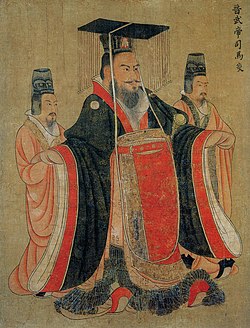 Emperor Wu of Jìn, by Yan Liben (600–673)
 Tang dynasty court ladies from the tomb of Princess Yongtai in the Qianling Mausoleum, near Xi'an in Shaanxi
 Official Song dynasty portrait painting of Empress Cao, wife of Emperor Renzong of Song
 Modern reconstruction of temple mural shows clothes of the Yuan dynasty
 Ming dynasty Empress Xiao'an
 A 15th-century portrait of the Ming official Jiang Shunfu. The decoration of two cranes on his chest are a mandarin square "rank badge" that indicate he was a civil official of the first rank.
 Detail of Jiang Shunfu's rank badge
 The Qing dynasty Qianlong Emperor in ceremonial armour on horseback
 Illustration of Chinese accessories from Olfert Dapper (1670): Gedenkwaerdig bedryf der Nederlandsche Oost-Indische maetschappye
 Zhou dynasty-style Chinese wedding dress
 Chinese silver crown
 Fengguan of the Ming dynasty empress
 Weimao in the Tang dynasty - Eighteen Songs of a Nomad Flute
 Tang dynasty woman wearing a cross-collared robe
 Hanfu in a famous Tang dynasty painting
 Ancient Chinese who played Go
 Portrait of a Ming dynasty female official
 Gu Hongzhong's night revels
 Traditional Chinese hat
 Queen Mother of the West from a wall-painting in a Han dynasty tomb
 Official Ming dynasty portrait
 Zhou Fang. Court Ladies Tuning the Lute (28x75) Nelson-Atkins Museum of Art, Kansas City (cropped)
 Official Ming dynasty portrait
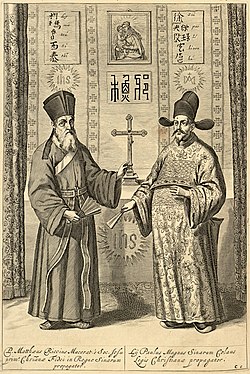 Religion during the Ming dynasty
 Famous Tang Bohu paintings
 Hanfu during the Song dynasty
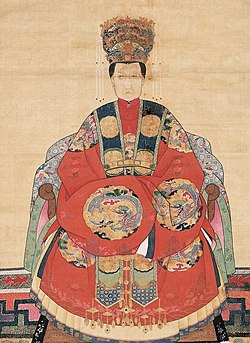 Portrait of a lady of the late Ming dynasty
 Image of musicians in ancient China
 Daily life records of court women during the Song dynasty
 Portrait of a Ming noblewoman
 Gu Hongzhong's Night Revels
 Portrait of Li Liufang
 Chinese bridal wedding gown
 Traditional Chinese clothing


See also
References
- ↑ Yang, Shaorong (2004). Chinese Clothing: Costumes, Adornments and Culture (Arts of China). Long River Press (published 1 April 2004). p. 3. ISBN 978-1-59265-019-4.
- ↑ "中国古代服饰文化". www.chnmuseum.cn. Archived from the original on 5 March 2021. Retrieved 29 October 2024.
- ↑ "Chinese Folk Stories: The Yellow Emperor". pages.ucsd.edu. Archived from the original on 5 October 2021. Retrieved 11 August 2025.
- ↑ hua, mei (1999). 中国都装史 (in Chinese). Tianjin People's Fine Arts Publishing House. ISBN 978-7-5305-0162-7.
- ↑ "靴 xuē - Chinese Etymology - Obsidian Publish". publish.obsidian.md. Retrieved 17 December 2025.
- ↑ "custom embroidered patches". Retrieved 14 May 2010.
- ↑ "On the Character 革". The World of Chinese. Archived from the original on 29 August 2024. Retrieved 17 December 2025.
- ↑ sima, zhen (1542). 鉴略三皇记 (in Chinese).
- ↑ Wang, Wei; Bae, Christopher; Xu, Xin (4 September 2020). "Chinese Prehistoric Eyed Bone Needles: A Review and Assessment". Journal of World Prehistory. 33 (3): 385–423. doi:10.1007/s10963-020-09144-2. ISSN 0892-7537.
- ↑ "Exploring Chinese History :: Culture :: Archaeology :: Peking Man". www.ibiblio.org. Retrieved 17 December 2025.
- ↑ "Upper Cave Man Site". Guizhou Digital Education Cloud Platform. Archived from the original on 5 April 2024.
- ↑ "The very first spinning wheels?". New Zealand Spinning Wheels and their makers. 4 May 2016. Retrieved 5 January 2025.
- ↑ 汉麻谷, 中国 (23 October 2024). "中国麻文化——追溯文明 呈现精品". 汉麻传承. Retrieved 5 January 2025.
- ↑ "百度安全验证". wappass.baidu.com. Retrieved 5 January 2025.
- ↑ "【灿烂的中国文明】新石器时代". Weixin Official Accounts Platform. Retrieved 2 April 2024.
- ↑ 朱, 和平 (July 2001). 中国服饰史稿 [Draft History of Chinese Apparel] (in Simplified Chinese). 郑州市: 中州古籍出版社. p. 33.
- ↑ "第566期:麻类纤维——我国古代纺织界的"顶梁柱"----中国科学院武汉植物园". www.whiob.ac.cn. Retrieved 1 November 2024.
- ↑ "The evolution of clothing in China's dynasties". zhihu.
- ↑ Zhouli [Zhouli] (in Chinese). Jinlang Academic Publishing House. 2017. p. 295. ISBN 978-3-330-82134-7.
- ↑ "Characteristic Chinese Clothing in Qin and Han Dynasty - CITS". www.cits.net. Retrieved 5 January 2025.
- ↑ 罗, 莹 (2003). 成镜深.中国古代服饰小史 Cheng Jingshen. A short history of ancient Chinese dress (in Chinese). 四川职业技术学院学报. p. 201.
{{cite book}}: CS1 maint: location missing publisher (link) - ↑ Na, Chunying (2023). 隋唐平民服饰研究 A study on civilian dress in Sui and Tang Dynasties (in Chinese). 人民出版社. p. 33. ISBN 978-7-01-025396-1.
- 1 2 FU, BOXING (2016). 大宋衣冠:图说宋人服饰 Dress of the Song Dynasty: A picture of Song dress (in Chinese). Shanghai Ancient Books Publishing House. p. 110. ISBN 978-7-5325-7765-1.
- ↑ "元代御用冠服特点简述".
元代人的衣服主要是"质孙服"是较短的长袍,比较紧、比较窄,在腰部有很多衣褶,这种衣服很方便上马下马。 元代服装以长袍为主。官员和士庶的日常服装多为窄袖长袍。另外,在元代大宴活动中,天子百官要穿统一颜色的服装,称为"质孙服",据古籍记载,天子的质孙服款式繁多,冬服有 11 种,夏服有 15 种。
[Yuan Dynasty people's clothes are mainly "quality Sun clothing" is a shorter robe, tighter, narrower, there are a lot of folds in the waist, this kind of clothing is very convenient to get on and off the horse. The Yuan Dynasty clothes were mainly long robes. The daily clothes of the officials and the common people were mostly narrow-sleeved robes. In addition, in the Yuan Dynasty feast activities, the Son of Heaven hundred officials to wear a uniform color clothing, known as the "quality of the Sun clothing", according to ancient records, the Son of Heaven of the quality of the Sun clothing style, there are 11 kinds of winter clothing, summer clothing there are 15 kinds.] - 1 2 3 4 Mingjian [Mingjian] (in Chinese) (1 ed.). China: China Textile press and apparel press. 2021. p. 154. ISBN 978-7-5180-8342-8.
- ↑ "旗袍演变史-文摘报-光明网". epaper.gmw.cn. Retrieved 21 June 2024.
- ↑ "从两会看中国时尚变迁_央广网". xj.cnr.cn. 4 March 2015. Retrieved 11 May 2024.
- ↑ "70张照片,带你看完建国70周年时尚变迁_服装" [70 photos, take you to see the 70th anniversary of the founding of the country's fashion changes_Clothing]. www.sohu.com. Retrieved 11 May 2024.
- ↑ Law, Kam-yee. [2003] (2003). The Chinese Cultural Revolution Reconsidered: beyond purge and Holocaust. ISBN 0-333-73835-7
- ↑ Wen, Chihua. Madsen, Richard P. [1995] (1995). The Red Mirror: Children of China's Cultural Revolution. Westview Press. ISBN 0-8133-2488-2
- ↑ Broun, Samantha (6 April 2006). "Designing a global brand". CNN World. Archived from the original on 26 October 2012. Retrieved 2 June 2012.
- ↑ Chevalier, Michel (2012). Luxury Brand Management. Singapore: John Wiley & Sons. ISBN 978-1-118-17176-9.
- ↑ "G.O.D. and Kukri Design Collaborate for the Rugby Sevens". Hong Kong Tatler. 16 March 2012. Archived from the original on 15 August 2012. Retrieved 19 November 2012.
- ↑ "G.O.D. x Kukri". G.O.D. official website. Archived from the original on 15 May 2012. Retrieved 19 November 2012.
- ↑ "Kukri and G.O.D. collaborate on HK7s Range!". Kukri Sports. Archived from the original on 2 February 2014. Retrieved 19 November 2012.
Further reading
- Watt, James C.Y.; Wardwell, Anne E. (1997). When silk was gold: Central Asian and Chinese textiles. New York: The Metropolitan Museum of Art. ISBN 0-87099-825-0.
- Jian, Li; Li, He & Sung, Hou-Mei & Shengnan, Ma (2014). Forbidden City: Imperial Treasures from the Palace Museum, Beijing. Richmond, Virginia: Virginia Museum of Fine Arts. ISBN 978-1-934351-06-2.
{{cite book}}: CS1 maint: multiple names: authors list (link)